
Verwandte Artikel zu The Faith of Ronald Reagan: A Spiritual Biography of...
Inhaltsangabe
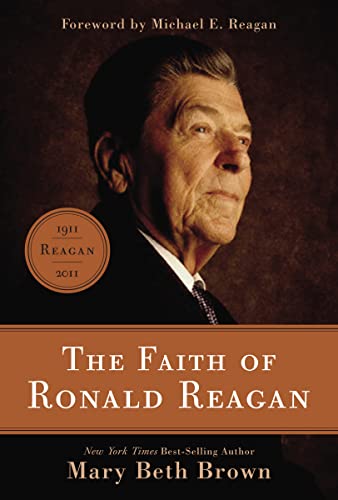
Reagan’s greatest virtue wasn’t allegiance to country, but allegiance to God.
With warmth and insight, this best-selling book by Mary Beth Brown delves into the spiritual journey of America’s 40th president and offers profound stories of the provisions God made in Ronald Reagan’s life– from first making it as an actor to winning the presidency, from surviving an assassination attempt to eventually changing the face of politics and the world.
Supported by Ronald Reagan’s own words and writings plus firsthand interviews with his family, friends, and co-workers, Brown weaves a magnificent story that inspires as it informs. Reagan’s strong devotion to God will encourage believers to enter public service, allowing their faith to motivate their actions, and will draw focus to Christ’s matchless sacrifice–forever near and dear to President Reagan’s heart.
Die Inhaltsangabe kann sich auf eine andere Ausgabe dieses Titels beziehen.
Über die Autorin bzw. den Autor
Mary Beth Brown is the author of the New York Times and USA Today best-selling book, Hand of Providence: The Strong and Quiet Faith of Ronald Reagan and Condi: The Life of a Steel Magnolia . Mary Beth writes a nationally syndicated column, which can be viewed at www.marybethbrown.net, and is a frequent guest on radio and TV.
Auszug. © Genehmigter Nachdruck. Alle Rechte vorbehalten.
The Faith of Ronald Reagan
By Mary Beth BrownThomas Nelson
Copyright © 2011 Mary Beth Brown
All rights reserved.
ISBN: 978-1-59555-353-9All rights reserved.
Contents
Foreword, ix,
Introduction, xi,
1 — The Hand of Providence, 1,
2 — Nelle Reagan: Building Young Reagan's Rock of Faith, 19,
3 — The High School Years, 39,
4 — The Quiet Faith of Ronald Reagan, 51,
5 — The American Dream, 63,
6 — A One-Man Battalion Named Ronald Reagan, 85,
7 — A Family in Crisis, 99,
8 — Nancy Gets Her Man, 111,
9 — California's Christian Governor, 135,
10 — The Open Cathedral, 147,
11 — The Road to the White House, 157,
12 — Fighting the Good Fight, 169,
13 — A Good and Faithful Servant, 191,
Eulogies, 205,
Acknowledgments, 223,
Bibliography, 225,
Index, 231,
About the Author, 237,
CHAPTER 1
THE HAND OF PROVIDENCE
* * *
And we know that all things work together for good to those who love God, to those who are the called according to His purpose. Romans 8:28
He leaned back in the luxurious chair reserved for the president of the United States on Air Force One. The two men, fortieth president of the United States, Ronald Wilson Reagan, and his grown son, Michael Edward Reagan, were deep in conversation as their plane sped onward toward Point Magu, California. One, two, three, four, five, six, seven, eight, nine, the president sat quietly counting his fingers.
"What are you doing, Dad?" asked Michael. "I'm counting the months until I will be out of office and I'll be able to attend church again," answered the president.
This conversation with his father was relayed to me by Michael Reagan in June of 2003 during a dinner at the Mimosa French Restaurant not far from the Reagan Ranch in Santa Barbara, California. Michael recounted the story with the passion a man has for an event that has been seared into his memory. I later learned that the trip he took alone with his father on Air Force One was taken shortly before Easter of 1988. Nine months later, in January 1989, Reagan left office after having served two terms as president.
Michael continued, "My father was really looking forward to the time when he was out of office and could attend church again. The reason he had stopped going to church while president was because he didn't want to put other people's lives in danger." Michael said that his dad still remembered all too vividly the people who had been severely injured and almost killed because of the assassination attempt against him. According to Michael, "Dad was willing to stop going to church, something that was very important to him and he liked to do, to prevent risking the lives of other innocent people, if another assassination attempt was made on him." But Michael said he encouraged his father to make an exception this Easter weekend and attend church. President Reagan paused a moment, then smiled, and said, "I think I will."
Early Easter Sunday morning, after he'd eaten a hearty breakfast, Reagan called John Barletta, head of the Secret Service at the Reagan Ranch, to have the helicopter readied for a short trip to church. The president attended a small country church in the Santa Ynez valley near his beloved Rancho del Cielo. This church had been a regular house of worship for him when he was at the ranch before his presidency. Sadly, he was still attacked by the liberal press for not attending church during his presidency, when it was actually something that was truly important to him—and his reason for not going was to protect lives.
This exchange between father and son showed the power and lasting impact of the near-tragic event that had occurred seven years earlier and how this attempted assassination had radically altered President Ronald Reagan's life. Reagan never wanted to put anyone in harm's way again.
Saved for a Higher Purpose
The president walked out of the side entrance of the Washington Hilton Hotel on a gloomy, gray afternoon in the spring, wearing his new blue pin-striped suit. Smiling and waving with his entourage of aides and Secret Service agents, he was met by a group of onlookers—mostly press photographers, TV cameramen, and reporters corralled behind a red velvet rope. It was March 30, 1981, the seventieth day of his presidency, and Reagan had just given a speech to the Construction Trades Council inside the hotel. The president's schedule was routinely printed in the Washington Star newspaper, as it was that day, giving the time and place of his speech. Anyone could find out where the president would be that day simply by looking it up in the daily newspaper, and someone did just that. That person was also waiting in the crowd outside the hotel. His name was John Hinckley Jr.
Because it was a warm and muggy day, President Reagan had not worn his bullet-proof vest. It was an oversight that nearly cost him his life. The president reasoned that his only exposure to the outside would be a short, thirty-foot walk from the hotel corridor to the car, and, besides, the vest restricted the movement of his arms, which he liked to use in gestures as he gave his speech. The president was to speak to a group of 3,500 people, his largest audience since the inauguration in January. He leisurely headed toward his limousine (code-named "Stagecoach" by the Secret Service) to return to the White House. Just before reaching the car, his assailant became visible—and the history of our nation and the world was nearly changed forever.
John Hinckley Jr. carried a .22-caliber Rohm snub-nosed revolver under his trench coat. It was loaded with six specially made bullets. He was a man on a mission—fully prepared to kill the president of the United States.
Only after the assassination attempt did we learn that Hinckley had written a letter to Jodie Foster, the young actress with whom he was obsessed. He told her in a letter, "I would abandon this idea of getting Reagan in a second, if I could only win your heart and live out the rest of my life with you.... I will admit to you that the reason I'm going ahead with this attempt now is because I just cannot wait any longer to impress you." Hinckley closed the letter saying, "I'm asking you to please look into your heart and at least give me the chance with this historical deed to gain your respect and love."
Hinckley had to have the right opportunity, and this gray, muggy day in March was it. A reporter tried to get the president's attention shouting, "Mr. President!" and "Mr. Reagan!" Hinckley's moment had arrived. He shoved several bystanders out of the way, assumed a crouching position, pulled out his weapon with a professional double-grip, and took aim.
Pop, pop, pop, pop. The bullets sounded like firecrackers, and the acrid smell of sulfur filled the air. Two seconds. That's all it took to change a life ... and the world.
Down went White House Press Secretary James Brady, who was in the line of fire and hit in the forehead with the first bullet. Brady was left lying facedown in a pool of blood. The second shot went astray, but the third hit Washington patrolman Thomas Delahanty in the back of his neck causing him to fall next to Brady on the ground. With tremendous courage, Secret Service agent Timothy McCarthy used his body as a human shield and took the fourth bullet intended for President Reagan. The bullet hit McCarthy in his lower right rib cage, throwing him backwards three feet onto the sidewalk beside...
„Über diesen Titel“ kann sich auf eine andere Ausgabe dieses Titels beziehen.
Suchergebnisse für The Faith of Ronald Reagan: A Spiritual Biography of...

Beispielbild für diese ISBN
The Faith of Ronald Reagan: A Spiritual Biography of an American President
Verlag:
Thomas Nelson Publishers, 2010
ISBN 10: 1595553533
ISBN 13: 9781595553539
Gebraucht
Paperback
Anbieter: World of Books (was SecondSale), Montgomery, IL, USA
Verkäuferbewertung 5 von 5 Sternen

Paperback. Zustand: Good. With warmth and insight, this best-selling book by Mary Beth Brown delves into the spiritual journey of Americas 40th president and offers profound stories of the provisions God made in Ronald Reagans life. Bestandsnummer des Verkäufers 00098711749
Gebraucht kaufen
EUR 4,04
Versand gratis
Versand innerhalb von USA
Versand innerhalb von USA
Anzahl: 3 verfügbar
Beispielbild für diese ISBN
The Faith of Ronald Reagan
Anbieter: Orion Tech, Kingwood, TX, USA
Verkäuferbewertung 5 von 5 Sternen
Paperback. Zustand: Good. Bestandsnummer des Verkäufers 1595553533-3-30835533
Gebraucht kaufen
EUR 4,05
Versand gratis
Versand innerhalb von USA
Versand innerhalb von USA
Anzahl: 1 verfügbar
Beispielbild für diese ISBN
The Faith of Ronald Reagan: A Spiritual Biography of an American President
Anbieter: Zoom Books East, Glendale Heights, IL, USA
Verkäuferbewertung 5 von 5 Sternen
Zustand: very_good. Book is in very good condition and may include minimal underlining highlighting. The book can also include "From the library of" labels. May not contain miscellaneous items toys, dvds, etc. . We offer 100% money back guarantee and 24 7 customer service. Bestandsnummer des Verkäufers ZEV.1595553533.VG
Gebraucht kaufen
EUR 4,06
Versand gratis
Versand innerhalb von USA
Versand innerhalb von USA
Anzahl: 1 verfügbar
Beispielbild für diese ISBN
The Faith of Ronald Reagan: A Spiritual Biography of an American President
Verlag:
Thomas Nelson (edition Illustrated), 2011
ISBN 10: 1595553533
ISBN 13: 9781595553539
Gebraucht
Paperback
Anbieter: BooksRun, Philadelphia, PA, USA
Verkäuferbewertung 5 von 5 Sternen
Paperback. Zustand: Very Good. Illustrated. It's a well-cared-for item that has seen limited use. The item may show minor signs of wear. All the text is legible, with all pages included. It may have slight markings and/or highlighting. Bestandsnummer des Verkäufers 1595553533-11-1
Gebraucht kaufen
EUR 4,57
Versand gratis
Versand innerhalb von USA
Versand innerhalb von USA
Anzahl: 4 verfügbar
Beispielbild für diese ISBN
The Faith of Ronald Reagan: A Spiritual Biography of an American President
Verlag:
Thomas Nelson Publishers, 2010
ISBN 10: 1595553533
ISBN 13: 9781595553539
Gebraucht
Paperback
Anbieter: World of Books Inc, Montgomery, IL, USA
Verkäuferbewertung 4 von 5 Sternen

Paperback. Zustand: Good. With warmth and insight, this best-selling book by Mary Beth Brown delves into the spiritual journey of Americas 40th president and offers profound stories of the provisions God made in Ronald Reagans life. Bestandsnummer des Verkäufers CIN1595553533G
Gebraucht kaufen
EUR 5,88
Versand gratis
Versand innerhalb von USA
Versand innerhalb von USA
Anzahl: 3 verfügbar
Beispielbild für diese ISBN
The Faith of Ronald Reagan
Verlag:
Nelson Incorporated, Thomas, 2011
ISBN 10: 1595553533
ISBN 13: 9781595553539
Gebraucht
Softcover
Anbieter: Better World Books, Mishawaka, IN, USA
Verkäuferbewertung 5 von 5 Sternen
Zustand: Very Good. Pages intact with possible writing/highlighting. Binding strong with minor wear. Dust jackets/supplements may not be included. Stock photo provided. Product includes identifying sticker. Better World Books: Buy Books. Do Good. Bestandsnummer des Verkäufers 3781963-75
Gebraucht kaufen
EUR 6,19
Versand gratis
Versand innerhalb von USA
Versand innerhalb von USA
Anzahl: 1 verfügbar
Beispielbild für diese ISBN
The Faith of Ronald Reagan: A Spiritual Biography of an American President
Anbieter: ThriftBooks-Reno, Reno, NV, USA
Verkäuferbewertung 5 von 5 Sternen
Paperback. Zustand: Very Good. No Jacket. May have limited writing in cover pages. Pages are unmarked. ~ ThriftBooks: Read More, Spend Less. Bestandsnummer des Verkäufers G1595553533I4N00
Gebraucht kaufen
EUR 6,55
Versand gratis
Versand innerhalb von USA
Versand innerhalb von USA
Anzahl: 1 verfügbar
Beispielbild für diese ISBN
The Faith of Ronald Reagan: A Spiritual Biography of an American President
Anbieter: ThriftBooks-Dallas, Dallas, TX, USA
Verkäuferbewertung 5 von 5 Sternen
Paperback. Zustand: Very Good. No Jacket. May have limited writing in cover pages. Pages are unmarked. ~ ThriftBooks: Read More, Spend Less. Bestandsnummer des Verkäufers G1595553533I4N00
Gebraucht kaufen
EUR 6,55
Versand gratis
Versand innerhalb von USA
Versand innerhalb von USA
Anzahl: 1 verfügbar
Beispielbild für diese ISBN
The Faith of Ronald Reagan: A Spiritual Biography of an American President
Anbieter: ThriftBooks-Atlanta, AUSTELL, GA, USA
Verkäuferbewertung 5 von 5 Sternen
Paperback. Zustand: Very Good. No Jacket. May have limited writing in cover pages. Pages are unmarked. ~ ThriftBooks: Read More, Spend Less. Bestandsnummer des Verkäufers G1595553533I4N00
Gebraucht kaufen
EUR 6,55
Versand gratis
Versand innerhalb von USA
Versand innerhalb von USA
Anzahl: 1 verfügbar
Beispielbild für diese ISBN
The Faith of Ronald Reagan: A Spiritual Biography of an American President
Anbieter: ThriftBooks-Phoenix, Phoenix, AZ, USA
Verkäuferbewertung 5 von 5 Sternen
Paperback. Zustand: Very Good. No Jacket. May have limited writing in cover pages. Pages are unmarked. ~ ThriftBooks: Read More, Spend Less. Bestandsnummer des Verkäufers G1595553533I4N00
Gebraucht kaufen
EUR 6,55
Versand gratis
Versand innerhalb von USA
Versand innerhalb von USA
Anzahl: 1 verfügbar