
Verwandte Artikel zu Restoring Disturbed Landscapes: Putting Principles...
Restoring Disturbed Landscapes: Putting Principles into Practice (The Science and Practice of Ecological Restoration) - Softcover
Buch 8 von 21: The Science and Practice of Ecological Restoration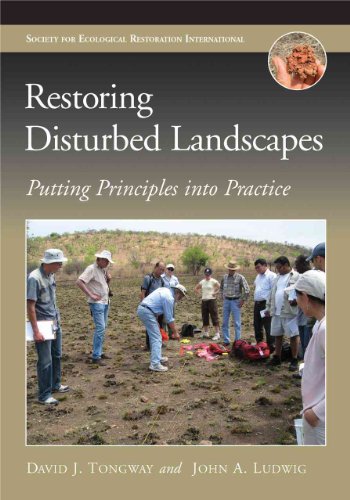
Inhaltsangabe
Restoring Disturbed Landscapes is a hands-on guide for individuals and groups seeking to improve the functional capacity of landscapes. The book presents a five-step, adaptive procedure for restoring landscapes that is supported by proven principles and concepts of ecological science.
Written by restoration experts with a wealth of experience teaching restoration principles and techniques to practitioners and would-be practitioners from a variety of backgrounds, the book offers:
Written by restoration experts with a wealth of experience teaching restoration principles and techniques to practitioners and would-be practitioners from a variety of backgrounds, the book offers:
- an outline of a science-based, ecologically sound approach to restoration
- discussion of the conceptual framework and rigorous principles that underlie the approach
- case studies of two types of restoration projects (restoring mined landscapes and restoring damaged rangelands) that illustrate how the approach, framework, and four key principles for restoring landscapes have been implemented
- a variety of scenarios that represent typical restoration problems and how those problems can be handled
- indicators for monitoring and how landscape function can be tracked and analyzed as part of a comprehensive monitoring program.
Abundantly illustrated with photos and figures that clearly explain concepts outlined in the book, Restoring Disturbed Landscapes is an engaging and accessible work designed specifically for restoration practitioners with limited training or experience in the field. It tells restorationists where to start, what information they need to acquire, and how to apply this information to their specific situations.
Die Inhaltsangabe kann sich auf eine andere Ausgabe dieses Titels beziehen.
Über die Autorinnen und Autoren
David Tongway is a soil scientist and landscape ecologist who worked for Australia’s Commonwealth Scientific and Industrial Research Organisation (CSIRO) for 38 years. He is an Honorary Fellow at CSIRO’s Gungahlin Laboratory in the Australian Capital Territory.
John Ludwig is a plant and landscape ecologist who worked in the Biology Department, New Mexico State University, in Las Cruces,1969–1985 and for CSIRO, 1985–2007. He is currently an Honorary Fellow at CSIRO’s laboratory in Atherton, Queensland.
David Tongway is a soil scientist and landscape ecologist who worked for Australia’s Commonwealth Scientific and Industrial Research Organisation (CSIRO) for 38 years. He is an Honorary Fellow at CSIRO’s Gungahlin Laboratory in the Australian Capital Territory.
John Ludwig is a plant and landscape ecologist who worked in the Biology Department, New Mexico State University, in Las Cruces,1969–1985 and for CSIRO, 1985–2007. He is currently an Honorary Fellow at CSIRO’s laboratory in Atherton, Queensland.
Auszug. © Genehmigter Nachdruck. Alle Rechte vorbehalten.
Restoring Disturbed Landscapes
Putting Principles into Practice
By David J. Tongway, John A. LudwigISLAND PRESS
Copyright © 2011 David J. Tongway and John A. Ludwig
All rights reserved.
ISBN: 978-1-59726-581-2All rights reserved.
Contents
FOREWORD James Aronson,
PREFACE,
ACKNOWLEDGMENTS,
PART I A Function-Based Approach to Restoring Disturbed Landscapes,
Chapter 1 Our Approach to Restoring Disturbed Landscapes: Five-Step Adaptive Procedure,
Chapter 2 A Framework for How Landscapes Function,
Chapter 3 Principles for Restoring Landscape Functionality,
PART II Case Studies on Restoring Landscapes: Mine Sites and Rangelands,
Chapter 4 Restoring Mined Landscapes,
Chapter 5 Restoring Damaged Rangelands,
PART III Scenarios for Restoring Landscapes: Mine Sites, Rangelands, Farmlands, and Roadsides,
Chapter 6 Restoration of Mine-Site Waste-Rock Dumps,
Chapter 7 Restoration of Mine-Site Tailings Storage Facilities,
Chapter 8 Restoring Landscapes after Open-Cut Coal Mining,
Chapter 9 Restoring Rangelands with an Overabundance of Shrubs,
Chapter 10 Renewing Pastureland Functions Using Tree Belts,
Chapter 11 Restoration of Former Farmlands near Urban Developments,
Chapter 12 Restoring Verges after Road Construction,
PART IV Monitoring Indicators,
Chapter 13 Landscape Function Analysis: An Overview and Landscape Organization Indicators,
Chapter 14 Landscape Function Analysis: Soil-Surface Indicators,
Chapter 15 Ephemeral Drainage-Line Assessments: Indicators of Stability,
Chapter 16 Vegetation Assessments: Structure and Habitat Complexity Indicators,
Chapter 17 Reflections on Restoring Landscapes: A Function-Based Adaptive Approach,
REFERENCES,
GLOSSARY,
FURTHER READING,
ABOUT THE AUTHORS,
INDEX,
CHAPTER 1
Our Approach to Restoring Disturbed Landscapes: A Five-Step Adaptive Procedure
In this chapter we describe our approach, which we feel is central to Restoring Disturbed Landscapes. We think of our approach as an orderly five-step adaptive procedure for restoring landscapes, or for short, adaptive landscape restoration. It comprises a sequence of steps (figure 1.1) where stakeholders in the disturbed landscape work with the restoration practitioner (hereafter abbreviated as RP) to (1) articulate the goals of restoration, (2) define and carefully analyze the problem, (3) identify appropriate solutions, (4) select treatments to apply, and (5) monitor restoration indicators and assess progress as trends in these data. If trends are negative, RPs should then adaptively revise treatments to improve trends. In practice, we view this procedure like planning a journey using a road map. The start and end points are known, but there are options to exercise in the actual route taken to reach the destination—the successful restoration of a landscape.
Before describing each of the five steps in our adaptive landscape restoration procedure we make a few observations and note some of its key features. We emphasize that our adaptive procedure is not a prescription or recipe for RPs to follow like a global positioning system (GPS)–guided route from start to finish. As with planning a journey, choices made at each road junction along the way require critical analysis and careful consideration. Sometimes the choice of route is crucial; sometimes options are roughly equivalent. The shortest route is not necessarily the most appropriate. For example, on revegetated mine sites, RPs often sow (in suitable climates) the colorful, exotic red natal grass because it quickly provides an attractive cover. However, red natal is a tufted grass (big top, small base), and from our monitoring experiences, we know it usually fails to adequately function to prevent soil erosion on sloping sites (even if soil materials are only moderately erodible). We have found that a better option for protecting sloping rehabilitated surfaces against erosion is to revegetate mine sites with native, spreading perennial plants.
In designing ways to restore the functional capacity of damaged landscapes, we first need to be clear about what we are aiming to achieve. The next step is to critically analyze the problem: Which landscape goods and services have been lost and which have been retained? What landscape processes have become ineffective? What caused losses in capacity? By understanding the problem, RPs can design solutions by selecting and applying appropriate landscape restoration technologies. The restoration procedure must include monitoring, that is, RPs need to collect data to evaluate whether gains in capacity have been achieved. If gains have not been achieved, then they need to go back and reexamine whether the goals are still appropriate (e.g., are they too ambitious?).
In most cases, goals will remain appropriate, but we sometimes find that we underestimated the importance of some processes so that some technologies need to be adjusted. This revision to improve restoration is called an adaptive learning loop (figure 1.1), which is an essential component of an adaptive landscape restoration procedure. After adjusting technologies, the RP must continue monitoring and analyzing data to see if restoration trends are toward desired goals. With time, these monitoring data will confirm if goals are being successfully achieved.
Our Five-step Procedure
Step 1: Setting goals
In step 1, stakeholders, or those with an interest in restoring a specified landscape, set goals that clearly define what they aim to achieve. When setting restoration goals, stakeholders require a clear understanding of underlying constraints, such as whether goals are driven by regulations, laws, or treaties, or by agreements based on the aspirations of particular stakeholder groups. Often the groups involved in defining and setting restoration goals have different views about the initial state or condition of the landscape being restored, as well as having different desires for the shape, appearance, and final use of the restored landscape. To have clearly defined, agreed upon goals, conflicting views and competing tensions need to be resolved.
Goals need to be stated in measurable terms so that RPs can collect the data that measures both progress toward the final goal and validates its achievement (i.e., whether rehabilitation trends are heading in the right direction and at an appropriate rate). If progress is lacking, monitoring data must provide the information needed for RPs to adjust technologies.
Step 2: Defining the problem
In step 2, stakeholders and RPs work together to carefully analyze the specific problem. This is a logical progression from having a clear understanding of constraints and goals. Step 2 involves a critical analysis of the landscape as a biophysical-socioeconomic system and the causes of the problem, not just a list of the symptoms. This analysis includes knowing the seriousness of the problem, how quickly it needs to be solved, and what information is available, or needs to be collected, to better understand the problem.
As well as identifying the underlying causes of the disturbance, we view step 2 as an analysis of damaged landscape processes, what we call dysfunctional landscapes (Tongway and Ludwig 1996, 2007). Background information also needs to be evaluated, ideally from reference sites in landscapes that reflect the level of functionality aimed for in restoration goals. Reference sites provide...
„Über diesen Titel“ kann sich auf eine andere Ausgabe dieses Titels beziehen.
Suchergebnisse für Restoring Disturbed Landscapes: Putting Principles...

Beispielbild für diese ISBN
Restoring Disturbed Landscapes: Putting Principles Into Practice 2Ed.
Anbieter: Basi6 International, Irving, TX, USA
Verkäuferbewertung 5 von 5 Sternen

Zustand: Brand New. New. US edition. Expediting shipping for all USA and Europe orders excluding PO Box. Excellent Customer Service. Bestandsnummer des Verkäufers ABEOCT25-177588
Beispielbild für diese ISBN
Restoring Disturbed Landscapes
Anbieter: Basi6 International, Irving, TX, USA
Verkäuferbewertung 5 von 5 Sternen
Zustand: Brand New. New. US edition. Expediting shipping for all USA and Europe orders excluding PO Box. Excellent Customer Service. Bestandsnummer des Verkäufers ABEOCT25-177589
Beispielbild für diese ISBN
Restoring Disturbed Landscapes
Anbieter: Romtrade Corp., STERLING HEIGHTS, MI, USA
Verkäuferbewertung 5 von 5 Sternen
Zustand: New. This is a Brand-new US Edition. This Item may be shipped from US or any other country as we have multiple locations worldwide. Bestandsnummer des Verkäufers ABBB-106848
Beispielbild für diese ISBN
Restoring Disturbed Landscapes
Anbieter: Books Puddle, New York, NY, USA
Verkäuferbewertung 4 von 5 Sternen

Zustand: Used. pp. 216 2nd Edition. Bestandsnummer des Verkäufers 261261386
Gebraucht kaufen
EUR 44,15
EUR 3,48 Versand
Versand innerhalb von USA
Versand innerhalb von USA
Anzahl: 1 verfügbar
Beispielbild für diese ISBN
Restoring Disturbed Landscapes
Anbieter: Majestic Books, Hounslow, Vereinigtes Königreich
Verkäuferbewertung 4 von 5 Sternen
Zustand: Used. pp. 216 Figures, Illus. Bestandsnummer des Verkäufers 6586517
Gebraucht kaufen
EUR 40,08
EUR 7,57 Versand
Versand von Vereinigtes Königreich nach USA
Versand von Vereinigtes Königreich nach USA
Anzahl: 1 verfügbar
Beispielbild für diese ISBN
Restoring Disturbed Landscapes
Anbieter: Biblios, Frankfurt am main, HESSE, Deutschland
Verkäuferbewertung 4 von 5 Sternen
Zustand: Used. pp. 216. Bestandsnummer des Verkäufers 181261376
Gebraucht kaufen
EUR 40,47
EUR 9,95 Versand
Versand von Deutschland nach USA
Versand von Deutschland nach USA
Anzahl: 1 verfügbar
Beispielbild für diese ISBN
Restoring Disturbed Landscapes: Putting Principles into Practice (The Science and Practice of Ecological Restoration Series)
Anbieter: BennettBooksLtd, Los Angeles, CA, USA
Verkäuferbewertung 5 von 5 Sternen
paperback. Zustand: New. In shrink wrap. Looks like an interesting title! Bestandsnummer des Verkäufers Q-1597265810
Neu kaufen
EUR 117,40
EUR 6,06 Versand
Versand innerhalb von USA
Versand innerhalb von USA
Anzahl: 1 verfügbar