
Verwandte Artikel zu Resilience Practice: Building Capacity to Absorb Disturbance...
Inhaltsangabe
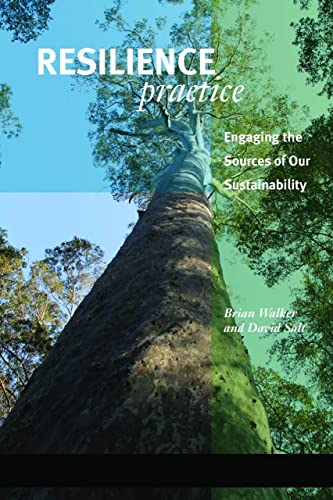
In 2006, Resilience Thinking addressed an essential question: As the natural systems that sustain us are subjected to shock after shock, how much can they take and still deliver the services we need from them? This idea caught the attention of both the scientific community and the general public. In Resilience Practice, authors Brian Walker and David Salt take the notion of resilience one step further, applying resilience thinking to real-world situations and exploring how systems can be managed to promote and sustain resilience. The book begins with an overview and introduction to resilience thinking and then takes the reader through the process of describing systems, assessing their resilience, and intervening as appropriate. Following each chapter is a case study of a different type of social-ecological system and how resilience makes a difference to that system in practice. The final chapters explore resilience in other arenas, including on a global scale. Resilience Practice will help people with an interest in the "coping capacity" of systems—from farms and catchments to regions and nations—to better understand how resilience thinking can be put into practice. It offers an easy-to-read but scientifically robust guide through the real-world application of the concept of resilience and is a must read for anyone concerned with the management of systems at any scale.
Die Inhaltsangabe kann sich auf eine andere Ausgabe dieses Titels beziehen.
Über die Autorin bzw. den Autor
Brian Walker and David Salt
Auszug. © Genehmigter Nachdruck. Alle Rechte vorbehalten.
Resilience Practice
Building Capacity to Absorb Disturbance and Maintain Function
By Brian Walker, David SaltISLAND PRESS
Copyright © 2012 Brian Walker David Salt
All rights reserved.
ISBN: 978-1-59726-801-1All rights reserved.
Contents
Foreword,
Preface,
Acknowledgments,
1 Preparing for Practice: The Essence of Resilience Thinking,
CASE STUDY 1 Thresholds on the Range: A Safe Operating Space for Grazing Enterprises,
2 Describing the System,
CASE STUDY 2 From Taos to Bali and Sri Lanka: Traditional Irrigation at the Crossroads,
3 Assessing Resilience,
CASE STUDY 3 Assessing Resilience for "the Plan": The Namoi and Central West Catchment Management Authorities,
4 Managing Resilience,
CASE STUDY 4 People and Pen Shells, Marine Parks and Rules: Why Governance Is Central to the Resilience of Coastal Fisheries,
5 Practicing Resilience in Different Ways,
CASE STUDY 5 Out of the Swamp: Lessons from Big Wetlands,
6 A Resilient World,
Postscript: A View from the Northwest Passage,
References,
Glossary,
About the Authors,
Index,
CHAPTER 1
Preparing for Practice:
The Essence of Resilience Thinking
There are any number of ways of putting resilience science into practice, and it needs to be said at the outset that following strict recipes and prescriptions simply isn't appropriate. Working with resilience requires you to constantly reflect on what you're doing and why you're doing it. And once an assessment of resilience is done, you are encouraged to go back and reexamine it, expand on it, and then adapt accordingly. Our focus in most of this book is on the resilience of social-ecological systems (linked systems of humans and nature). Resilience is a dynamic property of such a system, and managing for it requires a dynamic and adaptive approach.
This being said, the activities undertaken as part of resilience practice can be grouped into three broad steps: describing the system, assessing its resilience, and managing its resilience. In this book we'll provide a variety of ways you can undertake these steps, but the ultimate aim is that you devise your own approach.
While resilience science is not new, attempts to apply it in real-world situations have only recently started taking shape. Workshops of all sizes and flavors have been held around the world on various aspects of resilience practice, and one clear lesson is emerging from this experience. People seeking to undertake resilience assessments or work with resilience need to be in a "resilience frame of mind" to begin with. In other words, it's unlikely they'll engage with resilience practice if they haven't some idea of what resilience is about.
That's not a major hurdle. People with a bit of life experience and some responsibility for managing a system (e.g., a farm, a catchment, a business, or a national park) are usually very quick in picking up on resilience thinking. These systems are self-organizing systems, and people working with them have been attempting to understand them in their day-to-day work. Resilience thinking provides a useful framework for a deeper engagement on why these systems behave as they do.
A simple overview of resilience science is provided in our earlier book, Resilience Thinking, but there are also many other resources available at the website of the Resilience Alliance (www.resalliance.org). This is a group of organizations and individuals involved in interlinked aspects of ecological, social, and economic research. It is the network that has created and developed the framework of "resilience thinking."
Resilience and Identity
The word resilience is now common in many vision and mission statements. But ask the people who use these statements what they think it means, and you get a range of different answers, most of which relate to how something or someone copes with a shock or a disturbance.
Concepts of resilience are used in all sorts of disciplines, but the term has four main origins—psychosocial, ecological, disaster relief (and military), and engineering. We discuss these in chapter 5, but it's helpful to consider them briefly in this introduction.
Psychologists have long recognized marked differences in the resilience of individuals confronted with traumatic and disastrous circumstances. Considerable research has gone into trying to understand how individuals and societies can gain and lose resilience.
Ecologists have tended to describe resilience in two ways: one focused on the speed of return following a disturbance, the other focused on whether or not the system can recover.
People engaging with resilience from the perspective of disaster relief or in a military arena incorporate both aspects (i.e., speed and ability to recover). Indeed, there is a lot of commonality in the understanding of resilience in the three areas of psychology, ecology, and disaster relief.
In engineering the take on resilience is somewhat different. In fact, engineers more commonly use the term robustness with a connotation of "designed resilience." It differs from the other three uses in that it assumes bounded uncertainty—that is, the kinds and ranges of disturbances and shocks are known, and the system being built is designed to be robust in the face of these shocks. This view is now changing, and in chapter 5 we look at the emergence of what is being dubbed a "metarobustness" approach. This sees a convergence of ideas about resilience as used in the other three domains.
In this book we present a definition and description of resilience that is being used commonly by scientists in many areas of inquiry. It is the capacity of a system to absorb disturbance and reorganize so as to retain essentially the same function, structure, and feedbacks—to have the same identity. Put more simply, resilience is the ability to cope with shocks and keep functioning in much the same kind of way.
A key word in this definition is identity. It emerged independently in ecological and psychosocial studies, and it is both important and useful because it imparts the idea that people, societies, ecosystems, and social-ecological systems can all exhibit quite a lot of variation, be subjected to disturbance and cope, without changing their "identity"—without becoming something else.
The following pages seek to present a simple overview of the essence of resilience thinking. If you can appreciate the following ten key points, you're in a good position to consider how you can move from thinking to practice.
1. The systems we are dealing with are self-organizing.
2. There are limits to a system's self-organizing capacity.
3. These systems have linked social, economic, and biophysical domains.
4. Self-organizing systems move through adaptive cycles.
5. Linked adaptive cycles function across multiple scales.
6. There are three related dimensions to resilience: specified resilience, general resilience, and transformability.
7. Working with resilience involves both adapting and transforming.
8. Maintaining or building resilience comes at a cost.
9. Resilience is not about knowing everything.
10. Resilience is not about not changing.
1. Self-Organizing Systems
First and foremost, resilience thinking requires that you recognize and appreciate that the systems we depend upon are complex adaptive systems. We use the...
„Über diesen Titel“ kann sich auf eine andere Ausgabe dieses Titels beziehen.
Suchergebnisse für Resilience Practice: Building Capacity to Absorb Disturbance...

Beispielbild für diese ISBN
Resilience Practice: Building Capacity to Absorb Disturbance and Maintain Function
Anbieter: AwesomeBooks, Wallingford, Vereinigtes Königreich
Verkäuferbewertung 5 von 5 Sternen

Paperback. Zustand: Very Good. Resilience Practice: Building Capacity to Absorb Disturbance and Maintain Function This book is in very good condition and will be shipped within 24 hours of ordering. The cover may have some limited signs of wear but the pages are clean, intact and the spine remains undamaged. This book has clearly been well maintained and looked after thus far. Money back guarantee if you are not satisfied. See all our books here, order more than 1 book and get discounted shipping. Bestandsnummer des Verkäufers 7719-9781597268011
Gebraucht kaufen
EUR 10,57
EUR 4,92 Versand
Versand von Vereinigtes Königreich nach USA
Versand von Vereinigtes Königreich nach USA
Anzahl: 2 verfügbar
Beispielbild für diese ISBN
Resilience Practice: Building Capacity to Absorb Disturbance and Maintain Function
Anbieter: ThriftBooks-Dallas, Dallas, TX, USA
Verkäuferbewertung 5 von 5 Sternen
Paperback. Zustand: As New. No Jacket. Pages are clean and are not marred by notes or folds of any kind. ~ ThriftBooks: Read More, Spend Less. Bestandsnummer des Verkäufers G1597268011I2N00
Gebraucht kaufen
EUR 17,81
Versand gratis
Versand innerhalb von USA
Versand innerhalb von USA
Anzahl: 1 verfügbar
Beispielbild für diese ISBN
Resilience Practice : Building Capacity to Absorb Disturbance and Maintain Function
Anbieter: Better World Books Ltd, Dunfermline, Vereinigtes Königreich
Verkäuferbewertung 5 von 5 Sternen
Zustand: Good. Former library copy. Pages intact with minimal writing/highlighting. The binding may be loose and creased. Dust jackets/supplements are not included. Includes library markings. Stock photo provided. Product includes identifying sticker. Better World Books: Buy Books. Do Good. Bestandsnummer des Verkäufers 45725710-6
Gebraucht kaufen
EUR 12,12
EUR 5,97 Versand
Versand von Vereinigtes Königreich nach USA
Versand von Vereinigtes Königreich nach USA
Anzahl: 1 verfügbar
Beispielbild für diese ISBN
Resilience Practice: Building Capacity to Absorb Disturbance and Maintain Function
Verlag:
Island Press 30/10/2012, 2012
ISBN 10: 1597268011
ISBN 13: 9781597268011
Gebraucht
Paperback
Anbieter: Bahamut Media, Reading, Vereinigtes Königreich
Verkäuferbewertung 4 von 5 Sternen

Paperback. Zustand: Very Good. Shipped within 24 hours from our UK warehouse. Clean, undamaged book with no damage to pages and minimal wear to the cover. Spine still tight, in very good condition. Remember if you are not happy, you are covered by our 100% money back guarantee. Bestandsnummer des Verkäufers 6545-9781597268011
Gebraucht kaufen
EUR 10,61
EUR 8,34 Versand
Versand von Vereinigtes Königreich nach USA
Versand von Vereinigtes Königreich nach USA
Anzahl: 1 verfügbar
Beispielbild für diese ISBN
Resilience Practice: Building Capacity to Absorb Disturbance and Maintain Function
Anbieter: HPB-Emerald, Dallas, TX, USA
Verkäuferbewertung 5 von 5 Sternen
paperback. Zustand: Very Good. Connecting readers with great books since 1972! Used books may not include companion materials, and may have some shelf wear or limited writing. We ship orders daily and Customer Service is our top priority! Bestandsnummer des Verkäufers S_485240826
Gebraucht kaufen
EUR 17,08
EUR 3,34 Versand
Versand innerhalb von USA
Versand innerhalb von USA
Anzahl: 1 verfügbar
Beispielbild für diese ISBN
Resilience Practice : Building Capacity to Absorb Disturbance and Maintain Function
Anbieter: Better World Books, Mishawaka, IN, USA
Verkäuferbewertung 5 von 5 Sternen
Zustand: Very Good. Pages intact with possible writing/highlighting. Binding strong with minor wear. Dust jackets/supplements may not be included. Stock photo provided. Product includes identifying sticker. Better World Books: Buy Books. Do Good. Bestandsnummer des Verkäufers 18556231-75
Gebraucht kaufen
EUR 22,16
Versand gratis
Versand innerhalb von USA
Versand innerhalb von USA
Anzahl: 1 verfügbar
Beispielbild für diese ISBN
Resilience Practice: Building Capacity to Absorb Disturbance and Maintain Function
Anbieter: Textbooks_Source, Columbia, MO, USA
Verkäuferbewertung 5 von 5 Sternen
paperback. Zustand: New. 1st Edition. Ships in a BOX from Central Missouri! UPS shipping for most packages, (Priority Mail for AK/HI/APO/PO Boxes). Bestandsnummer des Verkäufers 001325897N
Neu kaufen
EUR 25,71
EUR 3,56 Versand
Versand innerhalb von USA
Versand innerhalb von USA
Anzahl: 1 verfügbar
Beispielbild für diese ISBN
Resilience Practice
Anbieter: PBShop.store UK, Fairford, GLOS, Vereinigtes Königreich
Verkäuferbewertung 5 von 5 Sternen
PAP. Zustand: New. New Book. Shipped from UK. Established seller since 2000. Bestandsnummer des Verkäufers WP-9781597268011
Neu kaufen
EUR 29,22
EUR 4,97 Versand
Versand von Vereinigtes Königreich nach USA
Versand von Vereinigtes Königreich nach USA
Anzahl: 11 verfügbar
Foto des Verkäufers
Resilience Practice
Verlag:
Princeton University Press, US, 2012
ISBN 10: 1597268011
ISBN 13: 9781597268011
Neu
Paperback
Anbieter: Rarewaves.com USA, London, LONDO, Vereinigtes Königreich
Verkäuferbewertung 5 von 5 Sternen
Paperback. Zustand: New. In 2006, "Resilience Thinking" addressed an essential question: As the natural systems that sustain us are subjected to shock after shock, how much can they take and still deliver the services we need from them? This idea caught the attention of both the scientific community and the general public. In "Resilience Practice", authors Brian Walker and David Salt take the notion of resilience one step further, applying resilience thinking to real-world situations and exploring how systems can be managed to promote and sustain resilience. The book begins with an overview and introduction to resilience thinking and then takes the reader through the process of describing systems, assessing their resilience, and intervening as appropriate. Following each chapter is a case study of a different type of social-ecological system and how resilience makes a difference to that system in practice. The final chapters explore resilience in other arenas, including on a global scale. "Resilience Practice" will help people with an interest in the "coping capacity" of systems - from farms and estates to regions and nations - to better understand how resilience thinking can be put into practice.It offers an easy-to-read but scientifically robust guide through the real-world application of the concept of resilience and is a must read for anyone concerned with the management of systems at any scale. Bestandsnummer des Verkäufers LU-9781597268011
Neu kaufen
EUR 34,74
Versand gratis
Versand von Vereinigtes Königreich nach USA
Versand von Vereinigtes Königreich nach USA
Anzahl: 6 verfügbar
Foto des Verkäufers
Resilience Practice: Building Capacity to Absorb Disturbance and Maintain Function (Paperback or Softback)
Verlag:
Island Press 8/6/2012, 2012
ISBN 10: 1597268011
ISBN 13: 9781597268011
Neu
Paperback or Softback
Anbieter: BargainBookStores, Grand Rapids, MI, USA
Verkäuferbewertung 5 von 5 Sternen
Paperback or Softback. Zustand: New. Resilience Practice: Building Capacity to Absorb Disturbance and Maintain Function. Book. Bestandsnummer des Verkäufers BBS-9781597268011