
Verwandte Artikel zu The Science of Open Spaces: Theory and Practice for...
Inhaltsangabe
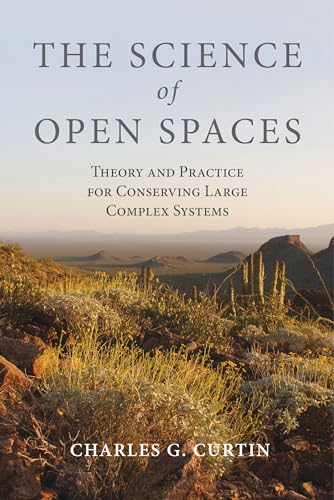
From the days of the American Frontier, the term "open spaces" has evoked a vision of unspoiled landscapes stretching endlessly toward the horizon, of nature operating on its own terms without significant human interference. Ever since, government agencies, academia, and conservation organizations have promoted policies that treat large, complex systems with a one-size-fits-all mentality that fails to account for equally complex social dimensions of humans on the landscape. This is wrong, argues landscape ecologist and researcher Charles Curtin. We need a science-based approach that tells us how to think about our large landscapes and open spaces at temporally and spatially appropriate scales in a way that allows local landowners and other stakeholders a say in their futures.
The Science of Open Spaces turns conventional conservation paradigms on their heads, proposing that in thinking about complex natural systems, whether the arid spaces of the southwestern United States or open seas shared by multiple nations, we must go back to "first principles"--those fundamental physical laws of the universe--and build innovative conservation from the ground up based on theory and backed up by practical experience. Curtin walks us through such foundational science concepts as thermodynamics, ecology, sociology, and resilience theory, applying them to real-world examples from years he has spent designing large-scale, place-based collaborative research programs in the United States and around the world.
Compelling for not only theorists and students, but also practitioners, agency personnel, and lay readers, this book offers a thoughtful and radical departure from business-as-usual management of Earth's dwindling wide-open spaces.
The Science of Open Spaces turns conventional conservation paradigms on their heads, proposing that in thinking about complex natural systems, whether the arid spaces of the southwestern United States or open seas shared by multiple nations, we must go back to "first principles"--those fundamental physical laws of the universe--and build innovative conservation from the ground up based on theory and backed up by practical experience. Curtin walks us through such foundational science concepts as thermodynamics, ecology, sociology, and resilience theory, applying them to real-world examples from years he has spent designing large-scale, place-based collaborative research programs in the United States and around the world.
Compelling for not only theorists and students, but also practitioners, agency personnel, and lay readers, this book offers a thoughtful and radical departure from business-as-usual management of Earth's dwindling wide-open spaces.
Die Inhaltsangabe kann sich auf eine andere Ausgabe dieses Titels beziehen.
Über die Autorin bzw. den Autor
Charles G. Curtin is a senior fellow at the Center for Natural Resources and Environmental Policy at the University of Montana and a consulting landscape ecologist with the Center for Large Landscape Conservation in Bozeman, Montana. His work focuses on community-based conservation, large-scale experimental science, and policy design in marine and terrestrial ecosystems.
Auszug. © Genehmigter Nachdruck. Alle Rechte vorbehalten.
The Science of Open Spaces
Theory and Practice for Conserving Large, Complex Systems
By Charles G. CurtinISLAND PRESS
Copyright © 2015 Charles G. Curtin
All rights reserved.
ISBN: 978-1-59726-993-3All rights reserved.
Contents
Acknowledgments,
Preface,
Chapter One Integrating Conservation and Complexity through the Perspective of Place,
Chapter Two Experiments in Post-Normal Science in Southwestern Rangelands,
Chapter Three Experiments in the Governance of Maine's Coastal Fisheries,
Chapter Four Conceptual Underpinnings for Preserving Open Spaces,
Chapter Five Resilience and the Socioecological Synthesis,
Chapter Six Practical Aspects of Sustaining Open Spaces,
Notes,
Literature Cited,
CHAPTER 1
Integrating Conservation and Complexity through the Perspective of Place
Earth so huge, and yet so bounded
pools of salt, and plots of land–
shallow skin of green and azure–
chains of mountains, grains of sand!
— Alfred, Lord Tennyson,
"Locksley Hall Sixty Years After"
Our Cessna banks into a tight turn above the East African savanna as Mount Kilimanjaro towers above, its summit rising through a layer of clouds. Below, a bright green expanse of wetland where hippos, elephants, and other wildlife wallow stands in stark contrast to the amber vastness of the plains of Amboseli National Park (fig. 1.1). As we enter the turn, Kenyan conservationist and ecologist David Western, handling the aircraft's controls, points out one specific, smaller patch of green coming into view, its sharply defined edges and geometric shape belying an electric fence designed to keep elephants and other large grazers out. It is an island of savanna surrounded by a sea of dust.
Western, one of the world's preeminent practitioners of large-scale conservation, describes the complex interplay unfolding below. Within the fenced enclosure are the remnants of native vegetation he saw when he first came to Amboseli as a student in the 1960s. The yellow "sea" represents huge tracts of land denuded by elephant herds forced to concentrate within the park's borders for protection from poachers and conflicts with people outside the park's boundaries. Amboseli's establishment as a national park in 1974, intended as a solution to the problem of Africa's declining wildlife populations, has instead created a series of new challenges. The current predicament of landscape degradation — too many elephants in too small an area resulting in too little vegetation — can be traced to an initial lack of engagement with local Maasai peoples in conservation efforts.
Establishing Amboseli as a park to protect wildlife has also meant the loss of traditional grazing grounds for the Maasai, whose presence and lifeways historically protected the elephants from poachers, and whose grazing cattle are documented to contribute to ecological richness. With these pastoralists mostly removed from the park, or concentrated around established settlements and water wells, the ecosystem no longer supports the complex interactions between people and wildlife that have promoted biological diversity and sustained ecological and cultural processes for millennia.
After another pass over the plot, we fly west toward the escarpment of the Rift Valley. Upon leaving Amboseli, the landscape becomes rich and varied, as a visible interchange between people and their environment is revealed. The diversity of land use and vegetation lies in stark contrast to the relatively monotypic composition of the park. Beyond Amboseli is a tapestry of landscape features reflecting a complex interplay of ecology, economy, and culture. Our flight path from one to the other is in many respects similar to the trajectory of this book, a contrast between conventional approaches to conservation and resource management and dynamic large-landscape perspectives that promote more nuanced and resilient conservation strategies.
Traditionally, conservation offered straightforward park-based prescriptions for protecting vulnerable ecosystems, yet the reality of sustaining large, open spaces is that they are much more than the sum of their parts. The term open spaces, as I use it here, is intended to invoke not only the challenge of physical size but also of time, ecology, culture, and all elements therein. This is a fundamentally different approach to science that reconceptualizes both problems and solutions to generate more timely and effective means of addressing the vast conservation challenges we face today. An underlying issue I seek to address is that current approaches to science are extremely effective at meeting the demands of academia or agency-based careers and as such are structured around producing papers and professional advancement, but are less effective at addressing large and complex social and environmental problems. To make science more relevant at large scales means reconceiving its role and approach to make it more relevant to operating at large scales in messy systems where solutions do not break out cleanly along disciplinary lines. The following pages reflect two decades of experimentation not just with addressing large-scale conservation challenges, but also with changing the process itself to facilitate more effective problem solving.
Foundations in Complexity
Conventional ecology and conservation reward empirically based experimental design with robust quantitative results but largely ignore the larger social framework within which they are embedded. Conversely, traditional sociological approaches often discuss the need for empirical science without creating the institutions needed to develop and sustain such efforts or a means of evaluating the effectiveness of the work. What is missing is widespread application of a perspective that blends rigorous science with critical institutional factors. This has been characterized by social theorists Silvio Funtowicz and Jerome Ravetz as post-normal science: that is, extensive public engagement with the scientific process to address situations where "facts are uncertain, values in dispute, stakes high, and decisions urgent." A science of open spaces links the post-normal paradigm with resilience and complexity-based perspectives, as well as the natural and social sciences, to examine how socioecological renewal and restoration stem from the emergent properties of particular land-and seascapes. At the same time, it identifies recurrent patterns of social and ecological interaction across a range of locales to find unifying strategies for successfully sustaining open spaces.
Nine thousand miles from Amboseli, Kenya, the Santa Fe Institute (SFI) sits on a hilltop above its namesake city, nestled among piñon pine and juniper. It is housed in a large, southwestern adobe-style structure that looks out across the Rio Grande Valley, the Jemez Mountains framing the western skyline. Although most academic disciplines focus on breaking down systems into pieces, SFI is a complex-systems think tank that focuses instead on synergy between biological and social systems. The Santa Fe Institute challenges the reductionist or positivist approach to science that has been a fundamental tenet of scholarship in the post–Enlightenment era in which we seek straightforward, quantitative solutions to complex, multifaceted problems. In the words of SFI cofounder and Nobel laureate Murray Gell-Mann,
In a great many places in our society, including academia and most bureaucracies, prestige accrues...
„Über diesen Titel“ kann sich auf eine andere Ausgabe dieses Titels beziehen.
Suchergebnisse für The Science of Open Spaces: Theory and Practice for...

Foto des Verkäufers
The Science of Open Spaces: Theory and Practice for Conserving Large, Complex Systems
Anbieter: Cycle Books LA, South el monte, CA, USA
Verkäuferbewertung 5 von 5 Sternen

Zustand: like_new. Bestandsnummer des Verkäufers AMTV.159726993X.LN
Gebraucht kaufen
EUR 26,54
EUR 2,67 Versand
Versand innerhalb von USA
Versand innerhalb von USA
Anzahl: 1 verfügbar
Beispielbild für diese ISBN
The Science of Open Spaces: Theory and Practice for Conserving Large, Complex Systems
Anbieter: Midtown Scholar Bookstore, Harrisburg, PA, USA
Verkäuferbewertung 5 von 5 Sternen
Paperback. Zustand: Acceptable. Acceptable - This is a significantly damaged book. It should be considered a reading copy only. Please order this book only if you are interested in the content and not the condition. May be ex-library. PAPERBACK Standard-sized. Bestandsnummer des Verkäufers M159726993XZ4
Gebraucht kaufen
EUR 25,18
EUR 5,36 Versand
Versand innerhalb von USA
Versand innerhalb von USA
Anzahl: 1 verfügbar
Beispielbild für diese ISBN
The Science of Open Spaces: Theory and Practice for Conserving Large, Complex Systems
Anbieter: WorldofBooks, Goring-By-Sea, WS, Vereinigtes Königreich
Verkäuferbewertung 5 von 5 Sternen
Paperback. Zustand: Very Good. The book has been read, but is in excellent condition. Pages are intact and not marred by notes or highlighting. The spine remains undamaged. Bestandsnummer des Verkäufers GOR010520701
Gebraucht kaufen
EUR 28,09
EUR 6,61 Versand
Versand von Vereinigtes Königreich nach USA
Versand von Vereinigtes Königreich nach USA
Anzahl: 1 verfügbar
Beispielbild für diese ISBN
THE SCIENCE OF OPEN SPACES
Anbieter: Basi6 International, Irving, TX, USA
Verkäuferbewertung 5 von 5 Sternen
Zustand: Brand New. New. US edition. Expediting shipping for all USA and Europe orders excluding PO Box. Excellent Customer Service. Bestandsnummer des Verkäufers ABEOCT25-177664
Beispielbild für diese ISBN
The Science of Open Spaces
Anbieter: Majestic Books, Hounslow, Vereinigtes Königreich
Verkäuferbewertung 4 von 5 Sternen

Zustand: New. pp. 264 59 Illus. Bestandsnummer des Verkäufers 353213858
Neu kaufen
EUR 35,49
EUR 7,67 Versand
Versand von Vereinigtes Königreich nach USA
Versand von Vereinigtes Königreich nach USA
Anzahl: 1 verfügbar
Beispielbild für diese ISBN
The Science of Open Spaces
Anbieter: Books Puddle, Woodside, NY, USA
Verkäuferbewertung 4 von 5 Sternen
Zustand: New. pp. 264. Bestandsnummer des Verkäufers 26360325757
Neu kaufen
EUR 39,70
EUR 3,56 Versand
Versand innerhalb von USA
Versand innerhalb von USA
Anzahl: 1 verfügbar
Beispielbild für diese ISBN
Science of Open Spaces
Anbieter: Romtrade Corp., STERLING HEIGHTS, MI, USA
Verkäuferbewertung 5 von 5 Sternen
Zustand: New. This is a Brand-new US Edition. This Item may be shipped from US or any other country as we have multiple locations worldwide. Bestandsnummer des Verkäufers ABBB-201358
Beispielbild für diese ISBN
Science of Open Spaces
Anbieter: Basi6 International, Irving, TX, USA
Verkäuferbewertung 5 von 5 Sternen
Zustand: Brand New. New. US edition. Expediting shipping for all USA and Europe orders excluding PO Box. Excellent Customer Service. Bestandsnummer des Verkäufers ABEOCT25-177665
Foto des Verkäufers
The Science of Open Spaces
Verlag:
Princeton University Press, US, 2015
ISBN 10: 159726993X
ISBN 13: 9781597269933
Neu
Paperback
Anbieter: Rarewaves.com USA, London, LONDO, Vereinigtes Königreich
Verkäuferbewertung 5 von 5 Sternen
Paperback. Zustand: New. This title presents a new framework for conservation based on public engagement and natural sciences. Management policies have tended to promote a one-size-fits-all mentality for large, complex landscapes. Landscape ecologist Charles Curtin argues that instead we need a science-based approach that accounts for the dynamic nature of complex systems and gives local stakeholders a say in their futures. The Science of Open Spaces proposes that we return to "first principles", fundamental physical laws of the universe, and think about complex systems from the ground up based on modern scientific theory backed up by practical experience. Curtin walks us through foundational concepts of thermodynamics, ecology, sociology, and resilience theory, applying them to real-world examples from years he has spent designing large-scale, place-based collaborative research programmes around the world. Bestandsnummer des Verkäufers LU-9781597269933
Neu kaufen
EUR 46,40
Versand gratis
Versand von Vereinigtes Königreich nach USA
Versand von Vereinigtes Königreich nach USA
Anzahl: Mehr als 20 verfügbar
Beispielbild für diese ISBN
The Science of Open Spaces: Theory and Practice for Conserving Large, Complex Systems (eng)
Anbieter: Brook Bookstore On Demand, Napoli, NA, Italien
Verkäuferbewertung 5 von 5 Sternen
Zustand: new. Bestandsnummer des Verkäufers 0a6dcb643b0f9265102764336419c1bc
Neu kaufen
EUR 43,50
EUR 5,50 Versand
Versand von Italien nach USA
Versand von Italien nach USA
Anzahl: Mehr als 20 verfügbar