
Verwandte Artikel zu Total Abs: Build a Rock-Hard Midsection in Four Weeks
Inhaltsangabe
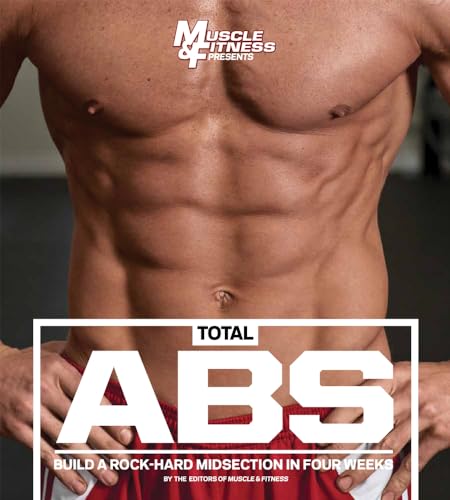
Intended for anyone who wants rock-hard abs but needs help getting motivated, the editors of fitness authority Muscle & Fitness magazine have created a four-week plan that incorporates invaluable take-away strategies to get a firmer midsection. More than 50 exercises and full-color photos guide readers through the best ways to obtain a tight six-pack. Throughout the exercises informative tips and fast facts  are included to ensure that each routine is executed in the safest and most effective manner possible.
Die Inhaltsangabe kann sich auf eine andere Ausgabe dieses Titels beziehen.
Über die Autorin bzw. den Autor
Muscle & Fitness is a bodybuilding magazine first launched in 1936 and that offers professional exercise and nutritional tips. They are based in New York City.
Auszug. © Genehmigter Nachdruck. Alle Rechte vorbehalten.
Total Abs
By Muscle & Fitness, Dylan Coulter, Michael Darter, Ian Logan, Robert Reiff, Marc Royce, Pavel YthjallTriumph Books
Copyright © 2013 American Media, Inc.
All rights reserved.
ISBN: 978-1-60078-830-7All rights reserved.
Contents
Chapter 1 AB TRAINING 101,
Chapter 2 FIVE WEEKS TO WASHBOARD ABS,
Chapter 3 SPOT-ON ABS,
Chapter 4 ABS DONE YOUR WAY,
Chapter 5 WORKING ALL THE ANGLES,
Chapter 6 OLD-SCHOOL ABS,
Chapter 7 GUT INSTINCT,
Chapter 8 THE NO-CRUNCH CORE WORKOUT,
Chapter 9 SHORT CIRCUIT,
Chapter 10 CORE CONSERVATION,
Chapter 11 THE FUTURE OF AB TRAINING,
Chapter 12 FAST-FORWARD YOUR FAT LOSS,
Chapter 13 KILLER COMBOS,
Chapter 14 50 RULES OF FAT BURNING,
Chapter 15 FIT WITH HIIT,
Chapter 16 FULL-METAL CARDIO,
AB EXERCISE FINDER,
CHAPTER 1
AB TRAINING 101
Is your pursuit of great abdominals all over the map? Take the guesswork out of finding your own defined six-pack with these simple guidelines.
Pretend for a moment that your midsection is a map you're trying to navigate. You'd like to explore a number of different areas and regions, but you're not quite sure what's the best way to go about it. After all, when it comes to this terrain in particular, there are all sorts of conflicting opinions on how to navigate it most effectively and find the path to the ultimate six-pack. What you really need is the ab version of a high-tech GPS, something that will tell you how to arrive at your destination the quickest way possible. That's where M&F comes in. Think of this introductory chapter (and the rest of this book, for that matter) as your very own Abdominal Positioning System, telling you what areas to train, when to train them, and how — with no risk of making any wrong turns along the way.
ROUTE 6 (PACK)
The four muscles that make up the abdominals are the rectus abdominis, the internal and external obliques, and the transverse abdominis. Without question, the best ab program is one that incorporates exercises that focus on all of these areas.
If you train abs more often than other body parts, you're not alone. Most people who give their abs the attention they deserve train them 3-5 times per week while working other major body parts (chest, back, legs, etc.) 1-3 times per week. Reason being, the abs are postural muscles that stay flexed for long periods to support the spine. As such, they have a higher percentage of slow-twitch muscle fibers than other body parts and require more regular training for adequate stimulation.
The rep range you choose to work within is critical to how your abs develop (and show) when your body fat is low. Using your own body weight as resistance and keeping your reps between 15 and 30, for example, will help you maintain a flat and lean midsection, allowing your waist to appear smaller. If you feel your abs need to grow so you can see them better, you'll need to include weighted exercises using a cable station or a lightweight plate or dumbbell to help build them up. Selecting exercises is easy — choose a total of four moves each time you train abs, one for each of the different areas.
With ab training, timing is crucial: Always hit abs last in your workout. You don't want them to be fatigued before training other body parts such as back or legs because you want your abs and core to be strong and fresh to help sustain the intra-abdominal pressure necessary to protect your spine.
So let's look at each region of the abs, dissecting the anatomy, location, and function, as well as review some of our favorite exercises to get the kind of washboard midsection you've always wanted.
REGION 1: RECTUS ABDOMINIS
Even though the six-pack looks like several individual muscles, the rectus abdominis is really only one. Running vertically from your sternum to your pelvis, the rectus is a thin sheath of muscle. While we'll discuss exercises for your upper and lower abs, note that they're all part of one muscle. That said, you can still emphasize the upper and lower portions of the rectus with specific movements.
The rectus abdominis is responsible for the standard crunching motion — moving your ribcage toward your pelvis. It also gets trained in the opposite direction, bringing your pelvis to your ribcage, which we refer to as a reverse crunching motion.
>>Basic Exercises: (Upper abs) crunch; (Lower abs) reverse crunch, hanging knee/leg raise
>>Exercises: (Upper abs) weighted crunch, machine crunch, decline bench cable crunch, kneeling cable crunch; (Lower abs) exercise-ball pull-in, dumbbell hip thrust, weighted hanging leg raise; (Upper and lower) double crunch
DECLINE BENCH CABLE CRUNCH
Set an adjustable bench to a moderate decline and place it in front of a low-pulley cable with a rope attachment. Sit squarely on it, feet secured under the ankle pads. Lie back on the bench and grasp the ends of the rope with your hands at the sides of your head. Contract your abs to curl your body up to a point just short of perpendicular to the floor; try to avoid pulling through your hip flexors. Round your back as you rise to increase the abdominal contraction, then lower yourself under control back to the start position.
DUMBBELL HIP THRUST
Lie faceup on the floor with your hands extended at your sides. Lift your feet so your legs are roughly perpendicular to the floor and place a dumbbell between your feet. (Due to the weight's placement above your body, use extra caution during this move to avoid injury.) Contract your abs to raise your hips and glutes straight up off the floor to push your feet toward the ceiling. Hold this position for a count before lowering your glutes back to the floor.
WEIGHTED HANGING KNEE RAISE
Perform this exercise either hanging from a high bar (using straps is an option) or on a vertical bench that supports your forearms. Hang at arm's length using an overhand grip, bending your knees 90 degrees and locking them in this position for the entire set. Hold a medicine ball between your knees or ankles. Without swinging your body, contract your abs to bring your knees toward your chest (at least above parallel to the floor) and lower under control, coming to a complete stop at the bottom so as not to generate momentum as you go into the next rep.
REGIONS 2 & 3: INTERNAL'S EXTERNAL OBLIQUES
The obliques are off to either side of the rectus abdominis and run diagonally from your lower ribs to near your hipbone. The external obliques are the ones you can see, as they're superficial to the internal obliques, which are hidden underneath. The internal and external fibers run in opposite directions. Both the internal and external obliques are responsible for torso rotation and lateral flexion of the torso.
>>Basic Exercises: Lying crossover crunch, oblique crunch, jackknife
>>Advanced Exercises: Oblique crunch on back-extension bench, standing oblique cable crunch, decline cable Russian twist
DECLINE CABLE TWIST
Place a decline bench in front of a cable stack with a D-handle attached to the low-pulley cable.
Sit on the bench in a half situp position (your lower back shouldn't touch down) and hold the D-handle with both hands straight above you. With your arms locked in that position, rotate your torso to the right until your right arm is about parallel to the floor. Pause for a moment, return to the start, then repeat to the left side. That's one...
„Über diesen Titel“ kann sich auf eine andere Ausgabe dieses Titels beziehen.
Suchergebnisse für Total Abs: Build a Rock-Hard Midsection in Four Weeks

Beispielbild für diese ISBN
Total Abs: Build a Rock-Hard M
Anbieter: World of Books (was SecondSale), Montgomery, IL, USA
Verkäuferbewertung 5 von 5 Sternen

Zustand: Very Good. Item in very good condition! Textbooks may not include supplemental items i.e. CDs, access codes etc. Bestandsnummer des Verkäufers 00105085249
Gebraucht kaufen
EUR 5,41
Versand gratis
Versand innerhalb von USA
Versand innerhalb von USA
Anzahl: 1 verfügbar
Beispielbild für diese ISBN
Total Abs: Build a Rock-Hard M
Anbieter: World of Books (was SecondSale), Montgomery, IL, USA
Verkäuferbewertung 5 von 5 Sternen
Zustand: Good. Item in good condition. Textbooks may not include supplemental items i.e. CDs, access codes etc. Bestandsnummer des Verkäufers 00091547501
Gebraucht kaufen
EUR 5,41
Versand gratis
Versand innerhalb von USA
Versand innerhalb von USA
Anzahl: 1 verfügbar
Beispielbild für diese ISBN
Total Abs: Build a Rock-Hard Midsection in Four Weeks
Verlag:
Triumph Books (edition Illustrated), 2013
ISBN 10: 1600788300
ISBN 13: 9781600788307
Gebraucht
Paperback
Anbieter: BooksRun, Philadelphia, PA, USA
Verkäuferbewertung 5 von 5 Sternen
Paperback. Zustand: Fair. Illustrated. The item might be beaten up but readable. May contain markings or highlighting, as well as stains, bent corners, or any other major defect, but the text is not obscured in any way. Bestandsnummer des Verkäufers 1600788300-7-1
Gebraucht kaufen
EUR 5,42
Versand gratis
Versand innerhalb von USA
Versand innerhalb von USA
Anzahl: 1 verfügbar
Foto des Verkäufers
Total Abs: Build a Rock-Hard Midsection in Four Weeks
Anbieter: Bay State Book Company, North Smithfield, RI, USA
Verkäuferbewertung 5 von 5 Sternen
Zustand: good. The book is in good condition with all pages and cover intact, including the dust jacket if originally issued. The spine may show light wear. Pages may contain some notes or highlighting, and there might be a "From the library of" label. Boxed set packaging, shrink wrap, or included media like CDs may be missing. Bestandsnummer des Verkäufers BSM.1B9TE
Gebraucht kaufen
EUR 5,77
Versand gratis
Versand innerhalb von USA
Versand innerhalb von USA
Anzahl: 1 verfügbar
Beispielbild für diese ISBN
Total Abs
Anbieter: ThriftBooks-Dallas, Dallas, TX, USA
Verkäuferbewertung 5 von 5 Sternen
Paperback. Zustand: Very Good. No Jacket. May have limited writing in cover pages. Pages are unmarked. ~ ThriftBooks: Read More, Spend Less. Bestandsnummer des Verkäufers G1600788300I4N00
Gebraucht kaufen
EUR 5,88
Versand gratis
Versand innerhalb von USA
Versand innerhalb von USA
Anzahl: 1 verfügbar
Beispielbild für diese ISBN
Total Abs : Build a Rock-Hard Midsection in Four Weeks
Anbieter: Better World Books, Mishawaka, IN, USA
Verkäuferbewertung 5 von 5 Sternen
Zustand: Good. Pages intact with minimal writing/highlighting. The binding may be loose and creased. Dust jackets/supplements are not included. Stock photo provided. Product includes identifying sticker. Better World Books: Buy Books. Do Good. Bestandsnummer des Verkäufers 14941842-6
Gebraucht kaufen
EUR 6,77
Versand gratis
Versand innerhalb von USA
Versand innerhalb von USA
Anzahl: 1 verfügbar
Beispielbild für diese ISBN
Total Abs : Build a Rock-Hard Midsection in Four Weeks
Anbieter: Better World Books, Mishawaka, IN, USA
Verkäuferbewertung 5 von 5 Sternen
Zustand: Very Good. Pages intact with possible writing/highlighting. Binding strong with minor wear. Dust jackets/supplements may not be included. Stock photo provided. Product includes identifying sticker. Better World Books: Buy Books. Do Good. Bestandsnummer des Verkäufers 15587630-6
Gebraucht kaufen
EUR 6,77
Versand gratis
Versand innerhalb von USA
Versand innerhalb von USA
Anzahl: 1 verfügbar
Beispielbild für diese ISBN
Total Abs: Build a Rock-Hard Midsection in Four Weeks
Anbieter: World of Books Inc, Montgomery, IL, USA
Verkäuferbewertung 4 von 5 Sternen

Paperback. Zustand: Very Good. Intended for anyone who wants rock-hard abs but needs help getting motivated, the editors of fitness authority Muscle & Fitness magazine have created a four-week plan that incorporates invaluable take-away strategies to get a firmer midsection. More than 50 exercises and full-color photos guide readers through the best ways to obtain a tight six-pack. Throughout the exercises informative tips and fast facts are included to ensure that each routine is executed in the safest and most effective manner possible. Bestandsnummer des Verkäufers CIN1600788300VG
Gebraucht kaufen
EUR 7,21
Versand gratis
Versand innerhalb von USA
Versand innerhalb von USA
Anzahl: 1 verfügbar
Beispielbild für diese ISBN
Total Abs: Build a Rock-Hard Midsection in Four Weeks
Anbieter: SustainableBooks.com, Amherst, NY, USA
Verkäuferbewertung 5 von 5 Sternen
Zustand: Very Good. Book is in Used-VeryGood condition. Pages and cover are clean and intact. Used items may not include supplementary materials such as CDs or access codes. May show signs of minor shelf wear and contain very limited notes and highlighting. Bestandsnummer des Verkäufers 1600788300-2-3
Gebraucht kaufen
EUR 9,08
Versand gratis
Versand innerhalb von USA
Versand innerhalb von USA
Anzahl: 1 verfügbar
Beispielbild für diese ISBN
Total Abs: Build a Rock-Hard Midsection in Four Weeks
Anbieter: Running Numbers, Grand Rapids, MI, USA
Verkäuferbewertung 5 von 5 Sternen
paperback. Zustand: Good. Book is new but with shelfwear and slight corner bends. Ships fast! Bestandsnummer des Verkäufers mon0000006157
Gebraucht kaufen
EUR 8,98
EUR 4,36 Versand
Versand innerhalb von USA
Versand innerhalb von USA
Anzahl: 2 verfügbar