
Verwandte Artikel zu The Last Arrow: Save Nothing for the Next Life
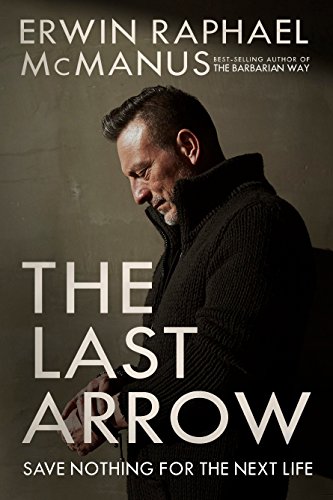
Inhaltsangabe
Before You Die,
Live the Life
You Were Born
To Live.
When you come to the end of your days, you will not measure your life based on success and failures. All of those will eventually blur together into a single memory called “life.”
What will give you solace is a life with nothing left undone. One that’s been lived with relentless ambition, a heart on fire, and with no regrets.
On the other hand, what will haunt you until your final breath is who you could have been but never became and what you could have done but never did.
The Last Arrow is your roadmap to a life that defies odds and alters destinies. Discover the attributes of those who break the gravitational pull of mediocrity as cultural pioneer and thought leader Erwin McManus examines the characteristics of individuals who risked everything for a life they could only imagine. Imagine living the life you were convinced was only a dream.
We all begin this life with a quiver full of arrows.
Now the choice is yours. Will you cling to your arrows or risk them all, opting to live until you have nothing left to give?
Time is short. Pick up The Last Arrow and begin the greatest quest of your life.
Die Inhaltsangabe kann sich auf eine andere Ausgabe dieses Titels beziehen.
Über die Autorin bzw. den Autor
Erwin Raphael McManus is an iconoclast, artist, and cultural thought leader known for his integration of creativity and spirituality. He is the founder of MOSAIC- a Los Angeles based community of faith recognized as one of America’s most influential and innovative churches.
Erwin is the acclaimed author of The Artisan Soul, Chasing Daylight, Soul Cravings, and The Barbarian Way. His books have sold over a million copies worldwide. He lives in Hollywood, California with his wife of 34 years Kim McManus.
Auszug. © Genehmigter Nachdruck. Alle Rechte vorbehalten.
1
The Point of No Return
William Osborne McManus married my mom when I was around six years old. He wasn’t my birth father, and he never legally adopted me or my brother, but for all intents and purposes, he was the only father I ever knew. We became close, and I imagine that in my childhood, I loved him as much as any son could love a father. When I was young I called him dad. Later in life I simply called him Bill.
This man was a contradiction in every way. He was warm and engaging, charismatic and winsome. At the same time, he was a con man for whom truth was simply material woven into whatever lies he needed to tell. I remember when the movie Catch Me If You Can, starring Leonardo DiCaprio, came out. My brother, Alex, called me up and said, “Have you seen the movie? It’s Dad.” I had the exact same thought when I sat in the theater watching the movie. If you want to understand my childhood, it’s summarized for you in two hours.
Over the years, Bill caused my family deep pain, callously disregarding my mom and my two little sisters, the daughters he had fathered. By the time he left us, when I was seventeen years old, all the love I had felt for him had turned to disdain. That day, he must have seen what I was feeling and thinking when he looked into my eyes, because he moved toward me aggressively. And while my instincts made me want to step back in fear, my anger made me hold my ground. Standing face to face with me, he said, “Hit me. I know you want to. See if you are man enough.”
I looked at him and said, “You’re not worth the effort.”
He got in his car as my little sisters begged me to find a way to reconcile. I went outside to plead with him not to leave. My last memory of him from that day was seeing his face on the other side of the windshield when he clipped me with the front of the car as he drove away.
Even after that fateful day, we did find a way to reconcile and stay in touch by phone, although our contact was minimal. But there is truth to the adage that what has been torn cannot be mended. Eventually Bill remarried, and around that same time, I married as well. As if it were a script, his new wife and my wife, Kim, were pregnant at the same time. But for more reasons than I can explain, I made the hard decision of leaving my stepdad in the past and focusing on building a future for my family without Bill as part of our lives.
Before I knew it, fifteen years had passed—years in which Bill and my son, Aaron, never met. Aaron was the first true McManus in our family. I had taken the name McManus from Bill without his ever legally becoming my father. And ironically, McManus wasn’t even his name—it was an alias he assumed. He was the kind of person who was always running from his past, and his false identity was a part of that. Finally Aaron came by the name legitimately.
When Aaron was fifteen, he wanted to meet the man who gave me that name in the first place—the man I called my father. I felt I owed him that. So even though I hadn’t spoken to my dad in fifteen years, I tracked him down as if he were a stranger I was trying to meet for the first time. We found him in a small town outside Charlotte, North Carolina, called Matthews. He was more than happy to see me and more than happy to meet my son. I think I had caused him great sadness by extricating myself from his life for the past fifteen years.
I didn’t know what to expect, but the reunion went well enough—for a while. Then there were the last words I heard him say as we were leaving (not just the last words that day but forever, as he died not too long afterward). He said to my son in my presence, “I don’t know what your dad has told you, but he was average. He was just average. His brother was exceptional, but your dad, he was just average.”
Those words cut me like a knife. Please don’t misunderstand me. What hurt most was not that those were the last words my father chose to say about me. Nor was I most hurt because my son heard this judgment. What cut me deepest was a terrifying sense that Bill McManus was right, that I was just average.
Frankly, if you look back at my early life, those words would have to be categorized as an exaggeration toward the positive. I was, in fact, always below average. I wasn’t the C student; I was a D student. I wasn’t second string; I was, at best, third string. The painful truth is that “average” had always eluded me. I seemed to always be diving toward the bottom. I was never picked first, nor second, nor anywhere in the middle. I was always literally the last player picked.
And while I always hoped that one day there would be something special about me, the truth is, I made my home in the average, if not the below average. I found a strange solace and safety in my power of invisibility and made obscurity my residence.
I am in no small part indebted to that conversation with Bill for all the thoughts that follow in this book. I do not believe anyone is born average, but I do believe that many of us choose to live a life of mediocrity. I think there are more of us than not who are in danger of disappearing into the abyss of the ordinary. The great tragedy in this, of course, is that there is nothing really ordinary about us. We might not be convinced of this, but our souls already know it’s true, which is why we find ourselves tormented when we choose lives beneath our capacities and callings.
There are two ways of hearing the indictment “You are just average.” One way of hearing this is as a statement of essence, that you’re cut from an average cloth. The second is subtly, but significantly, different. The statement can be about character—that you have chosen a path of least resistance, that you have not aspired to the greatness that is within your grasp. Here is the painful reality: we will find ourselves defined by the average if we do not choose to defy the odds. Odds are that you and I will fall at the average. That’s why it’s called the average. It’s where most of us live. To be above average demands a choice. It requires that we defy the odds. You have no control of whether you have been endowed with above-average talent or intelligence or physical attributes. What you can control is whether you choose to live your life defined and determined by the status quo. Even when the law of averages works against you, you can still defy the odds.
Bill’s was a statement of outcome and actions. I walked away from his house that day with a clear resolve that although I have no control over whatever talent has been placed inside of me—no control over the level of my intelligence or whatever other advantages or disadvantages my genetic composition might have brought me—I will take absolute control over my personal responsibility to develop and maximize whatever potential God has given me for the good of others. The journey of The Last Arrow begins when you raise the bar. We need to raise the bar of our standards of our faith, of our sacrifice, of our expectations of ourselves, of our belief of the goodness and generosity of God.
We can refuse to be average. We must refuse to be average. We must war against the temptation to settle for less. Average is always a safe choice, and it is the most dangerous choice we can make. Average protects us from the risk of failure, and it also separates us from futures of greatness. The Last Arrow is for those who decide they will never settle.
I am not talking about an uncompromising rigidity to your own expectations and standards. In fact, a huge part of the process we are about to enter into is learning how to let go of those things that don’t really matter and even of those things...
„Über diesen Titel“ kann sich auf eine andere Ausgabe dieses Titels beziehen.
Suchergebnisse für The Last Arrow: Save Nothing for the Next Life

Beispielbild für diese ISBN
The Last Arrow: Save Nothing for the Next Life
Anbieter: Your Online Bookstore, Houston, TX, USA
Verkäuferbewertung 5 von 5 Sternen

Hardcover. Zustand: Good. Bestandsnummer des Verkäufers 1601429533-3-24455751
Gebraucht kaufen
EUR 3,86
Versand gratis
Versand innerhalb von USA
Versand innerhalb von USA
Anzahl: 1 verfügbar
Beispielbild für diese ISBN
The Last Arrow: Save Nothing for the Next Life
Anbieter: Orion Tech, Kingwood, TX, USA
Verkäuferbewertung 5 von 5 Sternen
hardcover. Zustand: Very Good. Bestandsnummer des Verkäufers 1601429533-2-33572347
Gebraucht kaufen
EUR 3,86
Versand gratis
Versand innerhalb von USA
Versand innerhalb von USA
Anzahl: 2 verfügbar
Beispielbild für diese ISBN
The Last Arrow: Save Nothing for the Next Life
Anbieter: Your Online Bookstore, Houston, TX, USA
Verkäuferbewertung 5 von 5 Sternen
Hardcover. Zustand: Very Good. Bestandsnummer des Verkäufers 1601429533-2-22612161
Gebraucht kaufen
EUR 3,86
Versand gratis
Versand innerhalb von USA
Versand innerhalb von USA
Anzahl: 2 verfügbar
Beispielbild für diese ISBN
The Last Arrow: Save Nothing for the Next Life
Anbieter: Your Online Bookstore, Houston, TX, USA
Verkäuferbewertung 5 von 5 Sternen
Hardcover. Zustand: Fair. Bestandsnummer des Verkäufers 1601429533-4-25002414
Gebraucht kaufen
EUR 3,86
Versand gratis
Versand innerhalb von USA
Versand innerhalb von USA
Anzahl: 2 verfügbar
Beispielbild für diese ISBN
The Last Arrow: Save Nothing for the Next Life
Anbieter: Orion Tech, Kingwood, TX, USA
Verkäuferbewertung 5 von 5 Sternen
hardcover. Zustand: Fair. Bestandsnummer des Verkäufers 1601429533-4-28380322
Gebraucht kaufen
EUR 3,86
Versand gratis
Versand innerhalb von USA
Versand innerhalb von USA
Anzahl: 3 verfügbar
Beispielbild für diese ISBN
The Last Arrow: Save Nothing for the Next Life
Anbieter: Gulf Coast Books, Cypress, TX, USA
Verkäuferbewertung 5 von 5 Sternen
hardcover. Zustand: Very Good. Bestandsnummer des Verkäufers 1601429533-2-36583423
Gebraucht kaufen
EUR 3,86
Versand gratis
Versand innerhalb von USA
Versand innerhalb von USA
Anzahl: 4 verfügbar
Beispielbild für diese ISBN
The Last Arrow: Save Nothing for the Next Life
Verlag:
Waterbrook Press (A Division of Random House Inc), 2017
ISBN 10: 1601429533
ISBN 13: 9781601429537
Gebraucht
Hardcover
Anbieter: World of Books (was SecondSale), Montgomery, IL, USA
Verkäuferbewertung 5 von 5 Sternen
Hardback. Zustand: Very Good. Before You Die, Live the Life You Were Born To Live. When you come to the end of your days, you will not measure your life based on success and failures. All of those will eventually blur together into a single memory called life. What will give you solace is a life with nothing left undone. One that's been lived with relentless ambition, a heart on fire, and with no regrets. On the other hand, what will haunt you until your final breath is who you could have been but never became and what you could have done but never did. The Last Arrow is your roadmap to a life that defies odds and alters destinies. Discover the attributes of those who break the gravitational pull of mediocrity as cultural pioneer and thought leader Erwin McManus examines the characteristics of individuals who risked everything for a life they could only imagine. Imagine living the life you were convinced was only a dream. We all begin this life with a quiver full of arrows. Now the choice is yours. Will you cling to your arrows or risk them all, opting to live until you have nothing left to give? Time is short. Pick up The Last Arrow and begin the greatest quest of your life. Bestandsnummer des Verkäufers 00106077983
Gebraucht kaufen
EUR 3,87
Versand gratis
Versand innerhalb von USA
Versand innerhalb von USA
Anzahl: 4 verfügbar
Beispielbild für diese ISBN
The Last Arrow: Save Nothing for the Next Life
Verlag:
Waterbrook Press (A Division of Random House Inc), 2017
ISBN 10: 1601429533
ISBN 13: 9781601429537
Gebraucht
Hardcover
Anbieter: World of Books (was SecondSale), Montgomery, IL, USA
Verkäuferbewertung 5 von 5 Sternen
Hardback. Zustand: Fair. Before You Die, Live the Life You Were Born To Live. When you come to the end of your days, you will not measure your life based on success and failures. All of those will eventually blur together into a single memory called life. What will give you solace is a life with nothing left undone. One that's been lived with relentless ambition, a heart on fire, and with no regrets. On the other hand, what will haunt you until your final breath is who you could have been but never became and what you could have done but never did. The Last Arrow is your roadmap to a life that defies odds and alters destinies. Discover the attributes of those who break the gravitational pull of mediocrity as cultural pioneer and thought leader Erwin McManus examines the characteristics of individuals who risked everything for a life they could only imagine. Imagine living the life you were convinced was only a dream. We all begin this life with a quiver full of arrows. Now the choice is yours. Will you cling to your arrows or risk them all, opting to live until you have nothing left to give? Time is short. Pick up The Last Arrow and begin the greatest quest of your life. Bestandsnummer des Verkäufers 00106644196
Gebraucht kaufen
EUR 3,87
Versand gratis
Versand innerhalb von USA
Versand innerhalb von USA
Anzahl: 2 verfügbar
Beispielbild für diese ISBN
The Last Arrow: Save Nothing for the Next Life
Verlag:
Waterbrook Press (A Division of Random House Inc), 2017
ISBN 10: 1601429533
ISBN 13: 9781601429537
Gebraucht
Hardcover
Anbieter: World of Books (was SecondSale), Montgomery, IL, USA
Verkäuferbewertung 5 von 5 Sternen
Hardback. Zustand: Good. Before You Die, Live the Life You Were Born To Live. When you come to the end of your days, you will not measure your life based on success and failures. All of those will eventually blur together into a single memory called life. What will give you solace is a life with nothing left undone. One that's been lived with relentless ambition, a heart on fire, and with no regrets. On the other hand, what will haunt you until your final breath is who you could have been but never became and what you could have done but never did. The Last Arrow is your roadmap to a life that defies odds and alters destinies. Discover the attributes of those who break the gravitational pull of mediocrity as cultural pioneer and thought leader Erwin McManus examines the characteristics of individuals who risked everything for a life they could only imagine. Imagine living the life you were convinced was only a dream. We all begin this life with a quiver full of arrows. Now the choice is yours. Will you cling to your arrows or risk them all, opting to live until you have nothing left to give? Time is short. Pick up The Last Arrow and begin the greatest quest of your life. Bestandsnummer des Verkäufers 00091329541
Gebraucht kaufen
EUR 3,87
Versand gratis
Versand innerhalb von USA
Versand innerhalb von USA
Anzahl: Mehr als 20 verfügbar
Foto des Verkäufers
The Last Arrow: Save Nothing for the Next Life
Anbieter: Zoom Books East, Glendale Heights, IL, USA
Verkäuferbewertung 5 von 5 Sternen
Zustand: good. Book is in good condition and may include underlining highlighting and minimal wear. The book can also include "From the library of" labels. May not contain miscellaneous items toys, dvds, etc. . We offer 100% money back guarantee and 24 7 customer service. Bestandsnummer des Verkäufers ZEV.1601429533.G
Gebraucht kaufen
EUR 4,05
Versand gratis
Versand innerhalb von USA
Versand innerhalb von USA
Anzahl: 1 verfügbar