
Inhaltsangabe
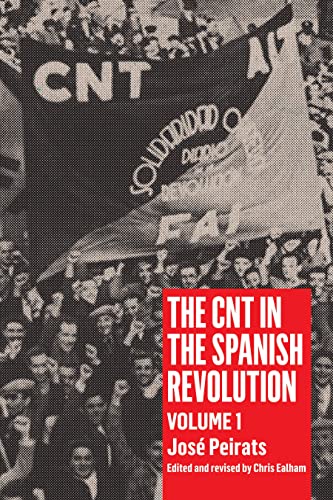
The CNT in the Spanish Revolution is the history of one of the most original and audacious, and arguably also the most far-reaching, of all the twentieth-century revolutions. It is the history of the giddy years of political change and hope in 1930s Spain, when the so-called ‘Generation of ’36’, Peirats’ own generation, rose up against the oppressive structures of Spanish society. It is also a history of a revolution that failed, crushed in the jaws of its enemies on both the reformist left and the reactionary right.
José Peirats’ account is effectively the official CNT history of the war, passionate, partisan but, above all, intelligent. Its huge sweeping canvas covers all areas of the anarchist experience—the spontaneous militias, the revolutionary collectives, the moral dilemmas occasioned by the clash of revolutionary ideals and the stark reality of the war effort against Franco and his German Nazi and Italian Fascist allies.
This new edition is carefully indexed in a way that converts the work into a usable tool for historians and makes it much easier for the general reader to dip in with greater purpose and pleasure.
Die Inhaltsangabe kann sich auf eine andere Ausgabe dieses Titels beziehen.
Über die Autorinnen und Autoren
After starting work at the age of 8, José Peirats joined the anarcho-syndicalist CNT at 14. He received his education inside the factories, union centres and anarchist-run schools of Barcelona, becoming one of the great ‘intellectuals’ of the Spanish anarchist movement, publishing a stream of books, pamphlets and newspaper articles on a diverse range of subjects, including history, philosophy, cinema and politics.
Chris Ealham currently lives and works in Madrid, where he teaches History at Saint Louis University. He is a specialist in Spanish labor history and movements, especially those of anarchist and anarcho-syndicalist inspiration. His work includes Anarchism and the City: Revolution and Counter-Revolution in Barcelona, 1898–1937, and (co-edited with Mike Richards), The Splintering of Spain: Cultural History and the Spanish Civil War(Cambridge: Cambridge University Press, 2005). He also writes in the Spanish anarchist and daily press on topics ranging from soccer to urban planning.
Auszug. © Genehmigter Nachdruck. Alle Rechte vorbehalten.
The CNT in the Spanish Revolution
Volume 1
By José Peirats Valls, Chris Ealham, Paul SharkeyPM Press
Copyright © 2011 PM Press
All rights reserved.
ISBN: 978-1-60486-207-2All rights reserved.
Contents
Glossary of organisations,
The history of a history,
Introduction,
Chapter One From the Bellas Artes Congress to the Primo de Rivera dictatorship,
Chapter Two From the military Directory to the Second Republic,
Chapter Three The Republic of Casas Viejas,
Chapter Four From the November elections to the October Revolution,
Chapter Five 6 October 1934 in Asturias and in Catalonia,
Chapter Six The end of the 'black biennium' and the Popular Front triumphant,
Chapter Seven From the Zaragoza Congress to 19 July 1936,
Chapter Eight Spain in flames,
Chapter Nine The revolutionary achievement,
Chapter Ten The dilemma of revolution and war,
Chapter Eleven The CNT in the government of Catalonia,
Chapter Twelve The CNT in the government of the Republic,
Chapter Thirteen Politics and revolution,
Chapter Fourteen Consequences of the Confederation's collaboration,
Chapter Fifteen The collectivisations,
A chronology of José Peirats's major writings,
Notes,
Index,
CHAPTER 1
From the Bellas Artes Congress to the Primo de Rivera dictatorship
The climate that existed before 30 October 1910 — this being the birthdate of the CNT — was such as to favour the founding of a nationwide, revolutionary labour organisation. The memory of the First International had not faded from workers' minds. Apart from brief interruptions, anarchist-oriented, revolutionary forms of labour organisation had been commonplace during the whole period leading up to the foundation of the CNT.
Events in Barcelona in 1909, when the need for some sort of solidarity action by all Spanish workers made itself so sorely felt, strengthened the determination to coordinate the fragmented forces across the country. However, the immediate aftermath of the 1909 'Tragic Week' and the tremendous repression, culminating in the firing squads on Montjuïc, retarded the crystallisation of the Confederation.
The so-called Bellas Artes Congress held at the Palace of Fine Arts in the Catalan capital on 8–10 September 1911, drew together a huge number of delegates from all parts of Spain. Little is known of its resolutions and proceedings, because of the harsh repression incurred by one of these resolutions, which called for a nationwide general strike in protest at the carnage in Morocco and in solidarity with the strikers at the Bilbao steel foundries. The CNT began its revolutionary career with a show of strength in the streets, fighting against militarism and Spain's ruling castes and earning the organisation an automatic ban. Not until 1914 did the CNT regain its right to a legal existence.
Spanish neutrality during the war in Europe was a stimulus to the class sentiment of the proletariat in industrial areas such as Catalonia. The manpower requirements of industries supplying the needs of both warring camps had two immediate effects: to stimulate both the ambitions of nascent capitalism and also the consequent demands of the proletariat. The trade union movement acquired new meaning for the people. Besides the problem of starvation wages, there was the matter of the rising cost of living. Capitalising on the effervescence created by these two problems, the republican parties, the PSOE and Marcel·lí Domingo's quasi-socialist party made their play. The so-called ' Assembly of Parliamentarians', while heralded with the trumpet blasts of a revolutionary apocalypse, was peacefully broken up by nothing more than a decree from the government. That episode put paid to working people's faith in the shepherds of politics. As a result, the CNT's unionism discovered its apolitical ideology. The betrayal by the bulk of the republican leadership, including the loud-mouth Alejandro Lerroux, culminated in the general strike of 1917, one of the most unanimous revolts by the people of Spain. Those political leaders who were convicted won their freedom the following year owing to an amnesty granted immediately before elections which enabled many of them to secure a parliamentary seat. A telling indication of the intentions of the politicians is to be found in the celebrated retort by Indalecio Prieto to the majority in congress: 'Sure, we gave weapons to the people. But it is equally true that we did not give them ammunition.'
The disrepute of politics was sealed. As the labouring masses began to discover their own strength, they drifted away from the parliamentary quagmire.
Another event that same year endowed the spirit of the workers with a new zeal: the Russian Revolution. The Iberian proletariat greeted this event with genuine enthusiasm.
The July 1918 Sants regional congress of the Catalan CNT signalled a new stage of organisational maturity with the establishment of the Sindicatos Únicos, which embraced the various associations in any given branch of industry. A provisional national committee was also appointed, which controlled the direction of the CNT until the 1919 La Comedia national congress in Madrid. One of the Sants congress's most important resolutions was the decision to organise a propaganda campaign throughout Spain. Many of the meetings in this campaign coincided with regional peasant congresses. Various labour associations and federations affiliated to the CNT en bloc as a result of this travelling roadshow which saw the Confederation's finest public speakers penetrate into even the most far-flung corners of the peninsula. The rate of recruitment was so promising that the government deemed it necessary to put a stop to the campaign, jailing a huge number of the propagandists. When this was deemed insufficient, the organisation per se was driven underground again and its press organs shut down by governmental order. The workers retaliated, and a few weeks later came the celebrated 'La Canadiense' strike, perhaps the best organised strike by the CNT proletariat, and maybe even one of the best organised in the whole world.
1919 found Catalan anarcho-syndicalism at its acme. In Catalonia alone, the Confederation numbered half a million members. Alarmed, the bourgeoisie resolved to engage cenetistas in battle, mobilising gangs of paid gunmen whose dastardly deeds were performed under the aegis of the civil authorities. Activists Pau Sabater and José Castillo were the first victims of the guns of these mercenaries. But the intrigue of the employers reached further than this. By way of a reply to the many strikes in Catalonia, in November 1919 there was a lockout by the bosses. The lockout lasted for four weeks but was converted into a strike by the workers and, although their energies visibly declined in week ten, the stoppage was prolonged into a twelfth week. This dispute affected upwards of 200,000 workers and ended in a calamitous defeat for the proletariat. It was against this background that the La Comedia congress was held.
The La Comedia congress was attended by more than 450 delegates representing over 700,000 cenetistas. Among the accords the one concerned with the statement of the principles of the CNT deserves special mention. It went as follows:
To congress. Bearing in mind that the tendency most strongly manifested in the bosom of workers' organisations in every country is the one aiming at the complete and absolute moral, economic and political...
„Über diesen Titel“ kann sich auf eine andere Ausgabe dieses Titels beziehen.
Weitere beliebte Ausgaben desselben Titels

Suchergebnisse für CNT in the Spanish Revolution Volume 1 (Cnt in the...

Beispielbild für diese ISBN
The CNT in the Spanish Revolution Format: Paperback
Anbieter: INDOO, Avenel, NJ, USA
Verkäuferbewertung 5 von 5 Sternen

Zustand: As New. Unread copy in mint condition. Bestandsnummer des Verkäufers PG9781604862072
Gebraucht kaufen
EUR 20,44
Versand gratis
Versand innerhalb von USA
Versand innerhalb von USA
Anzahl: Mehr als 20 verfügbar
Beispielbild für diese ISBN
The CNT in the Spanish Revolution Format: Paperback
Anbieter: INDOO, Avenel, NJ, USA
Verkäuferbewertung 5 von 5 Sternen
Zustand: New. Brand New. Bestandsnummer des Verkäufers 9781604862072
Neu kaufen
EUR 20,52
Versand gratis
Versand innerhalb von USA
Versand innerhalb von USA
Anzahl: Mehr als 20 verfügbar
Foto des Verkäufers
The Cnt In The Spanish Revolution Volume 1
Anbieter: Rarewaves USA, OSWEGO, IL, USA
Verkäuferbewertung 5 von 5 Sternen
Paperback. Zustand: New. Bestandsnummer des Verkäufers LU-9781604862072
Foto des Verkäufers
The CNT in the Spanish Revolution: Volume 1 (1) (Cnt in the Spanish Revolution, 1)
Verlag:
PM Press, United Kingdom, 2011
ISBN 10: 1604862076
ISBN 13: 9781604862072
Gebraucht
Soft cover
Anbieter: Carmarthenshire Rare Books, Carmarthen, Vereinigtes Königreich
Verkäuferbewertung 5 von 5 Sternen
Soft cover. Zustand: Fine. No Jacket. 2nd Edition. paperback, illustrated, 398 pages, fine. We are a real bookshop with real books situated in and shipping from the United Kingdom. Shelf B223. Bestandsnummer des Verkäufers 140702
Gebraucht kaufen
EUR 17,90
EUR 20,28 Versand
Versand von Vereinigtes Königreich nach USA
Versand von Vereinigtes Königreich nach USA
Anzahl: 1 verfügbar
Foto des Verkäufers
The Cnt In The Spanish Revolution Volume 1
Anbieter: Rarewaves USA United, OSWEGO, IL, USA
Verkäuferbewertung 5 von 5 Sternen
Paperback. Zustand: New. Bestandsnummer des Verkäufers LU-9781604862072
Neu kaufen
EUR 68,06
EUR 43,89 Versand
Versand innerhalb von USA
Versand innerhalb von USA
Anzahl: 13 verfügbar