
Verwandte Artikel zu How to Make Trouble and Influence People: Pranks, Protests,...
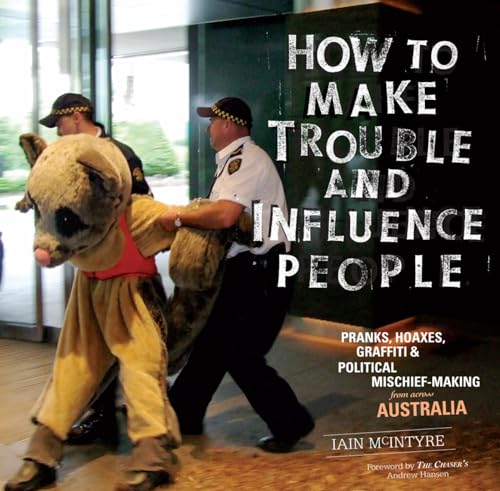
How to Make Trouble and Influence People: Pranks, Protests, Graffiti & Political Mischief-Making from across Australia - Softcover
Inhaltsangabe
This book reveals Australia’s radical past through more than 500 tales of Indigenous resistance, convict revolts and escapes, picket line hijinks, student occupations, creative direct action, street art, media pranks, urban interventions, squatting, blockades, banner drops, guerilla theatre, and billboard liberation. Twelve key Australian activists and pranksters are interviewed regarding their opposition to racism, nuclear power, war, economic exploitation, and religious conservatism via humor and creativity. Featuring more than 300 spectacular images How to Make Trouble and Influence People is an inspiring, and at times hilarious, record of resistance that will appeal to readers everywhere.
Die Inhaltsangabe kann sich auf eine andere Ausgabe dieses Titels beziehen.
Über die Autorinnen und Autoren
Iain McIntyre is a Melbourne-based author, musician, and community radio broadcaster who has written a variety of books on activism, history, and music. Recent publications include Wild About You: The Sixties Beat Explosion in Australia and New Zealand, and Tomorrow Is Today: Australia in the Psychedelic Era, 1966–70.
Andrew Hansen is a Sydney based comedian and musician, best known for being a member of satirical team The Chaser who have produced six award winning television series for Australian television.
Josh MacPhee is a designer, artist, activist, and archivist. He is a member of both the Justseeds Artists’ Cooperative (Justseeds.org) and the Occuprint collective (Occuprint.org). He is the coauthor of Signs of Change: Social Movement Cultures 1960s to Now, coeditor of Signal: A Journal of International Political Graphics & Culture, and he recently cofounded the Interference Archive, a public collection of cultural materials produced by social movements (InterferenceArchive.org).
Auszug. © Genehmigter Nachdruck. Alle Rechte vorbehalten.
How to Make Trouble and Influence People
Pranks, Protests, Graffiti & Political Mischief-Making from Across Australia
By Iain McIntyrePM Press
Copyright © 2013 Iain McIntyre
All rights reserved.
ISBN: 978-1-60486-595-0All rights reserved.
Contents
FOREWORD I: Josh MacPhee,
FOREWORD II: Andrew Hansen,
MAPS OF AUSTRALIA,
INTRODUCTION: Iain McIntyre,
MAKING TROUBLE AND INFLUENCING PEOPLE,
PRANKS, PROTESTS, GRAFFITI & POLITICAL MISCHIEF-MAKING FROM ACROSS AUSTRALIA,
1788 - 1849,
1850 - 1899,
1900 - 1945,
1946 - 1959,
1960 - 1969,
1970 - 1979,
1980 - 1989,
1990 - 1999,
2000 - 2012,
CONVERSATIONS,
Meredith Burgmann,
BUGA-UP,
John Safran,
Dave Burgess,
The Chaser,
John Howard Ladies' Auxiliary Fan Club,
Pauline Pantsdown,
Kevin Buzzacott,
Deborah Kelly,
Grevillea,
No To Pope Coalition,
Network Against Prohibition,
Order of Perpetual Indulgence,
Graffiti Games Organising Committee,
ENDNOTES,
SOURCES & FURTHER READING,
GLOSSARY OF ACRONYMS,
THANKS & BIOGRAPHIES,
ABOUT PM PRESS,
CHAPTER 1
1788-1849
Prior to the British invasion of 1788 the Australian continent had been occupied by Indigenous peoples for at least 42,000, if not 150,000 years. Living a largely nomadic lifestyle, involving gradual modification of their ecosystems through fire and selective hunting and gathering, Indigenous Australians' cultural forms and customs varied widely. Regardless of this divergence all emphasised a deep connection to the land and the intrinsic place of humans within it.
Outside of the Torres Strait Islands, which are situated between Cape York Peninsula, QLD and Papua New Guinea, most of the hundreds of Indigenous language groups and nations were organised in relatively non-hierarchal ways with power decentralised rather than centred in the hands of a few. Conflict between different communities occurred, but permanent standing armies were unknown and the annihilation of rival populations did not occur.
The first contacts with Europeans occurred from the Seventeenth Century as firstly Dutch, and then French and British, explorers and traders sought new territories to document and conquer. Most of these interactions ended in conflict, or with the local population fleeing their intruders.
Following Captain Cook's mapping of the Northern and Eastern coastlines in 1770, the British decided to set up a colony at Botany Bay in 1788. This decision was motivated by a number of factors, the most commonly cited of which was the need to establish a new penal colony in the wake of the American Revolution. The increasing urbanisation of the British populace and the impoverishment that followed the enclosure of lands, as society moved from feudalism to industrialisation, had generated major social dislocation. Minor property crimes, let alone political agitation, were dealt with harshly and, with many courts becoming less inclined to dish out the death penalty, Britain's jails and prison hulks were overflowing.
During the first eight decades of their existence the Australian colonies played host to around 160,000 convicts, 26,500 imported directly from Ireland. The decision to occupy Australia was, however, driven by more than the need to dump excess proletarians. Britain was engaged in fierce competition with the other European powers and felt the need to get in first, not least because a new colony at the bottom of the Pacific would provide a base for trade routes and naval supplies.
British law stipulated that negotiations should be entered into with the Indigenous owners of the lands they planned to annexe, but in the case of Australia the fiction of "terra nullias" was employed to void such obligations. Under this concept it was decreed that Australia was an "empty" land populated by people whose lack of European-style agriculture meant they lived only on the coast and lacked ties to any particular place. This falsehood was adhered to for the following 204 years, even though once invasion had taken place it became rapidly apparent that Indigenous groups lived in every part of the country and exerted strong claims to it. As a result Indigenous sovereignty has never been ceded and Australia remains without a treaty.
Due to the size of the continent, the colonisation of Australia took quite some time with some Indigenous peoples maintaining their traditional lifestyle into the 1960s. The initial invasion of new territories generally began with coastal enclaves. Although friction was evident, these small settlements, such as the first set up at Port Jackson (Botany Bay having proved unsuitable), were generally able to live in peace with Indigenous locals as the colonists engaged in trade and had a limited impact on the ecosystem.
Once these outposts began to expand conflict became inevitable, as Indigenous people were denied access to their lands, and the native plants and animals they relied upon were displaced by farms and stock runs. Many settlers on the frontier, some of which were dubbed "squatters" as they seized land before colonial permission had been granted, also engaged in raids of extermination and the use of poison. The occupation of sacred sites and disruption to traditional travel and customs further strained relations.
The level of Indigenous resistance which met British expansion varied according to factors such as the degree to which resident populations had been decimated by newly introduced diseases, the ability of colonial powers to deploy troopers and police in support of settlers, and the level of unity amongst Indigenous locals. The existing knowledge and capability of groups to engage in warfare and the nature of the country being fought in were also important.
Indigenous opposition creatively adapted customary forms of battle to suit new situations. As semi-nomadic peoples lacking a permanent military caste Indigenous Australians were unable to unite into large scale armies capable of carrying out conventional warfare, as had occurred in other British dominions. As a result resistance took place reactively region by region with guerrilla attacks focused upon individual farms and colonists. These involved the killing of some settlers, but primarily focused on the destruction and capture of tools, crops and stock to sustain Indigenous populations and bankrupt their opponents.
Reprisals by British authorities and settlers were sometimes limited to the warriors involved, but were generally indiscriminate. As Britain had annexed the island, Indigenous Australians were technically British citizens, but legal protections were rarely extended to them. Generally charges brought against those carrying out massacres were dismissed, either for lack of anyone left or willing to provide evidence or because, unable to swear an oath on the Bible, Indigenous people were not allowed to act as witnesses. Following the occasional case where settlers or soldiers were punished their fellow colonists became careful to ensure that no documentation or proof of their actions remained.
As the colonies became more established, and police forces were founded, the use of soldiers was phased out. From the 1840s onwards frontier police were increasingly backed by the use of "Native Troopers". These Indigenous collaborators were generally recruited from groups who had no connection, or were hostile, to those being suppressed. The use of these people's knowledge of the bush and language became...
„Über diesen Titel“ kann sich auf eine andere Ausgabe dieses Titels beziehen.
Suchergebnisse für How to Make Trouble and Influence People: Pranks, Protests,...

Beispielbild für diese ISBN
How to Make Trouble and Influence People: Pranks, Protests, Graffiti & Political Mischief-Making from across Australia
Anbieter: HPB-Diamond, Dallas, TX, USA
Verkäuferbewertung 5 von 5 Sternen

paperback. Zustand: Very Good. Connecting readers with great books since 1972! Used books may not include companion materials, and may have some shelf wear or limited writing. We ship orders daily and Customer Service is our top priority! Bestandsnummer des Verkäufers S_478938664
Gebraucht kaufen
EUR 8,97
EUR 3,27 Versand
Versand innerhalb von USA
Versand innerhalb von USA
Anzahl: 1 verfügbar
Beispielbild für diese ISBN
How to Make Trouble and Influence People: Pranks, Protests, Graffiti & Political Mischief-Making from Across Australia
Anbieter: ThriftBooks-Dallas, Dallas, TX, USA
Verkäuferbewertung 5 von 5 Sternen
Paperback. Zustand: Good. No Jacket. Pages can have notes/highlighting. Spine may show signs of wear. ~ ThriftBooks: Read More, Spend Less. Bestandsnummer des Verkäufers G1604865954I3N00
Gebraucht kaufen
EUR 12,77
Versand gratis
Versand innerhalb von USA
Versand innerhalb von USA
Anzahl: 1 verfügbar
Beispielbild für diese ISBN
How to Make Trouble and Influence People Format: Paperback
Anbieter: INDOO, Avenel, NJ, USA
Verkäuferbewertung 5 von 5 Sternen
Zustand: As New. Unread copy in mint condition. Bestandsnummer des Verkäufers PG9781604865950
Gebraucht kaufen
EUR 18,80
Versand gratis
Versand innerhalb von USA
Versand innerhalb von USA
Anzahl: 15 verfügbar
Beispielbild für diese ISBN
How to Make Trouble and Influence People Format: Paperback
Anbieter: INDOO, Avenel, NJ, USA
Verkäuferbewertung 5 von 5 Sternen
Zustand: New. Brand New. Bestandsnummer des Verkäufers 9781604865950
Foto des Verkäufers
How to Make Trouble and Influence People : Pranks, Protests, Graffiti & Political Mischief-Making from Across Australia
Anbieter: GreatBookPrices, Columbia, MD, USA
Verkäuferbewertung 5 von 5 Sternen
Zustand: New. Bestandsnummer des Verkäufers 18731501-n
Neu kaufen
EUR 21,69
EUR 2,30 Versand
Versand innerhalb von USA
Versand innerhalb von USA
Anzahl: 15 verfügbar
Foto des Verkäufers
How To Make Trouble and Influence People
Anbieter: Rarewaves USA, HEBRON, KY, USA
Verkäuferbewertung 5 von 5 Sternen
Paperback. Zustand: New. 2nd ed. Bestandsnummer des Verkäufers LU-9781604865950
Beispielbild für diese ISBN
How To Make Trouble and Influence People: Pranks, Graffiti, & Political Mischief-Making from Across Australia
Anbieter: AwesomeBooks, Wallingford, Vereinigtes Königreich
Verkäuferbewertung 5 von 5 Sternen
Paperback. Zustand: Very Good. How To Make Trouble and Influence People: Pranks, Graffiti, & Political Mischief-Making from Across Australia This book is in very good condition and will be shipped within 24 hours of ordering. The cover may have some limited signs of wear but the pages are clean, intact and the spine remains undamaged. This book has clearly been well maintained and looked after thus far. Money back guarantee if you are not satisfied. See all our books here, order more than 1 book and get discounted shipping. . Bestandsnummer des Verkäufers 7719-9781604865950
Gebraucht kaufen
EUR 21,41
EUR 4,81 Versand
Versand von Vereinigtes Königreich nach USA
Versand von Vereinigtes Königreich nach USA
Anzahl: 1 verfügbar
Beispielbild für diese ISBN
How to Make Trouble and Influence People: Pranks, Protests, Graffiti & Political Mischief-Making from Across Australia
Anbieter: Earthlight Books, Walla Walla, WA, USA
Verkäuferbewertung 4 von 5 Sternen

Paperback. Zustand: New. Brand New; satisfaction guaranteed. Trade paperback binding. This book reveals Australia?s radical past through more than 500 tales of Indigenous resistance, convict revolts and escapes, picket line hijinks, student occupations, creative direct action, street art, media pranks, urban interventions, squatting, blockades, banner drops, guerilla theatre, and billboard liberation. Twelve key Australian activists and pranksters are interviewed regarding their opposition to racism, nuclear power, war, economic exploitation, and religious conservatism via humor and creativity. Featuring more than 300 spectacular images How to Make Trouble and Influence People is an inspiring, and at times hilarious, record of resistance that will appeal to readers everywhere. Bestandsnummer des Verkäufers SKU11130348
Neu kaufen
EUR 22,41
EUR 4,14 Versand
Versand innerhalb von USA
Versand innerhalb von USA
Anzahl: 10 verfügbar
Foto des Verkäufers
How to Make Trouble and Influence People : Pranks, Protests, Graffiti & Political Mischief-Making from Across Australia
Anbieter: GreatBookPrices, Columbia, MD, USA
Verkäuferbewertung 5 von 5 Sternen
Zustand: As New. Unread book in perfect condition. Bestandsnummer des Verkäufers 18731501
Gebraucht kaufen
EUR 24,51
EUR 2,30 Versand
Versand innerhalb von USA
Versand innerhalb von USA
Anzahl: 15 verfügbar
Beispielbild für diese ISBN
How To Make Trouble and Influence People: Pranks, Graffiti, & Political Mischief-Making from Across Australia
Anbieter: Bahamut Media, Reading, Vereinigtes Königreich
Verkäuferbewertung 5 von 5 Sternen
Paperback. Zustand: Very Good. Shipped within 24 hours from our UK warehouse. Clean, undamaged book with no damage to pages and minimal wear to the cover. Spine still tight, in very good condition. Remember if you are not happy, you are covered by our 100% money back guarantee. Bestandsnummer des Verkäufers 6545-9781604865950
Gebraucht kaufen
EUR 21,41
EUR 8,14 Versand
Versand von Vereinigtes Königreich nach USA
Versand von Vereinigtes Königreich nach USA
Anzahl: 1 verfügbar