
Verwandte Artikel zu Walk Out Walk On: A Learning Journey into Communities...
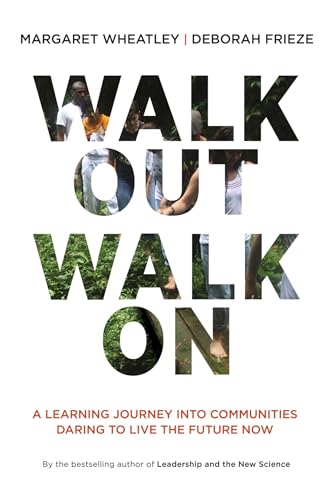
Walk Out Walk On: A Learning Journey into Communities Daring to Live the Future Now (Currents) - Softcover
Inhaltsangabe
In this era of increasingly complex problems and shrinking resources, can we find meaningful and enduring solutions to the challenges we face today as individuals, communities, and nations?
In Walk Out Walk On, we invite you on a learning journey to seven communities around the world to meet people who have walked out of limiting beliefs and assumptions and walked on to create healthy and resilient communities. These Walk Outs who Walk On use their ingenuity and caring to figure out how to work with what they have to create what they need.
From Mexico to India, from Columbus, Ohio to Johannesburg, South Africa, we discover that all communities have the intelligence and inventiveness to solve their seemingly insolvable problems. “We discovered a gift inside ourselves,” one Brazilian said, “something that was already there.”
Die Inhaltsangabe kann sich auf eine andere Ausgabe dieses Titels beziehen.
Über die Autorin bzw. den Autor
Margaret Wheatley cofounded and led the Berkana Institute, a global foundation that partners with people developing healthy and resilient communities. Margaret is the author of five other books, including Leadership and the New Science and Perseverance.
Deborah Frieze succeeded her. Berkana partners with people developing healthy and resilient communities worldwide, many of whom are described in this book.
Auszug. © Genehmigter Nachdruck. Alle Rechte vorbehalten.
LEAVING HOME
This is the setting out.
The leaving of everything behind.
Leaving the social milieu. The preconceptions.
The definitions. The language.
The narrowed field of vision. The expectations.
No longer expecting relationships, memories, words,
or letters to mean what they used to mean.
To be, in a word: Open.
—Rabbi Lawrence Kushner
This book takes you on a Learning Journey to places that will inspire, disturb, and provoke you, and to meet people who will delight, nourish, and encourage you. We’re glad that you’ve joined us. We visit seven communities around the world, seven very different cultures, all of which are experimenting with what it means to live the future now. We, the authors, are intimately connected with each of these communities; we’ve worked alongside them for several years and been transformed by these experiences and relationships.
Our journey takes us to Mexico, Brazil, South Africa, Zimbabwe, India, Greece, and the United States. In each community, we’ll experience firsthand what’s possible when we change our beliefs about what people are capable of and how change happens. We’ll witness communities that rely on everyone to be an entrepreneur, a leader, an artist. These communities trust that these are common human traits, not limited to a few gifted people. We’ll meet people who use their ingenuity and caring to figure out how to work with what they have to create what they need.
And as we move from community to community, we’ll explore the deeper patterns that link them together, diverse as they are. We’ll see how change happens through self-organized efforts that then move across the planet through networks of relationship. We’ll see that lasting change doesn’t start from the top of a system, but from deep inside it, when people step forward to solve a problem, then move on to the next issue that needs addressing. We’ll see how much becomes possible when we abandon hope of being saved by the perfect leader or the perfect program, and instead look inside our community to notice that the resources and wisdom we need are already here.
In every community, you’ll meet the Walk Outs Who Walk On. Perhaps you’ll recognize yourself in some of them.
WALK OUTS WHO WALK ON
Walk Outs are people who bravely choose to leave behind situations, jobs, relationships, and ideas that restrict and confine them, anything that inhibits them. They walk on to the ideas, people, and practices that enable them to explore and discover new gifts, new possibilities.
We learned the phrase “Walks Outs Who Walk On” from our friends in India. They had created a network of young people who chose to leave school. They didn’t consider themselves “dropouts,” a negative label assigned to them by the school system. They left school because they wanted to be learners, not passive students. They walked on to discover many ways they could contribute to creating change in their world.1
Although the phrase may be new to you, think about situations in your life that you’ve consciously chosen to leave because you knew that to stay any longer would limit you. Whenever we choose to leave behind what confines us, whenever we courageously step forward to discover new capacities, then we can rightfully call ourselves Walk Outs Who Walk On.
The people you meet on this journey have walked out of a world of unsolvable problems, scarce resources, limiting beliefs, and destructive individualism. They’ve walked on to beliefs and practices that solve problems and reveal abundant resources. They’ve created communities where everyone is welcome to learn, grow, and contribute. They’ve walked out of the greed and grasping of this time, where many individuals try to get as much as they can, and walked on to discover how to create what they need with what they have. And while we visit only seven communities on this journey, there are millions more people like them throughout the world.
When people and communities walk out, they discover they’re more gifted and wiser than they believed or had been told, that working together—even in the harshest circumstances—can be joyful, that they can invent solutions to problems that others have declared unsolvable. These communities are creating meaningful change in some of the most difficult political, social, and economic circumstances. They may have little money, few trustworthy formal leaders, and minimal material resources. They may have been told they’re “backward” or don’t possess the requisite expertise to solve their own problems. Had they accepted current thinking, they would have sat back and waited passively for help to come from the outside—from experts, foreign aid, heroic leaders.
But instead, they walked out. They had the good sense not to buy into these paralyzing beliefs about themselves and how change happens. They walked on to discover that the wisdom and wealth they need resides in themselves—in everyday people, their cultural traditions and their environment. They’ve used this wisdom and wealth to conduct bold experiments in how to create healthy and resilient communities where all people matter, all people can contribute. Their creativity and hard work make it easier for us to see that a different world is possible.
WHY WE VISIT THESE COMMUNITIES
Margaret (Meg) and Deborah, as your hosts for this Learning Journey, are taking you to meet people and communities we’ve partnered with for several years through our work with The Berkana Institute.2 There are many, many other places worthy of visiting, but these are the ones we know well, that we’re most intimate with. We’re taking you to meet our friends, people with whom we’ve worked, danced, argued, cried, laughed, consoled, celebrated, and loved. Together, we’ve explored how self-organization and change happen, we’ve learned to trust the illimitable power of community, and we’ve come to realize how important our heritage and cultural traditions are.
Not only do we know these people as friends, but they also know each other well. For several years now, they’ve worked and learned together, visited one another’s communities, shared their discoveries and dilemmas, and gathered annually as a learning community. As we visit each community, you may notice how they weave through each other’s lives, how they support each other in deep friendship.
Your experience with these people and communities doesn’t have to end with this book. We’ve created www.walkoutwalkon.net where you can watch videos, hear interviews, and keep informed about where these communities and people are now. Learn more about the Walk Out Walk On website on p. 260.)
YOUR HOSTS (THE AUTHORS)
Deborah has partnered with each one of these communities since 2004. She’s led Learning Journeys to Mexico, Brazil, South Africa, and Zimbabwe. In this book, she’s written each of the seven visits, wanting you to experience what it feels like to be there, getting to know these communities and their pioneering work. All of these relationships were developed through the Berkana Exchange (an initiative of The Berkana Institute), a community of friends and a community of practice that has worked together over several years and that continues to actively engage and support one another. The people Deborah writes about have become her extended family, an intimate learning community that is inventing new solutions to the issues she cares about most—such as food security, ecological sustainability, and economic self-reliance.
image
Meg...
„Über diesen Titel“ kann sich auf eine andere Ausgabe dieses Titels beziehen.
Suchergebnisse für Walk Out Walk On: A Learning Journey into Communities...

Foto des Verkäufers
Walk Out Walk On: A Learning Journey into Communities Daring to Live the Future Now (Currents)
Verlag:
Berrett-Koehler Publishers, 2011
ISBN 10: 1605097314
ISBN 13: 9781605097312
Gebraucht
Softcover
Anbieter: Dream Books Co., Denver, CO, USA
Verkäuferbewertung 5 von 5 Sternen

Zustand: good. Gently used with minimal wear on the corners and cover. A few pages may contain light highlighting or writing, but the text remains fully legible. Dust jacket may be missing, and supplemental materials like CDs or codes may not be included. May be ex-library with library markings. Ships promptly! Bestandsnummer des Verkäufers 4EKGU9006DWG_ns
Gebraucht kaufen
EUR 3,89
Versand gratis
Versand innerhalb von USA
Versand innerhalb von USA
Anzahl: 2 verfügbar
Foto des Verkäufers
Walk Out Walk On: A Learning Journey into Communities Daring to Live the Future Now (Currents)
Verlag:
Berrett-Koehler Publishers, 2011
ISBN 10: 1605097314
ISBN 13: 9781605097312
Gebraucht
Softcover
Anbieter: Zoom Books East, Glendale Heights, IL, USA
Verkäuferbewertung 5 von 5 Sternen
Zustand: good. Book is in good condition and may include underlining highlighting and minimal wear. The book can also include "From the library of" labels. May not contain miscellaneous items toys, dvds, etc. . We offer 100% money back guarantee and 24 7 customer service. Bestandsnummer des Verkäufers ZEV.1605097314.G
Gebraucht kaufen
EUR 4,06
Versand gratis
Versand innerhalb von USA
Versand innerhalb von USA
Anzahl: 2 verfügbar
Foto des Verkäufers
Walk Out Walk On: A Learning Journey into Communities Daring to Live the Future Now (Currents)
Verlag:
Berrett-Koehler Publishers, 2011
ISBN 10: 1605097314
ISBN 13: 9781605097312
Gebraucht
Softcover
Anbieter: Zoom Books Company, Lynden, WA, USA
Verkäuferbewertung 5 von 5 Sternen
Zustand: very_good. Book is in very good condition and may include minimal underlining highlighting. The book can also include "From the library of" labels. May not contain miscellaneous items toys, dvds, etc. . We offer 100% money back guarantee and 24 7 customer service. Bestandsnummer des Verkäufers ZBV.1605097314.VG
Gebraucht kaufen
EUR 4,06
Versand gratis
Versand innerhalb von USA
Versand innerhalb von USA
Anzahl: 3 verfügbar
Beispielbild für diese ISBN
Walk Out Walk On: A Learning Journey into Communities Daring to Live the Future Now (Currents)
Verlag:
Berrett-Koehler Publishers (edition 1), 2011
ISBN 10: 1605097314
ISBN 13: 9781605097312
Gebraucht
Paperback
Anbieter: BooksRun, Philadelphia, PA, USA
Verkäuferbewertung 5 von 5 Sternen
Paperback. Zustand: Very Good. 1. It's a well-cared-for item that has seen limited use. The item may show minor signs of wear. All the text is legible, with all pages included. It may have slight markings and/or highlighting. Bestandsnummer des Verkäufers 1605097314-11-1
Gebraucht kaufen
EUR 5,36
Versand gratis
Versand innerhalb von USA
Versand innerhalb von USA
Anzahl: 1 verfügbar
Beispielbild für diese ISBN
Walk Out Walk On: A Learning Journey into Communities Daring to Live the Future Now
Verlag:
Berrett-Koehler Publishers, 2011
ISBN 10: 1605097314
ISBN 13: 9781605097312
Gebraucht
Softcover
Anbieter: World of Books (was SecondSale), Montgomery, IL, USA
Verkäuferbewertung 5 von 5 Sternen
Zustand: Very Good. Item in very good condition! Textbooks may not include supplemental items i.e. CDs, access codes etc. Bestandsnummer des Verkäufers 00109515166
Gebraucht kaufen
EUR 5,53
Versand gratis
Versand innerhalb von USA
Versand innerhalb von USA
Anzahl: 1 verfügbar
Beispielbild für diese ISBN
Walk Out Walk On: A Learning Journey into Communities Daring to Live the Future Now
Verlag:
Berrett-Koehler Publishers, 2011
ISBN 10: 1605097314
ISBN 13: 9781605097312
Gebraucht
Softcover
Anbieter: World of Books (was SecondSale), Montgomery, IL, USA
Verkäuferbewertung 5 von 5 Sternen
Zustand: Good. Item in good condition. Textbooks may not include supplemental items i.e. CDs, access codes etc. Bestandsnummer des Verkäufers 00096522815
Gebraucht kaufen
EUR 5,53
Versand gratis
Versand innerhalb von USA
Versand innerhalb von USA
Anzahl: 8 verfügbar
Beispielbild für diese ISBN
Walk Out Walk On: A Learning Journey into Communities Daring to Live the Future Now
Anbieter: World of Books (was SecondSale), Montgomery, IL, USA
Verkäuferbewertung 5 von 5 Sternen
Paperback. Zustand: Fair. In this era of increasingly complex problems and shrinking resources, can we find meaningful and enduring solutions to the challenges we face today as individuals, communities, and nations? In Walk Out Walk On, we invite you on a learning journey to seven communities around the world to meet people who have walked out of limiting beliefs and assumptions and walked on to create healthy and resilient communities. These Walk Outs who Walk On use their ingenuity and caring to figure out how to work with what they have to create what they need. From Mexico to India, from Columbus, Ohio to Johannesburg, South Africa, we discover that all communities have the intelligence and inventiveness to solve their seemingly insolvable problems. "We discovered a gift inside ourselves," one Brazilian said, "something that was already there.". Bestandsnummer des Verkäufers CIN1605097314A
Gebraucht kaufen
EUR 5,53
Versand gratis
Versand innerhalb von USA
Versand innerhalb von USA
Anzahl: 1 verfügbar
Beispielbild für diese ISBN
Walk Out Walk On: A Learning Journey into Communities Daring to Live the Future Now
Verlag:
Berrett-Koehler Publishers, 2011
ISBN 10: 1605097314
ISBN 13: 9781605097312
Gebraucht
Paperback
Anbieter: Half Price Books Inc., Dallas, TX, USA
Verkäuferbewertung 5 von 5 Sternen
Paperback. Zustand: Very Good. Connecting readers with great books since 1972! Used books may not include companion materials, and may have some shelf wear or limited writing. We ship orders daily and Customer Service is our top priority! Bestandsnummer des Verkäufers S_424172975
Gebraucht kaufen
EUR 2,38
EUR 3,35 Versand
Versand innerhalb von USA
Versand innerhalb von USA
Anzahl: 1 verfügbar
Beispielbild für diese ISBN
Walk Out Walk On: A Learning Journey into Communities Daring to Live the Future Now (Currents)
Verlag:
Berrett-Koehler Publishers, 2011
ISBN 10: 1605097314
ISBN 13: 9781605097312
Gebraucht
paperback
Anbieter: Evergreen Goodwill, Seattle, WA, USA
Verkäuferbewertung 5 von 5 Sternen
paperback. Zustand: Good. Bestandsnummer des Verkäufers mon0000519999
Gebraucht kaufen
EUR 2,30
EUR 3,56 Versand
Versand innerhalb von USA
Versand innerhalb von USA
Anzahl: 1 verfügbar
Beispielbild für diese ISBN
Walk Out Walk on: A Learning Journey Into Communities Daring to Live the Future Now
Verlag:
Berrett-Koehler Publishers, 2011
ISBN 10: 1605097314
ISBN 13: 9781605097312
Gebraucht
Paperback
Anbieter: ThriftBooks-Dallas, Dallas, TX, USA
Verkäuferbewertung 5 von 5 Sternen
Paperback. Zustand: Very Good. No Jacket. May have limited writing in cover pages. Pages are unmarked. ~ ThriftBooks: Read More, Spend Less. Bestandsnummer des Verkäufers G1605097314I4N00
Gebraucht kaufen
EUR 5,96
Versand gratis
Versand innerhalb von USA
Versand innerhalb von USA
Anzahl: 1 verfügbar