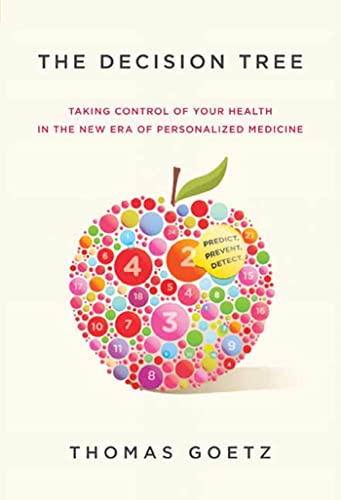
The Decision Tree: Taking Control of Your Health in the New Era of Personalized Medicine - Hardcover
Inhaltsangabe
In The Decision Tree, Thomas Goetz proposes a new strategy for thinking about health, one that applies cutting-edge technology and sound science to put us at the center of the equation. An individual's Decision Tree begins with genomics, where $400 and a test tube of spit provides a peek at how your DNA influences your health. It taps self-monitoring and collaborative health tools, where iPhone applications and next-generation monitoring gadgets can help individuals successfully change their behavior, once and for all. And it turns to new screening techniques that detect diseases like cancer and diabetes far earlier and with far better prospects for our health. Full of thoughtful, groundbreaking reporting on the impact personalized medicine will have on the average patient, The Decision Tree will show you how to take advantage of this new frontier in health care.
Die Inhaltsangabe kann sich auf eine andere Ausgabe dieses Titels beziehen.
Über die Autorin bzw. den Autor
THOMAS GOETZ is the executive editor of WIRED magazine, where he has written several cover stories, and a frequent contributor to the New York Times Magazine. He holds a masters in public health.
Auszug. © Genehmigter Nachdruck. Alle Rechte vorbehalten.
1
Living by Numbers
How a Lot of Science and a Little Self-Awareness Can Give You Control of Your Health
I.
AVIATION HAS KITTY HAWK. Biology has the Galapagos Islands. And medicine, or more specifically preventive medicine, has Framingham, Massachusetts.
A small city of 65,000 people about 20 miles due west of Boston, Framingham appears at first an indistinct patch of New England suburbia. Take Exit 13 off the Massachusetts Turnpike, and you'll drive past the usual temples of American sprawl: a Shopper's World shopping center (among the first malls built in the United States), a Super Stop & Shop grocery store, and a Lowe's, all built in the same squat, stuccoed style and painted in the same tan-to-taupe palette that characterizes the rest of American consumerland. As you drive along Highway 9 toward Framingham's center, it's easy to miss the original town. Even the arrow on the sign that points toward "Downtown Framingham" makes only a half-hearted gesture in the right direction, as if it can't decide whether or not to recommend the place. But make the turn, and the town starts to hint at its more dignified origins; pass the requisite Revolutionary War statue, and you'll reach the stately brick and stone buildings of what must have once been a thriving town center. These days, though, like many neglected downtowns outdone by the interstate, Framingham's center is dotted with empty storefronts and tinged with sad neglect.
None of this hints at why Framingham actually matters. In the years after World War II, when the town was a far smaller place with a population of just around 28,000, Framingham became the epicenter of what would become one of the great experiments in medicine--an experiment that is still running quietly today. In 1948, the National Heart Institute chose Framingham as the place that would reveal the causes of heart disease.
At the time, the idea of studying a disease by studying a population was an altogether novel concept, and an urgent one. In the first decades of the 20th century, most infectious diseases were eliminated from the United States and other industrialized nations. Cholera, diphtheria, typhoid, malaria, tuberculosis--all the diseases that had plagued mankind for centuries were largely banished from our shores as vaccines, antibiotics, and sanitation did their work. The result was profound: The average life span for an American male increased from 46 years in 1900 to 61 by 1940, while the average for women increased from 48 to 65.
But as remarkable as the elimination of infectious disease was, it didn't eliminate disease entirely. In fact, it revealed a new, unknown sort of disease, one that seemed to fester beneath the surface until it struck. A stunning 36 percent of Americans died of just two conditions in 1940: heart disease and stroke. But unlike with tuberculosis, it wasn't possible to lay the blame on a single pathogen. Medicine in postwar America had almost no idea what caused heart attacks or strokes or the other fatal events related to heart disease. They just happened. It was as if by eliminating epidemics of infectious diseases, medicine had unwittingly allowed new epidemics to kill thousands of other people.
By singling out Framingham, the National Heart Institute (known today as the National Heart, Lung, and Blood Institute) was taking a bold step: It would investigate heart disease as thoroughly, ambitiously, and successfully as the nation had fought World War II. Framingham then was just as much an Everytown, USA, as it is today. It had a mix of ethnic backgrounds: Irish, Greek, Polish, Italian. Its inhabitants smoked, worked in factories (GM opened a new plant in town in 1948), and, like other Americans, considered meat and potatoes a balanced diet. And when television came to town in 1948, they began to watch TV as well. They were, in other words, entirely typical citizens of postwar America.
The Framingham Heart Study, as it's called, began by recruiting as many townspeople as possible until it had enrolled 5,209 citizens--half of all of Framingham's adults, and nearly 20 percent of the total population. These citizens filled out a long questionnaire about their lifestyle, habits, and health; they tried to remember what their parents and grandparents had died of. They stripped down to their underwear and were given a thorough physical, including measuring their blood pressure and their lung capacity. A blood sample was taken and sent to the lab for tests. And every 2 years, these 5,209 citizens were called back for more poking, prodding, and reevaluation. The study has continued ever since. In 1971, it expanded to begin tracking a second generation of Framingham citizens--5,124 sons and daughters and their spouses of the original subjects. And in 2002, a third generation was signed up, 4,095 grandchildren. In Framingham, being one of the cohort is a point of family pride.
The size, ambition, and duration of the Framingham study--calling on thousands of townspeople and tracking them and their children and their children's children for more than 60 years--makes Framingham not an Everytown at all, but an exceptional experiment in science. The resulting pool of data has yielded insights into the human condition that were, prior to the study, entirely mysterious. The Framingham data have led to more than 1,200 published research papers, science that has broken ground on cholesterol and smoking and heart failure. It's because of Framingham that we know cigarettes increase the risk of heart disease. It's because of Framingham that we know high blood pressure can lead to stroke. And if not for Framingham, we'd have no idea that some cholesterol is good for you and some is bad. And it's not just heart disease. The Framingham data have been used to study osteoporosis, breast cancer, Alzheimer's disease, arthritis-- even sleep and happiness.
Most of all, Framingham, more than any other piece of research, has created the concept of health risks, the idea that behind every chronic disease lies a certain chance of developing that disease. It has given us the idea that we can and should anticipate disease, and that we might be able to identify what leads to chronic disease just as we try to identify the bacteria or pathogens that lead to infectious diseases. Indeed, the very term risk factors comes out of Framingham. Blood pressure, body mass index, cholesterol, triglyceride level--all these metrics today reflect the essential research gathered in the Framingham study.
This concept of risk is integral to the way our society tries to improve health. On a population level, reducing risk is the cornerstone of public health, and in your doctor's office, identifying individual risk factors is the backbone of preventive care. The study has changed not only our understanding of heart disease but also our understanding of how science should be practiced. The Framingham approach--population research--is now standard practice in public health, the basic framework of the science of epidemiology.
The Framingham Heart Study itself is run out of a building about a mile from downtown, a squat, two-level complex painted in the same shade of taupe as the malls near the freeway. Aside from that building, the only public acknowledgments of the town's significance are street signs posted here and there that hail Framingham as the Town That Changed America's Heart. But it's no exaggeration to add that it's the town that changed our concept of health as well.
IT'S A PLEASANT SPRING EVENING in San Francisco, and a group of supremely self-obsessed people has gathered in a downtown office to compare notes-- very, very specific and thorough notes. This group tracks pretty much anything and everything that one can imagine measuring, counting, or calculating about the human body. Blood pressure, weight, exercise, sleep, mood,...
„Über diesen Titel“ kann sich auf eine andere Ausgabe dieses Titels beziehen.
Weitere beliebte Ausgaben desselben Titels

Suchergebnisse für The Decision Tree: Taking Control of Your Health in...

Beispielbild für diese ISBN
The Decision Tree: Taking Control of Your Health in the New Era of Personalized Medicine
Anbieter: World of Books (was SecondSale), Montgomery, IL, USA
Verkäuferbewertung 5 von 5 Sternen

Zustand: Good. Item in good condition. Textbooks may not include supplemental items i.e. CDs, access codes etc. Bestandsnummer des Verkäufers 00086463175
Beispielbild für diese ISBN
The Decision Tree: Taking Control of Your Health in the New Era of Personalized Medicine
Anbieter: World of Books (was SecondSale), Montgomery, IL, USA
Verkäuferbewertung 5 von 5 Sternen
Zustand: Very Good. Item in very good condition! Textbooks may not include supplemental items i.e. CDs, access codes etc. Bestandsnummer des Verkäufers 00085593652
Beispielbild für diese ISBN
The Decision Tree: Taking Control of Your Health in the New Era of Personalized Medicine
Anbieter: Wonder Book, Frederick, MD, USA
Verkäuferbewertung 5 von 5 Sternen
Zustand: Very Good. Very Good condition. Very Good dust jacket. A copy that may have a few cosmetic defects. May also contain light spine creasing or a few markings such as an owner's name, short gifter's inscription or light stamp. Bestandsnummer des Verkäufers K03N-00615
Beispielbild für diese ISBN
The Decision Tree: Taking Control of Your Health in the New Era of Personalized Medicine
Anbieter: Wonder Book, Frederick, MD, USA
Verkäuferbewertung 5 von 5 Sternen
Zustand: Very Good. Signed Copy . Very Good dust jacket. Inscribed by author on title page. Bestandsnummer des Verkäufers W00OS-00693
Beispielbild für diese ISBN
The Decision Tree: Taking Control of Your Health in the New Era of Personalized Medicine
Anbieter: ThriftBooks-Dallas, Dallas, TX, USA
Verkäuferbewertung 5 von 5 Sternen
Hardcover. Zustand: Very Good. No Jacket. Former library book; May have limited writing in cover pages. Pages are unmarked. ~ ThriftBooks: Read More, Spend Less. Bestandsnummer des Verkäufers G1605297291I4N10
Beispielbild für diese ISBN
The Decision Tree : Taking Control of Your Health in the New Era of Personalized Medicine
Anbieter: Better World Books, Mishawaka, IN, USA
Verkäuferbewertung 5 von 5 Sternen
Zustand: Very Good. Former library book; may include library markings. Used book that is in excellent condition. May show signs of wear or have minor defects. Bestandsnummer des Verkäufers GRP62125384
Foto des Verkäufers
The Decision Tree: Taking Control of Your Health in the New Era of Personalized Medicine
Anbieter: Goodwill Books, Hillsboro, OR, USA
Verkäuferbewertung 5 von 5 Sternen
Zustand: good. Signs of wear and consistent use. Bestandsnummer des Verkäufers 3IIT2J002E98_ns
Beispielbild für diese ISBN
The Decision Tree: Taking Control of Your Health in the New Era of Personalized Medicine
Anbieter: WorldofBooks, Goring-By-Sea, WS, Vereinigtes Königreich
Verkäuferbewertung 5 von 5 Sternen
Paperback. Zustand: Very Good. The book has been read, but is in excellent condition. Pages are intact and not marred by notes or highlighting. The spine remains undamaged. Bestandsnummer des Verkäufers GOR004881910
Gebraucht kaufen
EUR 2,59
Versand:
EUR 6,39
Von Vereinigtes Königreich nach USA
Anzahl: 1 verfügbar
Foto des Verkäufers
The Decision Tree: Taking Control of Your Health in the New Era of Personalized Medicine
Anbieter: BoundlessBookstore, Wallingford, Vereinigtes Königreich
Verkäuferbewertung 5 von 5 Sternen
Zustand: Very Good. 1st printing. VG condition book with dust jacket. DJ is clean, has fresh colours and has little wear to edges. Book has clean and bright contents. Bestandsnummer des Verkäufers 9999-9996116242
Gebraucht kaufen
EUR 3,53
Versand:
EUR 7,97
Von Vereinigtes Königreich nach USA
Anzahl: 1 verfügbar
Beispielbild für diese ISBN
The Decision Tree: Taking Control of Your Health
Anbieter: Top Notch Books, Tolar, TX, USA
Verkäuferbewertung 5 von 5 Sternen
Hard Cover. Zustand: Very Good. Zustand des Schutzumschlags: Very Good. First Printing. Jacket has light edgewear. Boards have minor shelfwear. Pages are clean, text has no markings, binding is sound. Size: 8vo - 7¾" - 9¾" Tall. Bestandsnummer des Verkäufers 213679E