
Verwandte Artikel zu The Mindful Path to Self-Compassion: Freeing Yourself...
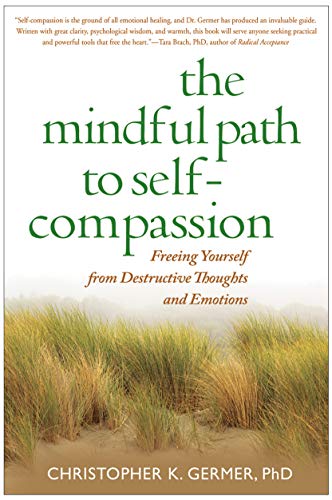
The Mindful Path to Self-Compassion: Freeing Yourself from Destructive Thoughts and Emotions - Hardcover
Inhaltsangabe
“Buck up.” “Stop feeling sorry for yourself.” “Don’t ruin everything.” When you are anxious, sad, angry, or lonely, do you hear this self-critical voice? What would happen if, instead of fighting difficult emotions, we accepted them? Over his decades of experience as a therapist and mindfulness meditation practitioner, Dr. Christopher Germer has learned a paradoxical lesson: We all want to avoid pain, but letting it in--and responding compassionately to our own imperfections, without judgment or self-blame--are essential steps on the path to healing. This wise and eloquent book illuminates the power of self-compassion and offers creative, scientifically grounded strategies for putting it into action. Free audio downloads of the meditation exercises are available at the author's website: www.chrisgermer.com.
See also The Mindful Self-Compassion Workbook, by Kristin Neff and Christopher Germer, which provides step-by-step guidance for building mindful self-compassion skills and applying them to specific life challenges, and Teaching the Mindful Self-Compassion Program, by Christopher Germer and Kristin Neff (for professionals).
Association for Behavioral and Cognitive Therapies (ABCT) Self-Help Book of Merit
See also The Mindful Self-Compassion Workbook, by Kristin Neff and Christopher Germer, which provides step-by-step guidance for building mindful self-compassion skills and applying them to specific life challenges, and Teaching the Mindful Self-Compassion Program, by Christopher Germer and Kristin Neff (for professionals).
Association for Behavioral and Cognitive Therapies (ABCT) Self-Help Book of Merit
Die Inhaltsangabe kann sich auf eine andere Ausgabe dieses Titels beziehen.
Über die Autorinnen und Autoren
Christopher Germer, PhD, has a private practice in mindfulness- and compassion-based psychotherapy in Arlington, Massachusetts, and is a part-time Lecturer on Psychiatry at Harvard Medical School/Cambridge Health Alliance. He is a founding faculty member of the Institute for Meditation and Psychotherapy and of the Center for Mindfulness and Compassion. His books include The Mindful Self-Compassion Workbook and The Mindful Path to Self-Compassion (for the general public) and Teaching the Mindful Self-Compassion Program, Wisdom and Compassion in Psychotherapy, and Mindfulness and Psychotherapy, Second Edition (for professionals). Dr. Germer lectures and leads workshops internationally. His website is https://chrisgermer.com.
Christopher Germer, PhD, has a private practice in mindfulness- and compassion-based psychotherapy in Arlington, Massachusetts, and is a part-time Lecturer on Psychiatry at Harvard Medical School/Cambridge Health Alliance. He is a founding faculty member of the Institute for Meditation and Psychotherapy and of the Center for Mindfulness and Compassion. His books include The Mindful Self-Compassion Workbook and The Mindful Path to Self-Compassion (for the general public) and Teaching the Mindful Self-Compassion Program, Wisdom and Compassion in Psychotherapy, and Mindfulness and Psychotherapy, Second Edition (for professionals). Dr. Germer lectures and leads workshops internationally. His website is https://chrisgermer.com.
Auszug. © Genehmigter Nachdruck. Alle Rechte vorbehalten.
The Mindful Path to Self-Compassion
Freeing Yourself from Destructive Thoughts and Emotions
By Christopher K. GermerThe Guilford Press
Copyright © 2009 The Guilford Press
All rights reserved.
ISBN: 978-1-60623-284-2All rights reserved.
Contents
Cover,
Title Page,
Copyright,
Dedication,
foreword,
acknowledgments,
introduction,
Part I discovering self-compassion,
1. being kind to yourself,
2. listening to your body,
3. bringing in difficult emotions,
4. what's self-compassion?,
5. pathways to self-compassion,
Part II practicing loving-kindness,
6. caring for ourselves,
7. caring for others,
Part III customizing self-compassion,
8. finding your balance,
9. making progress,
Appendix A. emotion words,
Appendix B. additional self-compassion exercises,
Appendix C. further reading and practice,
notes,
index,
about the author,
About Guilford Publications,
From the Publisher,
CHAPTER 1
being kind to yourself
The suffering itself is not so bad; it's the resentment against suffering that is the real pain.
—Allen Ginsberg, poet
"I'm afraid of what you're about to tell me, 'cause it probably won't work!" Michelle blurted out, fully expecting to be disappointed by what I had to say. Michelle had just finished telling me about her years of struggle with shyness, and I was taking a deep breath.
Michelle struck me as an exceptionally bright and conscientious person. She had read many books on overcoming shyness and tried therapy four times. She didn't want to be let down again. She'd recently received an MBA from a prestigious university and gotten a job as a consultant to large firms in the area. The main problem for Michelle was blushing. She believed it signaled to others that she wasn't competent and that they shouldn't trust what she had to say. The more she worried about blushing, the more she actually blushed in front of others. Her new job was an important career opportunity, and Michelle didn't want to blow it.
I assured Michelle that she was right: whatever I suggested wouldn't work. That's not because she was a lost cause—far from it—but rather because all well-intentioned strategies are destined to fail. It's not the fault of the techniques, nor is it the fault of the person who wants to feel better. The problem lies in our motivation and in a misunderstanding of how the mind works.
As Michelle knew only too well from her years of struggle, a lot of what we do to not feel bad is likely to make us feel worse. It's like that thought experiment: "Try not to think about pink elephants—the kind that are very large and very pink." Once an idea is planted in our minds, it's strengthened every time we try not to think about it. Sigmund Freud summed up the problem by saying there's "no negation" in the unconscious mind. Similarly, whatever we throw at our distress to make it go away—relaxation techniques, blocking our thoughts, positive affirmations—will ultimately disappoint, and we'll have no choice but to set off to find another option to feel better.
While we were discussing these matters, Michelle began to weep gently. I wasn't sure whether she was feeling more disheartened or in some way the truth of her experience was being articulated. She told me that even her prayers were going unanswered. We talked about two types of prayers: the kind where we want God to make bad things go away and the kind where we surrender—"Let go and let God." Michelle said it had never occurred to her to surrender her troubles to God. That wasn't her style.
Gradually we came around to what could be done for Michelle that might actually decrease her anxiety and blushing—not deep breathing, not pinching herself, not drinking cold water, not pretending to be unflappable. Since Michelle wasn't the kind of person to relax her efforts, she needed to find something entirely different. Michelle recognized that her anxiety decreased the more she accepted it, and it increased the less she accepted it. Hence, it made sense to Michelle to dedicate herself to a life of accepting anxiety and the fact that she was simply an anxious person. Our therapy was to be measured not by how often she blushed, but by how accepting she was of her blushing. That was a radical new idea for Michelle. She left our first session elated, if a bit perplexed.
She sent me an e-mail during the following week, happily announcing that "it worked." Since we hadn't discussed any new practices, I wasn't sure what Michelle meant. Later I learned that she had begun saying to herself "just scared, just scared" whenever she noticed she was anxious. Labeling her fear seemed to take Michelle's mind off how flushed her face felt, and she was able to chat briefly with colleagues in the lunchroom without incident, for example. She was relieved to feel more like "a scared person getting lunch" than like a "weak, overly sensitive, ridiculous person who didn't know what she was talking about." I marveled at how Michelle had taken the concept of "acceptance" and invented a useful technique in such a short time.
At our next meeting, however, Michelle was discouraged again. Her forays into the lunchroom once again became a battle against the blush. Her original wish to "stop looking anxious" reasserted itself. Acceptance had begun to "work" for Michelle, but she'd let go of her newfound commitment to cultivate acceptance. She mistakenly believed she'd found a clever bypass to her problem.
Unfortunately, we can't trick ourselves. There was a part of Michelle that was saying, "I'm practicing acceptance in order to reduce anxiety." But that's not acceptance. Within modern psychology, acceptance means to embrace whatever arises within us, moment to moment, just as it is. Sometimes it's a feeling we like; sometimes it's a bad feeling. We naturally want to continue the good feelings and stop the bad ones, but setting out with that goal doesn't work. The only answer to our problems is to first have our problems, fully and completely, whatever they may be. Michelle was hoping to skip that part.
This story has a happy ending, which was reached slowly over the course of 2 years. Michelle discovered how to live in accord with her sensitive nervous system. Relapses reliably occurred when Michelle tried not to blush, but she hardly blushed at all when she was ready to let blushing take its course. As Michelle made her peace with blushing, she found she could apply the same principles to other stress symptoms that inevitably arose during her day—tension in her chest, headaches, heart palpitations—and her life became much easier.
This is a book about how we can benefit by turning toward our emotional pain. That's a tall order. Any thinking person is likely to ask, "Why would I want to do that?" In this chapter, you'll see why it's often the best thing to do. The rest of the book will show you how to accomplish this improbable task. First you'll learn how to bring mindful awareness to what's bothering you. Then you'll discover how to bring kindness to yourself, especially when you're feeling really bad. That combination—mindfulness and self-compassion—can transform even the worst times of our lives.
TURNING TOWARD THE PAIN
From the moment of our birth, we're on a quest for happiness. It may...
„Über diesen Titel“ kann sich auf eine andere Ausgabe dieses Titels beziehen.
Weitere beliebte Ausgaben desselben Titels

Suchergebnisse für The Mindful Path to Self-Compassion: Freeing Yourself...

Beispielbild für diese ISBN
The Mindful Path to Self-Compassion : Freeing Yourself from Destructive Thoughts and Emotions
Verlag:
Guilford Publications, 2009
ISBN 10: 1606232843
ISBN 13: 9781606232842
Gebraucht
Hardcover
Erstausgabe
Anbieter: Better World Books: West, Reno, NV, USA
Verkäuferbewertung 5 von 5 Sternen

Zustand: Very Good. 1st Edition. Pages intact with possible writing/highlighting. Binding strong with minor wear. Dust jackets/supplements may not be included. Stock photo provided. Product includes identifying sticker. Better World Books: Buy Books. Do Good. Bestandsnummer des Verkäufers 45197085-6
Gebraucht kaufen
EUR 9,96
Versand gratis
Versand innerhalb von USA
Versand innerhalb von USA
Anzahl: 1 verfügbar
Beispielbild für diese ISBN
The Mindful Path to Self-Compassion: Freeing Yourself from Destructive Thoughts and Emotions
Verlag:
The Guilford Press, 2009
ISBN 10: 1606232843
ISBN 13: 9781606232842
Gebraucht
Hardcover
Erstausgabe
Anbieter: Regent College Bookstore, Vancouver, BC, Kanada
Verkäuferbewertung 5 von 5 Sternen
Hardcover. Zustand: Very Good. 1st Edition. Minimal if any discernible wear, corners sharp, text block clear and binding good. WR. Bestandsnummer des Verkäufers ABE-1725399544836
Gebraucht kaufen
EUR 7,06
EUR 8,35 Versand
Versand von Kanada nach USA
Versand von Kanada nach USA
Anzahl: 1 verfügbar
Beispielbild für diese ISBN
The Mindful Path to Self-Compassion: Freeing Yourself from Destructive Thoughts and Emotions
Anbieter: HPB-Movies, Dallas, TX, USA
Verkäuferbewertung 5 von 5 Sternen
hardcover. Zustand: Very Good. Connecting readers with great books since 1972! Used books may not include companion materials, and may have some shelf wear or limited writing. We ship orders daily and Customer Service is our top priority! Bestandsnummer des Verkäufers S_444937840
Gebraucht kaufen
EUR 21,63
EUR 3,21 Versand
Versand innerhalb von USA
Versand innerhalb von USA
Anzahl: 1 verfügbar
Foto des Verkäufers
The Mindful Path to Self-Compassion: Freeing Yourself from Destructive Thoughts and Emotions
Anbieter: WeBuyBooks, Rossendale, LANCS, Vereinigtes Königreich
Verkäuferbewertung 5 von 5 Sternen
hardcover. Zustand: Good. Most items will be dispatched the same or the next working day. A copy that has been read but remains in clean condition. All of the pages are intact and the cover is intact and the spine may show signs of wear. The book may have minor markings which are not specifically mentioned. Bestandsnummer des Verkäufers rev9462347233
Gebraucht kaufen
EUR 23,16
EUR 8,32 Versand
Versand von Vereinigtes Königreich nach USA
Versand von Vereinigtes Königreich nach USA
Anzahl: 1 verfügbar
Beispielbild für diese ISBN
the MINDFUL PATH to SELF~COMPASSION: Freeing Yourself from Destructive Thoughts and Emotions *
Verlag:
Guilford Press, New York ~ London * * * * *, 2009
ISBN 10: 1606232843
ISBN 13: 9781606232842
Gebraucht
Soft cover
Erstausgabe
Anbieter: L. Michael, North Hollywood, CA, USA
Verkäuferbewertung 5 von 5 Sternen
Soft cover. Zustand: Near Fine. BooK: Near Fine/, 2009 (illustrator). 1st Edition. BooK: Near Fine/, 38.90 9781606232842 the MINDFUL PATH to SELF~COMPASSION: Freeing Yourself from Destructive Thoughts and Emotions * GERMER, Christopher; GERMER, PhD, Christopher K. Guilford Press New York ~ London * * * * * 2009 1sT Edition, 1sT Printing S/c 0ff~White With A Brown Bottom Spine and Title In Mostly Green Letters, Soft Cover BooK: Near Fine/, Slight Shelf, Edge And Corner Wear. 306 Numbered Pages, Clean And Tight To The Spine, In Fine/ To As New/ Condition. D/j: None. This Item Will Be Sent Wrapped In Plastic, Taped Shut And In A = New Padded Mailing Envelope = To Prevent Shipping Damage So That It Will Arrive In The Description Described Which Applies To This Item, = ONLY. = No Odors, No Writing, No Names, No Rippling, Not Stuck Together, No Book Plate, Not X~Library, No Other Marks. = Will Make It, An Excellent Addition To Your Own Personal Library Collection, Or As A Gift, For The Discriminating Reader / Collector. = WORLD WIDE SHIPPING, AVAILABLE *. Bestandsnummer des Verkäufers 019045
Gebraucht kaufen
EUR 22,92
EUR 13,07 Versand
Versand innerhalb von USA
Versand innerhalb von USA
Anzahl: 1 verfügbar
Beispielbild für diese ISBN
The Mindful Path to Self-Compassion: Freeing Yourself from Destructive Thoughts and Emotions
Anbieter: GoldBooks, Denver, CO, USA
Verkäuferbewertung 5 von 5 Sternen
Hardcover. Zustand: new. New Copy. Customer Service Guaranteed. Bestandsnummer des Verkäufers 85P66_49_1606232843
Neu kaufen
EUR 37,25
EUR 4,71 Versand
Versand innerhalb von USA
Versand innerhalb von USA
Anzahl: 1 verfügbar