
Verwandte Artikel zu Mindfulness: An Eight-Week Program for Finding Peace...
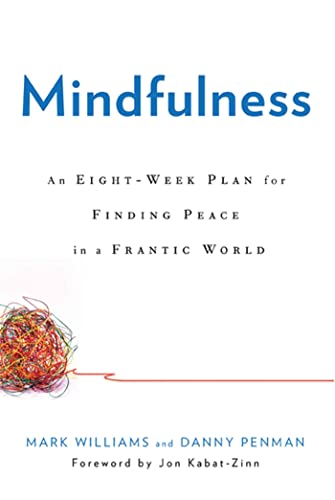
Inhaltsangabe
The Life-Changing International Bestseller
Mindfulness reveals a set of simple yet powerful practices that you can incorporate into daily life to help break the cycle of anxiety, stress, unhappiness, and exhaustion. It promotes the kind of happiness and peace that gets into your bones. It seeps into everything you do and helps you meet the worst that life throws at you with new courage.
The book is based on Mindfulness-Based Cognitive Therapy (MBCT). MBCT revolves around a straightforward form of mindfulness meditation which takes just a few minutes a day for the full benefits to be revealed. MBCT has been clinically proven to be at least as effective as drugs for depression and is widely recommended by US physicians and the UK's National Institute for Health and Clinical Excellence—in other words, it works. More importantly it also works for people who are not depressed but who are struggling to keep up with the constant demands of the modern world.
MBCT was developed by the book's author, Oxford professor Mark Williams, and his colleagues at the Universities of Cambridge and Toronto. By investing just 10 to 20 minutes each day, you can learn the simple mindfulness meditations at the heart of MBCT and fully reap their benefits. The book includes links to audio meditations to help guide you through the process. You'll be surprised by how quickly these techniques will have you enjoying life again.
Die Inhaltsangabe kann sich auf eine andere Ausgabe dieses Titels beziehen.
Über die Autorin bzw. den Autor
MARK WILLIAMS, PhD, is a professor of clinical psychology at the University of Oxford and a founding fellow of the Academy of Cognitive Therapy. He is the author of the best-selling Mindful Way through Depression, which has so far sold over 250,000 copies. He lives in England.
DANNY PENMAN, PhD, is an award winning feature and comment writer for the UK's Daily Mail. After earning a PhD in biochemistry, he worked for The Independent and the BBC. He has won two investigative journalism awards from the Humane Society of the United States and one from the Royal Society for the Prevention of Cruelty to Animals (RSPCA). He lives in England.
Auszug. © Genehmigter Nachdruck. Alle Rechte vorbehalten.
CHAPTER ONE
Chasing Your Tail
Can you remember the last time you lay in bed wrestling with your thoughts? You desperately wanted your mind to become calm, to just be quiet, so that you could get some sleep. But whatever you tried seemed to fail. Every time you forced yourself not to think, your thoughts exploded into life with renewed strength. You told yourself not to worry, but suddenly discovered countless new things to worry about. You tried fluffing up the pillow and rolling over to get more comfortable, but soon enough, you began thinking again. As the night ground ever onward, your strength progressively drained away, leaving you feeling fragile and broken. By the time the alarm went off, you were exhausted, bad-tempered and thoroughly miserable.
Throughout the next day you had the opposite problem--you wanted to be wide awake, but could hardly stop yawning. You stumbled into work, but weren't really present. You couldn't concentrate. Your eyes were red and puffy. Your whole body ached and your mind felt empty. You'd stare at the pile of papers on your desk for ages, hoping something, anything, would turn up so that you could gather enough momentum to do a day's work. In meetings, you could barely keep your eyes open, let alone contribute anything intelligent. It seemed as though your life had begun to slip through your fingers ... you felt ever more anxious, stressed and exhausted.
This is a book about how you can find peace and contentment in such troubled and frantic times as these. Or rather, this is a book about how you can rediscover them; for there are deep wellsprings of peace and contentment living inside us all, no matter how trapped and distraught we might feel. They're just waiting to be liberated from the cage that our frantic and relentless way of life has crafted for them.
We know this to be true because we--and our colleagues--have been studying anxiety, stress and depression for over thirty years at Oxford University, UMass, the University of Toronto, and other institutions around the world. This work has discovered the secret to sustained happiness and how you can successfully tackle anxiety, stress, exhaustion and even full-blown depression. It's the kind of happiness and peace that gets into your bones and promotes a deep-seated authentic love of life, seeping into everything you do and helping you to cope more skillfully with the worst that life throws at you.
It's a secret that was well understood in the ancient world and is kept alive in some cultures even today. But many of us in the Western world have largely forgotten how to live a good and joyful existence. And it's often even worse than this. We try so hard to be happy that we end up missing the most important parts of our lives and destroying the very peace that we were seeking.
We wrote this book to help you understand where true happiness, peace and contentment can be found and how you can rediscover them for yourself. It will teach you how to free yourself progressively from anxiety, stress, unhappiness and exhaustion. We're not promising eternal bliss; everyone experiences periods of pain and suffering, and it's naive and dangerous to pretend otherwise. And yet, it is possible to taste an alternative to the relentless struggle that pervades much of our daily lives.
In the following pages and in the accompanying downloads we offer a series of simple practices that you can incorporate into your daily life. They are based on mindfulness-based cognitive therapy (MBCT) that grew out of the inspiring work of Jon Kabat-Zinn at the UMass Medical Center in America. The MBCT program was originally developed by Professor Mark Williams (coauthor of this book), John Teasdale at Cambridge and Zindel Segal of the University of Toronto. It was designed to help people who had suffered repeated bouts of serious depression to overcome their illness. Clinical trials show that it works. It's been clinically proven to halve the risk of depression in those who have suffered the most debilitating forms of the illness. It's at least as effective as antidepressants, and has none of their downsides. In fact, it is so effective that it's now one of the preferred treatments recommended by the UK's National Institute for Health and Clinical Excellence.
The MBCT technique revolves around a form of meditation that was little known in the West until recently. Mindfulness meditation is so beautifully simple that it can be used by the rest of us to reveal our innate joie de vivre. Not only is this worthwhile in itself, but it can also prevent normal feelings of anxiety, stress and sadness from spiraling downwards into prolonged periods of unhappiness and exhaustion--or even serious clinical depression.
A typical meditation consists of focusing your full attention on your breath as it flows in and out of your body (see "A one-minute meditation"). Focusing on each breath in this way allows you to observe your thoughts as they arise in your mind and, little by little, to let go of struggling with them. You come to realize that thoughts come and go of their own accord; that you are not your thoughts. You can watch as they appear in your mind, seemingly from thin air, and watch again as they disappear, like a soap bubble bursting. You come to the profound understanding that thoughts and feelings (including negative ones) are transient. They come and they go, and ultimately, you have a choice about whether to act on them or not.
Mindfulness is about observation without criticism; being compassionate with yourself. When unhappiness or stress hovers overhead, rather than taking it all personally, you learn to treat them as if they were black clouds in the sky, and to observe them with friendly curiosity as they drift past. In essence, mindfulness allows you to catch negative thought patterns before they tip you into a downward spiral. It begins the process of putting you back in control of your life.
Over time, mindfulness brings about long-term changes in mood and levels of happiness and well-being. Scientific studies have shown that mindfulness not only prevents depression, but that it also positively affects the brain patterns underlying day-to-day anxiety, stress, depression and irritability so that when they arise, they dissolve away again more easily. Other studies have shown that regular meditators see their doctors less often and spend fewer days in hospital. Memory improves, creativity increases and reaction times become faster (see "The benefits of mindfulness meditation").
A One-Minute Meditation
1. Sit erect in a straight-backed chair. If possible, bring your back a little way from the rear of the chair so that your spine is self-supporting. Your feet can be flat on the floor. Close your eyes or lower your gaze.
2. Focus your attention on your breath as it flows in and out of your body. Stay in touch with the different sensations of each in-breath and each out-breath. Observe the breath without looking for anything special to happen. There is no need to alter your breathing in any way.
3. After a while your mind may wander. When you notice this, gently bring your attention back to your breath, without giving yourself a hard time--the act of realizing that your mind has wandered and bringing your attention back without criticizing yourself is central to the practice of mindfulness meditation.
4. Your mind may eventually become calm like a still pond--or it may not. Even if you get a sense of absolute stillness, it may only be fleeting. If you feel angry or exasperated, notice that this may be fleeting too. Whatever happens, just allow it to be as it is.
5. After a minute, let your eyes open and take in the room again.
The Benefits of Mindfulness Meditation
Numerous psychological studies have shown that regular meditators...
„Über diesen Titel“ kann sich auf eine andere Ausgabe dieses Titels beziehen.
Suchergebnisse für Mindfulness: An Eight-Week Program for Finding Peace...

Beispielbild für diese ISBN
Mindfulness: An Eight-Week Plan for Finding Peace in a Frantic World
Anbieter: World of Books (was SecondSale), Montgomery, IL, USA
Verkäuferbewertung 5 von 5 Sternen

Hardback. Zustand: Good. The life-changing international bestseller reveals a set of simple yet powerful mindfulness practices that you can incorporate into daily life to help break the cycle of anxiety, stress, unhappiness, and exhaustion. Mindfulness promotes the kind of happiness and peace that gets into your bones. It seeps into everything you do and helps you meet the worst that life throws at you with new courage. Based on Mindfulness-Based Cognitive Therapy (MBCT), the book revolves around a straightforward form of mindfulness meditation which takes just a few minutes a day for the full benefits to be revealed. MBCT has been clinically proven to be at least as effective as drugs for depression and is widely recommended by US physicians and the UK's National Institute for Health and Clinical Excellence--in other words, it works. More importantly it also works for people who are not depressed but who are struggling to keep up with the constant demands of the modern world. MBCT was developed by the book's author, Oxford professor Mark Williams, and his colleagues at the Universities of Cambridge and Toronto. By investing just 10 to 20 minutes each day, you can learn the simple mindfulness meditations at the heart of MBCT and fully reap their benefits. The book includes links to audio meditations to help guide you through the process. You'll be surprised by how quickly these techniques will have you enjoying life again. Bestandsnummer des Verkäufers 00104206376
Gebraucht kaufen
EUR 4,90
Versand gratis
Versand innerhalb von USA
Versand innerhalb von USA
Anzahl: 3 verfügbar
Foto des Verkäufers
Mindfulness: An Eight-Week Plan for Finding Peace in a Frantic World
Anbieter: Dream Books Co., Denver, CO, USA
Verkäuferbewertung 5 von 5 Sternen
Zustand: acceptable. This copy has clearly been enjoyedâ"expect noticeable shelf wear and some minor creases to the cover. Binding is strong, and all pages are legible. May contain previous library markings or stamps. Bestandsnummer des Verkäufers 4EKTGN003N1F_ns
Gebraucht kaufen
EUR 4,91
Versand gratis
Versand innerhalb von USA
Versand innerhalb von USA
Anzahl: 2 verfügbar
Foto des Verkäufers
Mindfulness: An Eight-Week Plan for Finding Peace in a Frantic World
Anbieter: Goodwill, Brooklyn Park, MN, USA
Verkäuferbewertung 4 von 5 Sternen

Zustand: good. All pages and cover are intact including the dust cover, if applicable . Spine may show signs of wear. Pages may include limited notes and highlighting. May include "From the library of" labels. Shrink wrap, dust covers, or boxed set case may be missing. Item may be missing bundled media. Bestandsnummer des Verkäufers 2Y6OIV005YK4_ns
Gebraucht kaufen
EUR 2,58
EUR 3,56 Versand
Versand innerhalb von USA
Versand innerhalb von USA
Anzahl: 1 verfügbar
Beispielbild für diese ISBN
Mindfulness: An Eight-Week Plan for Finding Peace in a Frantic World
Anbieter: ThriftBooks-Phoenix, Phoenix, AZ, USA
Verkäuferbewertung 5 von 5 Sternen
Hardcover. Zustand: Very Good. No Jacket. May have limited writing in cover pages. Pages are unmarked. ~ ThriftBooks: Read More, Spend Less. Bestandsnummer des Verkäufers G1609611985I4N00
Gebraucht kaufen
EUR 6,24
Versand gratis
Versand innerhalb von USA
Versand innerhalb von USA
Anzahl: 1 verfügbar
Beispielbild für diese ISBN
Mindfulness: An Eight-Week Plan for Finding Peace in a Frantic World
Anbieter: ThriftBooks-Reno, Reno, NV, USA
Verkäuferbewertung 5 von 5 Sternen
Hardcover. Zustand: Very Good. No Jacket. Missing dust jacket; May have limited writing in cover pages. Pages are unmarked. ~ ThriftBooks: Read More, Spend Less. Bestandsnummer des Verkäufers G1609611985I4N01
Gebraucht kaufen
EUR 6,24
Versand gratis
Versand innerhalb von USA
Versand innerhalb von USA
Anzahl: 1 verfügbar
Beispielbild für diese ISBN
Mindfulness: An Eight-Week Plan for Finding Peace in a Frantic World
Anbieter: ThriftBooks-Dallas, Dallas, TX, USA
Verkäuferbewertung 5 von 5 Sternen
Hardcover. Zustand: Fair. No Jacket. Readable copy. Pages may have considerable notes/highlighting. ~ ThriftBooks: Read More, Spend Less. Bestandsnummer des Verkäufers G1609611985I5N00
Gebraucht kaufen
EUR 6,24
Versand gratis
Versand innerhalb von USA
Versand innerhalb von USA
Anzahl: 1 verfügbar
Beispielbild für diese ISBN
Mindfulness: An Eight-Week Plan for Finding Peace in a Frantic World
Anbieter: ThriftBooks-Reno, Reno, NV, USA
Verkäuferbewertung 5 von 5 Sternen
Hardcover. Zustand: Very Good. No Jacket. May have limited writing in cover pages. Pages are unmarked. ~ ThriftBooks: Read More, Spend Less. Bestandsnummer des Verkäufers G1609611985I4N00
Gebraucht kaufen
EUR 6,24
Versand gratis
Versand innerhalb von USA
Versand innerhalb von USA
Anzahl: 2 verfügbar
Beispielbild für diese ISBN
Mindfulness: An Eight-Week Plan for Finding Peace in a Frantic World
Anbieter: ThriftBooks-Atlanta, AUSTELL, GA, USA
Verkäuferbewertung 5 von 5 Sternen
Hardcover. Zustand: Very Good. No Jacket. May have limited writing in cover pages. Pages are unmarked. ~ ThriftBooks: Read More, Spend Less. Bestandsnummer des Verkäufers G1609611985I4N00
Gebraucht kaufen
EUR 6,24
Versand gratis
Versand innerhalb von USA
Versand innerhalb von USA
Anzahl: 2 verfügbar
Beispielbild für diese ISBN
Mindfulness: An Eight-Week Plan for Finding Peace in a Frantic World
Anbieter: ThriftBooks-Reno, Reno, NV, USA
Verkäuferbewertung 5 von 5 Sternen
Hardcover. Zustand: Fair. No Jacket. Former library book; Readable copy. Pages may have considerable notes/highlighting. ~ ThriftBooks: Read More, Spend Less. Bestandsnummer des Verkäufers G1609611985I5N10
Gebraucht kaufen
EUR 6,24
Versand gratis
Versand innerhalb von USA
Versand innerhalb von USA
Anzahl: 1 verfügbar
Beispielbild für diese ISBN
Mindfulness: An Eight-Week Plan for Finding Peace in a Frantic World
Anbieter: ThriftBooks-Atlanta, AUSTELL, GA, USA
Verkäuferbewertung 5 von 5 Sternen
Hardcover. Zustand: Good. No Jacket. Pages can have notes/highlighting. Spine may show signs of wear. ~ ThriftBooks: Read More, Spend Less. Bestandsnummer des Verkäufers G1609611985I3N00
Gebraucht kaufen
EUR 6,24
Versand gratis
Versand innerhalb von USA
Versand innerhalb von USA
Anzahl: 1 verfügbar