
Verwandte Artikel zu Ecological Restoration, Second Edition: Principles,...
Ecological Restoration, Second Edition: Principles, Values, and Structure of an Emerging Profession (Society for Ecological Restoration) - Hardcover
Buch 19 von 21: The Science and Practice of Ecological Restoration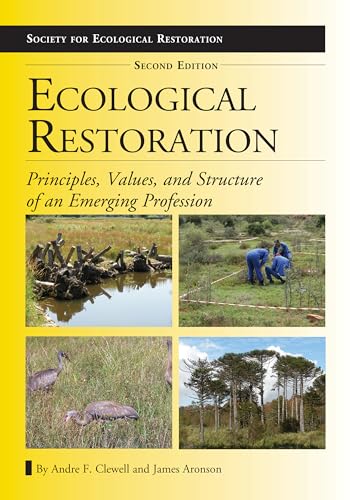
Inhaltsangabe
Ecological restoration is a rapidly growing discipline that encompasses a wide range of activities and brings together practitioners and theoreticians from a variety of backgrounds and perspectives, ranging from volunteer backyard restorationists to highly trained academic scientists and professional consultants. This book offers a comprehensive and coherent account of the field for everyone who initiates, finances, designs, administers, issues government permits for, manages, and implements ecological restoration projects, and all those who serve in supportive roles. Originally published in 2007, this revised and reorganized edition brings the book up to date with new developments and current trends in the field.
In a lively, personal fashion, the authors discuss scientific and practical aspects of the field as well as the human needs and values that motivate practitioners. The book
- identifies fundamental concepts upon which restoration is based
- considers the principles of restoration practice
- explores the diverse values that are fulfilled with the restoration of ecosystems
- reviews the structure of restoration practice, including the various contexts for restoration work, the professional development of its practitioners, and the relationships of restoration with allied fields and activities
The book also includes case studies and Virtual Field Trips around the world that illustrate points made in the book with on-the-ground information from those who were intimately involved with the projects described. Throughout, ecological restoration is conceived as a holistic endeavor, one that addresses issues of ecological degradation, biodiversity loss, personal engagement, and sustainability science simultaneously, and draws upon cultural resources and local skills and knowledge in restoration work.
Die Inhaltsangabe kann sich auf eine andere Ausgabe dieses Titels beziehen.
Über die Autorin bzw. den Autor
Andre F. Clewell and James Aronson
Auszug. © Genehmigter Nachdruck. Alle Rechte vorbehalten.
Ecological Restoration
Principles, Values, and Structure of an Emerging Profession
By Andre F. Clewell, James AronsonISLAND PRESS
Copyright © 2013 Andre F. Clewell and James Aronson
All rights reserved.
ISBN: 978-1-61091-167-2All rights reserved.
Contents
ABOUT THE SOCIETY FOR ECOLOGICAL RESTORATION,
LIST OF VIRTUAL FIELD TRIPS,
FOREWORD Paddy Woodworth,
PREFACE,
PART I. Why We Restore,
Chapter 1. Overview,
Chapter 2. Values and Ecological Restoration,
Chapter 3. Disturbance and Impairment,
PART II. What We Restore,
Chapter 4. Recovery,
Chapter 5. Ecological Attributes of Restored Ecosystems,
Chapter 6. Semicultural Landscapes and Ecosystems,
PART III. How We Restore,
Chapter 7. Ecological References,
Chapter 8. Approaches to Restoration,
Chapter 9. Project Planning and Evaluation,
PART IV. Ecological Restoration as a Profession,
Chapter 10. Relationship of Restoration to Related Fields,
Chapter 11. Projects and the Professional,
Chapter 12. Moving Restoration Forward—Together,
GLOSSARY,
REFERENCES CITED,
ABOUT THE AUTHORS AND COLLABORATORS,
INDEX,
CHAPTER 1
Overview
Ecological restoration is the process of assisting the recovery of an ecosystem that has been degraded, damaged, or destroyed (SER 2004). From an ecological perspective, it is an intentional activity that reinitiates ecological processes that were interrupted when an ecosystem was impaired. From a conservation perspective, it recovers biodiversity in the face of an unprecedented, human-mediated extinction crisis. From a socioeconomic perspective, ecological restoration recovers ecosystem services from which people benefit. From a cultural perspective, ecological restoration is a way that we strengthen our communities, institutions, and interpersonal relationships by participation in a common pursuit. From a personal perspective, ecological restoration allows us to reconnect with the rest of Nature and restore ourselves as we restore impaired ecosystems. All of these perspectives on ecological restoration distill down to a simple truth: Nature sustains us; therefore, we serve our own interests when we reciprocate and sustain Nature.
While globally cumulative, ecological restoration is necessarily a local endeavor. The decision to restore represents a long-term commitment of land and resources. Ideally, that decision is reached in consensus by all who are affected. A restored ecosystem contributes to peoples' ecological and socioeconomic security and their well-being into the indefinite future. The benefits of ecological restoration are intergenerational. People develop appreciation for local ecosystems when they participate in decisions regarding restoration, and their respect for ecosystems increases if they become actively engaged in restoration activities.
Ecological restoration reinitiates ecological processes, but we cannot intervene and create desired outcomes directly. Instead, we manipulate biophysical properties of an impaired ecosystem to facilitate resumption of processes that can only be performed by living organisms. The restoration practitioner assists ecosystem recovery much as a physician assists the recovery of a patient. Patients heal themselves under the physician's supervision, care, and encouragement. Similarly, ecosystems respond to assistance provided by restoration practitioners.
Once ecological restoration project activities are completed, a successfully restored ecosystem self-organizes and becomes increasingly self-sustaining in a dynamic sense. It again becomes resilient to disturbance and can maintain itself to the same degree as would be expected of an undisturbed ecosystem of the same kind in a similar position in the local landscape. In other words, the intent is to recover an impaired ecosystem to a condition of wholeness or intactness. A "whole" ecosystem is characterized by possession of a suite of ecological attributes that are discussed in chapter 5. We use the term holistic ecological restoration to distinguish such comprehensive efforts from partial restorative actions that are limited to incremental ecosystem recovery or ecological improvement.
In spite of our ideal to recover an impaired ecosystem to a condition of total self-sustainability, the era of Earth's history when intact ecosystems were entirely self-sustainable has come to a close, for two reasons. First, human-mediated environmental impacts have become so pervasive globally, and often so severe locally, that many restored ecosystems require ongoing ecosystem management to prevent them from slipping into an impaired state once again. Second, many seemingly natural ecosystems coevolved with human inhabitants, whose traditional cultural practices have transformed them into semicultural ecosystems. Such systems degrade from disuse following abandonment and become candidates for ecological restoration. If they are restored to their semicultural state, then cultural practices that previously maintained them should be resumed to ensure their sustainability.
Ecosystems are not static. They evolve in response to natural and anthropogenic modifications in the external environment and to internal processes that govern species composition and abundance. We use evolve and evolution with respect to ecosystems here and elsewhere in this book, not in a Darwinian sense, but in a developmental sense to indicate unidirectional or cyclic ecological change through time. Ecosystem evolution, just like the evolution of species, is sometimes gradual and subtle and at other times rapid or abrupt. A record of the sequential changes in expression that an ecosystem undergoes through time is called its historic ecological trajectory. If an ecosystem is impaired, its historic trajectory is interrupted. Ecological restoration allows an ecosystem to resume its historic trajectory. This is similar to a physician assisting in the healing process, so that patients can resume their lives.
During the hiatus caused by impairment, the Earth has not stood still. External conditions and boundaries may have changed, and the internal processes of ecosystem recovery may cause ecosystem expression that was not formerly present. Therefore the outcome of ecological restoration is necessarily a contemporary expression and not a return to the past, even though many if not most species may well persist from past to future on most sites. In this way, ecological restoration connects an impaired ecosystem to its future. We restore historical ecological continuity, not historic ecosystems. Regardless of how much we try to restore to the past, it never happens. We have no choice in this matter, because we can't control outcomes of restoration without losing the quality of naturalness that we ultimately strive to recover. At best, we can only emulate the past as we restore. The reason for this is that ecosystems consist of living organisms, and life does not run backward. In many restoration projects, the future state emulates the gross structural aspects of the preimpairment ecosystem, but to believe it can ever truly return to that former state—as if time were reversible—is wishful thinking and counterproductive. We invariably restore ecosystems "to the future." Consequently, ecological restoration is in some ways a metaphor that should not be taken literally. Nonetheless, it is a...
„Über diesen Titel“ kann sich auf eine andere Ausgabe dieses Titels beziehen.
Suchergebnisse für Ecological Restoration, Second Edition: Principles,...

Beispielbild für diese ISBN
Ecological Restoration, Second Edition: Principles, Values, and Structure of an Emerging Profession (Science Practice Ecological Restoration Andre F. Clewell et James Aronson
Anbieter: BUCHSERVICE / ANTIQUARIAT Lars Lutzer, Wahlstedt, Deutschland
Verkäuferbewertung 5 von 5 Sternen

Hardcover. Zustand: gut. Ecological Restoration, Second Edition: Principles, Values, and Structure of an Emerging Profession (Science Practice Ecological Restoration In englischer Sprache. pages. Bestandsnummer des Verkäufers BN318129
Gebraucht kaufen
EUR 179,90
EUR 39,95 Versand
Versand von Deutschland nach USA
Versand von Deutschland nach USA
Anzahl: 1 verfügbar