
Verwandte Artikel zu Roads Were Not Built for Cars: How Cyclists Were the...
Roads Were Not Built for Cars: How Cyclists Were the First to Push for Good Roads & Became the Pioneers of Motoring - Softcover
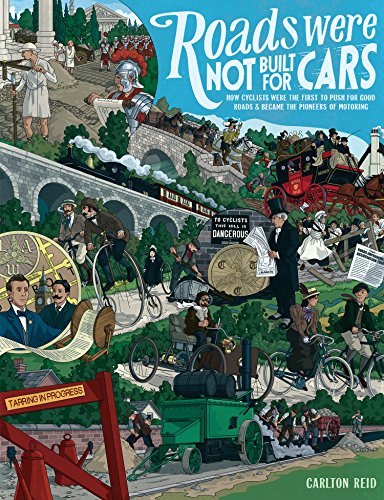
Inhaltsangabe
In Roads Were Not Built for Cars, Carlton Reid reveals the pivotal—and largely unrecognized—role that bicyclists played in the development of modern roadways. Reid introduces readers to cycling personalities, such as Henry Ford, and the cycling advocacy groups that influenced early road improvements, literally paving the way for the motor car. When the bicycle morphed from the vehicle of rich transport progressives in the 1890s to the “poor man’s transport” in the 1920s, some cyclists became ardent motorists and were all too happy to forget their cycling roots. But, Reid explains, many motor pioneers continued cycling, celebrating the shared links between transport modes that are now seen as worlds apart. In this engaging and meticulously researched book, Carlton Reid encourages us all to celebrate those links once again.
Die Inhaltsangabe kann sich auf eine andere Ausgabe dieses Titels beziehen.
Über die Autorin bzw. den Autor
Carlton Reid is the executive editor of trade magazine BikeBiz.com. His travel pieces have appeared in National Geographic Traveller and The Guardian. His previous books include Adventure Mountain Biking (Crowood Press,1990); Complete Book of Cycling (contributor, Hamlyn, 1997); I-Spy Bicycles (Michelin, 1998); Discover Israel (Berlitz, 1993); Lebanon: A Travel Guide (Kindlife, 1995); Classic Mountain Bike Routes of the World (contributor, Quarto Publishing, 2000); Bike to Work Book (Front Page Creations, November 2008) and Family Cycling (Snow Books, 2009).
Auszug. © Genehmigter Nachdruck. Alle Rechte vorbehalten.
Roads Were Not Built for Cars
How Cyclists Were the First to Push for Good Roads & Became the Pioneers of Motoring
By Carlton ReidISLAND PRESS
Copyright © 2015 Carlton Reid
All rights reserved.
ISBN: 978-1-61091-689-9All rights reserved.
Contents
Foreword,
Preface,
Introduction,
1. When Two Tribes Were One,
2. Pioneers,
3. Mastodons to Motorways,
4. Who Owns the Roads?,
5. Speed,
6. Width,
7. Hardtop History,
8. "What the Bicyclist Did for Roads",
9. Ripley: "the Mecca of all Good Cyclists",
10 Good Roads for America,
11. America's Forgotten Transport Network,
12. Pedal Power,
13. Motoring's Bicycling Beginnings,
14. Without Bicycles Motoring Might Not Exist,
15. From King of the Road to Cycle Chic,
Epilogue,
Acknowledgements,
Appendix A – History of roads timeline,
Appendix B – Motor marques with bicycling beginnings,
Appendix C – Kickstarter supporters,
Bibliography,
Index,
CHAPTER 1
WHEN TWO TRIBES WERE ONE
The roads you travel so briskly lead out of dim antiquity, and you study the past chiefly because of its bearing on the living present and its promise for the future. Lieutenant General James Harbord, 1946
The improvements made to highways are normally assumed to have been started by motorists. This assumption is mistaken. The "Good Roads" movement was created in the 1880s by cyclists. Many of these cyclists were rich and influential, and would later morph into motorists and continue campaigning for Good Roads. The first motorists drove automobiles that were heavily dependent on technologies developed by the cycle industry, an industry at the cutting edge of industrial design and which pioneered manufacturing processes absorbed by the automobile industry, an industry dependent on former or existing cycle entrepreneurs and technicians.
Many country roads in the 19th century were rutted in winter, dust-bowls in the summer and churned with deep mud at most other times. Urban areas fared better, with macadam roads capped with layers of dust-bound crushed stone. Major thoroughfares in cities were often topped not with setts – don't call 'em cobbles – but with wood. In 1871, Pennsylvania Avenue in Washington, D.C., "America's Main Street," was laid with hardwoods. Five years later some of the wood blocks were lifted, and a thin asphalte strip laid in their place. This was a test of a tar-and-gravel mix patented by a Civil War cavalry general who had been inspired by a Belgian scientist's mountain-sourced French bitumen. In effect, this was America's first bike path. Asphalte roads spread through the city – there were 45 miles of them by 1882. The District of Columbia's asphalte roads formed a "wheelman's paradise," said Bicycling World. A writer in 1889 asked: "How is it possible for a man or woman to get along in that city of magnificent surfaces without a cycle of some kind?"
Cyclists may have loved the pioneer blacktop, but it soon rippled and popped, and within a decade the asphalte roads had been grubbed up; the perfect road surface was still some years away. However, Gilded Age cyclists had seen the future – a future of hard, smooth roads. In the late 1880s the pushiest of these well-heeled cyclists created an influential highways improvement campaign. The Good Roads movement would go on to achieve much of what it wanted: Federal funding for roads, a national plan, and the start of the world-reshaping American highway system. The Federal Aid Road Act of 1916 was signed by President Woodrow Wilson. When a law professor, Wilson had spent much time in Europe, touring on his bicycle. The roads of France and England were far superior to the ones in America and Wilson became an advocate of Good Roads, an interest he kept as he became a motorist. By his side at the signing of the Federal Aid Road Act was Amos G. Batchelder, Executive Secretary of the American Automobile Association. By 1916, the Good Roads movement was no longer led by bicycle riders, but by motorists. However, Batchelder had first been a cycling official. A member of the League of American Wheelmen since 1888 he had been the L.A.W.'s official handicapper, and was also chairman of the National Cycling Association's racing board. A great many other motoring officials, journalists, promoters, and manufacturers had also been heavily involved in cycling but in 1916 cycling's contribution to the improvement of America's highways was becoming obscured, partly by design.
The hiding was so successful that, by 1927, the Ford Motor Company could boldly claim that the "Ford car ... started the movement for good roads." The record was set straight in 2011 by Suzanne Fischer, curator of The Henry Ford museum in Dearborn, Michigan. "It might surprise you," she said, in a video, "but it wasn't car owners that first demanded better roads – it was bicycle riders."
America's Good Roads movement was modelled on Britain's Roads Improvement Association, created by cycling organisations in 1886. "Cyclists were the class first to take a national interest in the conditions of the roads," said William Rees Jeffreys in 1949. In the early 1900s, Rees Jeffreys led the influential Roads Improvement Association via his role as a council member of the Cyclists' Touring Club, one of the two cycling organisations which had established the pioneering roads lobbying organisation.
That it was bicyclists who first pushed for improved highways is today surprising, but it was clear and obvious in the 1890s. "The bicycle has done more for good roads, and will do more for good roads in the future, than any other form of vehicle," remarked Brooklyn's Mayor in 1896. An American newspaper said in 1899 that the reason bicyclists were "such advocates of good roads is that, having to furnish the motive power by the use of their own muscles, they learn at once what a mighty difference there is in the energy required to move the same load on a smooth, hard road or an uneven and muddy one." Another newspaper, in the same year, stated that cyclists had at first been despised because many thought they were demanding "that others should, without cost to him, smooth the roads that he alone might have more pleasure." When faced with rough or muddy highways, American farmers had acquiesced: "For years the farmer drives behind his horse with many a bumpety-bump, and the horse became stalled without ever swearing about it or writing a long protest to the county paper."
Cyclists, on the other hand, didn't keep quiet: "Here were people who could swear and write, pushing their vehicles by main strength on wretched paths when a [smooth] street ... permitted them to glide along almost without effort."
Spreading the "Gospel of Good Roads," cyclists cajoled, leafleted and sued, and flexed their political muscles. The campaigning continued when these moneyed cyclists morphed into motorists. Motoring pioneers were successful at – finally! – getting roads improved because they either benefited from the earlier lobbying work of cyclists or, just as likely, had started to lobby for Good Roads when, back in the day, they were cyclists.
Cycling's role in highway history started to be obscured when cycling became proletarian and when, even though cyclists were still the overwhelming majority on the roads, most of the money spent on highways was devoted to the needs of motorists alone. Motoring was modern; motoring was thrusting; motoring, thought almost...
„Über diesen Titel“ kann sich auf eine andere Ausgabe dieses Titels beziehen.
Suchergebnisse für Roads Were Not Built for Cars: How Cyclists Were the...

Foto des Verkäufers
Roads Were Not Built for Cars: How cyclists were the first to push for good roads & became the pioneers of motoring
Anbieter: -OnTimeBooks-, Phoenix, AZ, USA
Verkäuferbewertung 5 von 5 Sternen

Zustand: very_good. Gently read. May have name of previous ownership, or ex-library edition. Binding tight; spine straight and smooth, with no creasing; covers clean and crisp. Minimal signs of handling or shelving. 100% GUARANTEE! Shipped with delivery confirmation, if you're not satisfied with purchase please return item! Ships USPS Media Mail. Bestandsnummer des Verkäufers OTV.1610916891.VG
Gebraucht kaufen
EUR 29,11
Versand gratis
Versand innerhalb von USA
Versand innerhalb von USA
Anzahl: 1 verfügbar
Beispielbild für diese ISBN
Roads Were Not Built for Cars: How cyclists were the first to push for good roads & became the pioneers of motoring
Anbieter: WorldofBooks, Goring-By-Sea, WS, Vereinigtes Königreich
Verkäuferbewertung 5 von 5 Sternen
Paperback. Zustand: Very Good. The book has been read, but is in excellent condition. Pages are intact and not marred by notes or highlighting. The spine remains undamaged. Bestandsnummer des Verkäufers GOR008550424
Gebraucht kaufen
EUR 24,72
EUR 6,72 Versand
Versand von Vereinigtes Königreich nach USA
Versand von Vereinigtes Königreich nach USA
Anzahl: 1 verfügbar
Beispielbild für diese ISBN
Roads Were Not Built for Cars
Anbieter: PBShop.store UK, Fairford, GLOS, Vereinigtes Königreich
Verkäuferbewertung 5 von 5 Sternen
PAP. Zustand: New. New Book. Shipped from UK. Established seller since 2000. Bestandsnummer des Verkäufers WP-9781610916899
Neu kaufen
EUR 34,82
EUR 7,04 Versand
Versand von Vereinigtes Königreich nach USA
Versand von Vereinigtes Königreich nach USA
Anzahl: 15 verfügbar
Foto des Verkäufers
Roads Were Not Built for Cars : How Cyclists Were the First to Push for Good Roads & Became the Pioneers of Motoring
Anbieter: GreatBookPrices, Columbia, MD, USA
Verkäuferbewertung 5 von 5 Sternen
Zustand: As New. Unread book in perfect condition. Bestandsnummer des Verkäufers 23473456
Gebraucht kaufen
EUR 40,08
EUR 2,37 Versand
Versand innerhalb von USA
Versand innerhalb von USA
Anzahl: Mehr als 20 verfügbar
Foto des Verkäufers
Roads Were Not Built for Cars : How Cyclists Were the First to Push for Good Roads & Became the Pioneers of Motoring
Anbieter: GreatBookPrices, Columbia, MD, USA
Verkäuferbewertung 5 von 5 Sternen
Zustand: New. Bestandsnummer des Verkäufers 23473456-n
Neu kaufen
EUR 40,70
EUR 2,37 Versand
Versand innerhalb von USA
Versand innerhalb von USA
Anzahl: Mehr als 20 verfügbar
Beispielbild für diese ISBN
Roads Were Not Built for Cars How cyclists were the first to push for good roads & became the pioneers of motoring
Anbieter: Revaluation Books, Exeter, Vereinigtes Königreich
Verkäuferbewertung 5 von 5 Sternen
Paperback. Zustand: Brand New. 331 pages. 9.75x7.75x0.75 inches. In Stock. Bestandsnummer des Verkäufers __1610916891
Neu kaufen
EUR 28,42
EUR 15,00 Versand
Versand von Vereinigtes Königreich nach USA
Versand von Vereinigtes Königreich nach USA
Anzahl: 1 verfügbar
Beispielbild für diese ISBN
Roads Were Not Built for Cars: How Cyclists Were the First to Push for Good Roads & Became the Pioneers of Motoring
Anbieter: Chiron Media, Wallingford, Vereinigtes Königreich
Verkäuferbewertung 5 von 5 Sternen
Paperback. Zustand: New. Brand new book, sourced directly from publisher. Dispatch time is 24-48 hours from our warehouse. Book will be sent in robust, secure packaging to ensure it reaches you securely. Bestandsnummer des Verkäufers 6666-GRD-9781610916899
Neu kaufen
EUR 36,49
EUR 7,79 Versand
Versand von Vereinigtes Königreich nach USA
Versand von Vereinigtes Königreich nach USA
Anzahl: 3 verfügbar
Foto des Verkäufers
Roads Were Not Built for Cars
Verlag:
Princeton University Press, US, 2015
ISBN 10: 1610916891
ISBN 13: 9781610916899
Neu
Paperback
Anbieter: Rarewaves.com USA, London, LONDO, Vereinigtes Königreich
Verkäuferbewertung 5 von 5 Sternen
Paperback. Zustand: New. The coming of the railways in the 1830s killed off the stage-coach trade; almost all rural roads reverted to low-level local use. Cyclists were the first group in a generation to use roads and were the first to push for high-quality leadership for roads. They were also the first promoters of motoring; the first motoring journalists had first been cycling journalists; and there was a transfer of technology from cycling to motoring without which cars as we know them wouldn't exist! 64 car marques, including Rolls-Royce, Aston Martin, Chevrolet, Cadillac and GMC, had bicycling beginnings. Roads Were Not Built for Cars is a history book, focussing on a time when cyclists had political clout, in Britain and especially in America. The book researches the Roads Improvement Association - a lobbying group created by the Cyclists' Touring Club in 1886 - and the Good Roads movement organised by the League of American Wheelmen in the same period. Bestandsnummer des Verkäufers LU-9781610916899
Neu kaufen
EUR 47,28
Versand gratis
Versand von Vereinigtes Königreich nach USA
Versand von Vereinigtes Königreich nach USA
Anzahl: Mehr als 20 verfügbar
Beispielbild für diese ISBN
Roads Were Not Built for Cars: How cyclists were the first to push for good roads & became the pioneers of motoring (eng)
Anbieter: Brook Bookstore On Demand, Napoli, NA, Italien
Verkäuferbewertung 5 von 5 Sternen
Zustand: new. Bestandsnummer des Verkäufers bcbe8d1b6215325f3e6350d88d9b78d6
Neu kaufen
EUR 39,74
EUR 8,00 Versand
Versand von Italien nach USA
Versand von Italien nach USA
Anzahl: Mehr als 20 verfügbar
Beispielbild für diese ISBN
Roads Were Not Built for Cars (Paperback)
Verlag:
Princeton University Press, Washington, 2015
ISBN 10: 1610916891
ISBN 13: 9781610916899
Neu
Paperback
Anbieter: Grand Eagle Retail, Bensenville, IL, USA
Verkäuferbewertung 5 von 5 Sternen
Paperback. Zustand: new. Paperback. In Roads Were Not Built for Cars, Carlton Reid reveals the pivotaland largely unrecognizedrole that bicyclists played in the development of modern roadways. Reid introduces readers to cycling personalities, such as Henry Ford, and the cycling advocacy groups that influenced early road improvements, literally paving the way for the motor car. When the bicycle morphed from the vehicle of rich transport progressives in the 1890s to the poor mans transport in the 1920s, some cyclists became ardent motorists and were all too happy to forget their cycling roots. But, Reid explains, many motor pioneers continued cycling, celebrating the shared links between transport modes that are now seen as worlds apart. In this engaging and meticulously researched book, Carlton Reid encourages us all to celebrate those links once again. Roads Were Not Built for Cars is a history book, focussing on a time when cyclists had political clout, in Britain and especially in America. The book researches the Roads Improvement Association - a lobbying group created by the Cyclists' Touring Club in 1886 - and the Good Roads movement organised by the League of American Wheelmen. Shipping may be from multiple locations in the US or from the UK, depending on stock availability. Bestandsnummer des Verkäufers 9781610916899