
Verwandte Artikel zu EarthEd: Rethinking Education on a Changing Planet...
Inhaltsangabe
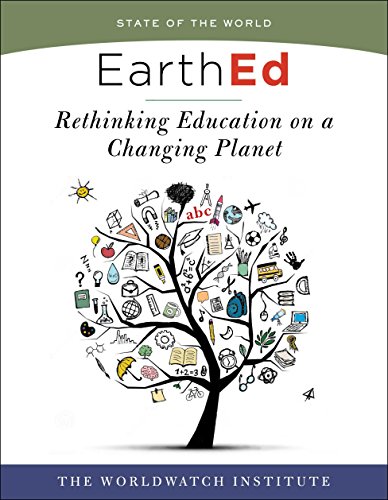
Earth education is traditionally confined to specific topics: ecoliteracy, outdoor education, environmental science. But in the coming century, on track to be the warmest in human history, every aspect of human life will be affected by our changing planet. Emerging diseases, food shortages, drought, and waterlogged cities are just some of the unprecedented challenges that today’s students will face. How do we prepare 9.5 billion people for life in the Anthropocene, to thrive in this uncharted and more chaotic future?
Answers are being developed in universities, preschools, professional schools, and even prisons around the world. In the latest volume of State of the World, a diverse group of education experts share innovative approaches to teaching and learning in a new era. Topics include systems thinking for kids; the importance of play in early education; social emotional learning; comprehensive sexuality education; indigenous knowledge; sustainable business; medical training to treat the whole person; teaching law in the Anthropocene; and more.
EarthEd addresses schooling at all levels of development, from preschool to professional. Its lessons can inform teachers, policy makers, school administrators, community leaders, parents, and students alike. And its vision will inspire anyone who wants to prepare students not only for the storms ahead but to become the next generation of sustainability leaders.
Answers are being developed in universities, preschools, professional schools, and even prisons around the world. In the latest volume of State of the World, a diverse group of education experts share innovative approaches to teaching and learning in a new era. Topics include systems thinking for kids; the importance of play in early education; social emotional learning; comprehensive sexuality education; indigenous knowledge; sustainable business; medical training to treat the whole person; teaching law in the Anthropocene; and more.
EarthEd addresses schooling at all levels of development, from preschool to professional. Its lessons can inform teachers, policy makers, school administrators, community leaders, parents, and students alike. And its vision will inspire anyone who wants to prepare students not only for the storms ahead but to become the next generation of sustainability leaders.
Die Inhaltsangabe kann sich auf eine andere Ausgabe dieses Titels beziehen.
Über die Autorin bzw. den Autor
Through research and outreach that inspire action, the Worldwatch Institute works to accelerate the transition to a sustainable world that meets human needs. The Institute’s top objectives are universal access to renewable energy and nutritious food, expansion of environmentally sound jobs and development, transformation of cultures from consumerism to sustainability, and an early end to population growth through healthy and intentional childbearing. Recent editions of Worldwatch's landmark publication, State of the World, include Can a City Be Sustainable? (2016); Confronting Hidden Threats to Sustainability (2015); and Governing for Sustainability (2013).
Auszug. © Genehmigter Nachdruck. Alle Rechte vorbehalten.
EarthEd: Rethinking Education on a Changing Planet
By Erik Assadourian, Lisa MastnyISLAND PRESS
Copyright © 2017 Worldwatch Institute
All rights reserved.
ISBN: 978-1-61091-842-8All rights reserved.
Contents
Foreword David Orr,
Acknowledgments,
INTRODUCTION,
1 EarthEd: Rethinking Education on a Changing Planet Erik Assadourian,
PART ONE: EARTH EDUCATION FUNDAMENTALS,
2 Outdoor School for All: Reconnecting Children to Nature David Sobel,
3 Ecoliteracy and Schooling for Sustainability Michael K. Stone,
4 Education for the Eighth Fire: Indigeneity and Native Ways of Learning Melissa K. Nelson,
5 Pathway to Stewardship: A Framework for Children and Youth Jacob Rodenburg and Nicole Bell,
6 Growing a New School Food Culture Luis González Reyes,
7 The Centrality of Character Education for Creating and Sustaining a Just World Marvin W. Berkowitz,
8 Social and Emotional Learning for a Challenging Century Pamela Barker and Amy McConnell Franklin,
9 Prioritizing Play David Whitebread,
10 Looking the Monster in the Eye: Drawing Comics for Sustainability Marilyn Mehlmann with Esbjörn Jorsäter, Alexander Mehlmann, and Olena Pometun,
11 Deeper Learning and the Future of Education Dennis McGrath and Monica M. Martinez,
12 All Systems Go! Developing a Generation of "Systems-Smart" Kids Linda Booth Sweeney,
13 Reining in the Commercialization of Childhood Josh Golin and Melissa Campbell,
14 Home Economics Education: Preparation for a Sustainable and Healthy Future Helen Maguire and Amanda McCloat,
15 Our Bodies, Our Future: Expanding Comprehensive Sexuality Education Mona Kaidbey and Robert Engelman,
PART TWO: HIGHER EDUCATION REIMAGINED,
16 Suddenly More Than Academic: Higher Education for a Post-Growth World Michael Maniates,
17 Bringing the Classroom Back to Life Jonathan Dawson and Hugo Oliveira,
18 Preparing Vocational Training for the Eco-Technical Transition Nancy Lee Wood,
19 Sustainability Education in Prisons: Transforming Lives, Transforming the World Joslyn Rose Trivett, Raquel Pinderhughes, Kelli Bush, Liliana Caughman, and Carri J. LeRoy,
20 Bringing the Earth Back into Economics Joshua Farley,
21 New Times, New Tools: Agricultural Education for the Twenty-First Century Laura Lengnick,
22 Educating Engineers for the Anthropocene Daniel Hoornweg, Nadine Ibrahim, and Chibulu Luo,
23 The Evolving Focus of Business Sustainability Education Andrew J. Hoffman,
24 Teaching Doctors to Care for Patient and Planet Jessica Pierce,
CONCLUSION,
25 The Future of Education: A Glimpse from 2030 Erik Assadourian,
Notes,
Index,
CHAPTER 1
EarthEd: Rethinking Education on a Changing Planet
Erik Assadourian
What is education for? Education — the process of facilitating learning — has been an integral part of human societies since before we were even human. After all, humans are not the only species that transmits knowledge from one individual to another. Chimpanzees and dolphins, for example, both teach their young specialized foraging and hunting techniques that are known only to their communities and pods. Learning has been documented in numerous species, even in plants and bacteria. Because learning is a natural part of being alive — and increases the odds of staying alive — at its very root, the role of education may be to facilitate survival, both for the individual that is learning and for the social group (and species) of which it is a part.
As humans evolved — going beyond day-to-day survival and developing systems of writing, arts, tools, and the like — complex cultural systems formed and helped to shape educational priorities. As anthropologists David Lancy, John Bock, and Suzanne Gaskins explain, "the end points of learning ... are culturally defined." In other words, education prepares children for life in the cultures into which they are born, giving them the tools and knowledge that they need to survive in the physical and social realities in which they most likely will spend their entire lives.
This might have been fine throughout most of human history, where cultural knowledge correlated strongly with the knowledge that was needed to survive and thrive in the immediate environment (for example, how to identify which plants and animals are dangerous and which are edible; how to make fire, tools, clothing, and shelter; and how to coexist with neighboring populations). But the cultures that most humans are now born into are variations of consumer cultures — cultures that, through their profligate use of resources and promotion of unsustainable levels of consumption, are rapidly undermining the Earth's systems to the point that they now threaten the very survival of countless species and human communities around the world.
For humans to thrive in the future, we will need to systematically rethink education, helping students learn the knowledge that is most useful for their survival on a planet that is undergoing rapid ecological changes. We must provide them with the tools and strategies that they need to question the current sociocultural reality and to become bold leaders who will help pull us back from the brink of ecocide and usher in a sustainable future. But even that is not enough. Considering how much damage human civilization has already done to the Earth, students also must learn how to prepare for and adapt to the ecological shifts that are already locked in to their future — and ideally do this in ways that help both to restore Earth's systems and to preserve their own humanity.
State of the World 2017 explores how education — particularly formal education — will need to evolve to prepare students for life on a changing planet. Some priorities will not change much in this new "Earth Education" or "EarthEd" context: basic literacy, numeracy, multilingualism — these skills will continue to be as important in the future as they are today. But many new educational priorities must emerge: ecoliteracy, moral education, systems thinking, and critical thinking, to name a few. Without these and other key skills, today's youth will be ill-equipped for the dual challenges that they face of building a sustainable society and adapting to a changing planet.
Our Changing Planet
Over the past few hundred years, as humans have harnessed coal, oil, and natural gas to generate heat, steam power, electricity, liquid fuels, and new materials, we have unleashed the start of a climate shift that has never before been experienced in human history, with temperatures today already higher than during our last eleven thousand years of civilization. Moreover, we have enabled a massive spike in the human population, thanks to discoveries ranging from germ theory to the scientific developments behind the Green Revolution. As early innovations solidified into a complex industrial economic system based primarily on fossil fuels, humanity's impact on the planet has grown exponentially — to the point where most of the Earth's ecosystem services are now degraded or are being used unsustainably.
Worse yet, we have created a series of positive feedback loops that are further accelerating the damage. This includes the $579 billion a year spent around the world to promote the ever-increasing consumption of consumer goods — from fast food, soft drinks, and coffee to cars, computers, and smartphones. Amazingly, many of these goods are no longer...
„Über diesen Titel“ kann sich auf eine andere Ausgabe dieses Titels beziehen.
Suchergebnisse für EarthEd: Rethinking Education on a Changing Planet...

Foto des Verkäufers
EarthEd (State of the World): Rethinking Education on a Changing Planet
Anbieter: Zoom Books Company, Lynden, WA, USA
Verkäuferbewertung 5 von 5 Sternen

Zustand: very_good. Book is in very good condition and may include minimal underlining highlighting. The book can also include "From the library of" labels. May not contain miscellaneous items toys, dvds, etc. . We offer 100% money back guarantee and 24 7 customer service. Bestandsnummer des Verkäufers ZBV.1610918428.VG
Gebraucht kaufen
EUR 4,06
Versand gratis
Versand innerhalb von USA
Versand innerhalb von USA
Anzahl: 1 verfügbar
Beispielbild für diese ISBN
EarthEd (State of the World): Rethinking Education on a Changing Planet
Anbieter: World of Books (was SecondSale), Montgomery, IL, USA
Verkäuferbewertung 5 von 5 Sternen
Zustand: Very Good. Item in very good condition! Textbooks may not include supplemental items i.e. CDs, access codes etc. Bestandsnummer des Verkäufers 00110503065
Gebraucht kaufen
EUR 5,50
Versand gratis
Versand innerhalb von USA
Versand innerhalb von USA
Anzahl: 1 verfügbar
Beispielbild für diese ISBN
EarthEd (State of the World): Rethinking Education on a Changing Planet
Anbieter: Evergreen Goodwill, Seattle, WA, USA
Verkäuferbewertung 5 von 5 Sternen
paperback. Zustand: Acceptable. Bestandsnummer des Verkäufers mon0000761322
Gebraucht kaufen
EUR 2,21
EUR 3,56 Versand
Versand innerhalb von USA
Versand innerhalb von USA
Anzahl: 1 verfügbar
Beispielbild für diese ISBN
EarthEd: Rethinking Education on a Changing Planet
Anbieter: ThriftBooks-Atlanta, AUSTELL, GA, USA
Verkäuferbewertung 5 von 5 Sternen
Paperback. Zustand: Very Good. No Jacket. May have limited writing in cover pages. Pages are unmarked. ~ ThriftBooks: Read More, Spend Less. Bestandsnummer des Verkäufers G1610918428I4N00
Gebraucht kaufen
EUR 5,97
Versand gratis
Versand innerhalb von USA
Versand innerhalb von USA
Anzahl: 1 verfügbar
Beispielbild für diese ISBN
EarthEd: Rethinking Education on a Changing Planet
Anbieter: ThriftBooks-Reno, Reno, NV, USA
Verkäuferbewertung 5 von 5 Sternen
Paperback. Zustand: Good. No Jacket. Pages can have notes/highlighting. Spine may show signs of wear. ~ ThriftBooks: Read More, Spend Less. Bestandsnummer des Verkäufers G1610918428I3N00
Gebraucht kaufen
EUR 5,97
Versand gratis
Versand innerhalb von USA
Versand innerhalb von USA
Anzahl: 1 verfügbar
Beispielbild für diese ISBN
EarthEd: Rethinking Education on a Changing Planet
Anbieter: ThriftBooks-Dallas, Dallas, TX, USA
Verkäuferbewertung 5 von 5 Sternen
Paperback. Zustand: Good. No Jacket. Pages can have notes/highlighting. Spine may show signs of wear. ~ ThriftBooks: Read More, Spend Less. Bestandsnummer des Verkäufers G1610918428I3N00
Gebraucht kaufen
EUR 5,97
Versand gratis
Versand innerhalb von USA
Versand innerhalb von USA
Anzahl: 1 verfügbar
Beispielbild für diese ISBN
EarthEd (State of the World) : Rethinking Education on a Changing Planet
Anbieter: Better World Books, Mishawaka, IN, USA
Verkäuferbewertung 5 von 5 Sternen
Zustand: Very Good. Former library copy. Pages intact with possible writing/highlighting. Binding strong with minor wear. Dust jackets/supplements may not be included. Includes library markings. Stock photo provided. Product includes identifying sticker. Better World Books: Buy Books. Do Good. Bestandsnummer des Verkäufers 14672954-75
Gebraucht kaufen
EUR 6,35
Versand gratis
Versand innerhalb von USA
Versand innerhalb von USA
Anzahl: 1 verfügbar
Beispielbild für diese ISBN
EarthEd (State of the World) : Rethinking Education on a Changing Planet
Anbieter: Better World Books, Mishawaka, IN, USA
Verkäuferbewertung 5 von 5 Sternen
Zustand: Good. Pages intact with minimal writing/highlighting. The binding may be loose and creased. Dust jackets/supplements are not included. Stock photo provided. Product includes identifying sticker. Better World Books: Buy Books. Do Good. Bestandsnummer des Verkäufers 17122061-6
Gebraucht kaufen
EUR 6,35
Versand gratis
Versand innerhalb von USA
Versand innerhalb von USA
Anzahl: 2 verfügbar
Beispielbild für diese ISBN
EarthEd (State of the World) : Rethinking Education on a Changing Planet
Anbieter: Better World Books, Mishawaka, IN, USA
Verkäuferbewertung 5 von 5 Sternen
Zustand: Good. Former library copy. Pages intact with minimal writing/highlighting. The binding may be loose and creased. Dust jackets/supplements are not included. Includes library markings. Stock photo provided. Product includes identifying sticker. Better World Books: Buy Books. Do Good. Bestandsnummer des Verkäufers 18336058-6
Gebraucht kaufen
EUR 6,35
Versand gratis
Versand innerhalb von USA
Versand innerhalb von USA
Anzahl: 1 verfügbar
Beispielbild für diese ISBN
EarthEd (State of the World): Rethinking Education on a Changing Planet
Anbieter: Midtown Scholar Bookstore, Harrisburg, PA, USA
Verkäuferbewertung 5 von 5 Sternen
Paperback. Zustand: Very Good. Very Good - Crisp, clean, unread book with some shelfwear/edgewear, may have a remainder mark - NICE PAPERBACK Standard-sized. Bestandsnummer des Verkäufers M1610918428Z2
Gebraucht kaufen
EUR 2,39
EUR 5,35 Versand
Versand innerhalb von USA
Versand innerhalb von USA
Anzahl: 7 verfügbar