
Verwandte Artikel zu The Civil War Lover's Guide to New York City
Inhaltsangabe
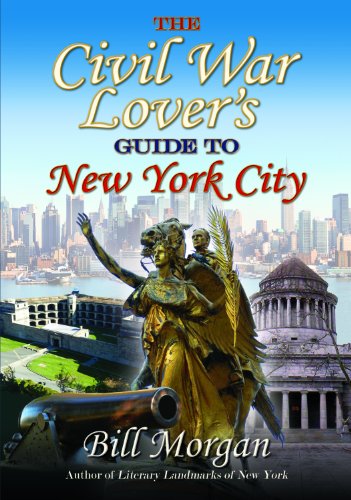
Few Americans associate New York City with the Civil War, but the most populated metropolitan area in the nation, then and now, is filled with scores of monuments, historical sites, and resources directly related to those four turbulent years. Veteran author Bill Morgan’s The Civil War Lover’s Guide to New York City examines more than 150 of these largely overlooked and often forgotten historical gems.New York City has always been full of surprises. Not only was it largely sympathetic to the South, but its citizens twice voted overwhelmingly against Abraham Lincoln and the mayor refused to fly the American flag over city hall on the day of his inauguration. The USS Monitor, the country’s first ironclad, was designed and built here, and General Meade sent troops to the city straight from the Gettysburg battlefield to put down the bloodiest civil rebellion in our history. By the time the war ended, New York had provided more men, equipment, and supplies for the Union than any other city in the North.Morgan’s book takes readers on a nearly endless journey of historical discovery. Walk inside the church where Stonewall Jackson was baptized (which still holds services), visit the building where Lincoln delivered his famous “Cooper Union Speech,” and marvel that the church built by the great abolitionist Henry Ward Beecher is still used for worship. A dozen Civil War era forts still stand (the star-shaped bastion upon which the Statue of Liberty rests was a giant supply depot), and one of them sent relief supplies to besieged Fort Sumter in Charleston. Visit the theater where “Dixie” was first performed and the house where Stephen Crane wrote The Red Badge of Courage.After the war, New York honored the brave men who fought by erecting some of the nation’s most beautiful memorials in honor of William T. Sherman, Admiral David Farragut, and Abraham Lincoln. These and many others still grace parks and plazas around the city. Ulysses S. Grant adopted New York as his home and is buried here in the largest mausoleum in America (which was also the most-visited monument in the country). See the homes where many generals, including Winfield Scott, George McClellan, Daniel Sickles, and even Robert E. Lee, once lived.Complete with full-color photos and maps, Morgan’s lavishly illustrated and designed The Civil War Lover’s Guide to New York City is a must-have book for every student of the Civil War and for every visitor to New York City.
Die Inhaltsangabe kann sich auf eine andere Ausgabe dieses Titels beziehen.
Über die Autorin bzw. den Autor
Bill Morgan specializes in Civil War history.
Auszug. © Genehmigter Nachdruck. Alle Rechte vorbehalten.
The Civil War Lover's Guide to New York City
By Bill MorganSavas Beatie LLC
Copyright © 2013 Bill Morgan
All rights reserved.
ISBN: 978-1-61121-122-1All rights reserved.
Contents
Introduction,
Acknowledgments,
Manhattan,
I. Downtown: South of Worth Street,
II. Downtown: Between Worth and Houston Streets,
III. East Village,
IV. Greenwich Village,
V. Union Square to Madison Square,
VI. Midtown,
VII. Central Park and the Upper East Side,
VIII. The Upper West Side, Harlem, and Washington Heights,
The Bronx,
Brooklyn,
Queens,
Staten Island,
Other Islands,
Appendix A: Some Significant Events,
Appendix B: An Interview with Author Bill Morgan,
Bibliography,
Index,
CHAPTER 1
Manhattan
I. Downtown: South of Worth Street
001. JOHN ERICSSON MONUMENT Battery Park, northeast of Castle Clinton near Battery Place
In 1903, a second version of a statue depicting the inventor John Ericsson (1803–1889) was unveiled in Battery Park. The first version had been dedicated in 1893, but the sculptor, Jonathan Scott Hartley (1845–1912), had been unhappy with that effort and revised his work at his own expense. The larger-than-life bronze statue of Ericsson stands on a granite pedestal on which four relief tablets are mounted. In Ericsson's left hand is a model of his most famous creation, the USS Monitor, and in his right he holds the design blueprints. The bronze reliefs on the base depict Ericsson's most important inventions, which include the screw-propelled warship, the rotary gun carriage, and a steam-driven fire engine.
Ericsson was a Swedish-born inventor who arrived in New York in 1839 and lived in the city for 50 years. From 1844 until 1864, he lived in a building that once stood at 95 Franklin Street near Church Street. On March 9, 1922, a tablet was affixed to that house identifying it as the site where the inventor designed the first ironclad, the USS Monitor. The building has since been demolished and the plaque has disappeared. At the same time, another plaque was placed on the building in which he lived from 1864 until his death in 1889. That location, 36 Beach Street, has now been renamed Ericsson Place in his honor. The plaque there was also destroyed when that building was demolished and replaced by a newer loft building. It included these lines from a letter Ericsson wrote to Abraham Lincoln volunteering to help preserve the Union: "I seek no private advantage or emolument of any kind. Attachment to the Union alone impels me to offer my services at this fearful crisis, my life if need be in the great cause which Providence has called us to defend."
As a naval engineer, Ericsson answered the Union's call to design a new type of fighting vessel. During the first days of the Civil War, news had reached the North that the Confederates were refitting the old USS Merrimack with an iron shell that would withstand artillery fire. The Southerners rechristened the resulting vessel the CSS Virginia, although it would be forever remembered in history as the Merrimack. Initially the Union's Navy Board was skeptical about the seaworthiness of Ericsson's monitor design, but the inventor was confident and commissioned three different companies to manufacture parts for the ship. The Monitor was quickly assembled during the winter of 1861-62 and arrived at the mouth of Chesapeake Bay just in time to defend the Union naval blockade of Richmond and Norfolk from attack by the Virginia.
The fight between the two ironclad warships, the USS Monitor and CSS Virginia, was perhaps the most important naval conflict of the entire Civil War. On March 9, 1862, they engaged in battle near the towns of Hampton and Newport News, just north of Norfolk. For nearly four hours they fired at each other at point-blank range. In the end, the two ships fought to a draw, which meant the South could not break the blockade. Later the Monitor sank in a storm off Cape Hatteras and the Virginia was scuttled by her crew to avoid capture by Northern troops. Realizing the importance of the ironclad, the Union Navy hastily built 66 more, making wooden-hulled warships obsolete.
002. PIER 13, NORTH RIVER Albany and West Streets, looking west
The Hudson River, or North River as it is known to sailors, extended inland as far east as West Street during the Civil War. In the past 150 years, all the area west of that street has been reclaimed from the river, but piers once lined the west side of the street. Pier 13 met West Street at the foot of Liberty near present-day Cedar Street and extended for a few hundred yards into the river. There are records of several smuggling incidents that took place on that particular pier.
One involved a runaway slave who had been captured under the Fugitive Slave Act of 1850 and was being returned to his owner, a Mr. Jameson of Lynchburg, Virginia. Two deputy marshals attracted a large antislavery crowd at Pier 13 when they attempted to drag the man to the SS Yorktown, then ready to weigh anchor. A policeman intervened and asked to see their papers, which the marshals had left in their carriage. While one of the marshals went for the papers, the slave managed to escape from the other and ran off up West Street, much to the delight of the crowd.
During the war, Pier 13 was also frequently used by gun smugglers. On one occasion, five cases of muskets were found waiting to be loaded onto the SS Mexico, a steamer bound for Havana. Customs officials stopped the shipment because they knew that the weapons would be transferred in Cuba to a blockade runner that would take the guns to a Southern port, after which they would be used to kill Union boys. This was not an isolated incident: many shipments of contraband weapons succeeded in making their way through the port of New York to Southern destinations.
003. JAMES HAMLET'S WORKPLACE 58 Water Street, mid-block between Cuyler's Alley and Old Slip
In September 1850, the first black man to be seized under the infamous Fugitive Slave Act of 1850 was James Hamlet, who lived in the Williamsburgh section of Brooklyn. At the time, he was a porter with the firm of Tilton and Maloney, then at 58 Water Street, and it was here that he was arrested. Mary Brown of Baltimore had sent Thomas J. Clare to New York to track down an escaped slave, and Clare said that Hamlet was his man, although it was later proven that Hamlet had been born a free black man. Under the law (which was supported, by such otherwise enlightened Northerners as Daniel Webster, as part of a compromise with southern states), Hamlet was not allowed to testify in his own defense. On October 1, 1850, a large crowd supportive of Hamlet attended a meeting at Mother Zion Church, the oldest black church in the city, where the audience took up a collection to buy his freedom.
John H. Woodgate, a white businessman, went to Baltimore and ransomed Hamlet for $800, $100 of which had been contributed by another free black man, Isaac Hollenbeck. As a result of the Hamlet case, free blacks in the city formed a vigilante group they called the Committee of Thirteen. Their goals were to prevent future kidnappings and to assist fugitive slaves. The case attracted a great deal of publicity and helped bring the humanitarian issues associated with the Fugitive Slave Act to the public's attention.
004. J. & W. SELIGMAN AND COMPANY BUILDING 1 William Street, at the intersection with...
„Über diesen Titel“ kann sich auf eine andere Ausgabe dieses Titels beziehen.
Suchergebnisse für The Civil War Lover's Guide to New York City

Beispielbild für diese ISBN
The Civil War Lover's Guide to New York City
Anbieter: BookHolders, Towson, MD, USA
Verkäuferbewertung 5 von 5 Sternen

Zustand: Good. [ No Hassle 30 Day Returns ][ Ships Daily ] [ Underlining/Highlighting: NONE ] [ Writing: SOME ] [ Edition: First ] Publisher: Savas Beatie Pub Date: 10/19/2013 Binding: Paperback Pages: 208 First edition. Bestandsnummer des Verkäufers 6777928
Gebraucht kaufen
EUR 5,43
Versand gratis
Versand innerhalb von USA
Versand innerhalb von USA
Anzahl: 1 verfügbar
Beispielbild für diese ISBN
The Civil War Loverâs Guide to New York City
Verlag:
Savas Beatie (edition ), 2013
ISBN 10: 1611211220
ISBN 13: 9781611211221
Gebraucht
Paperback
Anbieter: BooksRun, Philadelphia, PA, USA
Verkäuferbewertung 5 von 5 Sternen
Paperback. Zustand: Very Good. It's a well-cared-for item that has seen limited use. The item may show minor signs of wear. All the text is legible, with all pages included. It may have slight markings and/or highlighting. Bestandsnummer des Verkäufers 1611211220-11-1
Gebraucht kaufen
EUR 6,50
Versand gratis
Versand innerhalb von USA
Versand innerhalb von USA
Anzahl: 1 verfügbar
Foto des Verkäufers
The Civil War Loverâs Guide to New York City
Anbieter: Bay State Book Company, North Smithfield, RI, USA
Verkäuferbewertung 5 von 5 Sternen
Zustand: very_good. Bestandsnummer des Verkäufers BSM.1EO90
Gebraucht kaufen
EUR 6,80
Versand gratis
Versand innerhalb von USA
Versand innerhalb von USA
Anzahl: 1 verfügbar
Foto des Verkäufers
The Civil War Loverâs Guide to New York City
Anbieter: Greenworld Books, Arlington, TX, USA
Verkäuferbewertung 5 von 5 Sternen
Zustand: very_good. Fast Free Shipping â" Very Good condition book with a firm cover and clean pages. Shows normal use and some light wear or limited notes markings. A solid, nice copy to enjoy. Bestandsnummer des Verkäufers GWV.1611211220.VG
Gebraucht kaufen
EUR 7,76
Versand gratis
Versand innerhalb von USA
Versand innerhalb von USA
Anzahl: 1 verfügbar
Beispielbild für diese ISBN
The Civil War Loverâs Guide to New York City
Anbieter: HPB-Emerald, Dallas, TX, USA
Verkäuferbewertung 5 von 5 Sternen
paperback. Zustand: Very Good. Connecting readers with great books since 1972! Used books may not include companion materials, and may have some shelf wear or limited writing. We ship orders daily and Customer Service is our top priority! Bestandsnummer des Verkäufers S_409992771
Gebraucht kaufen
EUR 4,79
EUR 3,34 Versand
Versand innerhalb von USA
Versand innerhalb von USA
Anzahl: 1 verfügbar
Beispielbild für diese ISBN
The Civil War Lover's Guide to New York City
Anbieter: ThriftBooks-Atlanta, AUSTELL, GA, USA
Verkäuferbewertung 5 von 5 Sternen
Paperback. Zustand: Very Good. No Jacket. May have limited writing in cover pages. Pages are unmarked. ~ ThriftBooks: Read More, Spend Less. Bestandsnummer des Verkäufers G1611211220I4N00
Gebraucht kaufen
EUR 8,45
Versand gratis
Versand innerhalb von USA
Versand innerhalb von USA
Anzahl: 1 verfügbar
Beispielbild für diese ISBN
The Civil War Lover's Guide to New York City
Anbieter: ThriftBooks-Atlanta, AUSTELL, GA, USA
Verkäuferbewertung 5 von 5 Sternen
Paperback. Zustand: Good. No Jacket. Pages can have notes/highlighting. Spine may show signs of wear. ~ ThriftBooks: Read More, Spend Less. Bestandsnummer des Verkäufers G1611211220I3N00
Gebraucht kaufen
EUR 8,45
Versand gratis
Versand innerhalb von USA
Versand innerhalb von USA
Anzahl: 1 verfügbar
Beispielbild für diese ISBN
The Civil War Lover's Guide to New York City
Anbieter: WorldofBooks, Goring-By-Sea, WS, Vereinigtes Königreich
Verkäuferbewertung 5 von 5 Sternen
Paperback. Zustand: Very Good. The book has been read, but is in excellent condition. Pages are intact and not marred by notes or highlighting. The spine remains undamaged. Bestandsnummer des Verkäufers GOR011172486
Gebraucht kaufen
EUR 3,24
EUR 6,67 Versand
Versand von Vereinigtes Königreich nach USA
Versand von Vereinigtes Königreich nach USA
Anzahl: 1 verfügbar
Beispielbild für diese ISBN
The Civil War Loverâs Guide to New York City
Anbieter: suffolkbooks, Center moriches, NY, USA
Verkäuferbewertung 5 von 5 Sternen
paperback. Zustand: Very Good. Fast Shipping - Safe and Secure 7 days a week! Bestandsnummer des Verkäufers mon0000006438
Gebraucht kaufen
EUR 9,18
EUR 3,55 Versand
Versand innerhalb von USA
Versand innerhalb von USA
Anzahl: 1 verfügbar
Foto des Verkäufers
Civil War Lover's Guide to New York City
Anbieter: GreatBookPrices, Columbia, MD, USA
Verkäuferbewertung 5 von 5 Sternen
Zustand: New. Bestandsnummer des Verkäufers 19192520-n
Neu kaufen
EUR 13,53
EUR 2,35 Versand
Versand innerhalb von USA
Versand innerhalb von USA
Anzahl: Mehr als 20 verfügbar