
Verwandte Artikel zu Conviction: The Murder Trial That Powered Thurgood...
Inhaltsangabe
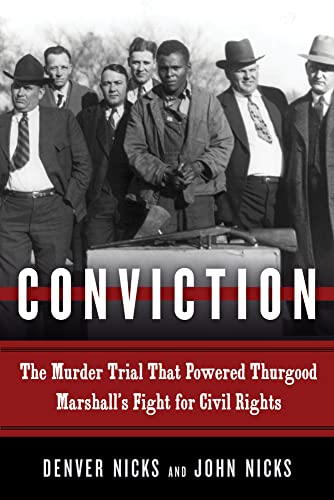
On New Year’s Eve, 1939, a horrific triple murder occurred in rural Oklahoma. Within a matter of days, investigators identified the killers: convicts on work release who had been at a craps game with one of the victims the night before. As anger at authorities grew, political pressure mounted to find a scapegoat. The governor's representative settled on a young black farmhand named W.D. Lyons. Lyons was arrested, tortured into signing a confession, and tried for the murder. The NAACP's new Legal Defense and Education Fund sent its young chief counsel, Thurgood Marshall, to take part in the trial. The organization desperately needed money, and Marshall was convinced that the Lyons case could be a fundraising boon for both the state and national organizations. He was right. The case went on to the US Supreme Court, and the NAACP raised much-needed money from the publicity. Unfortunately, not everything went according to Marshall’s plan. Filled with dramatic plot twists, Conviction is the story of the oft-forgotten case that set Marshall and the NAACP on the path that ultimately led to victory in Brown v. Board of Education and the accompanying social revolution in the United States.
Die Inhaltsangabe kann sich auf eine andere Ausgabe dieses Titels beziehen.
Über die Autorinnen und Autoren
Denver Nicks is a contributor to Rolling Stone, National Geographic Traveler and a former staff writer for Time magazine. He is the author of the books Private: Bradley Manning, Wikileaks, and the Biggest Exposure of Official Secrets in American History and Hot Sauce Nation: America’s Burning Obsession. John Nicks is an attorney in Tulsa, Oklahoma, specializing in oil and gas, personal injury, and civil rights law.
Denver Nicks is a contributor to Rolling Stone, National Geographic Traveler and a former staff writer for Time magazine. He is the author of the books Private: Bradley Manning, Wikileaks, and the Biggest Exposure of Official Secrets in American History and Hot Sauce Nation: America's Burning Obsession. John Nicks is an attorney in Tulsa, Oklahoma, specializing in oil and gas, personal injury, and civil rights law.
Auszug. © Genehmigter Nachdruck. Alle Rechte vorbehalten.
Conviction
The Murder Trial that Powered Thurgood Marshall's Fight for Civil Rights
By Denver NicksChicago Review Press Incorporated
Copyright © 2019 Denver Nicks and John Nicks
All rights reserved.
ISBN: 978-1-61373-833-7All rights reserved.
CHAPTER 1
December 31, 1939 Fort Towson, Choctaw County, Oklahoma
IT WAS COLD that Sunday night in Fort Towson, the town of around five hundred that had grown up near the ruin of the old army fort, along the railroad built in 1870 just south of the abandoned Doaksville settlement.
First settled by French traders, outposts along the Red and Kiamichi Rivers attracted the social outcasts and vagrants that tended to congregate at the frontier, where law was scant and where an abundance of diligence or a shortage of scruples could yield a man a small fortune. In 1824, the United States established Fort Towson near the juncture of the two rivers to protect settlers in western Arkansas from hostile Plains Indians and from the threat of Mexican invasion. At the time that the fort was established at the far western frontier of a young United States, the newly independent Republic of Mexico lay just on the far side of the Red River a few miles to the south. The land soon became the Choctaw Nation after the tribe became the first of many forcibly removed from the southeastern United States and resettled in Indian Territory in the 1830s. It was then used over time as a staging ground for attacks on native tribes to the west, a commercial center and source of law and order for fur trappers and settlers coming in from the east, a hub for the resettlement of the Choctaw and Chickasaw tribes, a staging ground for the US Army during the Mexican-American War, and, briefly, a Confederate headquarters during the Civil War. By 1939 the fort had long ago been abandoned and given back to the forest. But though it had been nearly a century since the military outpost had been put to any real use, the town that had blossomed in its shadow was alive and buzzing. Just fifteen miles down the highway was Hugo, the political and economic hub of Choctaw County.
As in much of the country, and the world, the 1930s had been a disorienting and difficult decade for Oklahoma. The Great Depression, which devastated the global economy, hit particularly hard as a glut in oil production and the general economic decline sent petroleum prices tumbling — incomes in the state saw the third-greatest decline in the country. Decades of ill-advised and destructive farming practices had robbed huge tracts of the western plains of the prairie grasses that for eons had held the earth in place, and when drought struck, the wind picked up the topsoil and carried it away in monstrous clouds that blinded and choked farm animals, and some humans too, as the winds rumbled east across the continent. The Dust Bowl devastation sent pitiful throngs of refugees fleeing to safety in the west, toward California.
In eastern Oklahoma, commodity prices — especially for cotton — that had soared during the First World War tumbled in the 1920s and didn't rebound when the decade kicked over. Between 1935 and 1940, eighty thousand Oklahomans, many of them sharecroppers, fled the state, double or more the number of refugees from any other state in the union. One in six farmers was driven off the land, their abandoned farms snapped up by predatory mortgage and insurance companies and big-money landholders.
And yet, for all the economic hardship, life in Choctaw County trundled on, and by 1939 Hugo was on the cusp of a rebound, with a growing population of nearly six thousand and more than one hundred retail stores and restaurants. Fort Towson had two cotton gins, a few banks, and even two speakeasy beer joints — two more than the law allowed in officially dry Oklahoma. Though Prohibition at the federal level ended in 1933, Oklahomans would continue voting dry, as Okie humorist Will Rogers famously quipped, "as long as they can stagger to the polls." That day wouldn't come until 1959. The town hosted a large general store, where you could buy whiskey under the counter, and a fire department. A little passenger train known as "the dinky" traveled up and down the railroad that ran roughly parallel to Highway 70, stopping at each little town along the way between Hugo and Idabel. Neighbors knew each other by name, and many didn't even have locks on their doors, much less use them. If a passerby happened to be thirsty, it was commonplace to stop in at a neighbor's house and help oneself to a glass of water.
The state that began as a kind of concentration camp for indigenous tribes had become the land of opportunity for white and black settlers alike. After the Civil War, enslaved people in Indian Territory were set free, and over time more former slaves and their descendants moved to the state hoping to carve out a new future apart from the centuries of cruel servitude that had shaped life and culture in the Old South. Many of them succeeded, to a degree, establishing all-black towns like Boley, Rentiesville, and Langston. They found opportunity in pockets, but the racism of turn-of-the-century America ran deep in Oklahoma too. The first act of the Oklahoma legislature after achieving statehood in 1907 was to pass a law that defined anyone with any African ancestry as black and banned interracial marriage and interracial schools. Many of the same attitudes, Jim Crow laws, and racist cultural mores that characterized the Deep South prevailed in Oklahoma too. This was especially true in the state's southeastern quadrant, a region known colloquially as Little Dixie, with the strongest ties to the former Confederacy. The divisions and scars of racist oppression only deepened as Oklahoma's economy soured in the 1920s and '30s.
But on that Sunday night in 1939, residents of Choctaw County, black and white alike, celebrated.
Shortly after sunset a waning gibbous moon glowed over the snow- covered fields and forests surrounding Fort Towson, and the sounds of worshippers issued softly from the Holiness Church. Outside the church, people scuttled about the neighborhood, a small section on the west side of town of about a dozen black families' homes that residents called the Quarters and whites on the other side of town called the Nigger Quarters. They observed New Year's Eve modestly, talking and joking about this and that, or idling near the "troll bridge" that spanned the branch of what locals called Negro Creek, which ran through the community. Some were warm and tipsy, having taken the occasional swig throughout the day from a jug of moonshine, or "wildcat" as people called illegal whiskey in southeastern Oklahoma. Now and then, musicians in Donna Scott's Cafe would strike up a tune, sending music, fleetingly, into the cool evening air, like plumes of warm breath condensing in the cold. A long stretch of icy winter weather finally broke that Sunday, and for the first time in days the temperature rose mercifully above freezing. Just.
A twenty-one-year-old farmhand named Willie D. Lyons — known to his friends as W.D. — lived with his wife at his mother-in-law's house in Hugo, but on New Year's Eve he was in Fort Towson, where he had been raised. He spent a leisurely afternoon in and around the Quarters, hanging out with friends on the neighborhood's dirt streets, sometimes sneaking off to swig from a jug of wildcat hidden in the trees near the creek. He spent a while splitting wood for his wife and went rabbit hunting, without success, in the open pasture just beyond the thicket on the western boundary of the Quarters. As he meandered among the neighborhood's humble...
„Über diesen Titel“ kann sich auf eine andere Ausgabe dieses Titels beziehen.
Suchergebnisse für Conviction: The Murder Trial That Powered Thurgood...

Foto des Verkäufers
Conviction: The Murder Trial That Powered Thurgood Marshall's Fight for Civil Rights
Anbieter: Greenworld Books, Arlington, TX, USA
Verkäuferbewertung 5 von 5 Sternen

Zustand: good. Fast Free Shipping â" Good condition. It may show normal signs of use, such as light writing, highlighting, or library markings, but all pages are intact and the book is fully readable. A solid, complete copy that's ready to enjoy. Bestandsnummer des Verkäufers GWV.1613738331.G
Gebraucht kaufen
EUR 7,01
Versand gratis
Versand innerhalb von USA
Versand innerhalb von USA
Anzahl: 1 verfügbar
Foto des Verkäufers
Conviction: The Murder Trial That Powered Thurgood Marshall's Fight for Civil Rights
Anbieter: Greenworld Books, Arlington, TX, USA
Verkäuferbewertung 5 von 5 Sternen
Zustand: like_new. Fast Free Shipping â" Excellent condition book with clean cover and pages. Barely handled, with minimal wear. An outstanding copy, close to enjoy! Bestandsnummer des Verkäufers GWV.1613738331.LN
Gebraucht kaufen
EUR 7,01
Versand gratis
Versand innerhalb von USA
Versand innerhalb von USA
Anzahl: 1 verfügbar
Beispielbild für diese ISBN
Conviction: The Murder Trial That Powered Thurgood Marshall's Fight for Civil Rights
Anbieter: ThriftBooks-Dallas, Dallas, TX, USA
Verkäuferbewertung 5 von 5 Sternen
Hardcover. Zustand: Very Good. No Jacket. Former library book; May have limited writing in cover pages. Pages are unmarked. ~ ThriftBooks: Read More, Spend Less. Bestandsnummer des Verkäufers G1613738331I4N10
Gebraucht kaufen
EUR 7,69
Versand gratis
Versand innerhalb von USA
Versand innerhalb von USA
Anzahl: 1 verfügbar
Beispielbild für diese ISBN
Conviction: The Murder Trial That Powered Thurgood Marshall's Fight for Civil Rights
Anbieter: St Vincent de Paul of Lane County, Eugene, OR, USA
Verkäuferbewertung 5 von 5 Sternen
Zustand: Good. PLEASE NOTE: FORMER LIBRARY COPY, MAY HAVE STICKERS AND INDENTIFYING STAMPS AND/OR MARKERS ON IT BUT BOOK REMAINS IN GOOD READABLE CONDITION. Former Library book. Hardcover 100% of proceeds go to charity! Good condition with all pages in tact. Item shows signs of use and may have cosmetic defects. Bestandsnummer des Verkäufers P-07-3642
Gebraucht kaufen
EUR 4,54
EUR 3,52 Versand
Versand innerhalb von USA
Versand innerhalb von USA
Anzahl: 1 verfügbar
Beispielbild für diese ISBN
Conviction: The Murder Trial That Powered Thurgood Marshall's Fight for Civil Rights
Anbieter: The Maryland Book Bank, Baltimore, MD, USA
Verkäuferbewertung 5 von 5 Sternen
hardcover. Zustand: Very Good. Used - Very Good. Bestandsnummer des Verkäufers 4-H-1-0670
Gebraucht kaufen
EUR 4,06
EUR 4,14 Versand
Versand innerhalb von USA
Versand innerhalb von USA
Anzahl: 1 verfügbar
Beispielbild für diese ISBN
Conviction : The Murder Trial That Powered Thurgood Marshall's Fight for Civil Rights
Verlag:
Chicago Review Press, Incorporated, 2019
ISBN 10: 1613738331
ISBN 13: 9781613738337
Gebraucht
Hardcover
Anbieter: Better World Books: West, Reno, NV, USA
Verkäuferbewertung 5 von 5 Sternen
Zustand: Very Good. Former library copy. Pages intact with possible writing/highlighting. Binding strong with minor wear. Dust jackets/supplements may not be included. Includes library markings. Stock photo provided. Product includes identifying sticker. Better World Books: Buy Books. Do Good. Bestandsnummer des Verkäufers 40631289-6
Gebraucht kaufen
EUR 8,25
Versand gratis
Versand innerhalb von USA
Versand innerhalb von USA
Anzahl: 1 verfügbar
Beispielbild für diese ISBN
Conviction : The Murder Trial That Powered Thurgood Marshall's Fight for Civil Rights
Verlag:
Chicago Review Press, Incorporated, 2019
ISBN 10: 1613738331
ISBN 13: 9781613738337
Gebraucht
Hardcover
Anbieter: Better World Books, Mishawaka, IN, USA
Verkäuferbewertung 5 von 5 Sternen
Zustand: Very Good. Pages intact with possible writing/highlighting. Binding strong with minor wear. Dust jackets/supplements may not be included. Stock photo provided. Product includes identifying sticker. Better World Books: Buy Books. Do Good. Bestandsnummer des Verkäufers 17353447-6
Gebraucht kaufen
EUR 8,25
Versand gratis
Versand innerhalb von USA
Versand innerhalb von USA
Anzahl: 1 verfügbar
Beispielbild für diese ISBN
Conviction : The Murder Trial That Powered Thurgood Marshall's Fight for Civil Rights
Verlag:
Chicago Review Press, Incorporated, 2019
ISBN 10: 1613738331
ISBN 13: 9781613738337
Gebraucht
Hardcover
Anbieter: Better World Books, Mishawaka, IN, USA
Verkäuferbewertung 5 von 5 Sternen
Zustand: Very Good. Former library copy. Pages intact with possible writing/highlighting. Binding strong with minor wear. Dust jackets/supplements may not be included. Includes library markings. Stock photo provided. Product includes identifying sticker. Better World Books: Buy Books. Do Good. Bestandsnummer des Verkäufers 40631289-6
Gebraucht kaufen
EUR 8,25
Versand gratis
Versand innerhalb von USA
Versand innerhalb von USA
Anzahl: 2 verfügbar
Beispielbild für diese ISBN
Conviction: The Murder Trial That Powered Thurgood Marshall's Fight for Civil Rights
Anbieter: HPB-Emerald, Dallas, TX, USA
Verkäuferbewertung 5 von 5 Sternen
hardcover. Zustand: Very Good. Connecting readers with great books since 1972! Used books may not include companion materials, and may have some shelf wear or limited writing. We ship orders daily and Customer Service is our top priority! Bestandsnummer des Verkäufers S_473002272
Gebraucht kaufen
EUR 7,97
EUR 3,31 Versand
Versand innerhalb von USA
Versand innerhalb von USA
Anzahl: 1 verfügbar
Beispielbild für diese ISBN
Conviction: The Murder Trial That Powered Thurgood Marshall's Fight for Civil Rights
Anbieter: Running Numbers, Grand Rapids, MI, USA
Verkäuferbewertung 5 von 5 Sternen
hardcover. Zustand: Good. Book is new but has some shelfwear. Ships fast! Bestandsnummer des Verkäufers mon0000006310
Gebraucht kaufen
EUR 9,08
EUR 4,41 Versand
Versand innerhalb von USA
Versand innerhalb von USA
Anzahl: 4 verfügbar