
Verwandte Artikel zu Quantum Physics for Poets
Inhaltsangabe
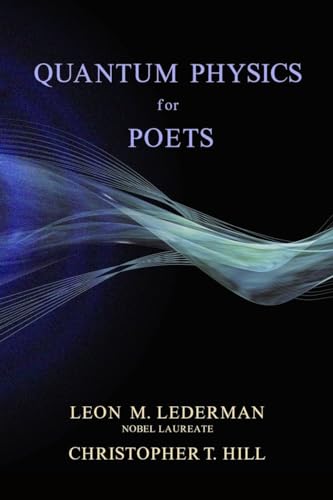
Quantum theory is the bedrock of contemporary physics and the basis of understanding matter in its tiniest dimensions and the vast universe as a whole. But for many, the theory remains an impenetrable enigma.
Now, two physicists seek to remedy this situation by both drawing on their scientific expertise and their talent for communicating science to the general reader. In this lucid, informative book, designed for the curious, they make the seemingly daunting subject of quantum physics accessible, appealing, and exciting.
Their story is partly historical, covering the many "Eureka" moments when great scientists—Max Planck, Albert Einstein, Niels Bohr, Werner Heisenberg, Erwin Schrödinger, and others—struggled to come to grips with the bizarre realities that quantum research revealed. Although their findings were indisputably proven in experiments, they were so strange and counterintuitive that Einstein refused to accept quantum theory, despite its great success.
The authors explain the many strange and even eerie aspects of quantum reality at the subatomic level, from "particles" that can be many places simultaneously and sometimes act more like waves, to the effect that a human can have on their movements by just observing them! Finally, the authors delve into quantum physics’ latest and perhaps most breathtaking offshoots—field theory and string theory. The intricacies and ramifications of these two theories will give the reader much to ponder.
In addition, the authors describe the diverse applications of quantum theory in its almost countless forms of modern technology throughout the world. Using eloquent analogies and illustrative examples, this book renders even the most profound reaches of quantum theory understandable and something for us all to savor.
Die Inhaltsangabe kann sich auf eine andere Ausgabe dieses Titels beziehen.
Über die Autorin bzw. den Autor
Leon M. Lederman, Nobel Laureate (Batavia, IL) is the author of Beyond the God Particle, Quantum Physics for Poets, and Symmetry and the Beautiful Universe(coauthored with Christopher T. Hill), as well as The God Particle (with Dick Teresi). He has served as the editor of Portraits of Great American Scientists and a contributor to Science Literacy for the Twenty-First Century. He is formerly the Resident Scholar at the Illinois Mathematics and Science Academy and Pritzker Professor of Science at the Illinois Institute of Technology, and he is director emeritus of Fermi National Accelerator Laboratory.
Christopher T. Hill, PhD (Batavia, IL) is the coauthor with Leon M. Lederman of Beyond the God Particle, Quantum Physics for Poets, and Symmetry and the Beautiful Universe. He is a theoretical physicist (Scientist III) and the former head of Theoretical Physics at Fermi National Accelerator Laboratory.
Auszug. © Genehmigter Nachdruck. Alle Rechte vorbehalten.
Quantum Physics for Poets
By LEON M. LEDERMAN CHRISTOPHER T. HILLPrometheus Books
Copyright © 2011 Leon M. Lederman and Chrisopher T. HillAll right reserved.
ISBN: 978-1-61614-233-9
Contents
ACKNOWLEDGMENTS..............................................................11CHAPTER 1. If You're Not Shocked, You Haven't Understood.....................13CHAPTER 2. Before the Quantum................................................41CHAPTER 3. Light and Its Various Curiosities.................................55CHAPTER 4: Rebels Storm the Office...........................................83CHAPTER 5: Heisenberg's Uncertainty..........................................119CHAPTER 6: Quantum Science at Work...........................................149CHAPTER 7 Controversy: Einstein vs. Bohr ... and Bell........................181CHAPTER 8: Modern Quantum Physics............................................219CHAPTER 9: Gravity and Quantum Theory: Strings...............................249CHAPTER 10: Quantum Physics for Millennium III...............................271APPENDIX: SPIN...............................................................289NOTES........................................................................299INDEX........................................................................329INDEX OF FIGURES.............................................................337
Chapter One
If You're Not Shocked, You Haven't Understood
In the TV series Star Trek, and in its subsequent derivatives, the starship Enterprise travels throughout intergalactic space. Its five-year mission of exploration is to go where no human being has gone before. Using the imaginative technology of the distant future, the crew of the Enterprise travels at warp speeds, many times the speed of light, calls home to Star Fleet Command from a distance of many parsecs, using "subspace communication," and scans approaching vessels and the surfaces of new planets, occasionally defending itself against hostile forces with photon torpedoes. And, perhaps most innovative of all, the starship crew members can "beam" themselves to the surfaces of many new worlds to explore strange landscapes and have face-to-face meetings with the leaders of alien civilizations, which are sometimes more, sometimes less, advanced.
In not one of the many episodes of Star Trek, however, or to our knowledge any other science fiction saga, has there ever been as bizarre an exploration of the universe as that which actually took place on planet Earth in the period 1900 to 1930 CE. The distances traveled by the explorers of the early twentieth-century scientific age were similarly vast, but not in the sense of the large scales of billions and billions of light-years of intergalactic space. Rather, it was a voyage into the deep, the unknown, and the unexplored space of the smallest objects that make up the entire universe, down to the scale of billionths and billionths of an inch.
The advancing technology and scientific skills at the turn of the nineteenth to the twentieth century enabled these scientist explorers to, in a sense, visit for the first time the domain of a remarkable and new alien civilization, the world of the atom. What they encountered was incredible, existential, and surreal: it was as if the art, music, and literature of the age—the eyes of Picasso, the ears of Schoenberg, and the pen of Kafka—were in lockstep with the physicists unraveling a weird, bizarre, and unfamiliar new world within the innermost depths of nature. Virtually all of science's sophisticated and well-honed "classical" knowledge of the laws of physics, with its rules acquired and polished over the previous three hundred years, proved to be dead wrong in this strange new world. It was as if Captain Kirk and his Enterprise mates had landed on a planet in which the very laws of nature were as different as those encountered by Alice after she fell down the rabbit hole. It was a new kind of "dream logic" reality. Objects placed over here appeared over there, instantaneously. A smooth, hard stone began to blur and diffuse into seeming nothingness as scientists watched. Solid walls could be promenaded straight through, effortlessly. Things jumped wildly about in space and time.
Plenty of "particles" of matter existed in this strange new world, swarming around, to and fro. By carefully observing these particles the scientists learned that they did not simply pass uniformly from starting point A to arrive at a well-defined time at destination point B. Motion was nothing as Galileo or Newton had conceived it three hundred years earlier. Instead, the "fundamental particles" of nature, out of which everything is composed, such as the tiny electron, were seen to explore all possible paths in getting from A to B—all at once! Particles were always nowhere and yet everywhere at the same time. They arrived at their destinations with a spooky knowledge of every available path they could have, or might have, taken, with no certainty as to which path they actually did take. The scientists toyed with the particles, blocking off some of the available paths they might have taken from A to B, and they found that their arrival at B could be influenced in this way—merely changing one of the many available paths a particle may have taken, whether it did so or not, could cause it to arrive at B more often—or not at all.
Particles, little pinpoints of matter with no apparent or discernable internal clockwork or organs, leave sharp tracks in detectors and little dots of light on fluorescent screens and cause Geiger counters to go "click ... click ... click, click ... click." Yet, these minute dots of matter now also appear to be waves. They display wavelike, cloudlike, blurry patterns of motion, with crests and troughs like the waves on the surface of a lake or the sea. And things that were thought to be waves, like radio waves and light, were now found to be particles. Waves became particles and particles became waves. Neither, or, yet both, and all at once. It was as if the radical artists, composers, and writers of the age were scripting the laws of nature.
In short, the world dramatically changed before the eyes of the early twentieth-century explorers—eyes that now peered through highly sophisticated instruments. The universe was now seen to work in a way starkly different from what science had taught over the previous three centuries of enlightenment, beginning with the Renaissance. This grand change of our understanding of the physical world marked the arrival of an entirely different way to view nature and was now giving rise to the birth of a whole new and more fundamental science—quantum physics.
Physicists wrestling with the new experimental data and theoretical ideas about the atom strained to use human language and metaphors that had been invented in the traditional world of the old classical era of Galileo and Newton, but they found them hopelessly inadequate to describe their new experiences. The world now seemed to require descriptors such as fuzzy, uncertain, and spooky action-at-a-distance, as if ghosts were running around influencing the outcome of experiments.
There emerged a new concept called "wave particle duality" to reconcile why waves were sometimes particles and why particles were sometimes waves, though scientists were still bewildered. So bizarre are the consequences of quantum physics that,...
„Über diesen Titel“ kann sich auf eine andere Ausgabe dieses Titels beziehen.
Suchergebnisse für Quantum Physics for Poets

Beispielbild für diese ISBN
Quantum Physics for Poets
Anbieter: Cronus Books, Carson City, NV, USA
Verkäuferbewertung 5 von 5 Sternen

hardcover. Zustand: New. ~ NEW Inside and Out! Clean & Crisp Pages. (E-mail for more info./pics). Bestandsnummer des Verkäufers 260912042
Beispielbild für diese ISBN
Quantum Physics for Poets
Anbieter: HPB Inc., Dallas, TX, USA
Verkäuferbewertung 5 von 5 Sternen
Hardcover. Zustand: Very Good. Connecting readers with great books since 1972! Used books may not include companion materials, and may have some shelf wear or limited writing. We ship orders daily and Customer Service is our top priority! Bestandsnummer des Verkäufers S_483455425
Gebraucht kaufen
EUR 12,09
EUR 3,33 Versand
Versand innerhalb von USA
Versand innerhalb von USA
Anzahl: 1 verfügbar
Foto des Verkäufers
Quantum Physics for Poets
Anbieter: Goodwill San Antonio, San Antonio, TX, USA
Verkäuferbewertung 5 von 5 Sternen
Zustand: good. Bestandsnummer des Verkäufers SANV.1616142332.G
Gebraucht kaufen
EUR 12,14
EUR 3,55 Versand
Versand innerhalb von USA
Versand innerhalb von USA
Anzahl: 1 verfügbar
Foto des Verkäufers
Quantum Physics for Poets
Anbieter: -OnTimeBooks-, Phoenix, AZ, USA
Verkäuferbewertung 5 von 5 Sternen
Zustand: good. A copy that has been read, remains in good condition. All pages are intact, and the cover is intact. The spine and cover show signs of wear. Pages can include notes and highlighting and show signs of wear, and the copy can include "From the library of" labels or previous owner inscriptions. 100% GUARANTEE! Shipped with delivery confirmation, if you're not satisfied with purchase please return item! Ships via media mail. Bestandsnummer des Verkäufers OTV.1616142332.G
Gebraucht kaufen
EUR 15,74
Versand gratis
Versand innerhalb von USA
Versand innerhalb von USA
Anzahl: 1 verfügbar
Foto des Verkäufers
Quantum Physics for Poets
Anbieter: clickgoodwillbooks, Indianapolis, IN, USA
Verkäuferbewertung 4 von 5 Sternen

Zustand: good. Used - Good: A book that has been read but is in good condition. Very minimal damage to the cover including scuff marks, but no holes or tears. The dust jacket for hard covers may not be included. Binding has minimal wear. The majority of pages are undamaged with minimal creasing or tearing, minimal pencil underlining of text, no highlighting of text, no writing in margins. No missing pages. Bestandsnummer des Verkäufers CSIV.1616142332.G
Gebraucht kaufen
EUR 12,27
EUR 3,55 Versand
Versand innerhalb von USA
Versand innerhalb von USA
Anzahl: 1 verfügbar
Beispielbild für diese ISBN
Quantum Physics for Poets
Anbieter: Textbooks_Source, Columbia, MO, USA
Verkäuferbewertung 5 von 5 Sternen
hardcover. Zustand: Good. First Edition. Ships in a BOX from Central Missouri! May not include working access code. Will not include dust jacket. Has used sticker(s) and some writing or highlighting. UPS shipping for most packages, (Priority Mail for AK/HI/APO/PO Boxes). Bestandsnummer des Verkäufers 001187170U
Gebraucht kaufen
EUR 15,11
EUR 3,55 Versand
Versand innerhalb von USA
Versand innerhalb von USA
Anzahl: 2 verfügbar
Beispielbild für diese ISBN
Quantum Physics for Poets Format: Hardcover
Anbieter: INDOO, Avenel, NJ, USA
Verkäuferbewertung 5 von 5 Sternen
Zustand: As New. Unread copy in mint condition. Bestandsnummer des Verkäufers SS9781616142339
Gebraucht kaufen
EUR 25,87
Versand gratis
Versand innerhalb von USA
Versand innerhalb von USA
Anzahl: Mehr als 20 verfügbar
Beispielbild für diese ISBN
Quantum Physics for Poets Format: Hardcover
Anbieter: INDOO, Avenel, NJ, USA
Verkäuferbewertung 5 von 5 Sternen
Zustand: New. Brand New. Bestandsnummer des Verkäufers 9781616142339
Neu kaufen
EUR 25,96
Versand gratis
Versand innerhalb von USA
Versand innerhalb von USA
Anzahl: Mehr als 20 verfügbar
Beispielbild für diese ISBN
Quantum Physics for Poets
Anbieter: Textbooks_Source, Columbia, MO, USA
Verkäuferbewertung 5 von 5 Sternen
hardcover. Zustand: New. First Edition. Ships in a BOX from Central Missouri! UPS shipping for most packages, (Priority Mail for AK/HI/APO/PO Boxes). Bestandsnummer des Verkäufers 001187170N
Neu kaufen
EUR 22,89
EUR 3,55 Versand
Versand innerhalb von USA
Versand innerhalb von USA
Anzahl: 9 verfügbar
Beispielbild für diese ISBN
Quantum Physics for Poets
Anbieter: Chiron Media, Wallingford, Vereinigtes Königreich
Verkäuferbewertung 5 von 5 Sternen
Hardcover. Zustand: New. Brand new book, sourced directly from publisher. Dispatch time is 24-48 hours from our warehouse. Book will be sent in robust, secure packaging to ensure it reaches you securely. Bestandsnummer des Verkäufers 6666-GRD-9781616142339
Neu kaufen
EUR 19,93
EUR 7,64 Versand
Versand von Vereinigtes Königreich nach USA
Versand von Vereinigtes Königreich nach USA
Anzahl: 1 verfügbar