
Verwandte Artikel zu Life Without Oil: Why We Must Shift to a New Energy...
Inhaltsangabe
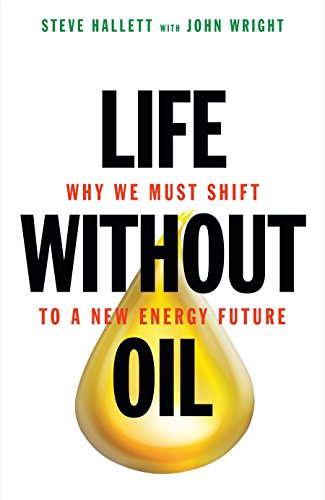
By the end of the 21st century, our oil and natural gas supplies will be virtually nonexistent, and limited coal supplies will be restricted to only a handful of countries. The authors - an environmental scientist and veteran journalist - make abundantly clear that we must plan for a future without reliance on oil. They make a compelling case that the key determinant of our global economy is not so much the invisible hand of the marketplace but the inexorable laws of ecology. Although the coming decades will be a time of much disruption and change of lifestyle, in the end we may learn a wiser, more sustainable stewardship of our natural resources.
This timely, sobering, yet constructive discussion of energy and ecology offers a realistic vision of the near future and many important lessons about the limits of our resources.
Die Inhaltsangabe kann sich auf eine andere Ausgabe dieses Titels beziehen.
Über die Autorin bzw. den Autor
Steve Hallett is an associate professor in the Department of Botany and Plant Pathology at Purdue University. His previous appointments include McGill University, Canada, and the University of Queensland, Australia.
John Wright is a journalist specializing in energy and environmental issues with over twenty-five years of experience. He is currently the Latin America news editor for Energy News Today, but has also worked for Knight-Ridder, Dow Jones, and the Associated Press. He is the author of The Obama Haters.
Auszug. © Genehmigter Nachdruck. Alle Rechte vorbehalten.
LIFE WITHOUT OIL
WHY WE MUST SHIFT TO A NEW ENERGY FUTUREBy STEVE HALLETT JOHN WRIGHTPrometheus Books
Copyright © 2011 Steve Hallett and John WrightAll right reserved.
ISBN: 978-1-61614-401-2
Contents
Prologue. The Invisible Hand...........................................13PART I: A BRIEF HISTORY OF PROGRESS....................................27Chapter 1. Seeds of Civilization.......................................29Chapter 2. The Ghosts of Empires Passed................................41Chapter 3. The Fossil Fuels Savings Bank...............................73Chapter 4. Divorced from Nature........................................89PART II: THE PETROLEUM INTERVAL........................................111Chapter 5. The Great Energy Transition.................................117Chapter 6. The Ecological Debt.........................................179Chapter 7. The View from Mauna Loa.....................................197PART III: THE WEALTH OF NATIONS........................................215Chapter 8. Collision Course............................................219Chapter 9. Around the World in Eighty Depressions......................247Chapter 10. End of Empire..............................................295PART IV: A GENERAL THEORY..............................................303Chapter 11. Ecology Is the Foundation of Economics.....................307Chapter 12. A New Foundation...........................................323Chapter 13. Reconnecting...............................................353Acknowledgments........................................................373Notes..................................................................375Index..................................................................407
Chapter One
SEEDS OF CIVILIZATION
IN THE BEGINNING ...
Nature has no mercy at all. Nature says "I am going to snow. If you have on a bikini and no snow shoes, that's tough. I am going to snow anyway." Maya Angelou
It's quite ironic that we are concerned about changes in the concentration of gases in the atmosphere. The composition of the earth's atmosphere has undergone much bigger upheaval than the meager increases in greenhouse gases that are currently getting us all excited. The planet has been much hotter than it is now. It has also been much colder. The very early earth had no oceans, had an atmosphere devoid of oxygen, was scorching hot, and was frequently bombarded by debris left over from the formation of the solar system. The "first atmosphere," primarily hydrogen and helium, was lost to space; and the "second atmosphere," formed by the release of gases from volcanoes and asteroid impacts, was a toxic brew of ammonia, methane, water vapor, carbon dioxide, and nitrogen. Nonetheless, it was in this seemingly inhospitable environment that life arose.
Molecules that could copy themselves were eventually formed, and these replicators became increasingly common in the primordial soup. The replicators were organic, digestible, and devoid of structural strength, yet they have turned out to be longer-lived than diamonds or granite. One of these replicators has copied itself through the ages and now finds itself in every living thing as DNA. It has survived for four billion years.
The natural selection of variant forms—evolution—resulted in replicators that could consume their counterparts and protect themselves from being consumed. Replicators interacted as predator and prey, as parasite and host, and formed the bodies and behaviors of the diaspora of life on earth. Humans are just one form in which those ancient replicators live out their primordial game of thermodynamics; but what a game of thermodynamics it has become: humans now seek control over the energy of the biosphere. So it is also ironic that we are nervous about descending into a global energy crisis. We are bathed in, and surrounded by, more energy than we could ever need.
Earth's "third atmosphere" was formed by the first global polluters, a group of microbes that had evolved an ingenious method of harnessing the energy of the sun. These organisms—photosynthesizers—consumed carbon dioxide to build their bodies, and the concentration of this gas gradually declined. Oxygen, which had been virtually absent from the atmosphere until then, was slowly released as their waste.
The atmosphere is now 20 percent oxygen: all of it made by photosynthesizing bacteria, protists, and plants. The first photosynthesizers were horrendous polluters that changed the climate of the planet and caused the extinction of untold numbers of species. We tend to think of them in a kind light because, by releasing copious volumes of oxygen into the atmosphere, the first global polluters paved the way for the evolution that led to us. The atmospheric concentrations of oxygen and carbon dioxide have remained more or less constant for the last few million years; the amount of oxygen released in photosynthesis balanced by the amount consumed in respiration.
Until recently, that is.
At the end of the Jurassic period, sixty-five million years ago, a massive asteroid smashed into the shallow sea between the continents of North and South America, where now sits the town of Chicxulub, Mexico. Two geological findings converge on this date. First, the fossil record of the dinosaurs ceases suddenly and completely. Indeed, fully two-thirds of the species of life on earth became extinct at that time, not just the dinosaurs. Second, rock strata of the same age show a flush of the heavy metal iridium. Iridium is very rare on earth but is found in asteroids and other space debris. The Chicxulub asteroid created a huge pall of dust in the atmosphere that blocked out the sun and threw the planet into a short but deep winter. The poor, old, cold-blooded dinosaurs froze and starved. The dust pall, as it settled, left a layer of iridium to mark the event.
The rest is history. Cute, little, recently evolved, warm-blooded mammals made it through the postimpact winter, evolved into less-cute mammals, and finally evolved into us. It's interesting to imagine what the world would have been like had the Chicxulub asteroid missed. Would cold-blooded reptiles be living in cities, playing sports, writing books, fretting about the future of a planet they were destroying? Tyrannosaurus Beck? A scary thought.
The asteroid that ended the dinosaurs was only one of a number that have struck our planet. An even more dramatic event took place two hundred million years earlier when nearly 95 percent of the earth's species were suddenly extinguished in an event known as the Great Permian extinction. NASA scientists estimate that significant asteroid impacts may occur every hundred thousand years or so. In fact, bad news might be coming soon. Astronomers declare it a 250,000:1 chance that the asteroid Apophis will strike the earth on April 13, 2036.
No matter how patient you are, it's hard to sense the movement of the continents (unless you are unfortunate enough to witness a tsunami or an earthquake). Billions of years our ancestry may be, but our spheres of influence and experiences are short-term. We now know that the continents drift around the planet like dinner plates floating on a sea of syrup. In its lifetime, the earth has spawned and swallowed entire continents. In only the last hundred and fifty million years (the last thirtieth of the planet's lifetime), the supercontinent of Pangaea split...
„Über diesen Titel“ kann sich auf eine andere Ausgabe dieses Titels beziehen.
Suchergebnisse für Life Without Oil: Why We Must Shift to a New Energy...

Beispielbild für diese ISBN
Life Without Oil: Why We Must Shift to a New Energy Future
Anbieter: ThriftBooks-Dallas, Dallas, TX, USA
Verkäuferbewertung 5 von 5 Sternen

Hardcover. Zustand: Fair. No Jacket. Former library book; Readable copy. Pages may have considerable notes/highlighting. ~ ThriftBooks: Read More, Spend Less. Bestandsnummer des Verkäufers G1616144017I5N10
Gebraucht kaufen
EUR 9,09
Versand gratis
Versand innerhalb von USA
Versand innerhalb von USA
Anzahl: 1 verfügbar
Beispielbild für diese ISBN
Life Without Oil : Why We Must Shift to a New Energy Future
Verlag:
Prometheus Books, Publishers, 2011
ISBN 10: 1616144017
ISBN 13: 9781616144012
Gebraucht
Hardcover
Anbieter: Better World Books, Mishawaka, IN, USA
Verkäuferbewertung 5 von 5 Sternen
Zustand: Good. Former library copy. Pages intact with minimal writing/highlighting. The binding may be loose and creased. Dust jackets/supplements are not included. Includes library markings. Stock photo provided. Product includes identifying sticker. Better World Books: Buy Books. Do Good. Bestandsnummer des Verkäufers 1548013-6
Gebraucht kaufen
EUR 9,09
Versand gratis
Versand innerhalb von USA
Versand innerhalb von USA
Anzahl: 1 verfügbar
Beispielbild für diese ISBN
Life Without Oil: Why We Must Shift to a New Energy Future
Anbieter: Once Upon A Time Books, Siloam Springs, AR, USA
Verkäuferbewertung 4 von 5 Sternen

hardcover. Zustand: Acceptable. This is a used book. It may contain highlighting/underlining and/or the book may show heavier signs of wear . It may also be ex-library or without dustjacket. This is a used book. It may contain highlighting/underlining and/or the book may show heavier signs of wear . It may also be ex-library or without dustjacket. Bestandsnummer des Verkäufers mon0001343154
Gebraucht kaufen
EUR 6,21
EUR 3,53 Versand
Versand innerhalb von USA
Versand innerhalb von USA
Anzahl: 1 verfügbar
Beispielbild für diese ISBN
Life Without Oil: Why We Must Shift to a New Energy Future
Anbieter: Amazing Books Pittsburgh, Pittsburgh, PA, USA
Verkäuferbewertung 5 von 5 Sternen
hardcover. Zustand: Very Good. Book is in very good condition. Pages are clean and unmarked. Some light scuffing on front of dust jacket, no rips or tears. Hardcover. LW. Bestandsnummer des Verkäufers D26499
Gebraucht kaufen
EUR 7,71
EUR 3,56 Versand
Versand innerhalb von USA
Versand innerhalb von USA
Anzahl: 1 verfügbar
Foto des Verkäufers
Life Without Oil: Why We Must Shift to a New Energy Future (Hardback or Cased Book)
Anbieter: BargainBookStores, Grand Rapids, MI, USA
Verkäuferbewertung 5 von 5 Sternen
Hardback or Cased Book. Zustand: New. Life Without Oil: Why We Must Shift to a New Energy Future. Book. Bestandsnummer des Verkäufers BBS-9781616144012
Foto des Verkäufers
Life Without Oil: Why We Must Shift to a New Energy Future
Anbieter: Southampton Books, Sag Harbor, NY, USA
Verkäuferbewertung 5 von 5 Sternen
Hardcover. Zustand: Like New. First Edition. First Edition, First Printing. Published by Prometheus, 2011. Octavo. Hardcover. Book is like new. Dust jacket is like new. Bestandsnummer des Verkäufers 556112
Gebraucht kaufen
EUR 22,99
EUR 4,46 Versand
Versand innerhalb von USA
Versand innerhalb von USA
Anzahl: 1 verfügbar
Beispielbild für diese ISBN
Life Without Oil
Verlag:
Globe Pequot Publishing Group Inc, 2011
ISBN 10: 1616144017
ISBN 13: 9781616144012
Neu
Hardcover
Anbieter: PBShop.store US, Wood Dale, IL, USA
Verkäuferbewertung 5 von 5 Sternen
HRD. Zustand: New. New Book. Shipped from UK. Established seller since 2000. Bestandsnummer des Verkäufers CX-9781616144012
Beispielbild für diese ISBN
Life Without Oil
Anbieter: PBShop.store UK, Fairford, GLOS, Vereinigtes Königreich
Verkäuferbewertung 5 von 5 Sternen
HRD. Zustand: New. New Book. Shipped from UK. Established seller since 2000. Bestandsnummer des Verkäufers CX-9781616144012
Neu kaufen
EUR 25,41
EUR 6,93 Versand
Versand von Vereinigtes Königreich nach USA
Versand von Vereinigtes Königreich nach USA
Anzahl: 15 verfügbar
Beispielbild für diese ISBN
Life Without Oil
Print-on-DemandAnbieter: Majestic Books, Hounslow, Vereinigtes Königreich
Verkäuferbewertung 4 von 5 Sternen
Zustand: New. Print on Demand pp. 435 Illus. Bestandsnummer des Verkäufers 5626908
Neu kaufen
EUR 27,35
EUR 7,67 Versand
Versand von Vereinigtes Königreich nach USA
Versand von Vereinigtes Königreich nach USA
Anzahl: 4 verfügbar
Beispielbild für diese ISBN
Life Without Oil
Print-on-DemandAnbieter: Biblios, Frankfurt am main, HESSE, Deutschland
Verkäuferbewertung 4 von 5 Sternen
Zustand: New. PRINT ON DEMAND pp. 435. Bestandsnummer des Verkäufers 182253769
Neu kaufen
EUR 26,28
EUR 9,95 Versand
Versand von Deutschland nach USA
Versand von Deutschland nach USA
Anzahl: 4 verfügbar