
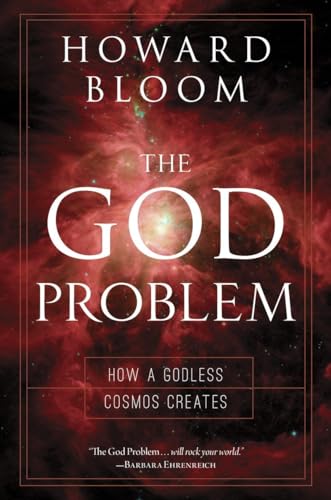
Verwandte Artikel zu The God Problem: How a Godless Cosmos Creates
Inhaltsangabe
God’s war crimes, Aristotle’s sneaky tricks, Einstein’s pajamas, information theory’s blind spot, Stephen Wolfram’s new kind of science, and six monkeys at six typewriters getting it wrong. What do these have to do with the birth of a universe and with your need for meaning? Everything, as you’re about to see.
How does the cosmos do something it has long been thought only gods could achieve? How does an inanimate universe generate stunning new forms and unbelievable new powers without a creator? How does the cosmos create?
That’s the central question of this book, which finds clues in strange places. Why A does not equal A. Why one plus one does not equal two. How the Greeks used kickballs to reinvent the universe. And the reason that Polish-born Benoît Mandelbrot—the father of fractal geometry—rebelled against his uncle.
You’ll take a scientific expedition into the secret heart of a cosmos you’ve never seen. Not just any cosmos. An electrifyingly inventive cosmos. An obsessive-compulsive cosmos. A driven, ambitious cosmos. A cosmos of colossal shocks. A cosmos of screaming, stunning surprise. A cosmos that breaks five of science’s most sacred laws. Yes, five. And you’ll be rewarded with author Howard Bloom’s provocative new theory of the beginning, middle, and end of the universe—the Bloom toroidal model, also known as the big bagel theory—which explains two of the biggest mysteries in physics: dark energy and why, if antimatter and matter are created in equal amounts, there is so little antimatter in this universe.
Called "truly awesome" by Nobel Prize–winner Dudley Herschbach, The God Problem will pull you in with the irresistible attraction of a black hole and spit you out again enlightened with the force of a big bang. Be prepared to have your mind blown.
Die Inhaltsangabe kann sich auf eine andere Ausgabe dieses Titels beziehen.
Über die Autorin bzw. den Autor
Howard Bloom has been called "the Darwin, Newton, Einstein, and Freud of the twenty-first century" and "the next Stephen Hawking." He is the author of The Genius of the Beast: A Radical Re-Vision of Capitalism ("impressive, stimulating, and tremendously enjoyable"—James Fallows, national correspondent, the Atlantic Monthly); Global Brain: The Evolution of Mass Mind from the Big Bang to the 21st Century ("reassuring and sobering"—the New Yorker); and The Lucifer Principle: A Scientific Expedition into the Forces of History ("mesmerizing"—the Washington Post). A recent visiting scholar at New York University, Bloom is the founder of the International Paleopsychology Project, founder of the Space Development Steering Committee (a group that includes astronauts Buzz Aldrin and Edgar Mitchell), and a founding board member of the Epic of Evolution Society. In addition, his scientific articles have appeared in PhysicaPlus, New Ideas in Psychology, and Across Species Comparisons and Psychopathology and on arXiv.org. He has appeared on Good Morning America, the CBS Morning News, CBS News Nightwatch, CNN, the BBC, and over one hundred other media outlets.
Auszug. © Genehmigter Nachdruck. Alle Rechte vorbehalten.
THE GOD PROBLEM
HOW A GODLESS COSMOS CREATESBy HOWARD BLOOMPrometheus Books
Copyright © 2012 Howard BloomAll right reserved.
ISBN: 978-1-61614-551-4
Contents
1. Appetizers, Canapés, and Snacks.......................92. A Taste of Sin.............................................233. The Saga of a Scratch Mark.................................754. How Aristotle Invented the Axiom...........................1595. Everybody Do the Flip......................................2116. Is Metaphor a Crime?.......................................2557. Einstein Turns an Axiom Inside Out.........................3458. The Amazing Repetition Machine.............................4099. It's from Bits: The Two-Bit Tarantella.....................45910. What Are the Rules of the Universe?.......................509Acknowledgments...............................................565Notes.........................................................567Index.........................................................661
Chapter One
APPETIZERS, CANAPÉS, AND SNACKS
INTRODUCTION: I DARE YOU—THE WEIRDEST RIDE IN THE UNIVERSE
The year was 1961. A dozen freshmen sat around a broad conference table at Reed College in Portland, Oregon. Statistics said they were the brightest class of college students in the country. Their median SAT scores were higher than those of the entering classes at Harvard, MIT, and Caltech. Yet what was about to come was a shock. A shock and an almost impossible challenge.
Little did these students know that the math course whose opening session they were about to undergo would dare them to grow an ornately complex and powerful tangle from nearly nothing. It would demand that they grow a vine big enough to house a tribe of giants from a handful of magic beans. It would challenge them to an act of secular sorcery.
And despite their brainpower, only one in ten would be able to handle the task. Only one in ten would be able to extract the entire system of natural numbers from just 165 words mimeographed in blue on a sheet of paper. Only one in ten would be able to find multiplication, addition, subtraction, negative numbers, positive numbers, and rational numbers in just five simple statements, five simple rules that occupied less than twelve lines of space.
But those who were able to successfully tackle this peculiar yearlong homework assignment would win two prizes. They would monopolize the attention of the girls in the class, girls desperate for help with their homework. And that 10 percent of achievers would do something more. They'd uncover a key to a brand-new way of understanding the naked creativity of a very peculiar cosmos.
* * *
God's war crimes, Aristotle's sneaky tricks, Galileo's creationism, Newton's intelligent design, entropy's errors, Einstein's pajamas, John Conway's game of loneliness, information theory's blind spot, Stephen Wolfram's new kind of science, and six monkeys at six typewriters getting it wrong. What do these have to do with the birth of a universe and with your need for meaning? Everything, as you're about to see.
How does the cosmos do something it has long been thought only gods could achieve? How does an inanimate universe generate stunning new forms and unbelievable new powers without a creator? How does the cosmos create? That's the central question of The God Problem.
In The God Problem you'll take a scientific expedition into the secret heart of a cosmos you've never seen. An electrifyingly inventive cosmos. An obsessive-compulsive cosmos. A driven, ambitious cosmos. A cosmos of colossal shocks. A cosmos of screaming, stunning surprise. A cosmos that's the biggest invention engine—the biggest breakthrough maker, the biggest creator—of all time.
For 350 years, science has dodged one of the biggest mysteries in the universe—the God Problem. The God Problem is the simple riddle of how the cosmos hatches explosive novelties, the riddle of how the cosmos creates. How does the universe do what only bearded deities, divine designers, and holy minds in the sky have been thought to do? How does the universe invent a big bang? How does she fashion the first quarks? How does she come up with stars and galaxies? And how does she produce the biggest puzzle of all—the life, the consciousness, and the passion that make your hundred trillion cells you, and my hundred trillion cells me?
How does the universe invent astonishments? And why does a material universe, a universe of mere forces, things, and laws, have creativity at all? That, too, is the God Problem, the problem that the creationists and the intelligent design advocates are trying to rub our noses in. It's the problem that scientific atheists like Richard Dawkins, Daniel Dennett, Christopher Hitchens, and Sam Harris have all too often dodged.
How does a cosmos of elementary particles and gravity turn the impossible into the real, the real into the ordinary, and the ordinary into the raw material of new inventions, new breakthroughs, new astonishments, and new impossibilities? How does the cosmos pull off the act of genesis over and over again? Without a creator?
That's the puzzle of the cosmos into whose heart you are about to dive, the cosmos of which you are a crucial part. It's the mystery of the universe as an invention engine out to surpass herself, setting off new bombshells that shatter every norm. It's the riddle of a cosmos that uses you and me to dream, to fantasize, and to reengineer the very nature of reality.
* * *
To tackle the God Problem, we'll thread our way through an enchanted forest of brain teasers. Why is this a profoundly social cosmos? A cosmos of stimulus and response? A conversational cosmos? A cosmos that outgoogles Google? A cosmos in search of her identity?
Why does this cosmos break some of the most cherished laws of physics? In this universe one plus one does not equal two, x does not equal x, and A does not equal A. Why? Why does this cosmos break the second law of thermodynamics—entropy? Over and over again?
Why does the cosmos shun randomness and laugh at the notion of six monkeys at six typewriters accidentally thumping out the works of Shakespeare, accidentally pounding out stars and galaxies? What does the answer tell us about how the cosmos outengineers human engineers when she generates amazements?
And how does overturning the basic assumptions of science without mercy help us peephole the naked workings of an ingenuity whose secrets this cosmos resolutely hides?
The God Problem will take you on a tour of corollary generator theory—an astonishingly simple way to understand the basics of nature's inventive itch without equations. The God Problem will put you on a train from Poland escaping the threat of Hitler to the questionable safety of Paris with eleven-year-old Benoît Mandelbrot, the father of fractals, and show you how even Mandelbrot was unwittingly following the simple rules of cosmic creativity.
The God Problem will tell you the tale of another thwackingly simple theory that explains the past and future of the universe, including mysteries like dark energy. That theory is the Big Bagel—the toroidal model of the cosmos.
The God Problem will put you smack in the middle of the minds of some of the most interesting humans ever to grace the earth. The God Problem will take you on a journey that covers six thousand years of riddles, puzzles, and paradoxes; six thousand years of...
„Über diesen Titel“ kann sich auf eine andere Ausgabe dieses Titels beziehen.
Suchergebnisse für The God Problem: How a Godless Cosmos Creates

Beispielbild für diese ISBN
The God Problem: How a Godless Cosmos Creates
Anbieter: More Than Words, Waltham, MA, USA
Verkäuferbewertung 5 von 5 Sternen

Zustand: Good. . . Before placing your order for please contact us for confirmation on the book's binding. Check out our other listings to add to your order for discounted shipping. All orders guaranteed and ship within 24 hours. Bestandsnummer des Verkäufers BOS-G-11h-01835
Gebraucht kaufen
EUR 2,07
EUR 3,55 Versand
Versand innerhalb von USA
Versand innerhalb von USA
Anzahl: 1 verfügbar
Beispielbild für diese ISBN
The God Problem: How a Godless Cosmos Creates
Anbieter: World of Books (was SecondSale), Montgomery, IL, USA
Verkäuferbewertung 5 von 5 Sternen
Hardback. Zustand: Good. How does the cosmos do something it has long been thought only gods could achieve? How does an inanimate universe generate stunning new forms and almost unbelievable new powers without a Creator? How does the cosmos create? This title uses them to take readers on a scientific expedition into the heart of cosmos like you've never seen it before. Bestandsnummer des Verkäufers 00096186985
Gebraucht kaufen
EUR 5,72
Versand gratis
Versand innerhalb von USA
Versand innerhalb von USA
Anzahl: 5 verfügbar
Beispielbild für diese ISBN
God Problem
Anbieter: Idaho Youth Ranch Books, Boise, ID, USA
Verkäuferbewertung 5 von 5 Sternen
Zustand: Good. A copy that has been read, but remains in clean condition. All pages are intact, and the cover is intact (including dust cover, if applicable). The spine may show signs of wear. Pages can include limited notes and highlighting, and the copy can include "From the library of" labels or limited small stickers. Book may have a remainder mark or be a price cutter. Bestandsnummer des Verkäufers C-06-02-07-0729
Gebraucht kaufen
EUR 2,25
EUR 3,55 Versand
Versand innerhalb von USA
Versand innerhalb von USA
Anzahl: 1 verfügbar
Beispielbild für diese ISBN
The God Problem: How a Godless Cosmos Creates
Anbieter: ThriftBooks-Atlanta, AUSTELL, GA, USA
Verkäuferbewertung 5 von 5 Sternen
Hardcover. Zustand: Very Good. No Jacket. May have limited writing in cover pages. Pages are unmarked. ~ ThriftBooks: Read More, Spend Less. Bestandsnummer des Verkäufers G161614551XI4N00
Gebraucht kaufen
EUR 6,44
Versand gratis
Versand innerhalb von USA
Versand innerhalb von USA
Anzahl: 1 verfügbar
Beispielbild für diese ISBN
The God Problem: How a Godless Cosmos Creates
Anbieter: ThriftBooks-Phoenix, Phoenix, AZ, USA
Verkäuferbewertung 5 von 5 Sternen
Hardcover. Zustand: Very Good. No Jacket. May have limited writing in cover pages. Pages are unmarked. ~ ThriftBooks: Read More, Spend Less. Bestandsnummer des Verkäufers G161614551XI4N00
Gebraucht kaufen
EUR 6,44
Versand gratis
Versand innerhalb von USA
Versand innerhalb von USA
Anzahl: 1 verfügbar
Beispielbild für diese ISBN
The God Problem: How a Godless Cosmos Creates
Anbieter: ThriftBooks-Dallas, Dallas, TX, USA
Verkäuferbewertung 5 von 5 Sternen
Hardcover. Zustand: Very Good. No Jacket. Missing dust jacket; May have limited writing in cover pages. Pages are unmarked. ~ ThriftBooks: Read More, Spend Less. Bestandsnummer des Verkäufers G161614551XI4N01
Gebraucht kaufen
EUR 6,44
Versand gratis
Versand innerhalb von USA
Versand innerhalb von USA
Anzahl: 1 verfügbar
Beispielbild für diese ISBN
The God Problem: How a Godless Cosmos Creates
Anbieter: ThriftBooks-Dallas, Dallas, TX, USA
Verkäuferbewertung 5 von 5 Sternen
Hardcover. Zustand: Good. No Jacket. Missing dust jacket; Pages can have notes/highlighting. Spine may show signs of wear. ~ ThriftBooks: Read More, Spend Less. Bestandsnummer des Verkäufers G161614551XI3N01
Gebraucht kaufen
EUR 6,44
Versand gratis
Versand innerhalb von USA
Versand innerhalb von USA
Anzahl: 1 verfügbar
Beispielbild für diese ISBN
The God Problem: How a Godless Cosmos Creates
Anbieter: ThriftBooks-Atlanta, AUSTELL, GA, USA
Verkäuferbewertung 5 von 5 Sternen
Hardcover. Zustand: As New. No Jacket. Pages are clean and are not marred by notes or folds of any kind. ~ ThriftBooks: Read More, Spend Less. Bestandsnummer des Verkäufers G161614551XI2N00
Gebraucht kaufen
EUR 6,44
Versand gratis
Versand innerhalb von USA
Versand innerhalb von USA
Anzahl: 1 verfügbar
Beispielbild für diese ISBN
The God Problem: How a Godless Cosmos Creates
Anbieter: ThriftBooks-Reno, Reno, NV, USA
Verkäuferbewertung 5 von 5 Sternen
Hardcover. Zustand: Good. No Jacket. Missing dust jacket; Pages can have notes/highlighting. Spine may show signs of wear. ~ ThriftBooks: Read More, Spend Less. Bestandsnummer des Verkäufers G161614551XI3N01
Gebraucht kaufen
EUR 6,44
Versand gratis
Versand innerhalb von USA
Versand innerhalb von USA
Anzahl: 1 verfügbar
Beispielbild für diese ISBN
The God Problem: How a Godless Cosmos Creates
Anbieter: ThriftBooks-Atlanta, AUSTELL, GA, USA
Verkäuferbewertung 5 von 5 Sternen
Hardcover. Zustand: Very Good. No Jacket. Missing dust jacket; May have limited writing in cover pages. Pages are unmarked. ~ ThriftBooks: Read More, Spend Less. Bestandsnummer des Verkäufers G161614551XI4N01
Gebraucht kaufen
EUR 6,44
Versand gratis
Versand innerhalb von USA
Versand innerhalb von USA
Anzahl: 1 verfügbar