
Verwandte Artikel zu The Aleppo Codex: The True Story of Obesession, Faith,...
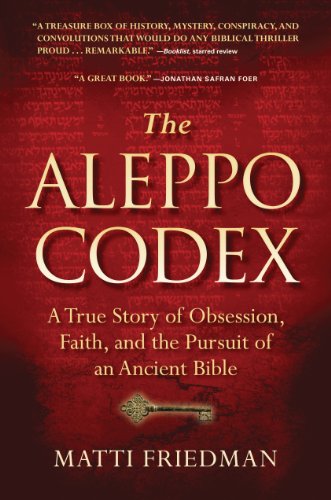
The Aleppo Codex: The True Story of Obesession, Faith, and the International Pursuit of an Ancient Bible - Hardcover
Inhaltsangabe
Winner of the 2014 Sami Rohr Prize for Jewish Literature
A thousand years ago, the most perfect copy of the Hebrew Bible was written. It was kept safe through one upheaval after another in the Middle East, and by the 1940s it was housed in a dark grotto in Aleppo, Syria, and had become known around the world as the Aleppo Codex.
Journalist Matti Friedman’s true-life detective story traces how this precious manuscript was smuggled from its hiding place in Syria into the newly founded state of Israel and how and why many of its most sacred and valuable pages went missing. It’s a tale that involves grizzled secret agents, pious clergymen, shrewd antiquities collectors, and highly placed national figures who, as it turns out, would do anything to get their hands on an ancient, decaying book. What it reveals are uncomfortable truths about greed, state cover-ups, and the fascinating role of historical treasures in creating a national identity.
Die Inhaltsangabe kann sich auf eine andere Ausgabe dieses Titels beziehen.
Über die Autorin bzw. den Autor
Matti Friedman's 2016 book Pumpkinflowers was chosen as a New York Times Notable Book and as one of Amazon's 10 Best Books of the Year. It was selected as one of the year's best by Booklist, Mother Jones, Foreign Affairs, the National Post, and the Globe and Mail. His first book, The Aleppo Codex, won the 2014 Sami Rohr Prize and the American Library Association's Sophie Brody Medal. A contributor to the New York Times' opinion page, Friedman has reported from Israel, Lebanon, Morocco, Moscow, the Caucasus, and Washington, DC, and his writing has appeared in publications such as the Wall Street Journal, the Atlantic, and the Washington Post. Friedman grew up in Toronto and now lives with his family in Jerusalem.
Auszug. © Genehmigter Nachdruck. Alle Rechte vorbehalten.
THE ALEPPO CODEX
A True Story of Obsession, Faith, and the Pursuit of an Ancient BibleBy Matti FriedmanALGONQUIN BOOKS OF CHAPEL HILL
Copyright © 2012 Matti FriedmanAll right reserved.
ISBN: 978-1-61620-040-4
Contents
Dramatis Personae....................................xiiiIntroduction.........................................xv1. Flushing Meadow...................................32. Aleppo............................................103. The Fire..........................................194. The Swift Scribe of Tiberias......................255. The Treasure in the Synagogue.....................356. The Jerusalem Circle..............................447. The Sack of Jerusalem.............................538. The Jump..........................................629. The President.....................................7310. The Merchant's Mission...........................8111. Maimonides.......................................8712. Alexandretta.....................................9713. The Brown Suitcase...............................10314. The Trial........................................11315. A Religious Man..................................12216. Our Last Drop of Blood...........................12717. The Book.........................................14118. The Keepers of the Crown.........................14619. The Officer and the Scroll.......................15720. Exodus...........................................16821. Aspergillus......................................17922. Brooklyn.........................................18423. The Fog Grows....................................19324. The Agent's Ivestigation.........................20225. The Collector....................................21326. The Magicians....................................22227. A Deal at the Hilton.............................22828. Room 915.........................................23529. Money............................................24030. The Missing Pieces...............................24731. Silo.............................................25532. The Institute....................................26533. Bahiyeh..........................................274Acknowledgments......................................279Notes on Sources.....................................283Photo Credits........................................299
Chapter One
Flushing Meadow
The first limousines pulled up beside bare trees and a grove of flagpoles at Flushing Meadow, on the outskirts of New York City, discharging their passengers into a gray building that had once housed a skating rink. Crowds gathered in the chill outside. An auditorium inside was full of spectators and delegates. It was November 29, 1947, a Saturday afternoon.
Grainy footage filmed that day shows men in suits seated in rows before a raised podium where three officials had their backs to a giant painting of the globe. Aides arrived and departed from the podium with sheaves of paper and expressions befitting the gravity of the occasion: the delegates to this new world organization, the United Nations, were about to alter the course of history simply by holding a vote.
"We will start now," said the man in the middle—this was the assembly's presiding diplomat, a Brazilian—and a silver microphone on the podium picked up those words in accented English and relayed them to Jewish garment workers clustered around radio sets on the Lower East Side of Manhattan, then across the Atlantic to camps for the refugees of the Second World War, which had ended barely two years before, and farther east to Arab students in Damascus, merchants in Jaffa and Cairo, store owners in sandy Tel Aviv, a city not yet thirty years old. Some had pencils ready to tally the votes. A two-thirds majority meant Palestine, ruled by the British since 1917, would be partitioned into two states, one for Jews and one for Arabs. The vote followed months of desperate diplomacy and strong-arm politics influenced by the horror of recent events in Europe. For supporters of the Jewish national movement, Zionism, passage of the resolution would mean justice for a persecuted people and the realization of a two-thousand-year-old dream of national rebirth. For the Arabs of Palestine and of surrounding countries, it would mean the imposition of a foreign entity in the heart of the Middle East, an unbearable humiliation, and certain war.
In the north of Syria, six thousand miles away from New York, it was evening. An aviator arriving from the west across the flat screen of the Mediterranean might first have seen that night's full moon reflected on the water and then a dark expanse of tribal grazing lands and farming plots stretching inland toward the Euphrates and the deserts of the interior. Aleppo would have appeared below as a cluster of lights at the meeting point of the rail lines and roads that converged from all directions, the city spreading around a nucleus of bazaar streets by the crumbling mass of the Citadel. Down in those streets, the stores now shuttered, the women of the manzul were receiving clients, and men were submerged in café smoke like deep-sea divers, tubes between their lips, inhaling the rose-scented oxygen of water pipes. From the outskirts of the Old City, labyrinthine passages led into the quarter where the Jews had always lived, and in the heart of this quarter, behind high walls, was their great synagogue. Inside the synagogue, at the end of a corridor and down a few steps, was a dark grotto. In the grotto sat an iron safe with two locks, and in this safe was the book.
In Aleppo, the sexton of the great synagogue—Asher Baghdadi was his name—a thin man in a robe that fell to his ankles, would have been making his rounds at this time, after the Sabbath had ended and the last of the worshippers had left, walking through the rooms as he always did, through the courtyard where prayers were held in summertime, past the grotto known as the Cave of the Prophet Elijah, with the safe inside. The double lock served as an additional precaution, this one against the treasure's own guardians, requiring the two elders entrusted with keys to be present and to watch over each other when the safe was opened. It rarely was. The sexton was not important enough to have one of those keys, though he did have an iron key to the synagogue's gate that was as long as the forearm of a small child. The sexton crossed a narrow alleyway and climbed the three flights of stairs to his home, where the windows looked down into the deserted courtyard of the building he had just left. Kerosene streetlamps flickered in the alleys.
Most of Aleppo's Jews appear to have been only vaguely aware of the events at Flushing Meadow, if at all; many believed Palestine had little to do with them, and only a lucky few owned a radio. Among those who did understand the gravity of the events afoot was fifteen-year-old Rafi Sutton, the retired spy I would encounter six decades later. Rafi was in his living room, in a modern neighborhood that was home to middle-class Jews, Muslims, and Christians who had fled the crowding and poverty of the Old City. He sat with his parents and sisters next to a Zenith radio housed in a wooden cabinet.
In the broadcast from Flushing Meadow, a flat American voice replaced that of the Brazilian. The new voice began reading from a list.
"Afghanistan?" he asked, and then repeated the inaudible answer from the assembly floor: "No.
"Argentina," he said. "Argentina? Abstention.
"Australia?" he said. "Yes."
In the days and weeks leading up to the vote, Arab leaders and...
„Über diesen Titel“ kann sich auf eine andere Ausgabe dieses Titels beziehen.
Suchergebnisse für The Aleppo Codex: The True Story of Obesession, Faith,...

Beispielbild für diese ISBN
The Aleppo Codex: A True Story of Obsession, Faith, and the Pursuit of an Ancient Bible
Anbieter: World of Books (was SecondSale), Montgomery, IL, USA
Verkäuferbewertung 5 von 5 Sternen

Hardback. Zustand: Very Good. Winner of the 2014 Sami Rohr Prize for Jewish Literature A thousand years ago, the most perfect copy of the Hebrew Bible was written. It was kept safe through one upheaval after another in the Middle East, and by the 1940s it was housed in a dark grotto in Aleppo, Syria, and had become known around the world as the Aleppo Codex. Journalist Matti Friedman's true-life detective story traces how this precious manuscript was smuggled from its hiding place in Syria into the newly founded state of Israel and how and why many of its most sacred and valuable pages went missing. It's a tale that involves grizzled secret agents, pious clergymen, shrewd antiquities collectors, and highly placed national figures who, as it turns out, would do anything to get their hands on an ancient, decaying book. What it reveals are uncomfortable truths about greed, state cover-ups, and the fascinating role of historical treasures in creating a national identity. Bestandsnummer des Verkäufers CIN1616200405VG
Gebraucht kaufen
EUR 4,57
Versand gratis
Versand innerhalb von USA
Versand innerhalb von USA
Anzahl: 1 verfügbar
Beispielbild für diese ISBN
The Aleppo Codex: A True Story of Obsession, Faith, and the Pursuit of an Ancient Bible
Anbieter: World of Books (was SecondSale), Montgomery, IL, USA
Verkäuferbewertung 5 von 5 Sternen
Hardback. Zustand: Good. Winner of the 2014 Sami Rohr Prize for Jewish Literature A thousand years ago, the most perfect copy of the Hebrew Bible was written. It was kept safe through one upheaval after another in the Middle East, and by the 1940s it was housed in a dark grotto in Aleppo, Syria, and had become known around the world as the Aleppo Codex. Journalist Matti Friedman's true-life detective story traces how this precious manuscript was smuggled from its hiding place in Syria into the newly founded state of Israel and how and why many of its most sacred and valuable pages went missing. It's a tale that involves grizzled secret agents, pious clergymen, shrewd antiquities collectors, and highly placed national figures who, as it turns out, would do anything to get their hands on an ancient, decaying book. What it reveals are uncomfortable truths about greed, state cover-ups, and the fascinating role of historical treasures in creating a national identity. Bestandsnummer des Verkäufers 00109659936
Gebraucht kaufen
EUR 4,57
Versand gratis
Versand innerhalb von USA
Versand innerhalb von USA
Anzahl: 1 verfügbar
Foto des Verkäufers
The Aleppo Codex: The True Story of Obesession, Faith, and the International Pursuit of an Ancient Bible
Anbieter: Bay State Book Company, North Smithfield, RI, USA
Verkäuferbewertung 5 von 5 Sternen
Zustand: good. The book is in good condition with all pages and cover intact, including the dust jacket if originally issued. The spine may show light wear. Pages may contain some notes or highlighting, and there might be a "From the library of" label. Boxed set packaging, shrink wrap, or included media like CDs may be missing. Bestandsnummer des Verkäufers BSM.19YHZ
Gebraucht kaufen
EUR 4,82
Versand gratis
Versand innerhalb von USA
Versand innerhalb von USA
Anzahl: 1 verfügbar
Foto des Verkäufers
The Aleppo Codex: The True Story of Obesession, Faith, and the International Pursuit of an Ancient Bible
Anbieter: ZBK Books, Carlstadt, NJ, USA
Verkäuferbewertung 5 von 5 Sternen
Zustand: good. Fast & Free Shipping â" Good condition. It may show normal signs of use, such as light writing, highlighting, or library markings, but all pages are intact and the book is fully readable. A solid, complete copy that's ready to enjoy. Bestandsnummer des Verkäufers ZWV.1616200405.G
Gebraucht kaufen
EUR 6,23
Versand gratis
Versand innerhalb von USA
Versand innerhalb von USA
Anzahl: 1 verfügbar
Beispielbild für diese ISBN
The Aleppo Codex : A True Story of Obsession, Faith, and the Pursuit of an Ancient Bible
Verlag:
Algonquin Books of Chapel Hill, 2012
ISBN 10: 1616200405
ISBN 13: 9781616200404
Gebraucht
Hardcover
Anbieter: Better World Books, Mishawaka, IN, USA
Verkäuferbewertung 5 von 5 Sternen
Zustand: Good. Former library copy. Pages intact with minimal writing/highlighting. The binding may be loose and creased. Dust jackets/supplements are not included. Includes library markings. Stock photo provided. Product includes identifying sticker. Better World Books: Buy Books. Do Good. Bestandsnummer des Verkäufers 4232440-6
Gebraucht kaufen
EUR 6,33
Versand gratis
Versand innerhalb von USA
Versand innerhalb von USA
Anzahl: 5 verfügbar
Beispielbild für diese ISBN
The Aleppo Codex: A True Story of Obsession, Faith, and the Pursuit of an Ancient Bible
Anbieter: Wonder Book, Frederick, MD, USA
Verkäuferbewertung 5 von 5 Sternen
Zustand: Very Good. Very Good condition. Very Good dust jacket. With remainder mark. A copy that may have a few cosmetic defects. May also contain light spine creasing or a few markings such as an owner's name, short gifter's inscription or light stamp. Bestandsnummer des Verkäufers E08L-00819
Gebraucht kaufen
EUR 6,40
Versand gratis
Versand innerhalb von USA
Versand innerhalb von USA
Anzahl: 1 verfügbar
Beispielbild für diese ISBN
The Aleppo Codex: A True Story of Obsession, Faith, and the Pursuit of an Ancient Bible
Anbieter: World of Books Inc, Montgomery, IL, USA
Verkäuferbewertung 4 von 5 Sternen

Hardback. Zustand: Good. Winner of the 2014 Sami Rohr Prize for Jewish Literature A thousand years ago, the most perfect copy of the Hebrew Bible was written. It was kept safe through one upheaval after another in the Middle East, and by the 1940s it was housed in a dark grotto in Aleppo, Syria, and had become known around the world as the Aleppo Codex. Journalist Matti Friedman's true-life detective story traces how this precious manuscript was smuggled from its hiding place in Syria into the newly founded state of Israel and how and why many of its most sacred and valuable pages went missing. It's a tale that involves grizzled secret agents, pious clergymen, shrewd antiquities collectors, and highly placed national figures who, as it turns out, would do anything to get their hands on an ancient, decaying book. What it reveals are uncomfortable truths about greed, state cover-ups, and the fascinating role of historical treasures in creating a national identity. Bestandsnummer des Verkäufers CIN1616200405G
Gebraucht kaufen
EUR 6,40
Versand gratis
Versand innerhalb von USA
Versand innerhalb von USA
Anzahl: 1 verfügbar
Beispielbild für diese ISBN
The Aleppo Codex: A True Story of Obsession, Faith, and the Pursuit of an Ancient Bible
Anbieter: World of Books Inc, Montgomery, IL, USA
Verkäuferbewertung 4 von 5 Sternen
Hardback. Zustand: Very Good. Winner of the 2014 Sami Rohr Prize for Jewish Literature A thousand years ago, the most perfect copy of the Hebrew Bible was written. It was kept safe through one upheaval after another in the Middle East, and by the 1940s it was housed in a dark grotto in Aleppo, Syria, and had become known around the world as the Aleppo Codex. Journalist Matti Friedman's true-life detective story traces how this precious manuscript was smuggled from its hiding place in Syria into the newly founded state of Israel and how and why many of its most sacred and valuable pages went missing. It's a tale that involves grizzled secret agents, pious clergymen, shrewd antiquities collectors, and highly placed national figures who, as it turns out, would do anything to get their hands on an ancient, decaying book. What it reveals are uncomfortable truths about greed, state cover-ups, and the fascinating role of historical treasures in creating a national identity. Bestandsnummer des Verkäufers CIN1616200405VG
Gebraucht kaufen
EUR 6,40
Versand gratis
Versand innerhalb von USA
Versand innerhalb von USA
Anzahl: 1 verfügbar
Beispielbild für diese ISBN
The Aleppo Codex: The True Story of Obesession, Faith, and the International Pursuit of an Ancient Bible
Anbieter: ThriftBooks-Dallas, Dallas, TX, USA
Verkäuferbewertung 5 von 5 Sternen
Hardcover. Zustand: Very Good. No Jacket. Former library book; May have limited writing in cover pages. Pages are unmarked. ~ ThriftBooks: Read More, Spend Less. Bestandsnummer des Verkäufers G1616200405I4N10
Gebraucht kaufen
EUR 6,46
Versand gratis
Versand innerhalb von USA
Versand innerhalb von USA
Anzahl: 1 verfügbar
Beispielbild für diese ISBN
The Aleppo Codex: The True Story of Obesession, Faith, and the International Pursuit of an Ancient Bible
Anbieter: ThriftBooks-Dallas, Dallas, TX, USA
Verkäuferbewertung 5 von 5 Sternen
Hardcover. Zustand: Very Good. No Jacket. May have limited writing in cover pages. Pages are unmarked. ~ ThriftBooks: Read More, Spend Less. Bestandsnummer des Verkäufers G1616200405I4N00
Gebraucht kaufen
EUR 6,46
Versand gratis
Versand innerhalb von USA
Versand innerhalb von USA
Anzahl: 1 verfügbar