
Verwandte Artikel zu The Rest Is Silence: A Billy Boyle WWII Mystery
The Rest Is Silence: A Billy Boyle WWII Mystery - Softcover
Buch 9 von 21: Billy Boyle World War II Mystery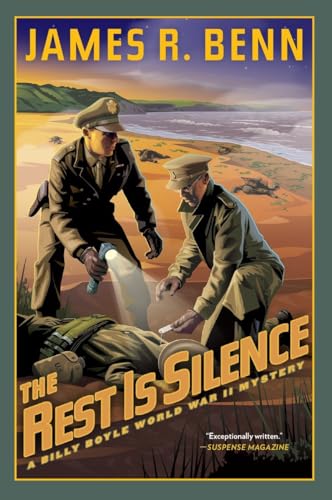
Inhaltsangabe
The fog of war surrounding D-Day and Operation Tiger provides cover for one of Billy Boyle's grisliest investigations.
When an unidentified corpse washes ashore at Slapton Sands on England's southern coast, US Army Captain Billy Boyle and his partner, Lieutenant Piotr "Kaz" Kazimierz, are assigned to investigate. The Devonshire beach is the home to Operation Tiger, the top-secret rehearsal for the approaching D-Day invasion of Normandy, and the area is restricted; no one seems to know where the corpse could have come from. Luckily, Billy and Kaz have a comfortable place to lay their heads at the end of the day: Kaz's old school chum David lives close by and has agreed to host the two men during their investigation. Glad for a distraction from his duties, Billy settles into life at David's family's fancy manor, Ashcroft, and makes it his mission to get to know its intriguing cast of characters.
Just when Billy and Kaz begin to wrap up their case, they find themselves with not one soggy corpse on their hands but hundreds following a terrible tragedy during the D-Day rehearsal. To complicate things, life at Ashcroft has been getting tense: secret agendas, buried histories, and family grudges abound. Then one of the men meets a sudden demise. Was it a heart attack? Or something more sinister?
Die Inhaltsangabe kann sich auf eine andere Ausgabe dieses Titels beziehen.
Über die Autorin bzw. den Autor
James R. Benn is the author of the Billy Boyle World War II mysteries. The debut, Billy Boyle, was named one of the top five mysteries of 2006 by Book Sense and was a Dilys Award nominee. Subsequent books have received starred reviews in Publishers Weekly and Library Journal, and been listed as the Bookpage Mystery of the Month. Two have been tagged as a "Killer Book" by the Independent Mystery Booksellers Association. A librarian for many years, Benn lives in Hadlyme, Connecticut, with his wife, Deborah Mandel.
Auszug. © Genehmigter Nachdruck. Alle Rechte vorbehalten.
Chapter One
KINGSBRIDGE, ENGLAND
April 23, 1944
I knew I was in trouble when the coroner wheeled in the body, encased in a rubber sack, on a wobbly gurney with one wheel that wanted to go in any direction but straight.
Police surgeon, I should say, instead of coroner, since this is England, not the States. I’m happy to tell you more, if only to put off thinking about that smell. It’s still coating the back of my throat and clinging to my skin, so here you go.
I’d been sent to Kingsbridge, a nice little town by the southwest coast of England. Picturesque, actually, despite the thousands of GIs everywhere, camped in fields, housed in barracks and barns, marching in every direction, whistling at girls, and tossing chewing gum to kids who trailed in their wake. The roar of trucks and tanks tore through the peace and quiet of this seaside town, as it did in plenty others like it.
Allied forces were here waiting for word to invade occupied Europe. Everyone knew the invasion was around the corner. Not the exact time or place, but with all these soldiers, sailors, and airmen here, the anticipation was building up to a fever pitch. They had to go somewhere, and soon, or else the pressure and the stress of waiting
would break even the strongest. Me, I was here because some poor slob got himself washed up on the shore near Slapton, a small seaside town not far from Kingsbridge. It would have passed unnoticed if the beach, Slapton Sands, wasn’t being used to practice amphibious landings: the kind of landings that would soon be happening across the Channel, in France.
I work for a guy who’s paid to get nervous about stuff like that, who sees conspiracies and danger in every unexplained event. Why did the corpse end up on this particular beach? Was he a German spy, a drunken fisherman, or a downed pilot? How come no one had reported him missing, no civil or military authority? Colonel Samuel Harding is an intelligence officer with Supreme Headquarters, Allied Expeditionary Force, and unanswered questions bother him, so here I am in Kingsbridge to fill in the blanks. I work at SHAEF as well. I have the flaming sword patch on my shoulder to prove it, not to mention orders signed by General Eisenhower himself giving me the authority to go anywhere and question anyone as part of this investigation. Helpful, if some senior officer wants to push a mere captain around.
That’s what led me to Dr. Verniquet and his mortuary. The questions and the corpse. The smell was already overpowering, even though the bag was zipped up tight. The antiseptic smell of the tiled basement room, painted bright white, faded under the onslaught of decay. Think of a slab of beef left out in the sun for a couple of days, then add a dash of metallic odor and a tinge of vomit.
“Are you ready, Captain Boyle?” Dr. Verniquet said. He was short, with a shock of white hair sticking out behind his ears, marking the last stand ofa receded hairline. He wore a stained white coat, and a lit cigarette dangled from his lips, probably to help mask the odor of decomposition, although in this case it might take an entire pack.
“Sure,” I said, aiming for a nonchalant tone. I’d seen plenty of corpses, even fished a few ripe ones out of Boston Harbor back when I was a cop, before the war, and before my personal count of dead bodies skyrocketed. I’d witnessed a few autopsies as well, and even though I’d retched bile in the hall midway through my first, no one had seen me slip out. I’d managed to keep it togetherafter that. Cops are supposed to always be in control, and that extended to the morgue. It was part of the job, a duty to the dead, and everyone expected you to get it done without putting your last meal on display. Especially my dad. He was a homicide detective, and he’d told me when I was a rookie not to disgrace myself when I got around to my first autopsy. That was
easy. I simply hadn’t eaten a thing that day.
“He’s been in cold storage waiting for you to arrive,” the elderly doctor said. “No one has claimed the body.” He gripped the zipper and glanced at me. I nodded.
As he pulled the zipper open, waves of putrid stench washed over me, each worse than the last. I tried to breathe, but my body revolted at drawing in more of the rancid air. I blinked, trying to make sense of what I was seeing. Dark, bloated flesh, marked by pockets of greyish-white growth on the cheeks and belly. No eyes, no lips. Teeth bared in a hideous grimace.
“Show me the bullet wounds,” I said, unable to focus my watering eyes, trying for quick, shallow breaths.
“Here,” Dr. Verniquet said, pointing to a bicep, seemingly immune to the smell. “The bullet went through his arm. A minor wound.” He tapped a pencil against a puckered hole on blackened skin, then drew on his cigarette and blew the smoke out his nostrils. I had never taken up the habit, but it looked like a good move. “He was killed by this shot to the head. Note the angle.” He tapped his pencil again, first on
an entry wound high on the forehead, right side, then on the exit wound above the left ear. Or where the ear would have been.
“He was shot in the arm while standing up,” I said, trying to block out the barrage of odors attacking my senses. I forced myself to study the body, wishing I could simply bolt for the clean air outdoors. The arm wound was on a straight line. “Judging from the position of the head shot, the killer was above him when he fired the second shot.”
“Yes. The victim may have turned away at the last second,” Dr. Verniquet said as ash dropped from his cigarette. He turned his own head upward and to the left, this time using the pencil to demonstrate the trajectory of the bullet. “He was almost certainly killed in the water, or thrown in immediately after death.”
“Because of the grave wax?” I asked. I instinctively held my hand over my nose, not that it helped much.
“Adipocere,” Dr. Verniquet said, nodding. “The fatty deposits turn into a white, waxy substance when the body is immersed in water, as has occurred in this unfortunate fellow. But it never happens in the presence of insect life, so we can assume that he went into the water immediately.”
The corpse’s gut and cheeks were covered in the stuff, which looked like homemade soap mixed with candle drippings. It wasn’t pretty, but all it told me was that he wasn’t skinny when he was killed. The bottom of the rubber sack was awash in fluids I didn’t want to think about. I pulled back the edges and studied the rest of the body. One foot was missing, the other without toes. His fingers were stubs.
“Fish food?” I asked.
“Yes,” the doctor said. “Probably happened close to the shore, before he went out with the tide. Or came in with it. As you can see, there’s nothing much left of the soft tissue on his fingers, so there’s no hope of fingerprints. I’d put his age at about thirty. Five foot eleven inches in...
„Über diesen Titel“ kann sich auf eine andere Ausgabe dieses Titels beziehen.
Suchergebnisse für The Rest Is Silence: A Billy Boyle WWII Mystery

Beispielbild für diese ISBN
The Rest Is Silence (A Billy Boyle WWII Mystery)
Verlag:
Soho Crime (edition Reprint), 2015
ISBN 10: 1616955708
ISBN 13: 9781616955700
Gebraucht
Paperback
Anbieter: BooksRun, Philadelphia, PA, USA
Verkäuferbewertung 5 von 5 Sternen

Paperback. Zustand: Very Good. Reprint. It's a well-cared-for item that has seen limited use. The item may show minor signs of wear. All the text is legible, with all pages included. It may have slight markings and/or highlighting. Bestandsnummer des Verkäufers 1616955708-8-1
Gebraucht kaufen
EUR 4,69
Versand gratis
Versand innerhalb von USA
Versand innerhalb von USA
Anzahl: 1 verfügbar
Foto des Verkäufers
The Rest Is Silence (A Billy Boyle WWII Mystery)
Anbieter: ZBK Books, Carlstadt, NJ, USA
Verkäuferbewertung 5 von 5 Sternen
Zustand: very_good. Fast & Free Shipping â" Very Good condition book with a firm cover and clean pages. Shows normal use and some light wear or limited notes markings. A solid, nice copy to enjoy. Bestandsnummer des Verkäufers ZWV.1616955708.VG
Gebraucht kaufen
EUR 5,30
Versand gratis
Versand innerhalb von USA
Versand innerhalb von USA
Anzahl: 1 verfügbar
Foto des Verkäufers
The Rest Is Silence (A Billy Boyle WWII Mystery)
Anbieter: Greenworld Books, Arlington, TX, USA
Verkäuferbewertung 5 von 5 Sternen
Zustand: very_good. Fast Free Shipping â" Very Good condition book with a firm cover and clean pages. Shows normal use and some light wear or limited notes markings. A solid, nice copy to enjoy. Bestandsnummer des Verkäufers GWV.1616955708.VG
Gebraucht kaufen
EUR 5,30
Versand gratis
Versand innerhalb von USA
Versand innerhalb von USA
Anzahl: 1 verfügbar
Foto des Verkäufers
The Rest Is Silence (A Billy Boyle WWII Mystery)
Anbieter: Goodwill, Brooklyn Park, MN, USA
Verkäuferbewertung 4 von 5 Sternen

Zustand: very_good. Item may have minor cosmetic defects such as marks, wears, cuts, bends, or crushes on the cover, spine, pages, or dust cover. Shrink wrap, dust covers, or boxed set case may be missing. Item may contain remainder marks on outside edges, which should be noted in listing comments. Item may be missing bundled media. Bestandsnummer des Verkäufers MINV.1616955708.VG
Gebraucht kaufen
EUR 2,33
EUR 3,56 Versand
Versand innerhalb von USA
Versand innerhalb von USA
Anzahl: 1 verfügbar
Beispielbild für diese ISBN
The Rest Is Silence
Anbieter: ThriftBooks-Reno, Reno, NV, USA
Verkäuferbewertung 5 von 5 Sternen
Paperback. Zustand: Good. No Jacket. Pages can have notes/highlighting. Spine may show signs of wear. ~ ThriftBooks: Read More, Spend Less. Bestandsnummer des Verkäufers G1616955708I3N00
Gebraucht kaufen
EUR 6,00
Versand gratis
Versand innerhalb von USA
Versand innerhalb von USA
Anzahl: 1 verfügbar
Beispielbild für diese ISBN
The Rest Is Silence
Anbieter: ThriftBooks-Phoenix, Phoenix, AZ, USA
Verkäuferbewertung 5 von 5 Sternen
Paperback. Zustand: Very Good. No Jacket. May have limited writing in cover pages. Pages are unmarked. ~ ThriftBooks: Read More, Spend Less. Bestandsnummer des Verkäufers G1616955708I4N00
Gebraucht kaufen
EUR 6,00
Versand gratis
Versand innerhalb von USA
Versand innerhalb von USA
Anzahl: 1 verfügbar
Beispielbild für diese ISBN
The Rest Is Silence
Anbieter: ThriftBooks-Reno, Reno, NV, USA
Verkäuferbewertung 5 von 5 Sternen
Paperback. Zustand: Very Good. No Jacket. May have limited writing in cover pages. Pages are unmarked. ~ ThriftBooks: Read More, Spend Less. Bestandsnummer des Verkäufers G1616955708I4N00
Gebraucht kaufen
EUR 6,00
Versand gratis
Versand innerhalb von USA
Versand innerhalb von USA
Anzahl: 1 verfügbar
Beispielbild für diese ISBN
The Rest Is Silence
Anbieter: ThriftBooks-Dallas, Dallas, TX, USA
Verkäuferbewertung 5 von 5 Sternen
Paperback. Zustand: Very Good. No Jacket. May have limited writing in cover pages. Pages are unmarked. ~ ThriftBooks: Read More, Spend Less. Bestandsnummer des Verkäufers G1616955708I4N00
Gebraucht kaufen
EUR 6,00
Versand gratis
Versand innerhalb von USA
Versand innerhalb von USA
Anzahl: 2 verfügbar
Beispielbild für diese ISBN
The Rest Is Silence
Anbieter: ThriftBooks-Atlanta, AUSTELL, GA, USA
Verkäuferbewertung 5 von 5 Sternen
Paperback. Zustand: Good. No Jacket. Former library book; Pages can have notes/highlighting. Spine may show signs of wear. ~ ThriftBooks: Read More, Spend Less. Bestandsnummer des Verkäufers G1616955708I3N10
Gebraucht kaufen
EUR 6,00
Versand gratis
Versand innerhalb von USA
Versand innerhalb von USA
Anzahl: 1 verfügbar
Beispielbild für diese ISBN
The Rest Is Silence
Anbieter: ThriftBooks-Atlanta, AUSTELL, GA, USA
Verkäuferbewertung 5 von 5 Sternen
Paperback. Zustand: Very Good. No Jacket. May have limited writing in cover pages. Pages are unmarked. ~ ThriftBooks: Read More, Spend Less. Bestandsnummer des Verkäufers G1616955708I4N00
Gebraucht kaufen
EUR 6,00
Versand gratis
Versand innerhalb von USA
Versand innerhalb von USA
Anzahl: 2 verfügbar