
Verwandte Artikel zu Mapmaker
Inhaltsangabe
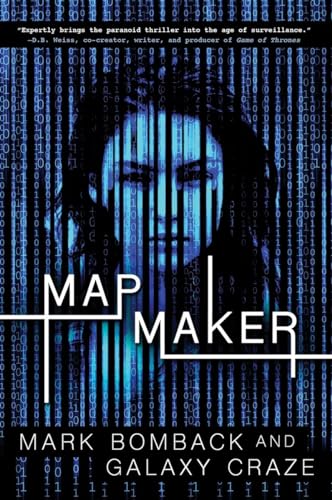
"Mapmaker expertly brings the paranoid thriller into the age of surveillance, and the result is both moving and chilling."
—D.B. Weiss, co-creator, writer, and producer of Game of Thrones
When Tanya Barrett takes an internship at MapOut, she expects emotional landmines. Her father cofounded the digital mapping company, and he died for it—on a cartographic expedition. Her father’s business partner welcomes her with open arms, as does his son, Connor, an old childhood friend. To Tanya’s surprise being with Connor turns out to be the only thing that makes her feel happy. But when the two of them accidentally stumble across a deadly secret, Connor disappears. Alone again—and on the run—Tanya must rely on her wits and innate gifts to find out what happened to him and to evade MapOut. In the world their fathers helped create, no one stays lost for long.
Die Inhaltsangabe kann sich auf eine andere Ausgabe dieses Titels beziehen.
Über die Autorin bzw. den Autor
Mark Bomback is a screenwriter whose credits include Dawn of the Planet of the Apes, The Wolverine, Unstoppable, Race to Witch Mountain, and Live Free or Die Hard. While primarily a writer of feature films, he recently co-developed the TV series Legends for TNT with Howard Gordon (Homeland). When his schedule permits, he teaches a class in screenwriting at his alma mater, Wesleyan University. He lives in Westchester County, New York, with his wife and four children.
Born in London, author Galaxy Craze moved to the United States in the ’80s with her mother and younger brother. Before becoming a writer, she appeared as an actress in several independent films. A Los Angeles Times Book Prize finalist and a national bestseller for her debut novel, By the Shore, she is also the author of the acclaimed Tiger, Tiger and Alloy Entertainment’s The Last Princess series.
Auszug. © Genehmigter Nachdruck. Alle Rechte vorbehalten.
Prologue
Dad’s home.
That was my first thought when I saw the footprints in the snow, leading to the front door of our house. The tracks were large, a man’s shoe size, and as I looked closer I saw the unmistakable zigzag imprint of his boots. He must have come home early, walking along the bike trail from MapOut. Maybe his office closed early because of the forecast; the blizzard would only get worse.
Our house was white with black shutters and two redbrick chimneys on either side. It reminded me of a guard dog: leaded-glass bedroom windows for eyes; the two chimneys for ears; the black front door, the nose. I’d lived here my whole life. The house was the one constant, the one thing that had remained while so much else had changed. The house was the one place I felt safe. The house was my guard dog. The excitement of Dad’s being home early was something I hadn’t felt in a long time, like waking up at dawn and knowing it was Christmas morning. I glanced over toward the garage. Beth’s car wasn’t here yet; she wouldn’t be back for an hour or two. I smiled. Dad and I would have some time together without my stepmom. Maybe we could make extra-strong hot chocolate with plain cocoa, maple syrup, and milk. If he was working (I knew he would be), I would just curl up on the couch in his office with the woodstove, and watch the cinders burn.
I followed the footsteps. The snowflakes on my lashes blurred my vision as I ran toward the house. Dad’s home: the words sounded again in my mind like a bell, my backpack heavy with a laptop, books hitting against me. Then I paused.
I did something I hadn’t allowed myself do since I was little. I stepped in one of his tracks in the snow, my boot print covering his.
Staring down at the footsteps, I tried to catch my breath. Something was wrong. I slipped as I scrambled toward the front porch. My knee cracked against the edge of the first wooden step. Pain shot through my body as I pushed myself up; my fingers burned red from the cold. I reached for the handle of the front door—and stopped cold at my reflection in the window.
Of course these weren’t my father’s footprints. My father was dead.
What was wrong with me? How could I have let myself pretend he was alive, even for a second? I took a step back, away from the house. I followed the length of my own footsteps, now trying to calculate how many steps and for how long I’d deluded myself. Twenty seconds at the most? The feeling I’d had was so hopeful, so real.
Turning back to the black shutters, the windows as dark as lake water, I felt a fear I could barely name. For the first time in my life, I was afraid of my own mind. My mother died when I was ten—and never, not once, not even in my dreams, had I ever forgotten. My mother’s death was like a badge I wore, forever pinned to my chest.
I blinked. The reality of my life fell back into focus: the loneliness inside that house, the empty rooms behind the windows, the dark glass reflecting the falling snow, the evergreen branches closing in like a gate. The heat would be set low for the workday, my father’s office deserted and still—no fire in the small woodstove, no one sitting at his desk, no books opened to the previous night’s page. The large upstairs bedroom my mother and father once shared: abandoned. Even my stepmother wouldn’t sleep there alone. After my father’s death, Beth moved into the tiny guest room my mother had painted her favorite shade of pale blue.
There was a zigzag pattern in the snow. That was the print on his soles. Those were his favorite boots. He had bought them in Vermont in grad school and still wore them every winter. But I was too old for this, too smart to let myself ever be fooled by signs or miracles or look-alikes. The boots must have belonged to the mailman, the furnace repairman, a college kid working for Greenpeace. That this person wore the same brand was just a cruel coincidence.
I took a step backward, then another and another, moving away from the house.
Fear was a cold feeling. This was a safe town. We hardly ever locked our house or car. Sometimes police were called for an overly noisy frat party or a lost dog wandering the streets, but that was it. I told myself this as I hurried up the slope to the sidewalk.
The afternoon was growing dim, the white sky turning grey. The lights of the passing cars glowed through the snowflakes.
I stood on the roadside, in what I assumed was the safety of being visible to the slow-moving cars. From the top of the slope, I kept my eyes on the vanishing trail. I saw the route now: he had come from the woods and walked to our front door before returning around the side of our house across the yard to the shed—where the trail ended.
There was an arch-pattern that would have only resulted from the door being opened. Meaning someone was hiding inside the shed. But why?
There was nothing that a thief would want. The shed was full of my father’s old encyclopedias, a large wooden desk made from two-by-fours, and a wooden chair. He used to work there in the spring and summer. The windows looked out to the narrow creek, the maple trees.
My dad never brought his computer into the shed, just his books and a thermos of tea. He scoured rare travel diaries and out-of-print history texts, studied landscape and waterways and topography. He read about nomads, exotic expeditions, import and export shipping. He told me that the best way to learn how people think is through the routes they take. The art of mapmaking was not just in precision and measurements, but in the ways we negotiate the climate and texture of the land around us.
There was only one thing of any value inside: Between the two windows on the wide-plank wooden boards hung a framed lithograph of the Piri Reis map.
Like a favorite painting or poem or song, Dad had a favorite map. The original was drawn in 1513, on gazelleskin parchment. Its claim to fame over six centuries was its incredible accuracy. Piri Reis, a navigator—a bit of a wild man, according to my father—rendered it long before most cartographers began to account for the curvature of the
earth. Yet it matched perfectly with modern satellite imagery from a geosynchronous orbit, 25,000 miles up.
Like Piri Reis, my father passionately believed that in order to map, one had to explore the terrain firsthand. Dad understood the Earth, too, in all its curves and secrets. He never sent assistants with high-tech computers to do the job for him. Wherever and whenever he traveled for work, he only took a roller of measuring tape, food, a supply of water, and sun block. I remember his partner snickering behind his back when he’d say for the hundredth time: “I map the land with my own eyes.”
It was the motto he lived by. The motto he died by.
My mother had found the print in an antique shop in Boston. It was expensive for her at the time; Dad had just started MapOut with his best friend and my godfather, and he had put most of our family’s savings into the business. I remember standing...
„Über diesen Titel“ kann sich auf eine andere Ausgabe dieses Titels beziehen.
Weitere beliebte Ausgaben desselben Titels

Suchergebnisse für Mapmaker

Beispielbild für diese ISBN
Mapmaker
Anbieter: World of Books (was SecondSale), Montgomery, IL, USA
Verkäuferbewertung 5 von 5 Sternen

Zustand: Good. Item in good condition. Textbooks may not include supplemental items i.e. CDs, access codes etc. Bestandsnummer des Verkäufers 00030534338
Gebraucht kaufen
EUR 8,84
Versand gratis
Versand innerhalb von USA
Versand innerhalb von USA
Anzahl: 1 verfügbar
Beispielbild für diese ISBN
Mapmaker
Verlag:
Soho Press, Incorporated, 2017
ISBN 10: 161695633X
ISBN 13: 9781616956332
Gebraucht
Softcover
Anbieter: Better World Books, Mishawaka, IN, USA
Verkäuferbewertung 5 von 5 Sternen
Zustand: Good. Reprint. Former library copy. Pages intact with minimal writing/highlighting. The binding may be loose and creased. Dust jackets/supplements are not included. Includes library markings. Stock photo provided. Product includes identifying sticker. Better World Books: Buy Books. Do Good. Bestandsnummer des Verkäufers 67841362-6
Gebraucht kaufen
EUR 8,85
Versand gratis
Versand innerhalb von USA
Versand innerhalb von USA
Anzahl: 1 verfügbar
Beispielbild für diese ISBN
Mapmaker
Anbieter: Once Upon A Time Books, Siloam Springs, AR, USA
Verkäuferbewertung 4 von 5 Sternen

paperback. Zustand: Good. This is a used book in good condition and may show some signs of use or wear . This is a used book in good condition and may show some signs of use or wear . Bestandsnummer des Verkäufers mon0003452698
Gebraucht kaufen
EUR 5,68
EUR 3,38 Versand
Versand innerhalb von USA
Versand innerhalb von USA
Anzahl: 1 verfügbar