Inhaltsangabe
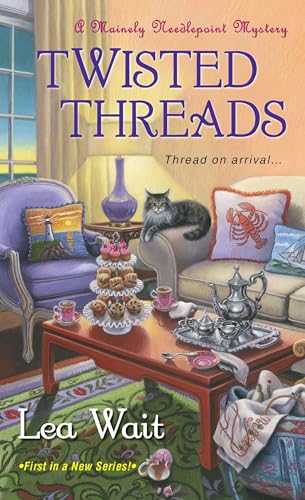
Returning to the quaint coastal town of Harbor Haven, Maine--a place she once called home--Angie Curtis finds her memories aren't all quite pleasant ones. . .
After leaving a decade ago, Angie has been called back to Harbor Haven by her grandmother, Charlotte, who raised her following her mother's disappearance when she was a child. Her mother has been found, and now the question of her whereabouts has sadly become the mystery of her murder.
The bright spot in Angie's homecoming is reuniting with Charlotte, who has started her own needlepointing business with a group called Mainely Needlepointers. But when a shady business associate of the stitchers dies suddenly under suspicious circumstances, Charlotte and Angie become suspects. As Angie starts to weave together clues, she discovers that this new murder may have ties to her own mother's cold case. . .
Die Inhaltsangabe kann sich auf eine andere Ausgabe dieses Titels beziehen.
Über die Autorin bzw. den Autor
Lea Wait lives on the coast of Maine. A fourth generation antique dealer, and author of the Agatha-nominated Shadows Antique Print mystery series, she loves all things antiques and Maine, and she’s learning to do needlepoint. She also writes historical novels for young people set in (where else?) nineteenth-century Maine. Lea adopted her four daughters when she was single; she’s now the grandmother of eight, and married to artist Bob Thomas. Find her at Facebook, Goodreads, and at www.leawait.com.
Auszug. © Genehmigter Nachdruck. Alle Rechte vorbehalten.
Twisted Threads
By Lea WaitKENSINGTON PUBLISHING CORP.
Copyright © 2015 Lea Wait
All rights reserved.
ISBN: 978-1-61773-004-7All rights reserved.
CHAPTER 1
Take your needle, my child, and work at your pattern; it will come out a rose by and by. Life is like that—one stitch taken patiently and the pattern will come out all right like embroidery.
—Oliver Wendell Holmes (1809–1894), The Autocrat of the Breakfast-Table
The day had already been the sort I wanted to drown in a cold beer or a bubble bath. Preferably both. And that was before I heard Gram's voice, loud and clear as always, coming from my "missed messages."
"Angel, it's time to come home. They've found your mama."
No one in Arizona called me "Angel."
I stared across the small room I'd called home for the past ten years at the stained needlepoint cushion squashed into the corner of my couch. The couch had come from Goodwill. The cushion had come from Gram. It was her last gift before I'd lit out and left the shores of Maine and the comforts of Haven Harbor.
She'd embroidered it in the sea blues and pine greens she knew I loved. And she'd done it quickly, in simple continental stitching and petit point. But in the middle of the design, instead of the lobster or lighthouse or puffin that was usually the center of a pillow she'd designed for the tourist trade, Gram had stitched her phone number.
Large. Complete with 207 area code.
Men who'd come and gone in my life had kidded me about it. "What's that? So you won't forget to call home?"
I'd laughed. Made a joke of it. I never told them why she'd stitched the number there, even though I hadn't called home half as often as I should have.
The number was there in case I was sick, or worse, and police searching my apartment needed to find my next of kin.
Gram wanted me to be found. She hadn't wanted to lose me, as she had Mama.
I pulled my duffel out of the closet and started packing. Wally would have to find someone else to sit surveillance on young Mrs. Juanita Simpson.
Mama had been found. Gram was right. It was time to go home.
At the last minute I decided to take my gun. I wouldn't need it in Haven Harbor, but I had a case for it—and a lock. And I didn't know how long I'd be away. It would be safer to take it with me. My apartment wasn't in the classiest neighborhood. And I'd gotten used to carrying.
Nine hours, two connecting planes, and an expensive taxi ride from Portland later, I walked in the front door of the house where I'd grown up. The one my sea-roving ancestors had built, and my great-grandparents had equipped with bathrooms, a furnace, and a wide front porch. Other than that, it was pretty much the same it'd been in 1807, the year it was built. Weather-worthy and standing tall across from the village green.
"Gram! I'm home." I dropped my bags in the wide front hall and followed my nose to the kitchen, as I always had, noting along the way that the old place could use a coat of paint. There was also a new sign in the front yard, which read Mainely Needlepoint, and a section of the living room was now arranged like an office.
Gram had gone commercial on me.
Still, despite the changes she'd made and the reason for my return, I felt my blood pressure dropping as I walked into the kitchen. At least I was calm until something unexpectedly streaked by me and headed for the stairs. My pulse rate soared. Then I realized it was a large yellow coon cat.
Gram didn't live alone now, after all.
I hadn't returned her call, but she'd known I'd come. A tin of my favorite lemon sugar cookies was on the table with a note: Angel, welcome home. I'm over to the church, arranging her service. Get yourself unpacked. I'll be home soon. Love you.
I took two cookies. "One for each hand," she'd always told me when I got home from school. Her words popped into my head without my knowing they were still there.
I remembered Mama in flashes. Smells. Touches. Laughs. The hollowness after she'd gone.
At least now we'd know where she was. What else would we know? Why she'd left? Whether she'd been dead this whole time?
I hoped Gram, or the police, had the answers.
I finished off the second cookie and headed up the stairs to my room.
Gram hadn't changed it since I'd left. I'd thought I was too smart to do anything as conventional as get married, or go to college, or enroll in beauty school down in Portland, like other girls in my graduating class. Instead, I'd taken the few hundred dollars I'd managed to save up from summers working the steamer at the lobstermen's co-op and headed west. As far as I could get from anyone who knew Angela Curtis, the girl with no dad whose wild mother had disappeared.
I'd gotten as far as Mesa, Arizona, taken a couple of classes at the university there, found class work dull, and ended up working for Wally Combs, a private investigator. Ten years ago it had sounded like exciting work. But turned out investigating meant sitting outside buildings waiting for people to come out, and then snapping pictures of them if they were with people they shouldn't be. Divorces were my boss's bread and butter, so they became mine.
First I worked in the office, deciphering Wally's expense accounts and handling the billing. Then I learned to focus a camera, take notes, be observant, and not fall asleep on overnight stakeouts. Wally liked that, and encouraged me to get a license to carry. I hadn't shot anyone, although I came close one time. In a state where a lot of folks carry—and weren't hunting moose for winter meat—having a gun was almost required when you were young, female, and had a job like mine. Came in handy off the job, too. Single women living alone in my part of town needed all the help they could get.
I never planned to stay in Arizona, though. Summers there are killers, and I missed the sea and the seasons. Whatever I hadn't found at home wasn't in Arizona, either. And a lot of what I learned there I wasn't proud of.
I kept thinking I'd come back to Maine sometime. Show Haven Harbor I'd become more than that betrayed teenager they'd watch struggle to find herself.
Now I had. At least for now. I wasn't ready to commit to more than now.
My old room was a time-free zone. The rocks and dried starfish and sea glass and shells I'd found on the shore, and the books I'd pored over to help me name the sea creatures and birds and stars, were still there. My roots were deep in this coast of Maine, wound in the mermaid's hair and rockweed that covers the rocks at low tide.
So deep that my toes were permanently scarred by gashes from clam and barnacle shells. I'd always refused to wear the old sneakers Gram set aside each year for shore and rock walking, preferring the feel of the rough sands and cold waters on my feet.
Mama used to say I was born at high tide; and when the doctor lifted me up to show me the ocean, I stopped crying. The first thing she'd done when she saw me was kiss the birthmark on my shoulder. She had a matching one on hers. We were linked.
She'd always liked to party more than most, and one night, three weeks before my tenth birthday, she hadn't come home.
There were searches, of course, and police questions, but although kids whispered and pointed, no grown-up said anything directly to me. Not at first. I was too young to understand, they thought. But I knew more than they imagined. I watched people shake their heads and hold their own children closer when I came near. Gram cried at night, sometimes. I could hear her. She could probably hear me, too....
„Über diesen Titel“ kann sich auf eine andere Ausgabe dieses Titels beziehen.
Suchergebnisse für Twisted Threads (A Mainely Needlepoint Mystery, Band...

Foto des Verkäufers
Twisted Threads (A Mainely Needlepoint Mystery)
Anbieter: Goodwill, Brooklyn Park, MN, USA
Verkäuferbewertung 5 von 5 Sternen

Zustand: good. All pages and cover are intact including the dust cover, if applicable . Spine may show signs of wear. Pages may include limited notes and highlighting. May include "From the library of" labels. Shrink wrap, dust covers, or boxed set case may be missing. Item may be missing bundled media. Bestandsnummer des Verkäufers MINV.1617730041.G
Gebraucht kaufen
EUR 1,20
EUR 3,41 shipping
Versand innerhalb von USA
Versand innerhalb von USA
Anzahl: 1 verfügbar
Beispielbild für diese ISBN
Twisted Threads (A Mainely Needlepoint Mystery)
Anbieter: Half Price Books Inc., Dallas, TX, USA
Verkäuferbewertung 5 von 5 Sternen
Mass Market Paperback. Zustand: Very Good. Connecting readers with great books since 1972! Used books may not include companion materials, and may have some shelf wear or limited writing. We ship orders daily and Customer Service is our top priority! Bestandsnummer des Verkäufers S_442649269
Gebraucht kaufen
EUR 2,28
EUR 2,98 shipping
Versand innerhalb von USA
Versand innerhalb von USA
Anzahl: 1 verfügbar
Beispielbild für diese ISBN
Twisted Threads (A Mainely Needlepoint Mystery)
Anbieter: World of Books (was SecondSale), Montgomery, IL, USA
Verkäuferbewertung 5 von 5 Sternen
Zustand: Good. Item in good condition. Textbooks may not include supplemental items i.e. CDs, access codes etc. Bestandsnummer des Verkäufers 00082387805
Gebraucht kaufen
EUR 5,33
Versand gratis
Versand innerhalb von USA
Versand innerhalb von USA
Anzahl: 5 verfügbar
Beispielbild für diese ISBN
Twisted Threads (A Mainely Needlepoint Mystery)
Anbieter: HPB-Diamond, Dallas, TX, USA
Verkäuferbewertung 5 von 5 Sternen
Mass Market Paperback. Zustand: Very Good. Connecting readers with great books since 1972! Used books may not include companion materials, and may have some shelf wear or limited writing. We ship orders daily and Customer Service is our top priority! Bestandsnummer des Verkäufers S_445866690
Gebraucht kaufen
EUR 2,28
EUR 3,20 shipping
Versand innerhalb von USA
Versand innerhalb von USA
Anzahl: 1 verfügbar
Beispielbild für diese ISBN
Twisted Threads (A Mainely Needlepoint Mystery)
Anbieter: HPB-Emerald, Dallas, TX, USA
Verkäuferbewertung 5 von 5 Sternen
Mass Market Paperback. Zustand: Very Good. Connecting readers with great books since 1972! Used books may not include companion materials, and may have some shelf wear or limited writing. We ship orders daily and Customer Service is our top priority! Bestandsnummer des Verkäufers S_442924658
Gebraucht kaufen
EUR 2,28
EUR 3,20 shipping
Versand innerhalb von USA
Versand innerhalb von USA
Anzahl: 1 verfügbar
Beispielbild für diese ISBN
Twisted Threads (A Mainely Needlepoint Mystery)
Anbieter: HPB-Ruby, Dallas, TX, USA
Verkäuferbewertung 5 von 5 Sternen
Mass Market Paperback. Zustand: Very Good. Connecting readers with great books since 1972! Used books may not include companion materials, and may have some shelf wear or limited writing. We ship orders daily and Customer Service is our top priority! Bestandsnummer des Verkäufers S_447962049
Gebraucht kaufen
EUR 2,28
EUR 3,20 shipping
Versand innerhalb von USA
Versand innerhalb von USA
Anzahl: 1 verfügbar
Foto des Verkäufers
Twisted Threads (A Mainely Needlepoint Mystery)
Anbieter: Blue Vase Books, Interlochen, MI, USA
Verkäuferbewertung 5 von 5 Sternen
Zustand: good. Mass market paperback in GOOD condition with normal wear from use. Cover art my differ from that shown in photo. Bestandsnummer des Verkäufers 31UI56002HXQ_ns
Gebraucht kaufen
EUR 5,50
Versand gratis
Versand innerhalb von USA
Versand innerhalb von USA
Anzahl: 1 verfügbar
Beispielbild für diese ISBN
Twisted Threads (A Mainely Needlepoint Mystery)
Anbieter: HPB Inc., Dallas, TX, USA
Verkäuferbewertung 5 von 5 Sternen
Mass Market Paperback. Zustand: Very Good. Connecting readers with great books since 1972! Used books may not include companion materials, and may have some shelf wear or limited writing. We ship orders daily and Customer Service is our top priority! Bestandsnummer des Verkäufers S_448352242
Gebraucht kaufen
EUR 2,81
EUR 3,20 shipping
Versand innerhalb von USA
Versand innerhalb von USA
Anzahl: 1 verfügbar
Beispielbild für diese ISBN
Twisted Threads
Verlag:
Kensington Publishing Corporation, 2015
ISBN 10: 1617730041
ISBN 13: 9781617730047
Gebraucht
Softcover
Anbieter: Better World Books, Mishawaka, IN, USA
Verkäuferbewertung 5 von 5 Sternen
Zustand: Good. Former library book; may include library markings. Used book that is in clean, average condition without any missing pages. Bestandsnummer des Verkäufers GRP102441075
Gebraucht kaufen
EUR 6,06
Versand gratis
Versand innerhalb von USA
Versand innerhalb von USA
Anzahl: 1 verfügbar
Beispielbild für diese ISBN
Twisted Threads
Verlag:
Kensington Publishing Corporation, 2015
ISBN 10: 1617730041
ISBN 13: 9781617730047
Gebraucht
Softcover
Anbieter: Better World Books, Mishawaka, IN, USA
Verkäuferbewertung 5 von 5 Sternen
Zustand: Good. Used book that is in clean, average condition without any missing pages. Bestandsnummer des Verkäufers 4453732-6
Gebraucht kaufen
EUR 6,06
Versand gratis
Versand innerhalb von USA
Versand innerhalb von USA
Anzahl: 3 verfügbar