Inhaltsangabe
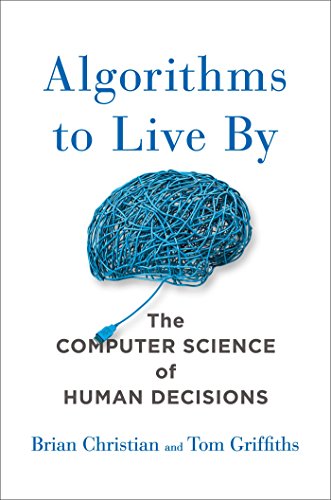
An exploration of how computer algorithms can be applied to our everyday lives to solve common decision-making problems and illuminate the workings of the human mind.
What should we do, or leave undone, in a day or a lifetime? How much messiness should we accept? What balance of the new and familiar is the most fulfilling? These may seem like uniquely human quandaries, but they are not. Computers, like us, confront limited space and time, so computer scientists have been grappling with similar problems for decades. And the solutions they’ve found have much to teach us.
In a dazzlingly interdisciplinary work, Brian Christian and Tom Griffiths show how algorithms developed for computers also untangle very human questions. They explain how to have better hunches and when to leave things to chance, how to deal with overwhelming choices and how best to connect with others. From finding a spouse to finding a parking spot, from organizing one’s inbox to peering into the future, Algorithms to Live By transforms the wisdom of computer science into strategies for human living.
Die Inhaltsangabe kann sich auf eine andere Ausgabe dieses Titels beziehen.
Über die Autorin bzw. den Autor
Brian Christian is the author of The Most Human Human, a Wall Street Journal bestseller, New York Times editors’ choice, and a New Yorker favorite book of the year. His writing has appeared in The New Yorker, The Atlantic, Wired, The Wall Street Journal, The Guardian, and The Paris Review, as well as in scientific journals such as Cognitive Science, and has been translated into eleven languages. He lives in San Francisco.
Tom Griffiths is a professor of psychology and cognitive science at UC Berkeley, where he directs the Computational Cognitive Science Lab. He has published more than 150 scientific papers on topics ranging from cognitive psychology to cultural evolution, and has received awards from the National Science Foundation, the Sloan Foundation, the American Psychological Association, and the Psychonomic Society, among others. He lives in Berkeley.
Auszug. © Genehmigter Nachdruck. Alle Rechte vorbehalten.
Algorithms to Live By
The Computer Science of Human Decisions
By Brian Christian, Tom GriffithsHenry Holt and Company
Copyright © 2016 Brian Christian and Tom Griffiths
All rights reserved.
ISBN: 978-1-62779-036-9All rights reserved.
Contents
Title Page,
Copyright Notice,
Dedication,
Introduction,
Algorithms to Live By,
1 Optimal Stopping Optimal Stopping When to Stop Looking,
2 Explore/Exploit The Latest vs. the Greatest,
3 Sorting Making Order,
4 Caching Forget About It,
5 Scheduling First Things First,
6 Bayes's Rule Predicting the Future,
7 Overfitting When to Think Less,
8 Relaxation Let It Slide,
9 Randomness When to Leave It to Chance,
10 Networking How We Connect,
11 Game Theory The Minds of Others,
Conclusion,
Computational Kindness,
Notes,
Bibliography,
Index,
Acknowledgments,
Also by Brian Christian,
About the Authors,
Copyright,
CHAPTER 1
Optimal Stopping
When to Stop Looking
Though all Christians start a wedding invitation by solemnly declaring their marriage is due to special Divine arrangement, I, as a philosopher, would like to talk in greater detail about this ... — JOHANNES KEPLER
If you prefer Mr. Martin to every other person; if you think him the most agreeable man you have ever been in company with, why should you hesitate? — JANE AUSTEN, EMMA
It's such a common phenomenon that college guidance counselors even have a slang term for it: the "turkey drop." High-school sweethearts come home for Thanksgiving of their freshman year of college and, four days later, return to campus single.
An angst-ridden Brian went to his own college guidance counselor his freshman year. His high-school girlfriend had gone to a different college several states away, and they struggled with the distance. They also struggled with a stranger and more philosophical question: how good a relationship did they have? They had no real benchmark of other relationships by which to judge it. Brian's counselor recognized theirs as a classic freshman-year dilemma, and was surprisingly nonchalant in her advice: "Gather data."
The nature of serial monogamy, writ large, is that its practitioners are confronted with a fundamental, unavoidable problem. When have you met enough people to know who your best match is? And what if acquiring the data costs you that very match? It seems the ultimate Catch-22 of the heart.
As we have seen, this Catch-22, this angsty freshman cri de coeur, is what mathematicians call an "optimal stopping" problem, and it may actually have an answer: 37%.
Of course, it all depends on the assumptions you're willing to make about love.
The Secretary Problem
In any optimal stopping problem, the crucial dilemma is not which option to pick, but how many options to even consider. These problems turn out to have implications not only for lovers and renters, but also for drivers, homeowners, burglars, and beyond.
The 37% Rule derives from optimal stopping's most famous puzzle, which has come to be known as the "secretary problem." Its setup is much like the apartment hunter's dilemma that we considered earlier. Imagine you're interviewing a set of applicants for a position as a secretary, and your goal is to maximize the chance of hiring the single best applicant in the pool. While you have no idea how to assign scores to individual applicants, you can easily judge which one you prefer. (A mathematician might say you have access only to the ordinal numbers — the relative ranks of the applicants compared to each other — but not to the cardinal numbers, their ratings on some kind of general scale.) You interview the applicants in random order, one at a time. You can decide to offer the job to an applicant at any point and they are guaranteed to accept, terminating the search. But if you pass over an applicant, deciding not to hire them, they are gone forever.
The secretary problem is widely considered to have made its first appearance in print — sans explicit mention of secretaries — in the February 1960 issue of Scientific American, as one of several puzzles posed in Martin Gardner's beloved column on recreational mathematics. But the origins of the problem are surprisingly mysterious. Our own initial search yielded little but speculation, before turning into unexpectedly physical detective work: a road trip down to the archive of Gardner's papers at Stanford, to haul out boxes of his midcentury correspondence. Reading paper correspondence is a bit like eavesdropping on someone who's on the phone: you're only hearing one side of the exchange, and must infer the other. In our case, we only had the replies to what was apparently Gardner's own search for the problem's origins fiftysome years ago. The more we read, the more tangled and unclear the story became.
Harvard mathematician Frederick Mosteller recalled hearing about the problem in 1955 from his colleague Andrew Gleason, who had heard about it from somebody else. Leo Moser wrote from the University of Alberta to say that he read about the problem in "some notes" by R. E. Gaskell of Boeing, who himself credited a colleague. Roger Pinkham of Rutgers wrote that he first heard of the problem in 1955 from Duke University mathematician J. Shoenfield, "and I believe he said that he had heard the problem from someone at Michigan."
"Someone at Michigan" was almost certainly someone named Merrill Flood. Though he is largely unheard of outside mathematics, Flood's influence on computer science is almost impossible to avoid. He's credited with popularizing the traveling salesman problem (which we discuss in more detail in chapter 8), devising the prisoner's dilemma (which we discuss in chapter 11), and even with possibly coining the term "software." It's Flood who made the first known discovery of the 37% Rule, in 1958, and he claims to have been considering the problem since 1949 — but he himself points back to several other mathematicians.
Suffice it to say that wherever it came from, the secretary problem proved to be a near-perfect mathematical puzzle: simple to explain, devilish to solve, succinct in its answer, and intriguing in its implications. As a result, it moved like wildfire through the mathematical circles of the 1950s, spreading by word of mouth, and thanks to Gardner's column in 1960 came to grip the imagination of the public at large. By the 1980s the problem and its variations had produced so much analysis that it had come to be discussed in papers as a subfield unto itself.
As for secretaries — it's charming to watch each culture put its own anthropological spin on formal systems. We think of chess, for instance, as medieval European in its imagery, but in fact its origins are in eighth-century India; it was heavy-handedly "Europeanized" in the fifteenth century, as its shahs became kings, its viziers turned to queens, and its elephants became bishops. Likewise, optimal stopping problems have had a number of incarnations, each reflecting the predominating concerns of its time. In the nineteenth century such problems were typified by baroque lotteries and by women choosing male suitors; in the early twentieth century by holidaying motorists searching for hotels and by male suitors choosing women; and in the paper-pushing, male-dominated mid-twentieth century, by male bosses choosing female assistants. The first explicit...
„Über diesen Titel“ kann sich auf eine andere Ausgabe dieses Titels beziehen.
Weitere beliebte Ausgaben desselben Titels

Suchergebnisse für Algorithms to Live by: The Computer Science of Human...

Foto des Verkäufers
Algorithms to Live By: The Computer Science of Human Decisions
Anbieter: Dream Books Co., Denver, CO, USA
Verkäuferbewertung 5 von 5 Sternen

Zustand: acceptable. This copy has clearly been enjoyedâ"expect noticeable shelf wear and some minor creases to the cover. Binding is strong, and all pages are legible. May contain previous library markings or stamps. Bestandsnummer des Verkäufers DBV.1627790365.A
Foto des Verkäufers
Algorithms to Live By: The Computer Science of Human Decisions
Anbieter: Zoom Books East, Glendale Heights, IL, USA
Verkäuferbewertung 5 von 5 Sternen
Zustand: good. Book is in good condition and may include underlining highlighting and minimal wear. The book can also include "From the library of" labels. May not contain miscellaneous items toys, dvds, etc. . We offer 100% money back guarantee and 24 7 customer service. Bestandsnummer des Verkäufers ZEV.1627790365.G
Foto des Verkäufers
Algorithms to Live By: The Computer Science of Human Decisions
Anbieter: Dream Books Co., Denver, CO, USA
Verkäuferbewertung 5 von 5 Sternen
Zustand: good. Gently used with minimal wear on the corners and cover. A few pages may contain light highlighting or writing, but the text remains fully legible. Dust jacket may be missing, and supplemental materials like CDs or codes may not be included. May be ex-library with library markings. Ships promptly! Bestandsnummer des Verkäufers DBV.1627790365.G
Foto des Verkäufers
Algorithms to Live By: The Computer Science of Human Decisions
Anbieter: Greenworld Books, Arlington, TX, USA
Verkäuferbewertung 5 von 5 Sternen
Zustand: good. Fast Free Shipping â" Good condition book with a firm cover and clean, readable pages. Shows normal use, including some light wear or limited notes highlighting, yet remains a dependable copy overall. Supplemental items like CDs or access codes may not be included. Bestandsnummer des Verkäufers GWV.1627790365.G
Foto des Verkäufers
Algorithms to Live By: The Computer Science of Human Decisions
Anbieter: Goodwill of Colorado, COLORADO SPRINGS, CO, USA
Verkäuferbewertung 5 von 5 Sternen
Zustand: good. All pages and cover are intact. Dust jacket included if applicable, though it may be missing on hardcover editions. Spine and cover may show minor signs of wear including scuff marks, curls or bends to corners as well as cosmetic blemishes including stickers. Pages may contain limited notes or highlighting. "From the library of" labels may be present. Shrink wrap, dust covers, or boxed set packaging may be missing. Bundled media e.g., CDs, DVDs, access codes may not be included. Bestandsnummer des Verkäufers COLV.1627790365.G
Foto des Verkäufers
Algorithms to Live By: The Computer Science of Human Decisions
Anbieter: Austin Goodwill 1101, Austin, TX, USA
Verkäuferbewertung 4 von 5 Sternen

Zustand: acceptable. Book shows noticeable wear from use. May include writing, highlighting, or other markings, but not excessive. Cover or edges may have visible wear. The book remains complete and fully readable. Bestandsnummer des Verkäufers 4RZUOL000V5L
Beispielbild für diese ISBN
Algorithms to Live By: The Computer Science of Human Decisions
Anbieter: Evergreen Goodwill, Seattle, WA, USA
Verkäuferbewertung 5 von 5 Sternen
hardcover. Zustand: Good. Bestandsnummer des Verkäufers mon0000209951
Beispielbild für diese ISBN
Algorithms to Live By: The Computer Science of Human Decisions
Anbieter: World of Books (was SecondSale), Montgomery, IL, USA
Verkäuferbewertung 5 von 5 Sternen
Zustand: Good. Item in good condition. Textbooks may not include supplemental items i.e. CDs, access codes etc. Bestandsnummer des Verkäufers 00094991443
Beispielbild für diese ISBN
Algorithms to Live by: The Computer Science of Human Decisions
Anbieter: ThriftBooks-Atlanta, AUSTELL, GA, USA
Verkäuferbewertung 5 von 5 Sternen
Hardcover. Zustand: Good. No Jacket. Pages can have notes/highlighting. Spine may show signs of wear. ~ ThriftBooks: Read More, Spend Less. Bestandsnummer des Verkäufers G1627790365I3N00
Beispielbild für diese ISBN
Algorithms to Live by: The Computer Science of Human Decisions
Anbieter: ThriftBooks-Dallas, Dallas, TX, USA
Verkäuferbewertung 5 von 5 Sternen
Hardcover. Zustand: Good. No Jacket. Former library book; Pages can have notes/highlighting. Spine may show signs of wear. ~ ThriftBooks: Read More, Spend Less. Bestandsnummer des Verkäufers G1627790365I3N10