
Verwandte Artikel zu Secret Language of Doctors: Cracking the Code of Hospital...
Inhaltsangabe
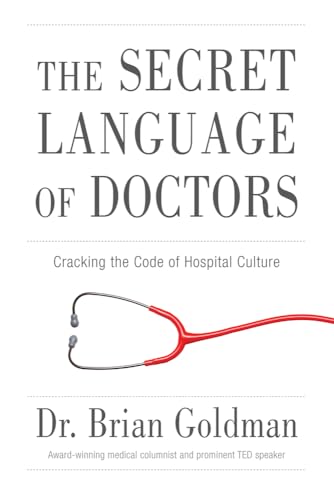
Most people have visited a doctor's office or emergency room in their lifetime to gain clarity about an ailment or check in after a procedure. While doctors strive to ensure their patients understand their diagnoses, rarely do those outside the medical community understand the words and phrases we hear practitioners yell across a hospital hallway or murmur to a colleague behind office doors. Doctors and nurses use a kind of secret language, comprised of words unlikely to be found in a medical textbook or heard on television. In The Secret Language of Doctors, Dr. Brian Goldman decodes those code words for the average patient. What does it mean when a patient has the symptoms of 'incarceritis'? What are 'blocking' and 'turfing'? And why do you never want to be diagnosed with a 'horrendoma'? Dr. Goldman reveals the meaning behind the colorful and secret expressions doctors use to describe difficult patients, situations, and medical conditions'including those they don't want you to know. Gain profound insight into what doctors really think about patients in this funny and biting examination of modern medical culture.
Die Inhaltsangabe kann sich auf eine andere Ausgabe dieses Titels beziehen.
Über die Autorin bzw. den Autor
Dr. Brian Goldman is an emergency physician at Toronto's Mount Sinai Hospital and the host of CBC Radio's award-winning program White Coat, Black Art. He is the author of the acclaimed book The Night Shift and his TEDx talk about medical errors, which has been viewed on the Internet almost one million times, has cemented his reputation as one of his generation's keenest observers of the culture of modern medicine. He lives in Toronto.
Auszug. © Genehmigter Nachdruck. Alle Rechte vorbehalten.
The Secret Language of Doctors
Cracking the Code of Hospital Culture
By Dr. Brian GoldmanTriumph Books
Copyright © 2014 Brian Goldman Enterprises Ltd.
All rights reserved.
ISBN: 978-1-62937-092-7All rights reserved.
Contents
1. The Bunker,
2. Slangmeister,
3. Code Brown and Other Bodily Fluids,
4. Status Dramaticus,
5. Failure to Die,
6. Swallowers,
7. Caesarean Section Consent Form,
8. Incarceritis,
9. Harpooning the Whale,
10. Frequent Flyers,
11. Blocking and Turfing,
12. Cowboys and Fleas,
13. Horrendomas,
14. Circling the Drain,
15. Slang Police,
Acknowledgements,
About the Author,
Copyright,
Dedication,
About the Author,
About the Publisher,
CHAPTER 1
. The Bunker
6 p.m. Handover
In a small, secluded room behind the nursing station of Ward 6 West, residents gather for the daily ritual called handover, or patient sign-out. It's the moment when the army of staff doing scheduled tests, interventions and operations shifts down to a skeleton crew of residents on call whose job is to monitor patients and attend to any sudden emergencies. It's also when residents who aren't on call finally get to go home. But first, they have to give their colleagues the heads-up on every patient under their charge.
The rectangular room where they meet is nicknamed the Bunker. The room contains four cubicles equipped with computers, a printer and a coffee machine. A small sofa bed is off to one side. The walls' blue paint is scuffed with furniture marks. In the middle of the room is a small conference table ringed with chairs.
The Bunker is where residents meet with the ward chief — the attending or most senior physician in charge of the patients — to write up chart notes and to talk frankly about patients and fellow doctors who work on other floors and in other hospitals. The room, teeming with two sets of residents — the ones on call and the ones handing over — is hot and stuffy.
"Room 22, bed B, 82-year-old male," says Rick, a first-year resident in internal medicine. "Admitted ten days ago with a fractured pelvis. He also has moderate Alzheimer's dementia, GERD and type 2 diabetes. OT and PT say it's not safe for him to go home. He's awaiting placement."
"What's his code status?" asks Sandi, the senior resident on call.
"He's Full Code," answers Rick. "We tried to get the DNR but the family said they're thinking about it."
"Thinking about it?" repeats Sandi. "Can we do a Hollywood Code?"
"You're on call, so it's your show," says Raza, the senior resident on Rick's team. "But the family is there 24/7. I think they'd know it if you run a Slow Code."
"You may hear about a consult we did on ortho," says Raza. "Eighty-eight-year-old female five days post right total hip replacement. Post-op, she was overhydrated by the ortho resident and put into CHF. She had a bump in her troponin. We've given her Lasix and she's feeling better. She's stable now."
"Saved another FOOBA," says Sandi.
"That's the third one this month," says Raza.
"Next patient is Room 24, bed C, 58-year-old female," says Rick. "Admitted over the weekend with type 1 diabetes and DKA triggered by a urinary tract infection. Unfortunately, she developed a pressure sore on her sacrum. Plastics is consulting on that."
"Pressure ulcer?" asks Sandi. "How the hell does a 58-year-old diabetic get a pressure ulcer on her bum?"
"She's a beemer," says Raza.
"How big is she?" asks Sandi.
"Three clinic units," answers Raza. "We tried using the Hoyer lift but it wasn't rated for her."
"Sounds like a horrendoma," says Sandi.
"It gets worse," says Rick. "We don't have a bariatric commode or wheelchair to get her to the bathroom. She had a Code Brown in the bed."
"Who got to clean that up?" asks Sandi.
"Thank god for LPNs," says Raza. Everybody in the room laughs.
* * *
The dialogue you just read was created to illustrate just how much medical jargon can be packed into a brief discussion.
The 82-year-old man has GERD, which stands for gastroesophageal reflux disease, better known as heartburn. The residents referred him to OT and PT — occupational therapy and physiotherapy. That's standard procedure for a patient with a cracked pelvis to determine whether the fracture will keep him from going home; an OT/PT assessment is also used to find out if a patient is likely to fall at home and what preventative safety measures might be necessary.
Raza's 88-year-old patient on the orthopedic floor went into CHF — congestive heart failure — after the orthopedic resident gave her too much intravenous fluid. A "bump in her troponin" means the woman had a slight increase in the level of a protein called troponin, which indicates that she suffered a mild heart attack.
The 58-year-old woman was admitted to hospital with DKA, which stands for diabetic ketoacidosis, a life-threatening condition in which both the sugar and acid in the bloodstream rise to dangerous levels. A "plastics consult" means she was seen by a plastic surgeon, the specialist who usually manages skin ulcers.
But the residents also used a bunch of words and phrases that aren't found in any medical textbook I know of, yet they were understood by everyone in the Bunker. If you sat in on that conversation, you might have thought you'd wandered into a very boring French film. Now, let's provide the subtitles — starting with the 82-year-old man.
• "He's awaiting placement" means there are no ongoing medical issues and if he could go home safely, we'd have sent him out by now.
• "What's his code status?" means "Do we have to do CPR (cardiopulmonary resuscitation) if his heart stops?"
• "He's Full Code. We tried to get the DNR but the family said they're thinking about it" means the family wants him to be resuscitated if his heart stops. They can't see the handwriting on the wall — that there's no point in doing CPR if his heart stops — and they aren't ready to sign a Do Not Resuscitate order.
• "Can we do a Hollywood Code?" means that if his heart stops we'll do a pretend resuscitation in which it looks as if we're trying to save him but we aren't.
Now, we'll take look at the acronym Sandi the resident used to talk about the patient on the orthopedic floor who was put into congestive heart failure. "Saved another FOOBA" means the internal medicine team saved another patient who was "found on orthopedics barely alive." It's a dig at orthopedic surgeons, who have a reputation for being so focused on what needs to be fixed surgically that they ignore signs of other diseases. FOOBA is a play on FUBAR, a military slang term that has entered common vernacular and stands for "fucked up beyond all repair."
Finally, let's unpack the slang that was used by the residents to talk about the 58-year-old woman in Room 24, bed C:
• "How the hell does a 58-year-old diabetic get a pressure ulcer on her bum? — She's a beemer" means the woman got a pressure ulcer on her buttocks because she has a high body mass index, or BMI, a polite way of saying that she is morbidly obese. In other words, she's so large that she developed a pressure ulcer from lying on her backside too long because she was too weak to move and she weighed too much for nurses to shift her position in bed.
• "Three clinic units" is a sneaky way of saying the patient weighs 600 pounds. One...
„Über diesen Titel“ kann sich auf eine andere Ausgabe dieses Titels beziehen.
Suchergebnisse für Secret Language of Doctors: Cracking the Code of Hospital...

Beispielbild für diese ISBN
The Secret Language of Doctors: Cracking the Code of Hospital Culture
Anbieter: World of Books (was SecondSale), Montgomery, IL, USA
Verkäuferbewertung 5 von 5 Sternen

Paperback. Zustand: Good. Most people have visited a doctor's office or emergency room in their lifetime to gain clarity about an ailment or check in after a procedure. While doctors strive to ensure their patients understand their diagnoses, rarely do those outside the medical community understand the words and phrases we hear practitioners yell across a hospital hallway or murmur to a colleague behind office doors. Doctors and nurses use a kind of secret language, comprised of words unlikely to be found in a medical textbook or heard on television. In The Secret Language of Doctors, Dr. Brian Goldman decodes those code words for the average patient. What does it mean when a patient has the symptoms of "incarceritis"? What are "blocking" and "turfing"? And why do you never want to be diagnosed with a "horrendoma"? Dr. Goldman reveals the meaning behind the colorful and secret expressions doctors use to describe difficult patients, situations, and medical conditions--including those they don't want you to know. Gain profound insight into what doctors really think about patients in this funny and biting examination of modern medical culture. Bestandsnummer des Verkäufers 00104413776
Gebraucht kaufen
EUR 5,58
Versand gratis
Versand innerhalb von USA
Versand innerhalb von USA
Anzahl: 3 verfügbar
Beispielbild für diese ISBN
The Secret Language of Doctors: Cracking the Code of Hospital Culture
Anbieter: Once Upon A Time Books, Siloam Springs, AR, USA
Verkäuferbewertung 4 von 5 Sternen

paperback. Zustand: Good. This is a used book in good condition and may show some signs of use or wear . This is a used book in good condition and may show some signs of use or wear . Bestandsnummer des Verkäufers mon0001361116
Gebraucht kaufen
EUR 2,07
EUR 3,52 Versand
Versand innerhalb von USA
Versand innerhalb von USA
Anzahl: 1 verfügbar
Beispielbild für diese ISBN
The Secret Language of Doctors: Cracking the Code of Hospital Culture
Anbieter: Gulf Coast Books, Cypress, TX, USA
Verkäuferbewertung 5 von 5 Sternen
paperback. Zustand: Fair. Bestandsnummer des Verkäufers 1629370924-4-33351430
Gebraucht kaufen
EUR 5,59
Versand gratis
Versand innerhalb von USA
Versand innerhalb von USA
Anzahl: 1 verfügbar
Beispielbild für diese ISBN
The Secret Language of Doctors: Cracking the Code of Hospital Culture
Anbieter: ThriftBooks-Atlanta, AUSTELL, GA, USA
Verkäuferbewertung 5 von 5 Sternen
Paperback. Zustand: Very Good. No Jacket. May have limited writing in cover pages. Pages are unmarked. ~ ThriftBooks: Read More, Spend Less. Bestandsnummer des Verkäufers G1629370924I4N00
Gebraucht kaufen
EUR 6,12
Versand gratis
Versand innerhalb von USA
Versand innerhalb von USA
Anzahl: 1 verfügbar
Beispielbild für diese ISBN
The Secret Language of Doctors: Cracking the Code of Hospital Culture
Anbieter: ThriftBooks-Dallas, Dallas, TX, USA
Verkäuferbewertung 5 von 5 Sternen
Paperback. Zustand: Very Good. No Jacket. May have limited writing in cover pages. Pages are unmarked. ~ ThriftBooks: Read More, Spend Less. Bestandsnummer des Verkäufers G1629370924I4N00
Gebraucht kaufen
EUR 6,12
Versand gratis
Versand innerhalb von USA
Versand innerhalb von USA
Anzahl: 1 verfügbar
Beispielbild für diese ISBN
The Secret Language of Doctors: Cracking the Code of Hospital Culture
Anbieter: ThriftBooks-Atlanta, AUSTELL, GA, USA
Verkäuferbewertung 5 von 5 Sternen
Paperback. Zustand: Good. No Jacket. Pages can have notes/highlighting. Spine may show signs of wear. ~ ThriftBooks: Read More, Spend Less. Bestandsnummer des Verkäufers G1629370924I3N00
Gebraucht kaufen
EUR 6,12
Versand gratis
Versand innerhalb von USA
Versand innerhalb von USA
Anzahl: 1 verfügbar
Beispielbild für diese ISBN
The Secret Language of Doctors: Cracking the Code of Hospital Culture
Anbieter: The Maryland Book Bank, Baltimore, MD, USA
Verkäuferbewertung 5 von 5 Sternen
paperback. Zustand: Very Good. Reprint. Used - Very Good. Bestandsnummer des Verkäufers 9-M-1-0210
Gebraucht kaufen
EUR 2,07
EUR 4,18 Versand
Versand innerhalb von USA
Versand innerhalb von USA
Anzahl: 1 verfügbar
Beispielbild für diese ISBN
The Secret Language of Doctors: Cracking the Code of Hospital Culture
Anbieter: World of Books Inc, Montgomery, IL, USA
Verkäuferbewertung 4 von 5 Sternen
Paperback. Zustand: Good. Most people have visited a doctor's office or emergency room in their lifetime to gain clarity about an ailment or check in after a procedure. While doctors strive to ensure their patients understand their diagnoses, rarely do those outside the medical community understand the words and phrases we hear practitioners yell across a hospital hallway or murmur to a colleague behind office doors. Doctors and nurses use a kind of secret language, comprised of words unlikely to be found in a medical textbook or heard on television. In The Secret Language of Doctors, Dr. Brian Goldman decodes those code words for the average patient. What does it mean when a patient has the symptoms of "incarceritis"? What are "blocking" and "turfing"? And why do you never want to be diagnosed with a "horrendoma"? Dr. Goldman reveals the meaning behind the colorful and secret expressions doctors use to describe difficult patients, situations, and medical conditions--including those they don't want you to know. Gain profound insight into what doctors really think about patients in this funny and biting examination of modern medical culture. Bestandsnummer des Verkäufers CIN1629370924G
Gebraucht kaufen
EUR 7,41
Versand gratis
Versand innerhalb von USA
Versand innerhalb von USA
Anzahl: 3 verfügbar
Beispielbild für diese ISBN
The Secret Language of Doctors: Cracking the Code of Hospital Culture
Anbieter: Book Outpost, Blawnox, PA, USA
Verkäuferbewertung 5 von 5 Sternen
Zustand: Like New. Never used! Light wear to corners/edges from shelving. Wholesale pricing available via Amazon business.Never used! Light wear to corners/edges from shelving. Bestandsnummer des Verkäufers WH-9781629370927-LN
Gebraucht kaufen
EUR 7,79
Versand gratis
Versand innerhalb von USA
Versand innerhalb von USA
Anzahl: Mehr als 20 verfügbar
Beispielbild für diese ISBN
The Secret Language of Doctors: Cracking the Code of Hospital Culture
Anbieter: Book Outpost, Blawnox, PA, USA
Verkäuferbewertung 5 von 5 Sternen
Zustand: New. Brand new.New. Bestandsnummer des Verkäufers WH-9781629370927-N
Neu kaufen
EUR 8,25
Versand gratis
Versand innerhalb von USA
Versand innerhalb von USA
Anzahl: Mehr als 20 verfügbar