
Verwandte Artikel zu Archive That, Comrade!: Left Legacies and the Counter...
Archive That, Comrade!: Left Legacies and the Counter Culture of Remembrance (Kairos) - Softcover
Buch 8 von 28: Kelman Library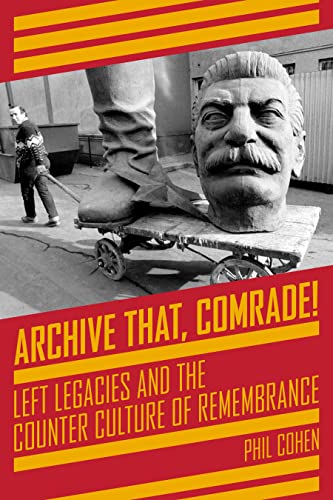
Inhaltsangabe
After a brief introduction that sets the contemporary scene of “archive fever,” this book considers the political legacy of 1960s counterculture for what it reveals about the process of commemoration. How far can the archive serve as a platform for dialogue and debate between different generations of activists in a culture that fetishizes the evanescent present, practices a profound amnesia about its counterfactual past, and forecloses the sociological imagination of an alternative future? Can the Left establish its own autonomous model of commemoration?
Die Inhaltsangabe kann sich auf eine andere Ausgabe dieses Titels beziehen.
Über die Autorin bzw. den Autor
Phil Cohen played a key role in the London counterculture scene of the 1960s. Currently he is research director of LivingMaps, a network of activists, artists, and academics developing a creative and critical approach to social mapping.
Auszug. © Genehmigter Nachdruck. Alle Rechte vorbehalten.
Archive That, Comrade!
Left Legacies and the Counter Culture of Remembrance
By Phil CohenPM Press
Copyright © 2018 PM Press
All rights reserved.
ISBN: 978-1-62963-506-4All rights reserved.
Contents
LIST OF ILLUSTRATIONS,
ACKNOWLEDGEMENTS,
PREFACE,
Moot Points,
Archive Fever: Coming in from the Cold?,
Counter Culture: Then and Now,
Ten Days That Shook My World: Remembering 144 Piccadilly between Spectacle and Trauma,
In My End Is Others' Beginning: Left Legacy Politics and the Dialectic of Generations,
Winners and Losers,
Let Us Now Praise Famous People: Paradigms of Remembrance and the Twin Cultures of Modernity,
Fame Academies,
On Memes and other Mnemonic Devices,
Technologies of Immortality,
Towards a Theory of Archival Genres,
A Tale of Two Archives,
Between Realpolitik and Dingpolitik: The Living Archive in a 'Post-information' Age,
The Adoptive Archive: A Thought Experiment,
Left Field and the Quest for Uncommon Ground,
Lest We Remember, Lest We Forget: On Iconoclasm and the Problematics of Silence,
Archival In/Disciplines,
Curating the Anarchive,
Not Everyone Will Be Taken into the Future,
The Arc of Memory,
Postscript: The Politics of False Memory in the Age of 'Post-Truth',
NOTES,
FURTHER READING,
ABOUT THE AUTHOR,
INDEX,
CHAPTER 1
Moot Points
archive: 1. From Greek arkheia, things kept at the public office, derived from arche, beginning, government; 2. A collection of documents such as letters, official papers, photographs or recorded material kept for their historical interest; 3. Backup computer file, kept often in compressed form on tape or disk for long-term storage; a directory of files that Internet users can access using File Transfer Protocol. — Encarta World English Dictionary
Ark: something that affords protection and safety; a chest or cupboard holding the scrolls of the Torah in a synagogue; a low hut used to house livestock; a ship or boat. — Oxford English Dictionary
An archive is where Mr and Mrs Noah and all the animals went to get out of the rain, but it rained and rained for 40 days and nights, so they just stayed put, luckily they had taken lots of story and picture books along with them so they weren't bored. — primary school pupil
It takes time for what has been erased to surface. Traces survive in registers, and nobody knows where these registers are hidden, and who has custody of them, and whether or not their custodians are willing to let you see them. Or perhaps they have forgotten that such registers exist. — Patrick Modiano, Search Warrant
Just as voluntary memory and utter oblivion belong together, so organised fame and remembrance lead ineluctably to nothingness. — Theodor Adorno, Minima Moralia
Modern memory is above all archival. It relies entirely on the materialities of the trace, the immediacy of records, the visibility of the image. What began as writing ends in high fidelity and tape recording. No longer living memories, more or less intended remainders, the archive has become the deliberate and calculated secretion of lost memory. It adds to life, itself often a function of its own recording, a secondary memory, a prosthesis-memory. — Pierre Nora, Les Lieux de mémoire
The starting point of critical elaboration is the question of what one really is, 'knowing thyself' as a product of historical processes to date which have deposited in you an infinity of traces, without leaving an inventory — therefore it is imperative at the outset to compile such an inventory. — Antonio Gramsci, The Prison Notebooks
The function of the archive, as of art, is to hold unlikely things. ... The primary operations of the archive are no longer the contents of its files but rather their logistical interlinking, just as the Web is not primarily defined by its contents but by its protocols. — Wolfgang Ernst, Digital Memory and the Archive
The question of the archive is not a question of the past. ... It is a question of the future, the question of the future itself, the question of a response, of a promise, and of a responsibility for tomorrow. ... Effective democratization can always be measured by this essential criterion: the participation in and the access to the archive. — Jacques Derrida, Archive Fever
We should not be deceived into thinking that heritage is an acquisition, a possession that grows and solidifies; rather it is an unstable assemblage of faults, fissures, and heterogeneous layers that threaten the fragile inheritor from within or from underneath. — Michel Foucault, 'Nietzsche, Genealogy, History'
The old word 'thing' or 'ding' originally meant a certain type of assembly. The point of reviving this old notion of assembly in a contemporary notion of assemblage, is that we don't assemble because we agree, look alike, feel good, are socially compatible, but because we are brought together by divisive matters of concern into some neutral isolated place in order to arrive at some sort of provisional makeshift (dis)agreement. — Bruno Latour, 'From Realpolitik to Dingpolitik or How to Make Things Public'
Moot
Noun: 1) An assembly held for debate in Anglo-Saxon and mediaeval times
2) A mock proceeding set up to examine a hypothetical case as an academic exercise
Verb: To raise or broach a question or topic for discussion
Adjective: 1) Subject to debate, dispute, uncertainty
2) Having little or no practical relevance
Archive Fever: Coming in from the Cold?
The child's confusion of the Ark with the archive in the preceding quote makes us smile, as if it were no more than a charming elision of sounds and meaning, but the association of the two words points to a significant but often overlooked point of connection between them. The archive is a safe harbour for all manner of materials, artefacts, texts, images, documents, which might otherwise perish, whether from neglect or active suppression. It is an affordance of memory which may be a container of profane narratives or holy scripts, bureaucratic protocols or autobiographical memories, but it restores their capacity to survive the storms of history which produced them. The archive is an ark of the covenant we all make with the world in which we struggle to make our mark on posterity. What might appear initially to be a mere container of accidental traces of the past turns out, on closer inspection, to be an object of calculation, even intervention, albeit one that is largely disavowed.
Yet this arch-mnemonic can also be a trap, a siren call to unwary historians, a seductive invitation to immerse themselves in an oceanic feeling of omniscience about the past or, conversely, to drown in sea of nostalgic identification with lives other than their own. The archive can be a talisman for the multifarious desire to 'get to the bottom of things' which may start off with innocent acts of curiosity but all too often ends by being driven by an obsessive ambition to capture and sum up the world. Patrick Modiano draws our attention to an even less attractive face of the archive, its capacity to conceal, to resist disclosure, to obfuscate, even to cover its own tracks so that its existence is either unknown or mere rumour. So it is not only a question of what is lost by being excluded from the archive, but also...
„Über diesen Titel“ kann sich auf eine andere Ausgabe dieses Titels beziehen.
Ihre gesetzlichen Garantierechte: Alle Verbraucher:innen in der EU profitieren von mindestens 2 Jahren gesetzlichem Garantieschutz für alle in der EU verkauften Konsumgüter. Mehr erfahren
Suchergebnisse für Archive That, Comrade!: Left Legacies and the Counter...

Foto des Verkäufers
Archive That, Comrade!: Left Legacies and the Counter Culture of Remembrance (KAIROS)
Anbieter: Goodwill of Greater Milwaukee and Chicago, Racine, WI, USA
Verkäuferbewertung 5 von 5 Sternen

Zustand: acceptable. Book is considered to be in acceptable condition. The actual cover image may not match the stock photo. Book may have one or more of the following defects: noticeable wear on the cover dust jacket or spine; curved, dog eared or creased page s ; writing or highlighting inside or on the edges; sticker s or other adhesive on cover; CD DVD may not be included; and book may be a former library copy. Bestandsnummer des Verkäufers SEWV.1629635065.A
Gebraucht kaufen
EUR 12,30
EUR 2,73 Versand
Versand innerhalb von USA
Versand innerhalb von USA
Anzahl: 1 verfügbar
Beispielbild für diese ISBN
Archive that, Comrade! Format: Trade Paper
Anbieter: INDOO, Avenel, NJ, USA
Verkäuferbewertung 5 von 5 Sternen
Zustand: As New. Unread copy in mint condition. Bestandsnummer des Verkäufers PG9781629635064
Gebraucht kaufen
EUR 16,62
Versand gratis
Versand innerhalb von USA
Versand innerhalb von USA
Anzahl: Mehr als 20 verfügbar
Beispielbild für diese ISBN
Archive that, Comrade! Format: Trade Paper
Anbieter: INDOO, Avenel, NJ, USA
Verkäuferbewertung 5 von 5 Sternen
Zustand: New. Brand New. Bestandsnummer des Verkäufers 9781629635064
Neu kaufen
EUR 16,72
Versand gratis
Versand innerhalb von USA
Versand innerhalb von USA
Anzahl: Mehr als 20 verfügbar
Beispielbild für diese ISBN
Archive That, Comrade!: Left Legacies and the Counter Culture of Remembrance (KAIROS)
Anbieter: Last Word Books, Olympia, WA, USA
Verkäuferbewertung 5 von 5 Sternen
paperback. Zustand: Very Good. A used book with minor shelf wear and imperfections. Thank you for supporting Last Word Books and independent bookstores. Bestandsnummer des Verkäufers 210449515
Gebraucht kaufen
EUR 16,89
Versand gratis
Versand innerhalb von USA
Versand innerhalb von USA
Anzahl: 1 verfügbar
Beispielbild für diese ISBN
Archive That, Comrade! : Left Legacies and the Counter Culture of Remembrance
Anbieter: Better World Books Ltd, Dunfermline, Vereinigtes Königreich
Verkäuferbewertung 5 von 5 Sternen
Zustand: Very Good. Former library copy. Pages intact with possible writing/highlighting. Binding strong with minor wear. Dust jackets/supplements may not be included. Includes library markings. Stock photo provided. Product includes identifying sticker. Better World Books: Buy Books. Do Good. Bestandsnummer des Verkäufers 68964308-20
Gebraucht kaufen
EUR 12,26
EUR 5,97 Versand
Versand von Vereinigtes Königreich nach USA
Versand von Vereinigtes Königreich nach USA
Anzahl: 1 verfügbar
Foto des Verkäufers
Archive That, Comrade! : Left Legacies and the Counter Culture of Remembrance
Anbieter: GreatBookPrices, Columbia, MD, USA
Verkäuferbewertung 5 von 5 Sternen
Zustand: New. Bestandsnummer des Verkäufers 31975502-n
Neu kaufen
EUR 16,65
EUR 2,41 Versand
Versand innerhalb von USA
Versand innerhalb von USA
Anzahl: 5 verfügbar
Foto des Verkäufers
Archive That, Comrade!
Anbieter: Rarewaves USA, HEBRON, KY, USA
Verkäuferbewertung 5 von 5 Sternen
Paperback. Zustand: New. Bestandsnummer des Verkäufers LU-9781629635064
Foto des Verkäufers
Archive That, Comrade! : Left Legacies and the Counter Culture of Remembrance
Anbieter: GreatBookPrices, Columbia, MD, USA
Verkäuferbewertung 5 von 5 Sternen
Zustand: As New. Unread book in perfect condition. Bestandsnummer des Verkäufers 31975502
Gebraucht kaufen
EUR 18,21
EUR 2,41 Versand
Versand innerhalb von USA
Versand innerhalb von USA
Anzahl: 5 verfügbar
Foto des Verkäufers
Archive That, Comrade!
Anbieter: Rarewaves.com USA, London, LONDO, Vereinigtes Königreich
Verkäuferbewertung 5 von 5 Sternen
Paperback. Zustand: New. Bestandsnummer des Verkäufers LU-9781629635064
Neu kaufen
EUR 21,10
Versand gratis
Versand von Vereinigtes Königreich nach USA
Versand von Vereinigtes Königreich nach USA
Anzahl: 2 verfügbar
Beispielbild für diese ISBN
Archive That, Comrade! , Left Legacies and the Counter Culture of Remembrance (Kairos)
Anbieter: Chiron Media, Wallingford, Vereinigtes Königreich
Verkäuferbewertung 5 von 5 Sternen
Paperback. Zustand: New. Brand new book, sourced directly from publisher. Dispatch time is 24-48 hours from our warehouse. Book will be sent in robust, secure packaging to ensure it reaches you securely. Bestandsnummer des Verkäufers 6666-GRD-9781629635064
Neu kaufen
EUR 16,90
EUR 5,36 Versand
Versand von Vereinigtes Königreich nach USA
Versand von Vereinigtes Königreich nach USA
Anzahl: 1 verfügbar