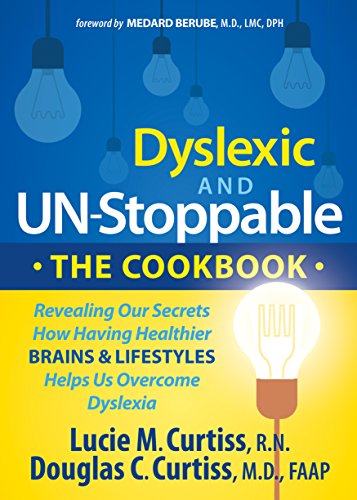
Dyslexic and Un-Stoppable the Cookbook: Revealing Our Secrets How Having Healthier Brains and Lifestyles Helps Us Overcome Dyslexia - Softcover
Inhaltsangabe
"Dyslexic and Un-Stoppable The Cookbook: Revealing Our Secrets How Having Healthier Brains and Lifestyles Helps Us Overcome Dyslexia," shares nutritional facts and healthier recipes Lucie and Dr. Doug Curtiss have incorporated in their daily routine. "Dyslexic and Un-Stoppable The Cookbook" complements "Dyslexic AND UN-Stoppable: How Dyslexia Helps Us Create the Life of Our Dreams and How YOU Can Do It Too!," by identifying healthy, beneficial ingredients to improve the odds of overcoming dyslexia.
Die Inhaltsangabe kann sich auf eine andere Ausgabe dieses Titels beziehen.
Über die Autorin bzw. den Autor
Lucie Curtiss, RN, is a dyslexic and UN-Stoppable author, mother, pediatric nurse, entrepreneur, and business manager of a successful pediatric practice.
Dr. Douglas Curtiss is a board-certified, Yale-trained pediatrician with over 18 years of experience, and has helped thousands of parents navigate the school system and advocate for their dyslexic children.
Lucie and Doug are the authors of the book, “Dyslexic AND UN-Stoppable: How Dyslexia Helps Us Live The Life Of Our Dreams And How You Can Do it Too!”
Auszug. © Genehmigter Nachdruck. Alle Rechte vorbehalten.
Dyslexic AND UN-Stoppable The Cookbook
Revealing Our Secrets — How Having Healthier Brains and Lifestyles Helps US Overcome Dyslexia
By Lucie M. Curtiss, Douglas C. CurtissMorgan James Publishing
Copyright © 2015 Lucie M. Curtiss, R.N. and Douglas C. Curtiss, M.D., FAAP
All rights reserved.
ISBN: 978-1-63047-559-8All rights reserved.
Contents
Foreword,
Part 1: Our Mission,
Chapter 1 Who Are We?,
Chapter 2 Where Does Dyslexic AND UN-Stoppable Come From?,
Chapter 3 Why We Wrote This Second Book,
Chapter 4 What Do Healthy Foods and Diet Have to Do with Dyslexia, Anyway?,
Part 2: The Yummy Recipes and Famous Quotes from Well-Known Dyslexics,
Recipe #1 Baba's "Almost Famous" Chocolate Torpedo Sandwich Well-Known Dyslexic: Thomas Edison,
Recipe #2 Tuna Melts My Way! Well-Known Dyslexic: Galileo Galilei,
Recipe #3 Super-Easy Shrimp Stir-Fry Well-Known Dyslexic: Benjamin Franklin,
Recipe #4: Scrumptious Salmon Well-Known Dyslexic: Albert Einstein,
Recipe #5: An Old Favorite: Smoked Salmon Bagel Well-Known Dyslexic: Henry Ford,
Recipe #6: Meat Tacos with "Dip-Dip" Well-Known Dyslexic: Alexander Graham Bell,
Recipe #7: Fish Tacos with "Dip-Dip" Well-Known Dyslexic: George Washington,
Recipe #8: Crêpes à la Maman Well-Known Dyslexic: Leonardo da Vinci,
Recipe #9: Super-Easy Banana Bread Well-Known Dyslexic: Pablo Picasso,
Recipe #10: Chloé's "Surprise" Peanut Butter Cookies,
Epilogue,
Acknowledgments,
About the Authors,
References,
CHAPTER 1
Who Are We?
Lucie M. Curtiss
My name is Lucie Curtiss, and I'm dyslexic. I've been coping with dyslexia for over forty years. Despite my struggles in school when I was young, I managed to become successful in my life. I finally realized I was dyslexic when I was in my mid-twenties. With fierce determination and a desire to succeed no matter what, I was able to overcome dyslexia and accomplish my dreams.
Also, my husband and I discovered that our son Félix-Alexander (FéZander) was dyslexic. So for the past twelve years, we've been helping him succeed, and the results are showing up in every aspect of his life. It's wonderful to see him blossom. Now we want to share our journey with other dyslexics and hope what we've learned may help someone else succeed.
You can learn more about Lucie's personal journey with dyslexia by reading her full story ("The Author's Journey with Dyslexia") in our first book, Dyslexic AND UN-Stoppable: How Dyslexia Helps Us Create the Life of Our Dreams and How YOU Can Do It Too!
Dr. Douglas C. Curtiss
I am Dr. Douglas Curtiss, an Ivy League–trained pediatrician who learned traditional Western medicine. As a student of personal development, I began to look at complementary medicine techniques to incorporate into my practice. When our son was discovered to be dyslexic, I worked with my wife, Lucie, to find the best methods, both traditional and complementary, to help our son overcome dyslexia and become an excellent student, moving to the top of his class. In this book, Lucie has developed delicious recipes to help your dyslexic child. I show you the science behind these recommendations so that you can make educated choices to help your child rise to his or her fullest potential.
You can learn more about Dr. Curtiss ("A Pediatrician's and Dad's Perspective") in our first book called Dyslexic AND UN-Stoppable: How Dyslexia Helps Us Create the Life of Our Dreams and How YOU Can Do It Too!
Félix-Alexander C. Curtiss
My name is Félix-Alexander. My friends call me Félix, and my family calls me Baba and FéZander. I do have many nicknames and I like them all.
After all the hard work, I now use dyslexia to my advantage. To keep me going, my mom and sister make healthy food. This food not only tastes great, it keeps my body healthy and me energized. This makes a win-win-win situation. As a dyslexic, I have endless ideas. My mom and sister cook great food to keep me energized, and I am able to complete my ideas.
I love taking care of my body and myself. Being healthy is important to me. I always check the ingredient lists on packages to make sure the food is healthy and doesn't have a bunch of chemicals. If the list contains five or less ingredients and I can read them, I know it's okay for me to eat.
Since this food tastes so good, there is no reason for me to eat fast food. I can't believe that such good food could taste so amazing. These recipes are the best in the world, as far as I'm concerned.
You can learn more about Félix-Alexander's full story and journey with dyslexia in our first book, Dyslexic AND UN-Stoppable: How Dyslexia Helps Us Create the Life of Our Dreams and How YOU Can Do It Too!
Chloé K. Curtiss ("Cookie")
I'm Chloé and I'm ten years old. I'm Félix's little sister. The two of us are best friends and always help each other out. When I was born and Félix was a little boy, he nicknamed me "Cookie" because he couldn't say "Chloé." Now my whole family calls me Cookie, even my cousins.
I like that my mom and dad let me help out with the drawing and cooking. I designed Sparky the Owl and the rainbow picture on the first book.
I love to cook with my mom, and making the videos for this book was a lot of fun. I made most of the recipes with the help of my mom, and my brother loved to eat all of the food we made, especially the peanut butter cookies!
CHAPTER 2Where Does Dyslexic AND UN-Stoppable Come From?
Dyslexic AND UN-Stoppable, LLC, was born out of our desire to see dyslexic children like our son overcome dyslexia. We've done the research, took the classes, and learned the tools. Now we want to pass this great information to other dyslexics and their families so they also can succeed and become UN-Stoppable.
Learning where to get the services and how to help our son was a long process of trial and error. So we figured it would be nice to help other parents and teachers find the information they needed in the fastest time possible. The sooner parents can identify dyslexia in their child, the greater the chance of success in overcoming it.
We hope that by sharing our journey with the world, we will be able to help other dyslexic children. We realize that some children are more severely challenged than our son, but if we can at least bring them hope, help them find their passion, help them find their unique gifts, or help save their self-esteem, then we will have served our purpose. We just need to open one little door for the possibilities to show up. We want to remind dyslexics that they are SMART and can do anything they put their minds to!
We have one main mission at Dyslexic AND UN-Stoppable: to help dyslexics rediscover their inner power and become UN-Stoppable.
The Dyslexic AND UN-Stoppable book series is designed to provide dyslexics with all the information, tools, and strategies we learned along this journey to help them overcome dyslexia. Living with dyslexia is a lifelong journey. We can overcome some of the challenges, but dyslexia will always remain part of us. For this reason, we will keep gathering the information, and we will continue sharing it with you. This is just the beginning for Dyslexic AND UN-Stoppable. Stay connected with us to remain updated about our new resources, such as Dr. Curtiss's empowering book for his dyslexic patients, which will be out soon.
Our mission at Dyslexic AND UN-Stoppable is to help dyslexic children rediscover their inner power and become UN-Stoppable.
CHAPTER 3Why We Wrote This Second Book
Our first book, Dyslexic AND UN-Stoppable: How Dyslexia Helps Us Create the Life of Our Dreams and How YOU Can Do It Too!, gave parents and teachers concrete examples of tools and strategies that helped our son overcome difficulties with writing, reading, math, and speech, and to help parents get the services they need for their children to succeed in the public schools.
Our goal for this second book in the Dyslexic AND UN-Stoppable series is to complement the first book. Overcoming dyslexia is a continual journey, so we recommend reading our first book in conjunction with this book to get maximum benefits and results.
In this book, we will focus mainly on nutritional facts, healthy recipes, and how to identify the healthy ingredients that are beneficial for improving your odds of overcoming dyslexia, as well as the non-healthy ingredients to avoid. We've adapted recipes we like to eat to provide our son who is dyslexic with the best nutrients to keep his brain functioning at its best. These recipes are designed for the whole family to enjoy. Like most people, we are a busy, on-the-go family, and time is of the essence. We need to make meals that we all enjoy and benefit from, because in the end, we all need and want a healthy brain, dyslexic or otherwise.
After years of research, we now realize that using as many pure and simple ingredients as possible is the key to getting maximum benefit from our foods.
We can only speak from our own experience, but we've noticed that by removing as many of certain ingredients from FéZander's diet as possible, he has made great improvements in his ability to concentrate and focus.
On a side note: I (Lucie/Mom) also noticed an improvement in my health as an adult living with dyslexia when I changed my eating habits. The better I eat, the better I cope with life and work-related stresses, which in return means I'm better able to concentrate and deal with problems as they arise.
When possible, we eat foods that contain no artificial dyes, no preservatives, no chemicals, no added salt, no aluminum, no antibiotics, and no growth hormones, and that are not genetically modified (non-GMO).
Some examples of foods we like to use are organic foods, wild caught fish, free-range eggs, and raw veggies and fruits. Basically we use foods in their purest and simplest form to preserve their nutrients.
As we said above, we can only speak from our own experience. Of course, we wouldn't expect that what we are doing to help our son will automatically help all other children overcome dyslexia. We are all unique individuals with different degrees of difficulties, but our hope is that we can help even a little.
One of our mentors always starts his courses and camps by stating something like, "Don't believe a word I say; this is my experience only. This is what works for me, and it doesn't mean it will work for you." When we first heard him say that, we thought, What? What does that mean? What is he trying to tell us? Today, we get it. Our mentor wants to help as many people as he can, but he also realizes that it's simply impossible to help everyone all the time. We are all at different places and on different paths in our lives. Some will benefit from our work and some won't, and we're okay with that. Some will hear similar information from someone else and understand it more clearly from them. In the end, as long as we do our best, that's all that matters.
The suggestions in this book are what work for us! We are not "recommending" anything. We are simply offering recipe ideas that have benefitted us. Again, it's important that you do your own research!
You always need to do your own research and make your own decisions about your food choices. We are all unique and different.
Since as dyslexics, we LOVE visuals, we decided to follow the successful trend of our first book by including video instructions on our website for each recipe.
For most recipes, "Cookie" (our daughter Chloé) will show you step-by-step how to make these delicious meals.
Visit our website www.DyslexicAndUnstoppable.com to view the videos for each recipe. Each video is titled with the same name as the recipe.
Recipe #1: Baba's "Almost Famous" Chocolate Torpedo Sandwich
Recipe #2: Tuna Melts My Way!
Recipe #3: Super-Easy Shrimp Stir-Fry
Recipe #4: Scrumptious Salmon
Recipe #5: An Old Favorite: Smoked Salmon Bagel
Recipe #6: Meat Tacos with "Dip-Dip"
Recipe #7: Fish Tacos with "Dip-Dip"
Recipe #8: Crêpes à la Maman
Recipe #9: Super-Easy Banana Bread
Recipe #10: Chloé's "Surprise" Peanut Butter Cookies
As a Bonus, this book also includes information on nine Well-Known Dyslexics who changed the world and made a huge impact. After each recipe, you will find one of them profiled, along with their "claim to fame" and a few quotes from them!
Remember, being healthy is the key to conquering obstacles in life. The healthier we are, the better we are able to cope with and manage difficulties and become successful. The healthier we eat, the better we feel. The better we feel, the better we can face challenges and surmount them. And a healthy brain is a happy brain. Surely a happy and healthy brain helps to overcome dyslexia!
We hope that after reading this book you will also be able to come up with new simple and yummy recipe ideas your family will enjoy, and we hope you will share them with us on our websiteDyslexicAndUnstoppable.com. Let's all work together to overcome dyslexia!
CHAPTER 4What Do Healthy Foods and Diet Have to Do with Dyslexia, Anyway?
Most parents understand the importance of good nutrition for their children's school performance. Many parents even know what nutrients boost brain power and concentration. The big question is how to get these nutritious foods into their children. This is why we wrote this cookbook. We wanted you to have simple, easy- to-make recipes of delicious meals and snacks that your children will eat and that will help improve their performance at school and in life. In this chapter, I (Doug) hope to explain why we included various recipes and ingredients, what the individual nutrients do to help brain function, and what the research has shown. We will look at specific nutrients and what their effect has been shown to be on the brain. At the end of the chapter we will include some of the controversies surrounding certain ingredients so that you can make an informed decision for your child.
Before we delve into individual ingredients and their effect on brain function, I want to lay out some of the general principles of this book. First, whenever possible, we have used organic, natural ingredients with no preservatives and very little in the way of additives. Essentially we feel that the closer the ingredients are to what nature has made, the more nutritious they are. Therefore, whenever possible, we have tried to include whole grains, unrefined sugars, and foods that require no cooking. This helps maintain the food in its most nutritious state.
You can learn more about how to help your child with dyslexia by reading the chapters ("A Pediatrician's and Dad's Perspective" and "Tools and Strategies") in our first book calledDyslexic AND UN-Stoppable: How Dyslexia Helps Us Create the Life of Our Dreams and How YOU Can Do It Too!
Basic Principles and Why They Are Important
1. Whole grains: The use of whole grains is important for general health for two reasons. First, the whole grain has all of the fiber, which helps improve the health of the colon. By improving colonic movement, the fiber in whole grains helps move waste through the bowel more regularly. The second benefit of whole grain products, as opposed to products manufactured with refined, white flour, is that whole grains cause a slower rise in blood sugar, which then mutes the body's secretion of insulin. This should help your child avoid that "crash" in energy that some children experience mid-morning.
2. Minimizing sugars and using unrefined sugars wherever possible: Using less refined sugar may require some adjustment. However, with time your children will appreciate a variety of tastes in the food and will miss that sugary flavor less. Still, there are ways to sweeten foods without sugar. Using maple sugar or coconut sugar adds the sweetness, as well as a slightly more complex flavor, and these sugars do have some trace elements missing in white sugar.
3. Organic ingredients: While organic products may be more expensive, they have the benefit of fewer additives. They are also usually grown with fewer pesticides.
Foods to Avoid
1. Artificial dyes: There has been controversy over the health effects of artificial dyes in foods. However, with the rise in the diagnosis of attention problems in conjunction with the increase in the use of these dyes, there has been interest in whether these artificial dyes may play a role. Many studies have been too small to definitively tell if these chemicals affect attention. However, there was one double-blind, placebo-controlled study, which is the best type of study to minimize bias. The study was performed in England and looked at preschoolers and elementary school children. The kids were randomized to drink either natural fruit juices or those with various artificial colors with and without the preservative sodium benzoate. The children who drank the juice with the artificial ingredients were found to have a mild but significant increase in hyperactivity during the six weeks they were observed. Given the amount of concentration that most children with dyslexia need for school, it only makes sense to avoid these chemicals.
2. Artificial flavors. There have been numerous studies showing the deleterious effects of artificial flavors on attention and concentration in children. A study by Egger et al in the journal The Lancet found that artificial flavors were the substances that most commonly exacerbated concentration problems in children.
(Continues...)
Excerpted from Dyslexic AND UN-Stoppable The Cookbook by Lucie M. Curtiss, Douglas C. Curtiss. Copyright © 2015 Lucie M. Curtiss, R.N. and Douglas C. Curtiss, M.D., FAAP. Excerpted by permission of Morgan James Publishing.
All rights reserved. No part of this excerpt may be reproduced or reprinted without permission in writing from the publisher.
Excerpts are provided by Dial-A-Book Inc. solely for the personal use of visitors to this web site.
„Über diesen Titel“ kann sich auf eine andere Ausgabe dieses Titels beziehen.
Suchergebnisse für Dyslexic and Un-Stoppable the Cookbook: Revealing Our...

Beispielbild für diese ISBN
Dyslexic and un-Stoppable the Cookbook : Revealing Our Secrets How Having Healthier Brains and Lifestyles Helps Us Overcome Dyslexia
Verlag:
Morgan James Publishing, 2015
ISBN 10: 1630475599
ISBN 13: 9781630475598
Gebraucht
Softcover
Anbieter: Better World Books, Mishawaka, IN, USA
Verkäuferbewertung 5 von 5 Sternen

Zustand: Very Good. Former library book; may include library markings. Used book that is in excellent condition. May show signs of wear or have minor defects. Bestandsnummer des Verkäufers 48433930-6
Beispielbild für diese ISBN
Dyslexic and Un-Stoppable the Cookbook: Revealing Our Secrets How Having Healthier Brains and Lifestyles Helps Us Overcome Dyslexia
Verlag:
Morgan James Publishing, 2015
ISBN 10: 1630475599
ISBN 13: 9781630475598
Gebraucht
Paperback
Anbieter: ThriftBooks-Atlanta, AUSTELL, GA, USA
Verkäuferbewertung 5 von 5 Sternen
Paperback. Zustand: Good. No Jacket. Pages can have notes/highlighting. Spine may show signs of wear. ~ ThriftBooks: Read More, Spend Less. Bestandsnummer des Verkäufers G1630475599I3N00
Foto des Verkäufers
Dyslexic and Un-Stoppable The Cookbook: Revealing Our Secrets How Having Healthier Brains and Lifestyles Helps Us Overcome Dyslexia
Verlag:
Morgan James Publishing, 2015
ISBN 10: 1630475599
ISBN 13: 9781630475598
Gebraucht
Softcover
Anbieter: Bay State Book Company, North Smithfield, RI, USA
Verkäuferbewertung 5 von 5 Sternen
Zustand: acceptable. The book is complete and readable, with all pages and cover intact. Dust jacket, shrink wrap, or boxed set case may be missing. Pages may have light notes, highlighting, or minor water exposure, but nothing that affects readability. May be an ex-library copy and could include library markings or stickers. Bestandsnummer des Verkäufers BSM.RHQY
Beispielbild für diese ISBN
Dyslexic and Un-Stoppable The Cookbook: Revealing Our Secrets How Having Healthier Brains and Lifestyles Helps Us Overcome Dyslexia
Anbieter: Lakeside Books, Benton Harbor, MI, USA
Verkäuferbewertung 5 von 5 Sternen
Zustand: New. Brand New! Not Overstocks or Low Quality Book Club Editions! Direct From the Publisher! We're not a giant, faceless warehouse organization! We're a small town bookstore that loves books and loves it's customers! Buy from Lakeside Books! Bestandsnummer des Verkäufers OTF-Y-9781630475598
Neu kaufen
EUR 8,98
Versand:
EUR 3,43
Innerhalb der USA
Anzahl: Mehr als 20 verfügbar
Foto des Verkäufers
Dyslexic and Un-stoppable the Cookbook : Revealing Our Secrets How Having Healthier Brains and Lifestyles Helps Us Overcome Dyslexia
Anbieter: GreatBookPrices, Columbia, MD, USA
Verkäuferbewertung 5 von 5 Sternen
Zustand: New. Bestandsnummer des Verkäufers 23757236-n
Neu kaufen
EUR 10,15
Versand:
EUR 2,27
Innerhalb der USA
Anzahl: Mehr als 20 verfügbar
Foto des Verkäufers
Dyslexic and Un-Stoppable the Cookbook: Revealing Our Secrets How Having Healthier Brains and Lifestyles Helps Us Overcome Dyslexia (Paperback or Softback)
Verlag:
Morgan James Publishing 7/7/2015, 2015
ISBN 10: 1630475599
ISBN 13: 9781630475598
Neu
Paperback or Softback
Anbieter: BargainBookStores, Grand Rapids, MI, USA
Verkäuferbewertung 5 von 5 Sternen
Paperback or Softback. Zustand: New. Dyslexic and Un-Stoppable the Cookbook: Revealing Our Secrets How Having Healthier Brains and Lifestyles Helps Us Overcome Dyslexia. Book. Bestandsnummer des Verkäufers BBS-9781630475598
Foto des Verkäufers
Dyslexic and Un-stoppable the Cookbook : Revealing Our Secrets How Having Healthier Brains and Lifestyles Helps Us Overcome Dyslexia
Verlag:
Morgan James Publishing, 2015
ISBN 10: 1630475599
ISBN 13: 9781630475598
Gebraucht
Softcover
Anbieter: GreatBookPrices, Columbia, MD, USA
Verkäuferbewertung 5 von 5 Sternen
Zustand: As New. Unread book in perfect condition. Bestandsnummer des Verkäufers 23757236
Gebraucht kaufen
EUR 11,34
Versand:
EUR 2,27
Innerhalb der USA
Anzahl: Mehr als 20 verfügbar
Foto des Verkäufers
Dyslexic and Un-Stoppable The Cookbook
Verlag:
Morgan James Publishing llc, US, 2015
ISBN 10: 1630475599
ISBN 13: 9781630475598
Neu
Paperback
Anbieter: Rarewaves USA, OSWEGO, IL, USA
Verkäuferbewertung 5 von 5 Sternen
Paperback. Zustand: New. "Dyslexic and Un-Stoppable The Cookbook: Revealing Our Secrets How Having Healthier Brains and Lifestyles Helps Us Overcome Dyslexia," shares nutritional facts and healthier recipes Lucie and Dr. Doug Curtiss have incorporated in their daily routine. "Dyslexic and Un-Stoppable The Cookbook" complements "Dyslexic AND UN-Stoppable: How Dyslexia Helps Us Create the Life of Our Dreams and How YOU Can Do It Too!," by identifying healthy, beneficial ingredients to improve the odds of overcoming dyslexia.Lucie M. Curtiss, RN, and Dr. Douglas C. Curtiss, FAAP, are the co-founders of Dyslexic AND UN-Stoppable, LLC. Their mission is to empower dyslexic children to become UN-Stoppable and overcome dyslexia by rediscovering their inner power. They are here to remind dyslexics that they are SMART! Bestandsnummer des Verkäufers LU-9781630475598
Neu kaufen
EUR 14,40
Versand:
Gratis
Innerhalb der USA
Anzahl: Mehr als 20 verfügbar
Beispielbild für diese ISBN
Dyslexic and Un-stoppable the Cookbook: Revealing Our Secrets How Having Healthier Brains and Lifestyles Helps Us Overcome Dyslexia
Anbieter: Revaluation Books, Exeter, Vereinigtes Königreich
Verkäuferbewertung 5 von 5 Sternen
Paperback. Zustand: Brand New. 90 pages. 7.25x5.25x0.25 inches. In Stock. Bestandsnummer des Verkäufers x-1630475599
Neu kaufen
EUR 14,34
Versand:
EUR 11,46
Von Vereinigtes Königreich nach USA
Anzahl: 2 verfügbar
Beispielbild für diese ISBN
Dyslexic and Un-Stoppable The Cookbook: Revealing Our Secrets How Having Healthier Brains and Lifestyles Helps Us Overcome Dyslexia
Verlag:
Morgan James Publishing llc, 2015
ISBN 10: 1630475599
ISBN 13: 9781630475598
Neu
Paperback / softback
Anbieter: THE SAINT BOOKSTORE, Southport, Vereinigtes Königreich
Verkäuferbewertung 5 von 5 Sternen
Paperback / softback. Zustand: New. This item is printed on demand. New copy - Usually dispatched within 5-9 working days. Bestandsnummer des Verkäufers C9781630475598
Neu kaufen
EUR 16,30
Versand:
EUR 13,81
Von Vereinigtes Königreich nach USA
Anzahl: Mehr als 20 verfügbar