
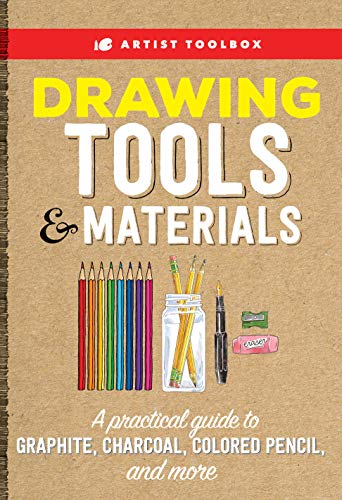
Artist Toolbox: Drawing Tools & Materials: A practical guide to graphite, charcoal, colored pencil, and more - Softcover
Inhaltsangabe
Artist Toolbox: Drawing Tools & Materials covers all drawing media, from graphite and colored pencils to crayons and pastels, as well as their uses and interactions with traditional drawing surfaces. Learn how to work with specific drawing tools, and then use them to create your own artwork.
*Named One of the 54 Best Colored Pencil Drawing Books of All Time by BookAuthority*
Artist Toolbox: Drawing Tools & Materials first discusses how to create a drawing workspace—in particular, ensuring proper lighting and storage. This guide then details all of the most popular drawing media: the differences between and advantages of each, their purposes, and the effects that each tool can create.
The book covers every drawing tool, including all pencil grades, flat sketching pencils, charcoal and vine charcoal, white charcoal, conte crayons, conte pencils, colored pencils, and pastel. Surfaces and supports are discussed as well to provide a thorough introduction to everything you need to learn to draw. Step-by-step drawing projects round out the book.
Artist Toolbox: Drawing Tools & Materials provides tips, techniques, clear instructions, beautiful artwork, and detailed demonstrations for a comprehensive look at drawing. This book will make an expert out of anyone who wants to learn this classic technique.
The Artist Toolbox series includes useful, practical reference guides designed for beginning artists and art hobbyists interested in fully understanding the focus and function of essential art tools of the trade.
Die Inhaltsangabe kann sich auf eine andere Ausgabe dieses Titels beziehen.
Über die Autorinnen und Autoren
Elizabeth T. Gilbert earned a BA in English from the University of San Diego in 2003, where she also studied art and anthropology. Elizabeth spent the next eight years as an editor, writer, and in-house artist for Walter Foster Publishing. In 2009, she co-authored The Daily Book of Art (Walter Foster Publishing). She's also the author of Walter Foster Publishing's The Fine Artist's Guide to Tools & Materials and Walter Foster Jr.'s The Big Book of Art: Draw! Paint! Create! Elizabeth lives in Colorado Springs, Colorado.
Like many artists, Steven Pearce got his start at a very early age. His mother was an accomplished oil painter, and his father was an oil painter, sculptor, and master jeweler. Their encouragement and knowledge helped Steven grow as an artist. Creating art with a pencil is Steven's passion. He enjoys experimenting with other media, including colored pencil, oil, and acrylics. Steven loves drawing portraits, still life, wildlife, landscapes, and anything that represents well in graphite and charcoal. www.srpearceart.com
Alain Picard earned a BA in illustration from Western CT State University and went on to study at the Art Student's League in New York City. Picard sites Sargent, Degas, and Sorolla among his artistic influences. A love of light and beauty are immediately apparent in his pastel and oil paintings. Alain's work has been featured in such publication as as The Artist's Magazine and The Pastel Journal. He has garnered top awards throughout the Northeast in esteemed exhibitions including the Portrait Society of America, the Hudson Valley Art Association, the Connecticut Society of Portrait Artists, the Connecticut Pastel Society, and the Pastel Society of America. Alain is a signature member of the Pastel Society of America as well as the Connecticut Pastel Society, where he previously served as President. In 2004 The Artist's Magazine highlighted Alain as one of 20 contemporary artists "On the Rise." He later won the Best Portfolio Award at the 2009 Portrait Society of America Conference in Washington, D.C. A frequent workshop instructor and demonstrator for art associations, schools, galleries, and museums, Alain was recently invited to demonstrate a portrait in pastel at the Metropolitan Museum of Art in New York City. He lives with his wife and two sons in Southbury, Connecticut. Visit www.picardstudio.com.
Paul Pigram is a full-time artist specializing in pastel painting. A resident of North Wales, Paul is passionate about painting landscapes and seascapes inspired by his own stunning backdrop, which includes Snowdonia National Park and the world-famous Bodnant Garden. His pastel-painting workshops share tips and techniques for artists of all skill levels. ww.paulpigram.co.uk
Marcio Ramos is a Brazilian artist currently living in Germany. He has worked with pens to create stippled artworks since 2000, focusing especially on trains and lions. COPIC selected Marcio to represent its Multiliner pen, and he was chosen as one of 20 finalists for Ketel One's "The Modern Craft Project" in 2012. Learn more at www.pontilhismo.com.br.
Auszug. © Genehmigter Nachdruck. Alle Rechte vorbehalten.
Drawing Tools & Materials
A Practical Guide to Graphite, Charcoal, Colored Pencil, and More
By Chelsea WardThe Quarto Group
Copyright © 2019 Quarto Publishing Group USA Inc.
All rights reserved.
ISBN: 978-1-63322-697-5All rights reserved.
Contents
INTRODUCTION,
MEET THE ARTISTS,
CHAPTER 1: DRAWING SURFACES & ACCESSORIES,
CHAPTER 2: DRAWING MATERIALS,
CHAPTER 3: DRAWING CONCEPTS,
CHAPTER 4: DRAWING DEMONSTRATIONS,
CLOSING WORDS,
CHAPTER 1
Drawing Surfaces & Accessories
Before putting your pencil to paper, take some time to think about your drawing space. Designating an area for art is a great way to stay focused and organized. And you don't need much — comfort, convenience, and good lighting are the most important elements of an effective art space. Once you've chosen your "studio," fill it with tools and materials that will simplify your drawing process. In this chapter, you'll learn about the following:
• Working surfaces
• Drawing papers
• Accessories
WORKING SURFACES
Working with dry media calls for a flat or slightly tilted drawing surface. Suitable surfaces vary widely, from tempered glass tabletops to portable boards. Sketching can even be done on your lap, using the hard cardboard backing of a notebook. Below are tips for choosing and preparing a drawing surface that suits you.
• Beware of working on uncoated or soft wood, which can score easily.
• Work on a surface that is larger than your paper to avoid creasing and damaging edges.
• Avoid textured or seamed surfaces.
• You may prefer to draw on a small stack of papers for a soft, cushioned feel.
• Before laying your paper on a surface, use a soft brush to wipe away dirt and old eraser crumbs.
• Make sure the surface is free of oil and moisture.
• Before beginning a piece of art, test your paper on the surface using your medium.
DRAWING PAPERS
These days, most paper is made out of cellulose fibers derived from wood pulp, cotton, or a blend of the two. Generally speaking, the higher the cotton content, the higher the paper quality. Paper made of 100-percent cotton is more durable and less likely to become brittle or yellow over time. Rag paper is a strong, high-quality paper made up of the longest cotton fibers. Other cotton papers are made up of cotton linter (shorter fibers). Wood pulp paper is more affordable than cotton paper, and modern techniques for reducing the acid content make this option more appealing to artists.
PAPER PROPERTIES & FORMATS
In addition to material, you can describe a paper using several properties, including weight, brightness, color, texture, and finish. Before choosing a paper, know how each property will affect the drawing process and your final work.
• Weight: Paper weight is measured in pounds per ream (500 sheets) or grams per square meter (gsm or g/m2). In general, the greater the lb. or gsm, the thicker the paper. Sketching paper is typically about 60 lb. (90 gsm), and drawing paper ranges from 80 to 100 lb. (130 to 260 gsm).
• Brightness & Color: Art papers are available in nearly every color imaginable. However, most drawing paper ranges from bright white to cream, providing a light, clean surface that contrasts well with graphite, charcoal, and other dark media. Some artists like working on toned paper, with the most common choices being gray and tan. Artists use the tone of the paper as a middle value and apply highlights and shadows using charcoal, pastel, or Conté crayon.
• Texture & Finish: Paper is generally described as smooth, medium, or rough. Rough papers have a prominent tooth, which refers to the bumps and grooves on the paper's surface. These raised areas catch the medium as you stroke across the paper. Smooth papers have little to no tooth, and medium papers have tooth somewhere in between. Laid paper offers an alternative texture made of fine, parallel grooves that simulate "chain lines" characteristic of old pressed, handmade papers. The grooves catch the medium and give the artwork a ribbed texture.
TIP
Sizing is a substance such as gelatin or animal glue that changes the way a surface accepts a medium. Paper manufactured with sizing (such as watercolor paper) is less likely to absorb moisture and pigment.
Formats: Paper comes in a variety of formats, including pads, books, rolls, and loose sheets. For serious drawings, loose sheets are a great choice because they have clean, ready-to-display edges.
ACCESSORIES
The tools featured on the following pages can streamline and enhance your drawing experience.
Clips
Use these tools to secure your paper onto a drawing board.
Drafting Triangles, Protractors & Stencils
These tools can help you create straight lines, exact angles, smooth curves, and other planned shapes in your drawings.
Measuring Instruments & Edges
These tools can help you produce a long, straight edge and are particularly useful for technical and perspective drawing. A T-square (shown) has a head that runs perpendicular to a long ruler. Simply align the head with the edge of the paper or drawing board to create vertical and horizontal lines.
Stylus
A stylus is an instrument with a small, rounded end that is often made of metal. Holding it like a pencil, you can use it to indent the paper, which helps keep areas free of tone while shading. You can also use it as a tool for transferring an image using carbon paper.
Pencil Extender
This tool allows you to extend the life of your pencils by providing extra gripping length as your pencils wear down.
Compass
This instrument can help you create circles — a difficult task to do freehand. One point of the compass acts as an anchor on the paper, and the other contains a clip to hold a pencil. To use, carefully spin the pencil end around the anchored point.
Artist Tape
This mildly tacky tape (usually white, off-white, or blue) is ideal for mounting your paper to a drawing surface. The tape will not damage the paper upon removal, and it will not leave a residue on your drawing surface.
SHARPENERS
Sharpening instruments give you control over your pencil tips, which in turn gives you control over the quality of your lines. Whether you're working in graphite, charcoal, or pastel, there is more than one way to sharpen a pencil. Experiment with the tools that follow and discover the sharpening method that works best for you.
Handheld Sharpener
Handheld sharpeners shave pencil ends into cone shapes, exposing the lead and creating pointed tips. Use a handheld sharpener over a trash can and make sure your fingers are free of graphite after sharpening. Some handheld sharpeners come with a plastic covering that catches the pencil shavings.
Electric Sharpener
Electric sharpeners simply and efficiently create long, sharp, uniform pencil points. However, they can quickly eat away a pencil, shortening its lifespan. Take care to avoid oversharpening.
Knife
Sharpening with a handheld knife, such as a pocket knife, takes skill and effort but allows you to customize the tip. This method is the only way to sharpen a flat carpenter's pencil. Hold the knife at a slight angle to the pencil shaft, and...
„Über diesen Titel“ kann sich auf eine andere Ausgabe dieses Titels beziehen.
Suchergebnisse für Artist Toolbox: Drawing Tools & Materials: A practical...

Beispielbild für diese ISBN
Artist Toolbox: Drawing Tools & Materials: A practical guide to graphite, charcoal, colored pencil, and more
Verlag:
Walter Foster Publishing (edition Illustrated), 2019
ISBN 10: 1633226972
ISBN 13: 9781633226975
Gebraucht
Paperback
Anbieter: BooksRun, Philadelphia, PA, USA
Verkäuferbewertung 5 von 5 Sternen

Paperback. Zustand: Very Good. Illustrated. It's a well-cared-for item that has seen limited use. The item may show minor signs of wear. All the text is legible, with all pages included. It may have slight markings and/or highlighting. Bestandsnummer des Verkäufers 1633226972-11-1
Gebraucht kaufen
EUR 4,75
Versand gratis
Versand innerhalb von USA
Versand innerhalb von USA
Anzahl: 1 verfügbar
Beispielbild für diese ISBN
Artist Toolbox: Drawing Tools & Materials: A practical guide to graphite, charcoal, colored pencil, and more
Verlag:
Walter Foster Publishing, 2019
ISBN 10: 1633226972
ISBN 13: 9781633226975
Gebraucht
paperback
Anbieter: HPB-Diamond, Dallas, TX, USA
Verkäuferbewertung 5 von 5 Sternen
paperback. Zustand: Very Good. Connecting readers with great books since 1972! Used books may not include companion materials, and may have some shelf wear or limited writing. We ship orders daily and Customer Service is our top priority! Bestandsnummer des Verkäufers S_457532793
Gebraucht kaufen
EUR 2,37
EUR 3,30 Versand
Versand innerhalb von USA
Versand innerhalb von USA
Anzahl: 1 verfügbar
Beispielbild für diese ISBN
Artist Toolbox: Drawing Tools & Materials: A practical guide to graphite, charcoal, colored pencil, and more
Verlag:
Walter Foster Publishing, 2019
ISBN 10: 1633226972
ISBN 13: 9781633226975
Gebraucht
Paperback
Anbieter: Bookmonger.Ltd, HILLSIDE, NJ, USA
Verkäuferbewertung 5 von 5 Sternen
Paperback. Zustand: Fine. Bestandsnummer des Verkäufers mon0000577788
Gebraucht kaufen
EUR 2,37
EUR 3,52 Versand
Versand innerhalb von USA
Versand innerhalb von USA
Anzahl: Mehr als 20 verfügbar
Beispielbild für diese ISBN
Artist Toolbox: Drawing Tools & Materials: A Practical Guide to Graphite, Charcoal, Colored Pencil, and More
Verlag:
Walter Foster Publishing, 2019
ISBN 10: 1633226972
ISBN 13: 9781633226975
Gebraucht
Paperback
Anbieter: ThriftBooks-Atlanta, AUSTELL, GA, USA
Verkäuferbewertung 5 von 5 Sternen
Paperback. Zustand: As New. No Jacket. Pages are clean and are not marred by notes or folds of any kind. ~ ThriftBooks: Read More, Spend Less. Bestandsnummer des Verkäufers G1633226972I2N00
Gebraucht kaufen
EUR 5,99
Versand gratis
Versand innerhalb von USA
Versand innerhalb von USA
Anzahl: 1 verfügbar
Beispielbild für diese ISBN
Artist Toolbox: Drawing Tools & Materials: A Practical Guide to Graphite, Charcoal, Colored Pencil, and More
Verlag:
Walter Foster Publishing, 2019
ISBN 10: 1633226972
ISBN 13: 9781633226975
Gebraucht
Paperback
Anbieter: ThriftBooks-Phoenix, Phoenix, AZ, USA
Verkäuferbewertung 5 von 5 Sternen
Paperback. Zustand: Very Good. No Jacket. May have limited writing in cover pages. Pages are unmarked. ~ ThriftBooks: Read More, Spend Less. Bestandsnummer des Verkäufers G1633226972I4N00
Gebraucht kaufen
EUR 5,99
Versand gratis
Versand innerhalb von USA
Versand innerhalb von USA
Anzahl: 1 verfügbar
Beispielbild für diese ISBN
Artist Toolbox: Drawing Tools & Materials: A Practical Guide to Graphite, Charcoal, Colored Pencil, and More
Verlag:
Walter Foster Publishing, 2019
ISBN 10: 1633226972
ISBN 13: 9781633226975
Gebraucht
Paperback
Anbieter: ThriftBooks-Atlanta, AUSTELL, GA, USA
Verkäuferbewertung 5 von 5 Sternen
Paperback. Zustand: Very Good. No Jacket. Former library book; May have limited writing in cover pages. Pages are unmarked. ~ ThriftBooks: Read More, Spend Less. Bestandsnummer des Verkäufers G1633226972I4N10
Gebraucht kaufen
EUR 5,99
Versand gratis
Versand innerhalb von USA
Versand innerhalb von USA
Anzahl: 1 verfügbar
Beispielbild für diese ISBN
Artist Toolbox: Drawing Tools & Materials: A Practical Guide to Graphite, Charcoal, Colored Pencil, and More
Verlag:
Walter Foster Publishing, 2019
ISBN 10: 1633226972
ISBN 13: 9781633226975
Gebraucht
Paperback
Anbieter: ThriftBooks-Dallas, Dallas, TX, USA
Verkäuferbewertung 5 von 5 Sternen
Paperback. Zustand: Very Good. No Jacket. May have limited writing in cover pages. Pages are unmarked. ~ ThriftBooks: Read More, Spend Less. Bestandsnummer des Verkäufers G1633226972I4N00
Gebraucht kaufen
EUR 5,99
Versand gratis
Versand innerhalb von USA
Versand innerhalb von USA
Anzahl: 1 verfügbar
Beispielbild für diese ISBN
Artist Toolbox: Drawing Tools & Materials: A Practical Guide to Graphite, Charcoal, Colored Pencil, and More
Verlag:
Walter Foster Publishing, 2019
ISBN 10: 1633226972
ISBN 13: 9781633226975
Gebraucht
Paperback
Anbieter: ThriftBooks-Dallas, Dallas, TX, USA
Verkäuferbewertung 5 von 5 Sternen
Paperback. Zustand: Very Good. No Jacket. Former library book; May have limited writing in cover pages. Pages are unmarked. ~ ThriftBooks: Read More, Spend Less. Bestandsnummer des Verkäufers G1633226972I4N10
Gebraucht kaufen
EUR 5,99
Versand gratis
Versand innerhalb von USA
Versand innerhalb von USA
Anzahl: 1 verfügbar
Beispielbild für diese ISBN
Artist Toolbox: Drawing Tools & Materials: A Practical Guide to Graphite, Charcoal, Colored Pencil, and More
Verlag:
Walter Foster Publishing, 2019
ISBN 10: 1633226972
ISBN 13: 9781633226975
Gebraucht
Paperback
Anbieter: ThriftBooks-Dallas, Dallas, TX, USA
Verkäuferbewertung 5 von 5 Sternen
Paperback. Zustand: Good. No Jacket. Pages can have notes/highlighting. Spine may show signs of wear. ~ ThriftBooks: Read More, Spend Less. Bestandsnummer des Verkäufers G1633226972I3N00
Gebraucht kaufen
EUR 5,99
Versand gratis
Versand innerhalb von USA
Versand innerhalb von USA
Anzahl: 1 verfügbar
Beispielbild für diese ISBN
Artist Toolbox: Drawing Tools & Materials: A practical guide to graphite, charcoal, colored pencil, and more
Verlag:
Walter Foster Publishing, 2019
ISBN 10: 1633226972
ISBN 13: 9781633226975
Gebraucht
paperback
Anbieter: HPB-Emerald, Dallas, TX, USA
Verkäuferbewertung 5 von 5 Sternen
paperback. Zustand: Very Good. Connecting readers with great books since 1972! Used books may not include companion materials, and may have some shelf wear or limited writing. We ship orders daily and Customer Service is our top priority! Bestandsnummer des Verkäufers S_467322015
Gebraucht kaufen
EUR 4,52
EUR 3,30 Versand
Versand innerhalb von USA
Versand innerhalb von USA
Anzahl: 1 verfügbar