
Verwandte Artikel zu Tunnel Rats: The larrikin Aussie legends who discovered...
Inhaltsangabe
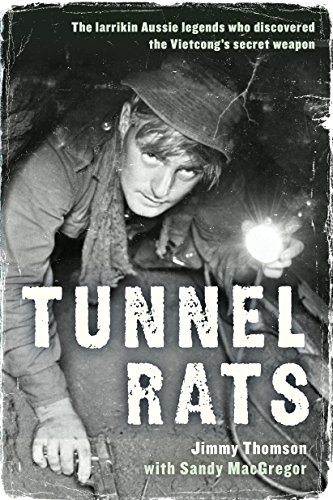
The thrilling story of the young Australian Army engineers of 3 Field Troop who were the first allied soldiers to risk their lives in the darkness of the Vietcong tunnels of South Vietnam. Staring death squarely in the face every day, these young Australian Army engineers not only followed their enemy down into these unknown underground labyrinths, but matched the Vietcong's jungle warfare skills and defused thousands of their clever booby traps. Off duty, it was a different story. The bad boys of 3 Field Troop were a boozing, brawling, bonking bunch of larrikins, who cut a swathe through the bars and brothels of Saigon, fought American Military Police to a standstill, built a secret casino, and booby-trapped their own HQ to teach their officers a lesson. Thrilling, inspiring, and action packed, this is the true story of the unsung heroes of Australia's war in Vietnam. Living up to their motto of "We Make and We Break," they created the legend of the Tunnel Rats.
Die Inhaltsangabe kann sich auf eine andere Ausgabe dieses Titels beziehen.
Über die Autorin bzw. den Autor
Jimmy Thomson is a journalist, author, and screenwriter whose credits include the ABC-TV series Rain Shadow. His most recent book is Snitch: Crooked Cops and Kings Cross Crims by the Man Who Saw it All. Sandy MacGregor commanded 3 Field Troop in Vietnam, where he won the Military Cross. He served in the Army for thirty years, finishing as a colonel in the Reserves.
Auszug. © Genehmigter Nachdruck. Alle Rechte vorbehalten.
Tunnel Rats
The Larrikin Aussie Legends Who Discovered the Vietcong's Secret Weapon
By Jimmy Thomson, Sandy MacGregorAllen & Unwin
Copyright © 2011 Jimmy Thomson and Sandy MacGregor
All rights reserved.
ISBN: 978-1-74331-735-8All rights reserved.
Contents
Maps,
Prologue-GOING UNDERGROUND,
1. Whose War Is It Anyway?,
2. A Conflict Overseas,
3. The First Tunnels,
4. The Airborne Americans,
5. trooping the Colour,
6. Rain in the Rice Bowl,
7. Sex and the Single Soldier,
8. Knights in Sinking Armour,
9. Onward and Downward,
10. The First Tunnel Rats,
11. The Underground Army,
12. Like a Rolling Stone,
13. The Last Detail,
14. Playing Hard,
15. On the Beach,
16. Passing the Baton,
17. The Long Night Before Long Tan,
18. The Last Post,
APPENDIX A-THE TUNNELS OF VIETNAM,
APPENDIX B-HOW TO BUILD AN UNDERGROUND CITY,
CHAPTER 1
WHOSE WAR IS IT ANYWAY?
With the benefit of hindsight, the Vietnam War — from 1955 to 1975 — was an inevitability. At the end of the Second World War, the political situation in Vietnam was precariously balanced between indigenous people who justifiably demanded the freedom to determine their own destinies and European powers who felt entitled to control their colonies. Under the rule of France, long before the war, control of Vietnam was passed around like an unwanted gift ... to anyone but the Vietnamese themselves. It was also a pawn in a Cold War chess game in which the West's attitude to who should run the country was ABC — Anyone But Communists.
During the Second World War, the pro-Axis Vichy French government invited the Japanese to occupy the country. Afterwards, when Vietnam was 'liberated' by the British, the local population demanded independence. This did not sit well with the Western powers and, incredibly, Japanese prisoners of war were freed and armed to help subdue local nationalists. The Potsdam treaty, in which the victorious Allies shared the world among themselves, saw Vietnam split between Chinese control of the north and British control in the south, but both soon withdrew and it was returned to French control.
The Vietnamese wanted freedom and they were ripe for revolution. Up to two million Vietnamese died in the north during a famine in 1945 caused largely by the French government's insistence that more land be given over to cash crops than food production. The charismatic Ho Chi Minh declared independence from France and encouraged the peasantry to rise up and loot the rice stores he believed had worsened the food shortages. A protracted war with France ended at the battle of Bien Dien Phu in March 1954 when an attempt to lure the Vietminh guerrilla forces into a conventional battle backfired. Instead of attacking the French, the Vietminh surrounded them and infiltrated their lines with the extensive use of tunnels while Vietminh reinforcements arrived from all over the country, building their forces up to about seven times that of the besieged French.
Facing defeat, France had asked America to intervene and even discussed the use of nuclear weapons against the Vietminh, but US President Dwight Eisenhower wouldn't get directly involved unless their British allies were there too. Britain said they preferred to wait until meetings in Geneva, convened to also resolve the conflict in Korea, sorted out the future of the country.
Outthought and outfought, French troops were routed at Bien Dien Phu and France announced it was quitting Vietnam. In Geneva it was proposed that an independent Vietnam be divided into North and South, but no formal government be formed until after democratic elections in both parts. Ho Chi Minh believed, rightly, that he had enough support throughout the country to form a government in his own right but his Chinese backers pressured him into accepting partition.
The United States delegation proposed Ngo Dinh Diem as the new ruler of South Vietnam. The French argued against this, claiming that Diem was 'not only incapable but mad'. However, eventually it was decided that Diem presented the best opportunity to keep South Vietnam from falling under the control of communism.
Had there been free elections in both North and South, Ho Ch Minh would probably have won overwhelming support to lead a unified Vietnam. This view was shared by President Eisenhower. 'I have never talked or corresponded with a person knowledgeable in Indochinese affairs who did not agree that had elections been held at the time of the fighting, possibly 80 per cent of the population would have voted for the communist Ho Chi Minh,' he wrote later.
In any case, the despotic Diem refused to hold elections, saying the South (and America) had never signed an agreement. A devout Catholic in a predominantly Buddhist country, Diem embarked on a campaign of repression that saw tens of thousands imprisoned and executed. His targets were other religions and pro-communist political groups readying themselves for an election that would never take place. In fairness, the North also endured bloody purges but Diem's ruthless suppression of all possible dissenters and his promotion of Catholics in the government and army, regardless of their ability, had a whiff of the Borgias and the Spanish Inquisition rather than the excesses of Stalin and Mao.
Instead of elections, Diem staged a farcical referendum, run by his brother, that 'voted' against reunification by 98 per cent. Despite advice from American advisors not to over-egg the pudding, a miscalculation in the vote rigging meant Saigon voted 130 per cent in his favour.
So the North's National Front for the Liberation of Vietnam (better known in the West by the somewhat pejorative term 'Vietcong') began an insurrection in South Vietnam, targeting government symbols such as police, civil servants and teachers for assassination and infiltrating every level of government with spies and activists. Meanwhile, Diem continued to be an embarrassment to his American supporters but the 'domino theory' — that every time a country fell to communism, its neighbour would be under threat — convinced many Western leaders to stand by him regardless of his lunacies. This was a pattern America would repeat throughout Latin America where any government, no matter how corrupt, brutal or oppressive, was supported in preference to popular socialism.
The Cold War between Russia and the West was in full swing and American President John F. Kennedy had suffered the ignominy of the failed Bay of Pigs invasion in Cuba and the challenge of the Berlin Wall being built, so he felt he had to draw a line in the sand to protect America's status as leader of the free world and a bastion of democracy against the spread of communism. Vietnam, he decided, was where that line would be drawn.
But Kennedy did not want American troops to be fighting South Vietnam's war. Instead, like his predecessor President Eisenhower, he sent advisors to help train the South Vietnamese army (ARVN) in the hope they could withstand a growing insurrection themselves. But the ARVN was riddled with corruption and nepotism, with senior officers promoted on political and religious grounds and the troops focused more on deterring coups than fighting the North. The ARVN soldiers were brave and disciplined but their leaders were all too often weak, incompetent and corrupt.
With American involvement having increased from the initial allocation of 900 advisors sent by Eisenhower to 16,000 US personnel 'training' the...
„Über diesen Titel“ kann sich auf eine andere Ausgabe dieses Titels beziehen.
Suchergebnisse für Tunnel Rats: The larrikin Aussie legends who discovered...

Foto des Verkäufers
Tunnel Rats (Paperback)
Anbieter: Grand Eagle Retail, Bensenville, IL, USA
Verkäuferbewertung 5 von 5 Sternen

Paperback. Zustand: new. Paperback. 'All I could do was prod the earth with my bayonet and shine the light to see if I could find anything. It doesn't matter how small the tunnel is you never know what's around the bend . You don't know if it's abandoned, you don't know if it's booby trapped and you don't know why the tunnel is there in the first place.'They were young, they were Australian, they were Army engineers and they were the first allied soldiers to risk their lives in the darkness of the Vietcong tunnels of South Vietnam. Staring death squarely in the face every day, not only did they follow their enemy down into these unknown underground labyrinths, but matched the Vietcong's jungle warfare skills and defused thousands of their clever booby traps.Off duty, it was a different story. The bad boys of 3 Field Troop were a boozing, brawling, bonking bunch of larrikins, who cut a swathe through the bars and brothels of Saigon, fought American Military Police to a standstill, built a secret casino and booby-trapped their own HQ to teach their officers a lesson.Thrilling, inspiring and action packed, this is the true story of the unsung heroes of Australia's war in Vietnam. Living up to their motto of 'We Make and We Break', they created the legend of the Tunnel Rats. The thrilling story of the young Australian Army engineers of 3 Field Troop who were the first allied soldiers to risk their lives in the darkness of the Vietcong tunnels of South Vietnam. Shipping may be from multiple locations in the US or from the UK, depending on stock availability. Bestandsnummer des Verkäufers 9781743317358
Foto des Verkäufers
Tunnel Rats (Paperback)
Anbieter: AussieBookSeller, Truganina, VIC, Australien
Verkäuferbewertung 5 von 5 Sternen
Paperback. Zustand: new. Paperback. 'All I could do was prod the earth with my bayonet and shine the light to see if I could find anything. It doesn't matter how small the tunnel is you never know what's around the bend . You don't know if it's abandoned, you don't know if it's booby trapped and you don't know why the tunnel is there in the first place.'They were young, they were Australian, they were Army engineers and they were the first allied soldiers to risk their lives in the darkness of the Vietcong tunnels of South Vietnam. Staring death squarely in the face every day, not only did they follow their enemy down into these unknown underground labyrinths, but matched the Vietcong's jungle warfare skills and defused thousands of their clever booby traps.Off duty, it was a different story. The bad boys of 3 Field Troop were a boozing, brawling, bonking bunch of larrikins, who cut a swathe through the bars and brothels of Saigon, fought American Military Police to a standstill, built a secret casino and booby-trapped their own HQ to teach their officers a lesson.Thrilling, inspiring and action packed, this is the true story of the unsung heroes of Australia's war in Vietnam. Living up to their motto of 'We Make and We Break', they created the legend of the Tunnel Rats. The thrilling story of the young Australian Army engineers of 3 Field Troop who were the first allied soldiers to risk their lives in the darkness of the Vietcong tunnels of South Vietnam. Shipping may be from our Sydney, NSW warehouse or from our UK or US warehouse, depending on stock availability. Bestandsnummer des Verkäufers 9781743317358
Neu kaufen
EUR 25,83
EUR 32,48 Versand
Versand von Australien nach USA
Versand von Australien nach USA
Anzahl: 1 verfügbar
Foto des Verkäufers
Tunnel Rats (Paperback)
Anbieter: CitiRetail, Stevenage, Vereinigtes Königreich
Verkäuferbewertung 5 von 5 Sternen
Paperback. Zustand: new. Paperback. 'All I could do was prod the earth with my bayonet and shine the light to see if I could find anything. It doesn't matter how small the tunnel is you never know what's around the bend . You don't know if it's abandoned, you don't know if it's booby trapped and you don't know why the tunnel is there in the first place.'They were young, they were Australian, they were Army engineers and they were the first allied soldiers to risk their lives in the darkness of the Vietcong tunnels of South Vietnam. Staring death squarely in the face every day, not only did they follow their enemy down into these unknown underground labyrinths, but matched the Vietcong's jungle warfare skills and defused thousands of their clever booby traps.Off duty, it was a different story. The bad boys of 3 Field Troop were a boozing, brawling, bonking bunch of larrikins, who cut a swathe through the bars and brothels of Saigon, fought American Military Police to a standstill, built a secret casino and booby-trapped their own HQ to teach their officers a lesson.Thrilling, inspiring and action packed, this is the true story of the unsung heroes of Australia's war in Vietnam. Living up to their motto of 'We Make and We Break', they created the legend of the Tunnel Rats. The thrilling story of the young Australian Army engineers of 3 Field Troop who were the first allied soldiers to risk their lives in the darkness of the Vietcong tunnels of South Vietnam. Shipping may be from our UK warehouse or from our Australian or US warehouses, depending on stock availability. Bestandsnummer des Verkäufers 9781743317358
Neu kaufen
EUR 22,14
EUR 43,02 Versand
Versand von Vereinigtes Königreich nach USA
Versand von Vereinigtes Königreich nach USA
Anzahl: 1 verfügbar