
Verwandte Artikel zu Islamic Ethos and the Specter of Modernity (Anthem...
Islamic Ethos and the Specter of Modernity (Anthem Middle East Studies / Key Issues in Modern Sociology) - Softcover
Inhaltsangabe
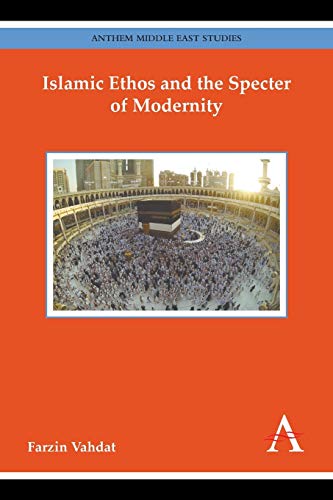
Drawing on the work of Hegel, this book proposes a framework for understanding modernity in the Muslim world and analyzes the discourse of prominent Muslim thinkers and political leaders. Chapter by chapter, the book undertakes a close textual analysis of the works of Mohammad Iqbal, Abul Ala Maududi , Sayyid Qutb , Fatima Mernissi, Mehdi Haeri Yazdi, Mohammad Mojtaehd Shabestari, Mohammad Khatami, Seyyed Hussein Nasr and Mohamad Arkoun, drawing conclusions about contemporary Islamic thought with reference to some of the most significant markers of modernity.
Die Inhaltsangabe kann sich auf eine andere Ausgabe dieses Titels beziehen.
Über die Autorin bzw. den Autor
Farzin Vahdat
Auszug. © Genehmigter Nachdruck. Alle Rechte vorbehalten.
Islamic Ethos and the Specter of Modernity
By Farzin VahdatWimbledon Publishing Company
Copyright © 2015 Farzin Vahdat
All rights reserved.
ISBN: 978-1-78308-437-1All rights reserved.
Contents
Acknowledgments,
A Note on Transliteration,
Introduction,
Chapter One Sir Muhammad Iqbal: The Dialectician of Muslim Authenticity,
Chapter Two Sayyid Abul 'Ala Maududi: A Theorist of Disciplinary Patriarchal State,
Chapter Three An Islamic Totality in the Ideology of Sayyid Qutb,
Chapter Four Fatima Mernissi: Women, Islam, Modernity and Democracy,
Chapter Five Mehdi Haeri Yazdi and the Discourse of Modernity,
Chapter Six Postrevolutionary Islamic Modernity in Iran: The Intersubjective Hermeneutics of Mohamad Mojtahed Shabestari,
Chapter Seven Religious Modernity in Iran: Dilemmas of Islamic Democracy in the Discourse of Mohammad Khatami,
Chapter Eight Seyyed Hossein Nasr: An Islamic Romantic?,
Chapter Nine Mohammed Arkoun and the Idea of Liberal Democracy in Muslim Lands,
Conclusion,
Bibliography,
Index,
CHAPTER 1
SIR MUHAMMAD IQBAL: THE DIALECTICIAN OF MUSLIM AUTHENTICITY
Muhammad Iqbal, who was knighted by the British in 1922, was one of the most important intellectual architects of the Islamic revival in the twentieth century. While he wrote most of his considerable output as Persian poetry, he neither considered himself a poet, nor could he easily engage in a conversation in Persian. By his own admission, his thought was vastly influenced by European philosophy, and yet his discourse is one of the largest and most profound bodies of work attempting to construct a Muslim selfhood ever produced. To be sure, Iqbal's discourse is replete with tensions and contradictions, but as I will try to show below, these contradictions are not primarily the result of his mixing European philosophy and Islamic thought, and therefore he should not be accused of bad eclecticism. As with many other social and political philosophers, some of these contradictions were the consequences of the development of his thought in their different stages. But many other contrarieties in his writings, as I argue below, were caused by his attempt to construct an Islamic subjectivity that he wished to build by invoking the monotheistic Godhead. Like many of his Islamist cohorts, Iqbal insisted that human agency is possible only if it is derived from the Divine Agency; and this, I will argue, is at the core of some of the most elemental tensions in his thought. However, this is not to dismiss the significance of his discourse in the creation of Muslim selfhood and agency. In the history of Western modernity, a very similar process of projecting the desired attributes of human empowerment and agency onto an image of a powerful omniscient God and then re-appropriating these attributes for humans has laid the foundations of the modern world in the West. A very analogous process has been at work in the Islamic world since mid-nineteenth century, producing dialectical tensions in the discourses of most of its prominent modernist thinkers, and the work of Iqbal is no exception in this regard. In fact, this type of contradiction is a source of dynamism in the Islamic world, which carries within itself the seeds of major changes in the cultures and polities of the Muslim regions involved.
Iqbal himself viewed his role as very much akin to that of "prophecy." Thus, in one of his most important works, Javidnameh, he prophesied a resurrection for the East wherein "jewels" would emerge from its rocks and its mountains would be shaken. In the same book he asserted that if the intention of "poetry" is forging of human subjects [adam gari], then poesy is the heir to prophethood.
Muhammad Iqbal was born, apparently in 1877, at Sialkot, a border town in Punjab and near Kashmir, now an area of contention between Pakistan and India. Iqbal's grandfather Shaikh Rafiq left the ancestral village of Looehar in Kashmir some time after 1857 and settled in Sialkot, working as peddler of Kashmiri shawls. Iqbal's father, Shaikh Nur Muhammad, was a pious Muslim and while not formally educated, was close to Sufi orders and interested in mystical pursuits. He made a living as a tailor and embroiderer. Iqbal's mother, Imam Bibi, was also devout, came from a working class family and, beyond an elementary knowledge of the Qur'an, had no formal education. Iqbal's father's business experienced some ups and downs, but on the whole, Sheikh Nur Muhammad's income was not sufficient to support a proper education for the children. Only the fact that Iqbal's elder brother acquired training as an engineer by joining the British Indian Army and then secured a supervisory job in the same army catapulted the family into the middle class and paved the way for Iqbal's education.
Iqbal graduated from high school in 1892, having already been tutored by a religious scholar who was well versed in Arabic and Persian literatures. A year later Iqbal entered the Scotch Mission College, a junior college that had been established in 1889 in Sialkot by European missionaries. As he graduated from high school, his parents married him to Karim Bibi. This marriage was a source of unhappiness and frustration for Iqbal, and he eventually broke it off in 1916. Having excelled in his studies, in 1895 Iqbal's father, encouraged by his teachers, decided to send him to Government College, a prestigious institution in Lahore. He graduated cum laude from Government College, receiving a Bachelor of Arts degree in 1897, and was awarded a scholarship toward a Master's degree in philosophy. At about the same time, his talents in poetry began to be recognized, and by the time he received his Master's degree in 1899, his reputation as a talented young poet was established among the intellectual circles of Lahore.
One of Iqbal's British professors at the Government College, Sir Thomas Arnold, a scholar of Islam and of modern Western philosophy, had a lasting influence on him. It was with Arnold's guidance and friendship that Iqbal developed the interest and preliminary skills to combine Islamic and modern Western ideas. It was also Arnold who persuaded Iqbal to pursue further post-graduate studies in Europe.
From the time of his graduation until 1905, Iqbal engaged in some junior academic positions and tried to enter the legal profession in Lahore. But he found the academic career unsatisfactory and failed the preliminary examinations for a career in law. In 1905, with the financial and moral support of his brother, Iqbal left India for England, where he studied to qualify for the Bar. He also enrolled in an undergraduate program at the Trinity College of Cambridge University, although he had already obtained a master's degree in India. Apparently Iqbal wished to benefit from the lectures of John McTaggart and James Ward, two Hegel scholars, as well as those of prominent scholars of Iran and the Persian language, Edward G. Browne and Reynold A. Nicholson, all of whom were in Cambridge at that time. At the same time, Iqbal made an arrangement with Munich University in Germany to submit a dissertation on Philosophy for a doctoral degree. His dissertation, which was accepted for the fulfillment of his doctorate in 1907, was published a year later in London under the title The Development of Metaphysics in Persia, which laid the foundations for much of his subsequent intellectual output.
During the years that Iqbal spent in Europe, he met and befriended 'Atiya Begum Faizee, a wellborn young and educated Indian Muslim woman with a free spirit. They seem...
„Über diesen Titel“ kann sich auf eine andere Ausgabe dieses Titels beziehen.
Suchergebnisse für Islamic Ethos and the Specter of Modernity (Anthem...

Beispielbild für diese ISBN
Islamic Ethos and the Specter of Modernity
Anbieter: Better World Books, Mishawaka, IN, USA
Verkäuferbewertung 5 von 5 Sternen

Zustand: Good. Pages intact with minimal writing/highlighting. The binding may be loose and creased. Dust jackets/supplements are not included. Stock photo provided. Product includes identifying sticker. Better World Books: Buy Books. Do Good. Bestandsnummer des Verkäufers 19133885-6
Gebraucht kaufen
EUR 22,39
Versand gratis
Versand innerhalb von USA
Versand innerhalb von USA
Anzahl: 1 verfügbar
Beispielbild für diese ISBN
Islamic Ethos and the Specter of Modernity (Anthem Middle East Studies)
Verlag:
Anthem Press, Wimbledon, 2015
ISBN 10: 1783084375
ISBN 13: 9781783084371
Gebraucht
Trade Paperback
Erstausgabe
Anbieter: Katsumi-san Co., Cambridge, MA, USA
Verkäuferbewertung 5 von 5 Sternen
Trade Paperback. Zustand: Very Good-. First Edition. Volume is a bit curved and has minor wear; tight, text clean. xxi, [1], 285 p. Published at $40.00 [otob: 8]. Bestandsnummer des Verkäufers 205567
Gebraucht kaufen
EUR 22,98
EUR 1,74 Versand
Versand innerhalb von USA
Versand innerhalb von USA
Anzahl: 1 verfügbar
Beispielbild für diese ISBN
Islamic Ethos and the Specter of Modernity (Key Issues in Modern Sociology,Anthem Middle East Studies)
Anbieter: Books From California, Simi Valley, CA, USA
Verkäuferbewertung 4 von 5 Sternen

paperback. Zustand: Very Good. Bestandsnummer des Verkäufers mon0003151498
Gebraucht kaufen
EUR 24,24
EUR 4,45 Versand
Versand innerhalb von USA
Versand innerhalb von USA
Anzahl: 1 verfügbar
Foto des Verkäufers
Islamic Ethos and the Specter of Modernity
Anbieter: GreatBookPrices, Columbia, MD, USA
Verkäuferbewertung 5 von 5 Sternen
Zustand: As New. Unread book in perfect condition. Bestandsnummer des Verkäufers 23964006
Gebraucht kaufen
EUR 31,49
EUR 2,36 Versand
Versand innerhalb von USA
Versand innerhalb von USA
Anzahl: 5 verfügbar
Foto des Verkäufers
Islamic Ethos and the Specter of Modernity
Anbieter: GreatBookPrices, Columbia, MD, USA
Verkäuferbewertung 5 von 5 Sternen
Zustand: New. Bestandsnummer des Verkäufers 23964006-n
Neu kaufen
EUR 31,81
EUR 2,36 Versand
Versand innerhalb von USA
Versand innerhalb von USA
Anzahl: 5 verfügbar
Beispielbild für diese ISBN
Islamic Ethos and the Specter of Modernity
Anbieter: PBShop.store US, Wood Dale, IL, USA
Verkäuferbewertung 5 von 5 Sternen
PAP. Zustand: New. New Book. Shipped from UK. Established seller since 2000. Bestandsnummer des Verkäufers CX-9781783084371
Foto des Verkäufers
Islamic Ethos and the Specter of Modernity
Anbieter: Rarewaves.com USA, London, LONDO, Vereinigtes Königreich
Verkäuferbewertung 5 von 5 Sternen
Paperback. Zustand: New. Drawing on the work of Hegel, this book proposes a framework for understanding modernity in the Muslim world and analyzes the discourse of prominent Muslim thinkers and political leaders. Chapter by chapter, the book undertakes a close textual analysis of the works of Mohammad Iqbal, Abul Ala Maududi , Sayyid Qutb , Fatima Mernissi, Mehdi Haeri Yazdi, Mohammad Mojtaehd Shabestari, Mohammad Khatami, Seyyed Hussein Nasr and Mohamad Arkoun, drawing conclusions about contemporary Islamic thought with reference to some of the most significant markers of modernity. Bestandsnummer des Verkäufers LU-9781783084371
Neu kaufen
EUR 34,50
Versand gratis
Versand von Vereinigtes Königreich nach USA
Versand von Vereinigtes Königreich nach USA
Anzahl: 2 verfügbar
Beispielbild für diese ISBN
Islamic Ethos and the Specter of Modernity
Anbieter: PBShop.store UK, Fairford, GLOS, Vereinigtes Königreich
Verkäuferbewertung 5 von 5 Sternen
PAP. Zustand: New. New Book. Shipped from UK. Established seller since 2000. Bestandsnummer des Verkäufers CX-9781783084371
Neu kaufen
EUR 31,10
EUR 5,99 Versand
Versand von Vereinigtes Königreich nach USA
Versand von Vereinigtes Königreich nach USA
Anzahl: 15 verfügbar
Foto des Verkäufers
Islamic Ethos and the Specter of Modernity
Anbieter: Rarewaves USA, HEBRON, KY, USA
Verkäuferbewertung 5 von 5 Sternen
Paperback. Zustand: New. Drawing on the work of Hegel, this book proposes a framework for understanding modernity in the Muslim world and analyzes the discourse of prominent Muslim thinkers and political leaders. Chapter by chapter, the book undertakes a close textual analysis of the works of Mohammad Iqbal, Abul Ala Maududi , Sayyid Qutb , Fatima Mernissi, Mehdi Haeri Yazdi, Mohammad Mojtaehd Shabestari, Mohammad Khatami, Seyyed Hussein Nasr and Mohamad Arkoun, drawing conclusions about contemporary Islamic thought with reference to some of the most significant markers of modernity. Bestandsnummer des Verkäufers LU-9781783084371
Neu kaufen
EUR 37,20
Versand gratis
Versand innerhalb von USA
Versand innerhalb von USA
Anzahl: Mehr als 20 verfügbar
Beispielbild für diese ISBN
Islamic Ethos and the Specter of Modernity
Print-on-DemandAnbieter: Chiron Media, Wallingford, Vereinigtes Königreich
Verkäuferbewertung 5 von 5 Sternen
PF. Zustand: New. This item is printed on demand. Brand new book, sourced directly from publisher. Dispatch time is 6-7 days from our warehouse. Book will be sent in robust, secure packaging to ensure it reaches you securely. Bestandsnummer des Verkäufers 6666-IUK-9781783084371
Neu kaufen
EUR 33,10
EUR 5,96 Versand
Versand von Vereinigtes Königreich nach USA
Versand von Vereinigtes Königreich nach USA
Anzahl: 3 verfügbar