
Verwandte Artikel zu Managing Data Using Excel: Organizing, Summarizing...
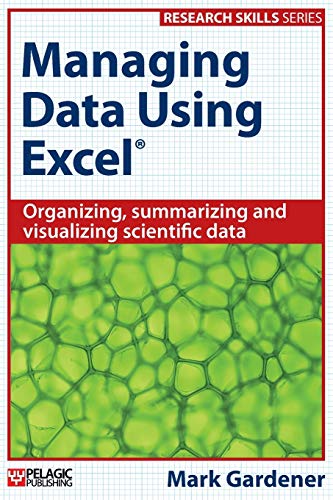
Managing Data Using Excel: Organizing, Summarizing and Visualizing Scientific Data (Research Skills) - Softcover
Inhaltsangabe
Microsoft Excel is a powerful tool that can transform the way you use data. This book explains in comprehensive and user-friendly detail how to manage, make sense of, explore and share data, giving scientists at all levels the skills they need to maximize the usefulness of their data. Readers will learn how to use Excel to: * Build a dataset - how to handle variables and notes, rearrangements and edits to data. * Check datasets - dealing with typographic errors, data validation and numerical errors. * Make sense of data - including datasets for regression and correlation; summarizing data with averages and variability; and visualizing data with graphs, pivot charts and sparklines. * Explore regression data - finding, highlighting and visualizing correlations. * Explore time-related data - using pivot tables, sparklines and line plots. * Explore association data - creating and visualizing contingency tables. * Explore differences - pivot tables and data visualizations including box-whisker plots. * Share data - methods for exporting and sharing your datasets, summaries and graphs. Alongside the text, Have a Go exercises, Tips and Notes give readers practical experience and highlight important points, and helpful self-assessment exercises and summary tables can be found at the end of each chapter. Supplementary material can also be downloaded on the companion website. Managing Data Using Excel is an essential book for all scientists and students who use data and are seeking to manage data more effectively. It is aimed at scientists at all levels but it is especially useful for university-level research, from undergraduates to postdoctoral researchers.
Die Inhaltsangabe kann sich auf eine andere Ausgabe dieses Titels beziehen.
Über die Autorin bzw. den Autor
By Mark Gardener
Auszug. © Genehmigter Nachdruck. Alle Rechte vorbehalten.
Managing Data Using Excel
Organizing, Summarizing and Visualizing Scientific Data
By Mark GardenerPelagic Publishing
Copyright © 2015 Mark Gardener
All rights reserved.
ISBN: 978-1-78427-007-0All rights reserved.
Contents
About the author, vii,
Acknowledgements, viii,
Introduction, ix,
PART 1 ARRANGING AND MANAGING YOUR DATA,
Chapter 1 Arranging your data, 3,
Chapter 2 Managing your data: building your dataset, 27,
Chapter 3 Managing your data: checking your dataset, 88,
PART 2 USING YOUR DATASET – SUMMARIZING, VISUALIZING AND SHARING YOUR DATA,
Chapter 4 Making sense of your data, 139,
Chapter 5 Exploring regression data, 163,
Chapter 6 Exploring time-related data, 190,
Chapter 7 Exploring association data, 224,
Chapter 8 Exploring differences data, 243,
Chapter 9 Sharing your data, 279,
Appendix 1 Answers to exercises, 299,
Appendix 2 Differences between versions of Excel, 305,
Index, 309,
CHAPTER 1
ARRANGING YOUR DATA
All data are important. At the least they are important to you, as you've invested time and effort in collecting the data. Your data may well be important to others as well, it doesn't matter whether you are doing a high school project, a PhD or government research, the data you collect are important. You will use these data to help you make sense of your project and they may also be shared and presented to others. It is therefore important that your data are understandable by others. You may well take a break from your project so it is also helpful if your data are understandable by you when you return at some future date!
You may have spent a considerable time planning your work and deciding how to collect the data. You can also spend a lot of time collecting data so it is important to take care of them. The scientific process is a cyclical one and generally involves several stages:
• Planning.
• Data collection and recording.
• Analysis.
• Reporting and moving on.
You should have spent some time during the planning process to determine various aspects of your data:
• What data to collect.
• How to collect the data.
• How much data to collect.
• How to record the data.
• How to analyze and present the data.
In this book you will learn how to make best use of your data. The way you record your data underpins all your data management. It is easy to underestimate the importance of this aspect. Good data management can:
• Save time.
• Save money.
• Save effort.
• Reduce errors.
Good data management also means that you are able to add to your data at a later stage with minimal fuss.
You'll also learn how to explore your data and get some insights into the patterns that may (or not) exist in your carefully collected data. This aspect is sometimes called data mining, and can be a useful way to look for patterns and trends.
So, the way you arrange your data is of fundamental importance to your ability to utilize it. In the next section you'll see some examples of how you might set about arranging your data.
1.1 SYSTEMS FOR DATA LAYOUT
The way you arrange your data should be part of your general scientific approach. Science is a way of looking at the natural world. In short, the scientific process goes along the following lines:
1. You have an idea about something.
2. You come up with a hypothesis.
3. You work out a way of testing this hypothesis.
4. You collect appropriate data in order to apply a test.
5. You test the hypothesis and decide if the original idea is supported or rejected.
6. If the hypothesis is rejected, then the original idea is modified to take the new findings into account.
7. The process then repeats.
In this way, ideas are continually refined and our knowledge of the natural world is expanded. You can split the scientific process into four parts (more or less): planning, recording, analysing and reporting.
• Planning: This is the stage where you work out what you are going to do: formulate your ideas, undertake background research, decide on your hypothesis and determine a method of collecting the appropriate data and a means by which the hypothesis may be tested. This is the stage where you should be thinking about how to arrange your data to make maximum use of them.
• Recording: The means of data collection should be determined at the planning stage although you may undertake a small pilot study to see if it works. After the pilot stage you may return to the planning stage and refine the methodology. You collect and arrange your data in a manner that allows you to begin the analysis. The arrangement of your data should help you to check it for errors and also to add extra information at a later point. Good data layout also facilitates the following stages.
• Analyzing: The method of analysis should have been determined at the planning stage. You use analytical methods (involving statistics) to test a hypothesis. Having a good arrangement of data means that the analyses run smoothly.
• Reporting: Disseminating your work is vitally important. Your results need to be delivered in an appropriate manner so they can be understood by your peers (and perhaps by the public); this means summarizing your data numerically and graphically. Part of the reporting process is to determine what the future direction needs to be. Having a good data layout can help make your data understandable by others and also help you to present as usefully as possible.
Essentially you use the planning stage to help you determine what data to collect and how to arrange it. You use the recording stage to save your data in an arrangement that allows you to proceed to the analytical stage. The recording stage should also allow you to check for errors and permit you to add extra information that you may have overlooked at the earlier planning stage. If your data are arranged sensibly the analysis and reporting stages are facilitated, and you can share your data with others more easily.
It is easier to understand the issues by looking at some examples. In the following sections you'll see examples of different ways to set out data.
1.1.1 Common ways to lay out data
How you set out your data depends somewhat on the kind of analysis you are going to do. In the following examples you'll see several kinds of experimental situation.
Comparing samples
When you are comparing samples of things the simplest way to set out data is sample by sample. In Table 1.1 you can see such a layout, where there are two samples of data. Each column represents the data from a separate sample: there is one for females and one for males. The numbers in the columns show the lengths of the mandibles in millimetres. There is seemingly no great problem with Table 1.1 and if this were annotated fully it would certainly be acceptable as a data format. If you have more samples you simply have more columns, such as in Table 1.2.
In Table 1.2 there are five columns; one for each diet. The values in each column show the wing lengths of flies fed on that particular diet. If you had carried out this experiment and recorded the data in your lab notebook you would probably have included the date and a few additional details so that you could repeat the experiment at...
„Über diesen Titel“ kann sich auf eine andere Ausgabe dieses Titels beziehen.
Suchergebnisse für Managing Data Using Excel: Organizing, Summarizing...

Foto des Verkäufers
Managing Data Using Excel : Organizing, Summarizing and Visualizing Scientific Data
Anbieter: GreatBookPrices, Columbia, MD, USA
Verkäuferbewertung 5 von 5 Sternen

Zustand: As New. Unread book in perfect condition. Bestandsnummer des Verkäufers 23327295
Gebraucht kaufen
EUR 33,52
EUR 2,30 Versand
Versand innerhalb von USA
Versand innerhalb von USA
Anzahl: 3 verfügbar
Beispielbild für diese ISBN
Managing Data Using Excel
Verlag:
Pelagic Publishing Ltd., 2015
ISBN 10: 1784270075
ISBN 13: 9781784270070
Gebraucht
Softcover
Anbieter: Better World Books, Mishawaka, IN, USA
Verkäuferbewertung 5 von 5 Sternen
Zustand: Very Good. Pages intact with possible writing/highlighting. Binding strong with minor wear. Dust jackets/supplements may not be included. Stock photo provided. Product includes identifying sticker. Better World Books: Buy Books. Do Good. Bestandsnummer des Verkäufers 49653292-6
Gebraucht kaufen
EUR 35,85
Versand gratis
Versand innerhalb von USA
Versand innerhalb von USA
Anzahl: 1 verfügbar
Beispielbild für diese ISBN
Managing Data Using Excel
Verlag:
Pelagic Publishing Ltd., 2015
ISBN 10: 1784270075
ISBN 13: 9781784270070
Gebraucht
Softcover
Anbieter: Better World Books: West, Reno, NV, USA
Verkäuferbewertung 5 von 5 Sternen
Zustand: Very Good. Former library copy. Pages intact with possible writing/highlighting. Binding strong with minor wear. Dust jackets/supplements may not be included. Includes library markings. Stock photo provided. Product includes identifying sticker. Better World Books: Buy Books. Do Good. Bestandsnummer des Verkäufers 39103073-6
Gebraucht kaufen
EUR 35,85
Versand gratis
Versand innerhalb von USA
Versand innerhalb von USA
Anzahl: 1 verfügbar
Foto des Verkäufers
Managing Data Using Excel : Organizing, Summarizing and Visualizing Scientific Data
Anbieter: GreatBookPrices, Columbia, MD, USA
Verkäuferbewertung 5 von 5 Sternen
Zustand: New. Bestandsnummer des Verkäufers 23327295-n
Neu kaufen
EUR 33,57
EUR 2,30 Versand
Versand innerhalb von USA
Versand innerhalb von USA
Anzahl: 3 verfügbar
Beispielbild für diese ISBN
MANAGING DATA USING EXCEL Format: Paperback
Anbieter: INDOO, Avenel, NJ, USA
Verkäuferbewertung 5 von 5 Sternen
Zustand: As New. Unread copy in mint condition. Bestandsnummer des Verkäufers SS9781784270070
Gebraucht kaufen
EUR 35,90
Versand gratis
Versand innerhalb von USA
Versand innerhalb von USA
Anzahl: Mehr als 20 verfügbar
Beispielbild für diese ISBN
MANAGING DATA USING EXCEL Format: Paperback
Anbieter: INDOO, Avenel, NJ, USA
Verkäuferbewertung 5 von 5 Sternen
Zustand: New. Bestandsnummer des Verkäufers 9781784270070
Neu kaufen
EUR 35,95
Versand gratis
Versand innerhalb von USA
Versand innerhalb von USA
Anzahl: Mehr als 20 verfügbar
Beispielbild für diese ISBN
Managing Data Using Excel
Anbieter: PBShop.store US, Wood Dale, IL, USA
Verkäuferbewertung 5 von 5 Sternen
PAP. Zustand: New. New Book. Shipped from UK. Established seller since 2000. Bestandsnummer des Verkäufers CX-9781784270070
Beispielbild für diese ISBN
Managing Data Using Excel
Anbieter: PBShop.store UK, Fairford, GLOS, Vereinigtes Königreich
Verkäuferbewertung 5 von 5 Sternen
PAP. Zustand: New. New Book. Shipped from UK. Established seller since 2000. Bestandsnummer des Verkäufers CX-9781784270070
Neu kaufen
EUR 35,85
EUR 5,86 Versand
Versand von Vereinigtes Königreich nach USA
Versand von Vereinigtes Königreich nach USA
Anzahl: 15 verfügbar
Beispielbild für diese ISBN
Managing Data Using Excel: Organizing, Summarizing and Visualizing Scientific Data
Print-on-DemandAnbieter: Revaluation Books, Exeter, Vereinigtes Königreich
Verkäuferbewertung 5 von 5 Sternen
Paperback. Zustand: Brand New. 556 pages. 9.00x6.00x0.75 inches. In Stock. This item is printed on demand. Bestandsnummer des Verkäufers __1784270075
Neu kaufen
EUR 33,44
EUR 11,67 Versand
Versand von Vereinigtes Königreich nach USA
Versand von Vereinigtes Königreich nach USA
Anzahl: 1 verfügbar
Beispielbild für diese ISBN
Managing Data Using Excel : Organizing, Summarizing and Visualizing Scientific Data
Anbieter: GreatBookPricesUK, Woodford Green, Vereinigtes Königreich
Verkäuferbewertung 5 von 5 Sternen
Zustand: New. Bestandsnummer des Verkäufers 23327295-n
Neu kaufen
EUR 35,64
EUR 17,50 Versand
Versand von Vereinigtes Königreich nach USA
Versand von Vereinigtes Königreich nach USA
Anzahl: 3 verfügbar