
Verwandte Artikel zu Martin Luther: .
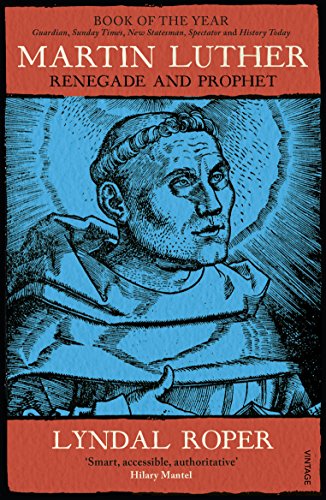
Inhaltsangabe
SHORTLISTED FOR THE WOLFSON HISTORY PRIZE 2017
SHORTLISTED FOR THE ELIZABETH LONGFORD PRIZE 2017
'A magnificent study of one of history's most compelling and divisive figures' Richard J. Evans
When Martin Luther nailed a sheet of paper to the church door of a small university town in 1517, he set off a process that changed the Western world for ever.
Within a few years Luther’s ideas had spread like wildfire. His attempts to reform Christianity by returning it to its biblical roots split the Western Church, divided Europe and polarised people’s beliefs, leading to religious persecution, social unrest and war; and in the long run his ideas would help break the grip of religion on every sphere of life.
Yet Luther was a deeply flawed human being: a fervent believer tormented by spiritual doubts; a prolific writer whose translation of the Bible would shape the German language yet whose attacks on his opponents were vicious and foul-mouthed; a married ex-monk who liberated human sexuality from the stigma of sin but who insisted that women should know their place; a religious fundamentalist, Jew-hater and political reactionary who called ‘for the private and public murder of the peasants’ who had risen against their lords in response to his teaching. And perhaps surprisingly, the man who helped create in the modern world was not modern himself: for him the devil was not a figure of speech but a real, physical presence.
As an acclaimed historian, Lyndal Roper explains how Luther’s impact can only be understood against the background of the times. As a brilliant biographer, she gives us the flesh-and-blood figure. She reveals the often contradictory psychological forces that drove Luther forward and the dynamics they unleashed, which turned a small act of protest into a battle against the power of the Church.
A New Statesman, Spectator, History Today, Guardian and Sunday Times Book of the Year
Die Inhaltsangabe kann sich auf eine andere Ausgabe dieses Titels beziehen.
Über die Autorin bzw. den Autor
Lyndal Roper is Regius Professor of History at Oxford and one of the most respected historians at work in Britain today. An expert on early modern Germany, her previous books include a study of witchcraft, Witch Craze: Terror and Fantasy in Baroque Germany. In 2016 she received the prestigious Gerda Henkel Foundation Prize for her work on Luther and the Reformation.
Von der hinteren Coverseite
When Martin Luther nailed a sheet of paper to the church door of a small university town on 31 October 1517, he set off a process that changed the Western world for ever. Luther's ideas spread like wildfire. His attack on the Church soon convulsed Germany, divided Europe and polarised people's beliefs. They triggered decades of religious persecution, social unrest and war. And in the long run, his ideas paradoxically helped break the grip of religion in every sphere of life.
But the man who started the
Auszug. © Genehmigter Nachdruck. Alle Rechte vorbehalten.
1. Mansfeld and Mining
“I am the son of a peasant,” Luther averred, “my great-grandfather, grandfather and my father were all true peasants.”1 This was only half the truth. If he came from peasant stock, Luther grew up in a mining town, and his upbringing was to have a profound influence on him. Martin’s childhood was spent in Mansfeld, a small mining town in the territory of the same name, where wagonloads of charcoal would file along the muddy roads, and where the smell of the fires of the smelters hung on the air. He would remain loyal to Mansfeld throughout his life, referring to himself as “from Mansfeld,” enrolling at the University of Erfurt as “Martinus ludher ex mansfelt,” and corresponding with the counts of Mansfeld until he died.2 In 1546, he set out, ill, on what was to be his final journey to Eisleben, trying to settle yet another dispute between the counts. He knew that the trip could cost him his life, and it did: He died still trying to put matters right in Mansfeld. Yet this deep connection has been almost completely obliterated in the image of Luther we have today.3 Most biographies have little to say about Luther’s childhood. Unlike his birthplace Eisleben, and unlike Wittenberg, where he spent most of his life, Mansfeld never became a site of Lutheran pilgrimage. But to make sense of Luther, one has to understand the world from which he came.
There had been mining in the Mansfeld area since about 1200 but in the mid-fifteenth century a new process of refining allowed silver and pure copper to be separated after the initial process of smelting.4 Highly capital-intensive, this technological innovation led to the involvement of the big financiers of Leipzig and Nuremberg, and it brought an economic boom to the area. Mansfeld was soon among the biggest European producers of silver and it produced a quarter of the continent’s copper.5 Copper was used in combination with tin or zinc, as bronze or brass, in the hundreds of household items produced in towns like Nuremberg, and it played a large part in the lifestyle revolution in this period, as people began to acquire not only glass and crockery but also metal dishes, pans, and other implements for use at home. Luther’s father, Hans Luder, probably through connections of his mother’s family, heard of the new mining leases that were up for sale in the 1480s, and moved first to Eisleben, where Luther was born in 1483, and then to Mansfeld.
Luther himself later described his father as “a metal worker, a miner”; but the story told by his early biographers of Hans Luder’s rise from rags to riches is not true.6 Although his family were clearly not educated people, Hans was certainly never one of those hooded, squat men who toiled lying down in the low mine tunnels with their pickaxes.7 The Luder family had been peasants, yet even though he was the eldest son, Hans did not inherit: According to local custom at Möhra, where his parents lived, it was the youngest son who took over the farm. The value of the property was probably equally divided between the children, and this may have given the oldest son some capital. Recent research also suggests that the Luder family may have owned a rudimentary copper-smelting works near Möhra, where Hans might have gained some experience.8 He must have had serious prospects, however, for it is otherwise hard to explain why the Lindemanns, an established urban family in Eisenach—whose members included Anthonius Lindemann, the highest-ranking official in the county of Mansfeld and himself a smelter-master—should in 1479 have betrothed their daughter to a young man without a trade and with no promise of an inheritance.9 It turned out to be a wise decision. Within a short period of time Luder was not only running mines, but by 1491 at the latest had become one of the Vierer, an adjunct to the town council representing the four quarters of Mansfeld, and would eventually become a mining inspector (Schauherr), which made him one of the five most senior mining officials in the area.10 By the early sixteenth century, he was operating seven smelters in joint ventures with others, placing him among the bigger operators in Mansfeld.
In 1500 the town had a population of around 2,000–3,000 people, with five “hospitals” to care for the poor and houses for the sick; more unusually, it also boasted a Latin school for boys. Mansfeld nestled in a valley, with four gates and two portals allowing entry. Its “quarters” had mushroomed out from a much smaller initial settlement.11 One of its two main streets wound steeply up the hill to the church on the main square, and it was on this street that the smelter-masters and the officials of the counts had their houses. The church, dedicated to St. George, the patron saint of Mansfeld, had been erected in the thirteenth century but burned down when Luther was in his early teens (thanks to an absent-minded organist who forgot to put out the fire that heated the bellows). It was rebuilt between 1497 and 1502, with a choir finally finished in 1518–20.12 The sword-wielding knight St. George was locally believed to have been a count of Mansfeld, who had fought the dragon on the nearby Lindberg hill. The counts certainly made capital out of this fictional connection, and the saint was depicted on their coins and fountains and above doors; there were even St. George weathercocks.13
Hans Luder’s house was located opposite the Golden Ring tavern, one of two hostelries where travelers might stop. The town lay on the trade route from Hamburg to Nuremberg via Erfurt, but there were few reasons why travelers would have broken their journey in Mansfeld, unless they were going to visit the counts or were involved in mining.14 Luder’s house still stands, and it is now believed to have been twice as big as previously thought. (We do not know for certain when Hans Luder acquired the house; he certainly owned it in 1507.15) There is a wide entrance through which a horse and cart could pass, and a big barn and stables for horses.16 From the house the effects of mining would have been visible everywhere: Slag heaps pockmarked the landscape and the large pond below the town was polluted with the slag water from the two smelters outside the town walls. Farther up the street, toward the square in front of the Church of St. George, stood the large house of Luther’s best friend, Hans Reinicke, whose father was also a mine owner and one of the most prosperous men in Mansfeld. Next door, between Luther’s house and the school, lived another friend, Nickel Öhmler, who would later become related by marriage.
Above the town loomed the castles of the Mansfeld counts. It is hard to imagine a setup more likely to impress on a young lad like Luther the power of the town’s rulers. There was no primogeniture among the counts. Instead, all sons inherited, and when Luther was a boy there were three lines of Mansfeld counts; in 1501, when a formal pact was made dividing the territory, the ruling collective consisted of no fewer than five counts.17 Not surprisingly, they did not always get along, and one of the points of tension between them was the castle. In Luther’s childhood, two castles stood on the site along with two other dwellings, two bakeries, two breweries, stables, and a dividing wall with a shared path. It must have been an impressive set of structures, for in 1474 the counts had been able to host the king of Denmark and 150 of his knights for three nights.18 In 1501, when Count Albrecht decided to build a third castle on the site, he met with opposition from the other counts. The dispute was eventually settled, and Albrecht was allowed to realize his ambitions. With the wealth from the mines, three pocket-handkerchief-sized...
„Über diesen Titel“ kann sich auf eine andere Ausgabe dieses Titels beziehen.
Suchergebnisse für Martin Luther: .

Beispielbild für diese ISBN
Martin Luther : Renegade and Prophet
Anbieter: Better World Books, Mishawaka, IN, USA
Verkäuferbewertung 5 von 5 Sternen

Zustand: Good. Pages intact with minimal writing/highlighting. The binding may be loose and creased. Dust jackets/supplements are not included. Stock photo provided. Product includes identifying sticker. Better World Books: Buy Books. Do Good. Bestandsnummer des Verkäufers 17432229-20
Gebraucht kaufen
EUR 10,11
Versand gratis
Versand innerhalb von USA
Versand innerhalb von USA
Anzahl: 1 verfügbar
Beispielbild für diese ISBN
Martin Luther : Renegade and Prophet
Anbieter: Better World Books Ltd, Dunfermline, Vereinigtes Königreich
Verkäuferbewertung 5 von 5 Sternen
Zustand: Good. Pages intact with minimal writing/highlighting. The binding may be loose and creased. Dust jackets/supplements are not included. Stock photo provided. Product includes identifying sticker. Better World Books: Buy Books. Do Good. Bestandsnummer des Verkäufers 17432229-20
Gebraucht kaufen
EUR 5,99
EUR 5,97 Versand
Versand von Vereinigtes Königreich nach USA
Versand von Vereinigtes Königreich nach USA
Anzahl: 1 verfügbar
Beispielbild für diese ISBN
Martin Luther: Renegade and Prophet
Anbieter: HPB-Emerald, Dallas, TX, USA
Verkäuferbewertung 5 von 5 Sternen
paperback. Zustand: Very Good. Connecting readers with great books since 1972! Used books may not include companion materials, and may have some shelf wear or limited writing. We ship orders daily and Customer Service is our top priority! Bestandsnummer des Verkäufers S_460075162
Gebraucht kaufen
EUR 10,02
EUR 3,35 Versand
Versand innerhalb von USA
Versand innerhalb von USA
Anzahl: 1 verfügbar
Beispielbild für diese ISBN
Martin Luther: Renegade and Prophet
Anbieter: WorldofBooks, Goring-By-Sea, WS, Vereinigtes Königreich
Verkäuferbewertung 5 von 5 Sternen
Paperback. Zustand: Very Good. The book has been read, but is in excellent condition. Pages are intact and not marred by notes or highlighting. The spine remains undamaged. Bestandsnummer des Verkäufers GOR008806807
Gebraucht kaufen
EUR 10,90
EUR 6,69 Versand
Versand von Vereinigtes Königreich nach USA
Versand von Vereinigtes Königreich nach USA
Anzahl: 5 verfügbar
Beispielbild für diese ISBN
Martin Luther: Renegade and Prophet
Anbieter: WorldofBooks, Goring-By-Sea, WS, Vereinigtes Königreich
Verkäuferbewertung 5 von 5 Sternen
Paperback. Zustand: Good. The book has been read but remains in clean condition. All pages are intact and the cover is intact. Some minor wear to the spine. Bestandsnummer des Verkäufers GOR009422628
Gebraucht kaufen
EUR 10,90
EUR 6,69 Versand
Versand von Vereinigtes Königreich nach USA
Versand von Vereinigtes Königreich nach USA
Anzahl: 1 verfügbar
Foto des Verkäufers
Martin Luther: Renegade and Prophet
Anbieter: WeBuyBooks, Rossendale, LANCS, Vereinigtes Königreich
Verkäuferbewertung 5 von 5 Sternen
paperback. Zustand: Very Good. Most items will be dispatched the same or the next working day. A copy that has been read, but is in excellent condition. Pages are intact and not marred by notes or highlighting. The spine remains undamaged. Bestandsnummer des Verkäufers rev8208308579
Gebraucht kaufen
EUR 12,36
EUR 7,49 Versand
Versand von Vereinigtes Königreich nach USA
Versand von Vereinigtes Königreich nach USA
Anzahl: 1 verfügbar
Foto des Verkäufers
Martin Luther: Renegade and Prophet
Anbieter: WeBuyBooks, Rossendale, LANCS, Vereinigtes Königreich
Verkäuferbewertung 5 von 5 Sternen
paperback. Zustand: Good. Most items will be dispatched the same or the next working day. A copy that has been read but remains in clean condition. All of the pages are intact and the cover is intact and the spine may show signs of wear. The book may have minor markings which are not specifically mentioned. A tan to the pages. Bestandsnummer des Verkäufers rev9439393850
Gebraucht kaufen
EUR 12,36
EUR 7,49 Versand
Versand von Vereinigtes Königreich nach USA
Versand von Vereinigtes Königreich nach USA
Anzahl: 1 verfügbar
Beispielbild für diese ISBN
Martin Luther: Renegade and Prophet
Anbieter: Chiron Media, Wallingford, Vereinigtes Königreich
Verkäuferbewertung 5 von 5 Sternen
paperback. Zustand: New. Brand new book, sourced directly from publisher. Dispatch time is 24-48 hours from our warehouse. Book will be sent in robust, secure packaging to ensure it reaches you securely. Bestandsnummer des Verkäufers 6666-GRD-9781784703448
Neu kaufen
EUR 17,19
EUR 5,96 Versand
Versand von Vereinigtes Königreich nach USA
Versand von Vereinigtes Königreich nach USA
Anzahl: 7 verfügbar
Foto des Verkäufers
Martin Luther (Paperback)
Anbieter: Grand Eagle Retail, Bensenville, IL, USA
Verkäuferbewertung 5 von 5 Sternen
Paperback. Zustand: new. Paperback. The first historical biography, for many decades, of Martin Luther (1483-1546), the rebellious monk who ushered in the modern worldSHORTLISTED FOR THE WOLFSON HISTORY PRIZE 2017SHORTLISTED FOR THE ELIZABETH LONGFORD PRIZE 2017'A magnificent study of one of history's most compelling and divisive figures' Richard J. EvansWhen Martin Luther nailed a sheet of paper to the church door of a small university town in 1517, he set off a process that changed the Western world for ever.Within a few years Luther's ideas had spread like wildfire. His attempts to reform Christianity by returning it to its biblical roots split the Western Church, divided Europe and polarised people's beliefs, leading to religious persecution, social unrest and war; and in the long run his ideas would help break the grip of religion on every sphere of life.Yet Luther was a deeply flawed human being: a fervent believer tormented by spiritual doubts; a prolific writer whose translation of the Bible would shape the German language yet whose attacks on his opponents were vicious and foul-mouthed; a married ex-monk who liberated human sexuality from the stigma of sin but who insisted that women should know their place; a religious fundamentalist, Jew-hater and political reactionary who called 'for the private and public murder of the peasants' who had risen against their lords in response to his teaching. And perhaps surprisingly, the man who helped create in the modern world was not modern himself: for him the devil was not a figure of speech but a real, physical presence.As an acclaimed historian, Lyndal Roper explains how Luther's impact can only be understood against the background of the times. As a brilliant biographer, she gives us the flesh-and-blood figure. She reveals the often contradictory psychological forces that drove Luther forward and the dynamics they unleashed, which turned a small act of protest into a battle against the power of the Church.A New Statesman, Spectator, History Today, Guardian and Sunday Times Book of the Year She reveals the often contradictory psychological forces that drove Luther forward and the dynamics they unleashed, which turned a small act of protest into a battle against the power of the Church.A New Statesman, Spectator, History Today, Guardian and Sunday Times Book of the Year Shipping may be from multiple locations in the US or from the UK, depending on stock availability. Bestandsnummer des Verkäufers 9781784703448
Beispielbild für diese ISBN
Martin Luther
Anbieter: PBShop.store UK, Fairford, GLOS, Vereinigtes Königreich
Verkäuferbewertung 5 von 5 Sternen
PAP. Zustand: New. New Book. Shipped from UK. Established seller since 2000. Bestandsnummer des Verkäufers GB-9781784703448
Neu kaufen
EUR 21,23
EUR 4,97 Versand
Versand von Vereinigtes Königreich nach USA
Versand von Vereinigtes Königreich nach USA
Anzahl: 7 verfügbar