
Verwandte Artikel zu Carolina of Orange-Nassau: Ancestress of the royal...
Inhaltsangabe
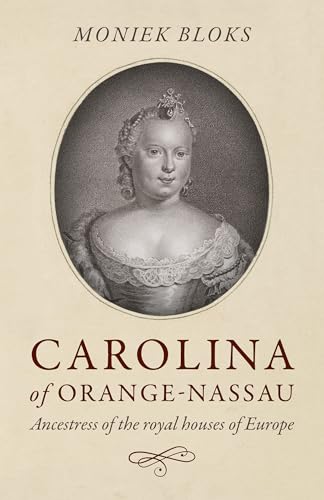
Carolina of Orange-Nassau (1743 – 1787) was born the daughter of William IV, Prince of Orange, and Anne, Princess Royal and was thus the granddaughter of King George II. It was upon the King's orders that she was named after his wife, Caroline of Ansbach. She was the first of Anne and William's children to survive to adulthood. When her father was at last made stadtholder of all seven united provinces, Carolina was included in the line of succession, in the event she had no brothers. A brother was eventually born, but due to his weak health, she remained an important figure. Carolina married Charles Christian of Nassau-Weilburg and suffered the loss of half her children, either in childbirth or infancy. Despite this, she acted as regent for her minor brother while heavily pregnant and remained devoted to him and the Dutch republic. Her children married well and her descendants sit upon the royal thrones of Europe, truly making her a grandmother of Europe.
Die Inhaltsangabe kann sich auf eine andere Ausgabe dieses Titels beziehen.
Über die Autorinnen und Autoren
Moniek Bloks is the editor of the successful blog History of Royal Women. She lives in the Netherlands and has a background in law. Her interest in historical royal women and writing began at an early age, and she has been glad to share the stories of often little-known royal women. When she isn't writing, she is visiting castles and palaces around Europe with her trusty camera.
Moniek Bloks is the editor of the successful blog History of Royal Women. She lives in the Netherlands and has a background in law. Her interest in historical royal women and writing began at an early age, and she has been glad to share the stories of often little-known royal women. When she isn't writing, she is visiting castles and palaces around Europe with her trusty camera.
Auszug. © Genehmigter Nachdruck. Alle Rechte vorbehalten.
Carolina of Orange-Nassau
Ancestress of the royal houses of Europe
By Moniek BloksJohn Hunt Publishing Ltd.
Copyright © 2018 Moniek Bloks
All rights reserved.
ISBN: 978-1-78535-914-9All rights reserved.
Contents
Acknowledgements, vi,
Introduction, 1,
Chapter 1: Birth and Youth, 3,
Chapter 2: The Early Years of Marriage and the Regency, 19,
Chapter 3: Life as the Princess of Nassau-Weilburg, 35,
Chapter 4: Her Legacy and Descendants, 50,
Chapter 5: Walking in Carolina's Footsteps, 59,
References, 74,
Bibliography, 83,
Selected Index, 86,
CHAPTER 1
Birth and Youth
Princess Wilhelmine Carolina of Orange-Nassau was born on 28 February 1743 at the Princely Court of Leeuwarden as the eldest surviving child of the Stadtholder of Friesland, Groningen, Drenthe and Gelderland, William IV, Prince of Orange and Anne of Hanover, also known as Anne, Princess Royal.
Her father was the de facto head of state as the Stadtholder of Friesland, Groningen, Drenthe and Gelderland, which were all provinces in the Dutch Republic. This was a largely hereditary role, which he had been born to fulfil as he was born six weeks after his father's death. His father, Johan William Friso, head of the Frisian branch of the House of Orange-Nassau, had drowned in the Hollands Diep as he was travelling to The Hague on 22 October 1751. He was just 23-years-old. The title itself originated from the middle ages and became closely associated with the Republic of the Seven United Netherlands. Some provinces refused to appoint a stadtholder during two occasions, which became known as the First and Second Stadtholderless Period. Previous stadtholders include William the Silent, leader of the Dutch revolt against Spanish rule, his sons Philip William, Maurice and Frederick Henry, William II and William III, who also became King William III of England, Scotland and Ireland. In addition, her father was Prince of Orange, a title associated with the Principality of Orange in Southern France. Although the Principality itself was ceded to King Louis XIV of France in 1713, the title continued to be used.
Her mother was the eldest daughter of King George II of Great Britain and Caroline of Ansbach and she was thus known as the Princess Royal, an honorific title for the eldest daughter of the King. She was born on 2 November 1709 in Herrenhausen Palace in Hanover, five years before her paternal grandfather would succeeded as King George I of Great Britain. She was named for the Queen her grandfather would succeed, Anne, Queen of Great Britain, the last of the Protestant Stuarts. Anne had been pregnant many times but only one child survived past infancy, Prince William, Duke of Gloucester. He tragically died at the age of 11 in 1700. As Parliament did not wish the throne to revert to a Catholic, most notably Anne's half-brother James Francis Edward Stuart, also known as the Old Pretender, the Act of Settlement 1701 settled the succession on Sophia of Hanover, a granddaughter of James VI and I, and her Protestant heirs. Sophia died shortly before Queen Anne did and so her son succeeded as King George I.
The marriage between the Prince of Orange and the daughter of the British King was perhaps not one many would expect. However, the Hanoverians were relatively unpopular and a marriage with a Protestant Prince would be popular and perhaps one day, the Prince of Orange would play a large role in the Dutch Republic. The marriage was also meant to improve the relationship between the Dutch Republic and England, which had been bad since the War of the Spanish Succession.
Her parents had married on 7 March 1734 in St. James's Chapel. Her mother had spent much time studying Dutch history and copying works by Titian and Van Dyck from the Royal Collection. Anne walked down the aisle in a wedding dress of stiff blue French silk, embroidered with thread. It was lavishly trimmed with ruffles of fine lace and loops of diamonds. She wore her robe of state over it and her six-foot-train was supported by eight peers' daughters who were dressed in white and silver. Around her neck was a magnificent diamond necklace, which had been a gift from her future husband. The ceremony was rather quick and from Lord Hervey's memoirs we learn that the ceremony was "more like the mournful pomp of a sacrifice than the celebration of marriage and put one in mind rather of an Iphigenia leading to the altar than of a bride." It seemed like an auspicious start to the marriage and the reaction to the Prince of Orange was rather lukewarm.
However, Anne was smitten with her new husband. After a brief honeymoon at Kew, the couple returned to the court of Anne's father. Lord Hervey again comments on the situation, "She always behaved to him as if he was an Adonis and he hardly took any notice of her at all nor gave her one look by which one could have guessed that they ever slept in the same sheets." Despite the lukewarm reception, William was given the Order of the Garter and Parliament made him a British subject. Soon the couple would be on their way to the Netherlands. Anne was given a pair of diamond pendant earrings by her father and her mother later agonised over her departure, "Dear Hart, my sadness is indescribable. I never had any sorrows over you Anne, this is the first cruel one. Caroline behaves so well but our conversations always finish on the same sad note. The King, who sends you affectionate greetings, is worse than us all. To change the conversation I was forced to talk about Griff. Orange is good man and will ever be a great favourite of mine ... love me always as tenderly as the most affectionate mother flatters herself that you do."
The party left from Gravesend and after a calm journey across the North Sea, they landed at Rotterdam. They would then need to cross the Zuiderzee to Friesland, where William's mother anxiously awaited them. Marie Louise of Hesse-Kassel had been informed that Anne, as the daughter of a King, must take precedence over her, but Marie Louise needn't be told. She had already moved out of the Court when William had come of age and now lived in the next street over. Although Anne seized the first opportunity she could to return to England she refers to him in her letters as "Pepin" or "Pip", while he responds with "my adorable Annin."
Anne was soon pregnant with her first child and William was absolutely delighted. He wrote to her that her pregnancy, "serves but to redouble and augment if that were possible my love and my devotion for you, my incomparable Annin." Anne was in London at the time and she became ill on the ship back to the Netherlands, forcing it back to port. William was not amused and he ordered her back at once. She finally arrived at Calais and the couple travelled to The Hague to celebrate the New Year and to await the child.
Although Anne grew bigger or as William wrote to his mother, "she gets heavier and less inclined to move about.", rumours soon began to grow that there was no pregnancy at all. Anne had informed her husband of her pregnancy in July 1734 but by the next spring even William had become agitated. By 20 April 1735 it appeared that there would be no child. William wrote, "I can hardly bear to tell you but the accoucheur has told her that there is no child. It is not the fact that she is not pregnant which gives me pain we are both young and if it not to be this year then we dare to hope for another time and besides it is the will of God ... it is the blow to my poor princess which is so terrible. The swelling stays with her though the doctors assure me that there is no...
„Über diesen Titel“ kann sich auf eine andere Ausgabe dieses Titels beziehen.
Suchergebnisse für Carolina of Orange-Nassau: Ancestress of the royal...

Beispielbild für diese ISBN
Carolina of Orange-Nassau: Ancestress of the Royal Houses of Europe
Anbieter: HPB-Emerald, Dallas, TX, USA
Verkäuferbewertung 5 von 5 Sternen

paperback. Zustand: Very Good. Connecting readers with great books since 1972! Used books may not include companion materials, and may have some shelf wear or limited writing. We ship orders daily and Customer Service is our top priority! Bestandsnummer des Verkäufers S_471640658
Gebraucht kaufen
EUR 2,75
EUR 3,34 Versand
Versand innerhalb von USA
Versand innerhalb von USA
Anzahl: 1 verfügbar
Beispielbild für diese ISBN
Carolina of Orange-Nassau: Ancestress of the royal houses of Europe
Anbieter: WorldofBooks, Goring-By-Sea, WS, Vereinigtes Königreich
Verkäuferbewertung 5 von 5 Sternen
Paperback. Zustand: Very Good. The book has been read, but is in excellent condition. Pages are intact and not marred by notes or highlighting. The spine remains undamaged. Bestandsnummer des Verkäufers GOR009703547
Gebraucht kaufen
EUR 4,31
EUR 6,64 Versand
Versand von Vereinigtes Königreich nach USA
Versand von Vereinigtes Königreich nach USA
Anzahl: 1 verfügbar
Foto des Verkäufers
Carolina of Orange-Nassau : Ancestress of the royal houses of Europe
Anbieter: GreatBookPrices, Columbia, MD, USA
Verkäuferbewertung 5 von 5 Sternen
Zustand: New. Bestandsnummer des Verkäufers 33442908-n
Beispielbild für diese ISBN
CAROLINA OF ORANGE NASSAU:ANCESTRESS OF Format: Paperback
Anbieter: INDOO, Avenel, NJ, USA
Verkäuferbewertung 5 von 5 Sternen
Zustand: New. Bestandsnummer des Verkäufers 9781785359149
Neu kaufen
EUR 12,11
Versand gratis
Versand innerhalb von USA
Versand innerhalb von USA
Anzahl: Mehr als 20 verfügbar
Beispielbild für diese ISBN
Carolina of Orange-Nassau : Ancestress of the royal houses of Europe
Anbieter: GreatBookPrices, Columbia, MD, USA
Verkäuferbewertung 5 von 5 Sternen
Zustand: As New. Unread book in perfect condition. Bestandsnummer des Verkäufers 33442908
Gebraucht kaufen
EUR 10,03
EUR 2,35 Versand
Versand innerhalb von USA
Versand innerhalb von USA
Anzahl: 1 verfügbar
Beispielbild für diese ISBN
CAROLINA OF ORANGE NASSAU:ANCESTRESS OF Format: Paperback
Anbieter: INDOO, Avenel, NJ, USA
Verkäuferbewertung 5 von 5 Sternen
Zustand: As New. Unread copy in mint condition. Bestandsnummer des Verkäufers SS9781785359149
Gebraucht kaufen
EUR 12,46
Versand gratis
Versand innerhalb von USA
Versand innerhalb von USA
Anzahl: Mehr als 20 verfügbar
Beispielbild für diese ISBN
Carolina of Orange-Nassau
Anbieter: PBShop.store US, Wood Dale, IL, USA
Verkäuferbewertung 5 von 5 Sternen
PAP. Zustand: New. New Book. Shipped from UK. Established seller since 2000. Bestandsnummer des Verkäufers FW-9781785359149
Beispielbild für diese ISBN
Carolina of Orange-Nassau
Anbieter: PBShop.store UK, Fairford, GLOS, Vereinigtes Königreich
Verkäuferbewertung 5 von 5 Sternen
PAP. Zustand: New. New Book. Shipped from UK. Established seller since 2000. Bestandsnummer des Verkäufers FW-9781785359149
Neu kaufen
EUR 13,09
EUR 3,90 Versand
Versand von Vereinigtes Königreich nach USA
Versand von Vereinigtes Königreich nach USA
Anzahl: 1 verfügbar
Beispielbild für diese ISBN
Carolina of OrangeNassau Ancestress of the royal houses of Europe
Anbieter: Revaluation Books, Exeter, Vereinigtes Königreich
Verkäuferbewertung 5 von 5 Sternen
Paperback. Zustand: Brand New. 87 pages. 8.50x5.50x0.25 inches. In Stock. Bestandsnummer des Verkäufers __1785359142
Neu kaufen
EUR 8,72
EUR 11,86 Versand
Versand von Vereinigtes Königreich nach USA
Versand von Vereinigtes Königreich nach USA
Anzahl: 1 verfügbar
Beispielbild für diese ISBN
Carolina of Orange-Nassau: Ancestress of the Royal Houses of Europe
Anbieter: Kennys Bookshop and Art Galleries Ltd., Galway, GY, Irland
Verkäuferbewertung 5 von 5 Sternen
Zustand: New. 2019. Paperback. . . . . . Bestandsnummer des Verkäufers V9781785359149
Neu kaufen
EUR 13,84
EUR 9,50 Versand
Versand von Irland nach USA
Versand von Irland nach USA
Anzahl: 1 verfügbar