
Verwandte Artikel zu Deliberative Democracy and Social Movements: Transition...
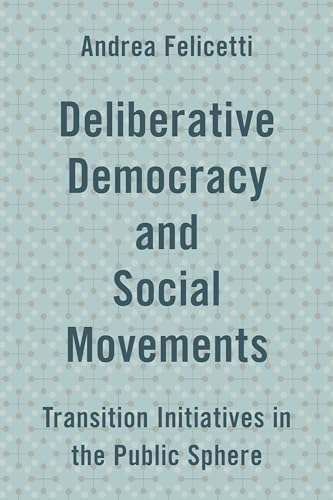
Deliberative Democracy and Social Movements: Transition Initiatives in the Public Sphere - Softcover
Inhaltsangabe
By offering a critical assessment of deliberation in social movement organisations, this study identifies key aspects affecting their ability to pursue democratic deliberation and sheds new light on the role of community actors in deliberative democracy.
Die Inhaltsangabe kann sich auf eine andere Ausgabe dieses Titels beziehen.
Über die Autorin bzw. den Autor
Andrea Felicetti is a Postdoctoral Researcher at the Institute for Humanities and Social Sciences, Center on Social Movement Studies (COSMOS), Scuola Normale Superiore, Italy.
Auszug. © Genehmigter Nachdruck. Alle Rechte vorbehalten.
Deliberative Democracy and Social Movements
Transition Initiatives in the Public Sphere
By Andrea FelicettiRowman & Littlefield International, Ltd.
Copyright © 2017 Andrea Felicetti
All rights reserved.
ISBN: 978-1-78660-165-0All rights reserved.
Contents
List of Figures, ix,
Acknowledgements, xi,
Introduction and Structure of the Book, 1,
1 Deliberative Capacity: From Deliberative Theory to Democratic Life, 7,
2 Transition from a Deliberative Democratic Perspective, 33,
3 Transition Connor: A Case Study, 55,
4 Notari Città di Transizione: A Case Study, 75,
5 Transition Dickson Hills: A Case Study, 99,
6 Vaiai in Transizione: A Case Study, 121,
7 Comparative Findings, 143,
8 The Drivers of Deliberative Capacity, 157,
Conclusions, 181,
References, 201,
Index, 219,
About the Author, 227,
CHAPTER 1
Deliberative Capacity
From Deliberative Theory to Democratic Life
SUMMARY
This chapter explores the idea of deliberative capacity, introduces the research methodology, and discusses previous work on deliberation in social movements. The first section presents deliberative capacity as a contribution to the wider systemic turn in deliberative democracy. A synthetic definition of the concept is also provided, as well as an illustration of how deliberative capacity can be and has been used in empirical research. The next section discusses in detail each of the three dimensions of deliberative capacity (authenticity, inclusivity and consequentiality) and their respective components. The concept of deliberative capacity is thus refined in order to make it more suited to investigating community groups. The following section presents the goals of the research, the methods through which they are pursued, and it explains its comparative and interpretive research design. The last part of the chapter discusses literature from deliberative democracy and social movement studies that this research builds upon in order to investigate the deliberative quality of social movement organisations.
AN INTRODUCTION TO DELIBERATIVE CAPACITY
In recent years many deliberative scholars have come to agree on the need to develop a systemic approach to deliberative democracy. In an attempt to envision more deliberative and democratic societies, the systemic turn focuses on the deliberative and democratic qualities of different activities and the way they interact (Parkinson and Mansbridge, 2012, see: Mansbridge et al., 2012). Certainly, the idea of deliberative systems is far from uncontested (e.g. Owen and Smith, 2015), and theoretical refinements are needed, as the emerging literature on this topic shows (e.g. Hendriks 2016, Boswell 2015). Nonetheless, the idea of a systemic approach to deliberative democracy embodies an interest that has characterised the field since its inception. In fact, deliberative theory has long been concerned with the possibilities of democratisation of societies at large. Indeed, early deliberative theorists such as Manin (1987: 363) stressed the importance of systematically investigating discursive processes, assessing their overall quality, and envisioning ways in which real world experiences can be drawn closer to the deliberative ideals. Generally, deliberation has been understood and investigated at micro or macro levels. That is, research has focused on deliberative assemblies or on the study of deliberation in the public at large in formal and informal settings (Hendriks, 2006). This divide has been paralleled by a tendency to neglect the empirical investigation of the deliberative qualities of social practices outside deliberative assemblies, despite their fundamental importance (Mansbridge, 1999, Young, 2000, Mansbridge et al., 2012). Overall, as pointed out by Chambers (2009, 2012), although it makes sense to distinguish between the notions of 'democratic deliberation' and 'deliberative democracy', in times of mass democracy, deliberative democratic hopes depend upon the capacity to bridge, rather than split, these two understandings of deliberation. The systemic turn acknowledges this necessity and provides a theoretical context to extend deliberative analysis to those events that are not straightforwardly deliberative in nature.
The idea of deliberative capacity (Dryzek, 2009, 2010a) can be understood within the context of this wider effort to build a systemic understanding of deliberative democracy. It can be intended also as a contribution to the oft-mentioned recommendation to connect deliberative theory and observation of societal dynamics (e.g. Neblo, 2005, Bachtiger et al., 2010). As argued by Benhabib (1996b: 10) deliberative democrats agree on the idea that in order to envision deliberative reforms of democratic systems it is necessary to 'combine the virtues of deliberative politics with a sociological realism adequate to the complexity of modern societies'. Deliberative capacity provides a means to assess the deliberative democratic qualities of contemporary societal practices without sacrificing the critical nature of the deliberative approach.
It is worth noticing that Dryzek (2009) first defined 'deliberative capacity' while discussing his own elaboration of the deliberative system, the main one referred to in this study. This system is influenced by a critical tradition built upon the Habermasian notion of the public sphere and discursive democracy, and it is composed of just two parts, 'empowered' and 'public' spaces. These are connected through 'transmission' and 'accountability' mechanisms and meta-deliberation, and each space possesses a degree of deliberative capacity (Dryzek, 2010a).
Dryzek has referred directly to the idea of deliberative capacity three times. On each occasion, he argued that deliberative capacity can be related to a deliberative system in its entirety or to parts of it, and it is articulated in three fundamental dimensions. In fact, deliberative capacity is the extent to which an overall deliberative system or its parts host authentic, inclusive, and consequential deliberative processes. It is worth noticing that the idea of deliberative systems suggests an understanding of deliberation as a series of dynamic and overlapping phenomena. The notion of 'deliberative processes' or 'discursive processes' may better express this idea than just 'deliberation', which, instead, may lead us to think of formal deliberative processes only. Discursive processes, in particular, are the main concern of investigations on deliberative capacity; other elements (e.g. organisational aspects) are valuable in so far as they help understand discursive processes.
The three dimensions upon which the concept of deliberative capacity is articulated are based on certain criteria, each of which is connected to concepts and debates which have long characterised deliberative democratic thinking. The idea of 'capacity' can be intended to mean the 'capability' (of a system or parts of it) to act in a deliberative and democratic fashion. Nonetheless, when authentic and inclusive deliberative processes can be found, it does not necessarily follow that these processes are consequential in any substantial way. Thus, ultimately, the idea of capacity seems to acknowledge the possibility of a situation where an object under investigation may have a certain level of a resource (in this case, authentic and inclusive deliberative processes) without necessarily exploiting it (that is, without consequentiality).
One can study the deliberative capacity of one (or more) deliberative...
„Über diesen Titel“ kann sich auf eine andere Ausgabe dieses Titels beziehen.
Suchergebnisse für Deliberative Democracy and Social Movements: Transition...

Foto des Verkäufers
Deliberative Democracy and Social Movements : Transition Initiatives in the Public Sphere
Verlag:
Rowman & Littlefield International, 2018
ISBN 10: 1786601656
ISBN 13: 9781786601650
Neu
Softcover
Anbieter: GreatBookPrices, Columbia, MD, USA
Verkäuferbewertung 5 von 5 Sternen

Zustand: New. Bestandsnummer des Verkäufers 26472033-n
Neu kaufen
EUR 57,61
EUR 2,35 Versand
Versand innerhalb von USA
Versand innerhalb von USA
Anzahl: Mehr als 20 verfügbar
Foto des Verkäufers
Deliberative Democracy and Social Movements
Verlag:
Bloomsbury Publishing PLC, GB, 2018
ISBN 10: 1786601656
ISBN 13: 9781786601650
Neu
Paperback
Anbieter: Rarewaves.com USA, London, LONDO, Vereinigtes Königreich
Verkäuferbewertung 5 von 5 Sternen
Paperback. Zustand: New. Deliberative democracy is increasingly central in democratic theory and its concepts are employed in a growing number of fields, including social movement studies and environmental politics. At the same time, contemporary citizen activism seems to feature some forms of engagement that resonate with deliberative democratic ideas.This book provides an in-depth investigation of the qualities of citizens' engagement from a deliberative democratic standpoint. The key concept through which such qualities are investigated is 'deliberative capacity', the extent to which organisations host authentic, inclusive, and consequential discursive processes. This book is based on a comparative study of four grassroots local initiatives, two from Australia (in Tasmania and Queensland) and two from Italy (in Emilia-Romagna and Sicily).By offering a critical assessment of deliberation in social movement organisations, this study identifies key aspects affecting their ability to pursue democratic deliberation and sheds new light on the role of community actors in deliberative democracy. Bestandsnummer des Verkäufers LU-9781786601650
Neu kaufen
EUR 60,03
Versand gratis
Versand von Vereinigtes Königreich nach USA
Versand von Vereinigtes Königreich nach USA
Anzahl: Mehr als 20 verfügbar
Beispielbild für diese ISBN
Deliberative Democracy and Social Movements
Print-on-DemandAnbieter: PBShop.store US, Wood Dale, IL, USA
Verkäuferbewertung 5 von 5 Sternen
PAP. Zustand: New. New Book. Shipped from UK. THIS BOOK IS PRINTED ON DEMAND. Established seller since 2000. Bestandsnummer des Verkäufers L0-9781786601650
Neu kaufen
EUR 60,21
Versand gratis
Versand innerhalb von USA
Versand innerhalb von USA
Anzahl: Mehr als 20 verfügbar
Foto des Verkäufers
Deliberative Democracy and Social Movements : Transition Initiatives in the Public Sphere
Verlag:
Rowman & Littlefield International, 2018
ISBN 10: 1786601656
ISBN 13: 9781786601650
Gebraucht
Softcover
Anbieter: GreatBookPrices, Columbia, MD, USA
Verkäuferbewertung 5 von 5 Sternen
Zustand: As New. Unread book in perfect condition. Bestandsnummer des Verkäufers 26472033
Gebraucht kaufen
EUR 59,02
EUR 2,35 Versand
Versand innerhalb von USA
Versand innerhalb von USA
Anzahl: Mehr als 20 verfügbar
Beispielbild für diese ISBN
Deliberative Democracy and Social Movements
Print-on-DemandAnbieter: PBShop.store UK, Fairford, GLOS, Vereinigtes Königreich
Verkäuferbewertung 5 von 5 Sternen
PAP. Zustand: New. New Book. Delivered from our UK warehouse in 4 to 14 business days. THIS BOOK IS PRINTED ON DEMAND. Established seller since 2000. Bestandsnummer des Verkäufers L0-9781786601650
Neu kaufen
EUR 56,38
EUR 5,95 Versand
Versand von Vereinigtes Königreich nach USA
Versand von Vereinigtes Königreich nach USA
Anzahl: Mehr als 20 verfügbar
Beispielbild für diese ISBN
Deliberative Democracy and Social Movements (Paperback)
Verlag:
Bloomsbury Publishing PLC, London, 2018
ISBN 10: 1786601656
ISBN 13: 9781786601650
Neu
Paperback
Anbieter: Grand Eagle Retail, Bensenville, IL, USA
Verkäuferbewertung 5 von 5 Sternen
Paperback. Zustand: new. Paperback. Deliberative democracy is increasingly central in democratic theory and its concepts are employed in a growing number of fields, including social movement studies and environmental politics. At the same time, contemporary citizen activism seems to feature some forms of engagement that resonate with deliberative democratic ideas.This book provides an in-depth investigation of the qualities of citizens engagement from a deliberative democratic standpoint. The key concept through which such qualities are investigated is deliberative capacity, the extent to which organisations host authentic, inclusive, and consequential discursive processes. This book is based on a comparative study of four grassroots local initiatives, two from Australia (in Tasmania and Queensland) and two from Italy (in Emilia-Romagna and Sicily).By offering a critical assessment of deliberation in social movement organisations, this study identifies key aspects affecting their ability to pursue democratic deliberation and sheds new light on the role of community actors in deliberative democracy. By offering a critical assessment of deliberation in social movement organisations, this study identifies key aspects affecting their ability to pursue democratic deliberation and sheds new light on the role of community actors in deliberative democracy. This item is printed on demand. Shipping may be from multiple locations in the US or from the UK, depending on stock availability. Bestandsnummer des Verkäufers 9781786601650
Beispielbild für diese ISBN
Deliberative Democracy and Social Movements
Verlag:
Rowman & Littlefield International, 2018
ISBN 10: 1786601656
ISBN 13: 9781786601650
Neu
Softcover
Anbieter: Ria Christie Collections, Uxbridge, Vereinigtes Königreich
Verkäuferbewertung 5 von 5 Sternen
Zustand: New. In English. Bestandsnummer des Verkäufers ria9781786601650_new
Neu kaufen
EUR 61,46
EUR 11,11 Versand
Versand von Vereinigtes Königreich nach USA
Versand von Vereinigtes Königreich nach USA
Anzahl: Mehr als 20 verfügbar
Beispielbild für diese ISBN
Deliberative Democracy and Social Movements : Transition Initiatives in the Public Sphere
Verlag:
Rowman & Littlefield International, 2018
ISBN 10: 1786601656
ISBN 13: 9781786601650
Neu
Softcover
Anbieter: GreatBookPricesUK, Woodford Green, Vereinigtes Königreich
Verkäuferbewertung 5 von 5 Sternen
Zustand: New. Bestandsnummer des Verkäufers 26472033-n
Neu kaufen
EUR 56,37
EUR 17,79 Versand
Versand von Vereinigtes Königreich nach USA
Versand von Vereinigtes Königreich nach USA
Anzahl: Mehr als 20 verfügbar
Foto des Verkäufers
Deliberative Democracy and Social Movements : Transition Initiatives in the Public Sphere
Verlag:
Rowman & Littlefield International, 2018
ISBN 10: 1786601656
ISBN 13: 9781786601650
Gebraucht
Softcover
Anbieter: GreatBookPricesUK, Woodford Green, Vereinigtes Königreich
Verkäuferbewertung 5 von 5 Sternen
Zustand: As New. Unread book in perfect condition. Bestandsnummer des Verkäufers 26472033
Gebraucht kaufen
EUR 60,91
EUR 17,79 Versand
Versand von Vereinigtes Königreich nach USA
Versand von Vereinigtes Königreich nach USA
Anzahl: Mehr als 20 verfügbar
Beispielbild für diese ISBN
Deliberative Democracy and Social Movements: Transition Initiatives in the Public Sphere
Verlag:
Rowman & Littlefield, 2018
ISBN 10: 1786601656
ISBN 13: 9781786601650
Neu
Paperback / softback
Anbieter: THE SAINT BOOKSTORE, Southport, Vereinigtes Königreich
Verkäuferbewertung 5 von 5 Sternen
Paperback / softback. Zustand: New. This item is printed on demand. New copy - Usually dispatched within 5-9 working days. Bestandsnummer des Verkäufers C9781786601650
Neu kaufen
EUR 63,28
EUR 19,26 Versand
Versand von Vereinigtes Königreich nach USA
Versand von Vereinigtes Königreich nach USA
Anzahl: Mehr als 20 verfügbar