
Verwandte Artikel zu When Genius Failed: The Rise and Fall of Lang-Term...
Inhaltsangabe
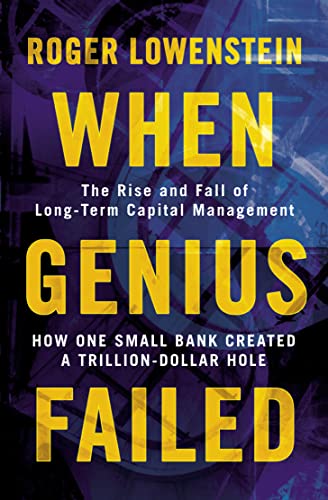
Founded by John Meriweather, a notoriously confident bond dealer, along with two Nobel prize winners and a floor of Wall Street's brightest and best, long-term capital management was from the beginning hailed as a new gold standard in investing. It was to be the hedge fund to end all other hedge funds: a discreet private investment club limited to those rich enough to pony up millions. It became the banks' own favourite fund and from its inception achieved a run of dizzyingly spectacular returns. New investors barged each other aside to get their investment money into LTCM's hands. But as competitors began to mimic Meriweather's fund, he altered strategy to maintain the fund's performance, leveraging capital with credit on a scale not fully understood and never seen before. When the markets in Indonesia, South America and Russia crashed in 1998 LCTM's investments crashed with them and mountainous debts accumulated. The fund was in melt-down, and threatening to bring down into its trillion-dollar black hole a host of financial institutions from New York to Switzerland. It is a tale of vivid characters, overwheening ambition and perilous drama told, in Roger Lowenstein's hands, with style and panache.
Die Inhaltsangabe kann sich auf eine andere Ausgabe dieses Titels beziehen.
Über die Autorin bzw. den Autor
Roger Lowenstein has reported for the Wall Street Journalfor more than a decade and is a frequent contributor to the New York Times and The New Republic. He is the author of Buffet: the Making of an American Capitalist.
Auszug. © Genehmigter Nachdruck. Alle Rechte vorbehalten.
INTRODUCTION
William J. McDonough, the beefy president of the New York Fed, talks to bankers and traders often. McDonough wants to be kept abreast of the gossip that traders share with one another. He especially wants to hear about anything that might upset markets or, in the extreme, the financial system. But McDonough tries to stay in the background. The Fed has always been a controversial regulator - a servant of the people that is elbow to elbow with Wall Street, a cloistered agency amid the democratic chaos of markets. For McDonough to intervene, even in a small way, would take a crisis, perhaps a war. And in the first days of the autumn of 1998, McDonough did intervene - and not in a small way.
The source of the trouble seemed so small, so laughably remote, as to be insignificant. But isn't it always that way? A load of tea is dumped into a harbor, an archduke is shot, and suddenly a tinderbox is lit, a crisis erupts, and the world is different. In this case, the shot was Long-Term Capital Management, a private investment partnership with its headquarters in Greenwich, Connecticut, a posh suburb some forty miles from Wall Street. LTCM managed money for only one hundred investors; it employed not quite two hundred people, and surely not one American in a hundred had ever heard of it. Indeed, five years earlier, LTCM had not even existed.
But on the Wednesday afternoon of September 23, 1998, Long-Term did not seem small. On account of a crisis at LTCM, McDonough had summoned - "invited," in the Fed's restrained idiom - the heads of every major Wall Street bank. For the first time, the chiefs of Bankers Trust, Bear Stearns, Chase Manhattan, Goldman Sachs, J.JP. Morgan, Lehman Brothers, Merrill Lynch, Morgan Stanley Dean Witter, and Salomon Smith Barney gathered under the oil portraits in the Fed's tenth-floor boardroom - not to bail out a Latin American nation but to consider a rescue of one of their own. The chairman of the New York Stock Exchange joined them, as did representatives from major European banks. Unaccustomed to hosting such a large gathering, the Fed did not have enough leather-backed chairs to go around, so the chief executives had to squeeze into folding metal seats.
Although McDonough was a public official, the meeting was secret. As far as the public knew, America was in the salad days of one of history's great bull markets, although recently, as in many previous autumns, it had seen some backsliding. Since mid-August, when Russia had defaulted on its ruble debt, the global bond markets in particular had been highly unsettled. But that wasn't why McDonough had called the bankers. Long-Term, a bond-trading firm, was on the brink of failing. The fund was run by John W. Meriwether, formerly a well-known trader at Salomon Brothers. Meriwether, a congenial though cautious midwesterner, had been popular among the bankers. It was because of him, mainly, that the bankers had agreed to give financing to Long-Term - and had agreed on highly generous terms. But Meriwether was only the public face of Long-Term. The heart of the fund was a group of brainy, Ph.D.-certified arbitrageurs. Many of them had been professors. Two had won the Nobel Prize. All of them were very smart. And they knew they were very smart.
This one obscure arbitrage fund had amassed an amazing $100 billion in assets, virtually all of it borrowed - borrowed, that is, from the bankers at McDonough's table. As monstrous as this indebtedness was, it was by no means the worst of Long-TermUs problems. The fund had entered into thousands of derivative contracts, which had endlessly intertwined it with every bank on Wall Street. These contracts, essentially side bets on market prices, covered an astronomical sum - more than $1 trillion worth of exposure.
If Long-Term defaulted, all of the banks in the room would be left holding one side of a contract for which the other side no longer existed. In other words, they would be exposed to tremendous - and untenable - risks. Undoubtedly, there would be a frenzy as every bank rushed to escape its now one-sided obligations and tried to sell its collateral from Long-Term.
Panics are as old as markets, but derivatives were relatively new. Regulators had worried about the potential risks of these inventive new securities, which linked the country's financial institutions in a complex chain of reciprocal obligations. Officials had wondered what would happen if one big link in the chain should fail. McDonough feared that the markets would stop working; that trading would cease; that the system itself would come crashing down.
James Cayne, the cigar-chomping chief executive of Bear Stearns, had been vowing that he would stop clearing Long-Term's trades - which would put it out of business - if the fund's available cash fell below $500 million. At the start of the year, that would have seemed remote, for Long-Term's capital had been $4.7 billion. But during the past five weeks, or since Russia's default, Long-Term had suffered numbing losses - day after day after day. Its capital was down to the minimum. Cayne didn't think it would survive another day.
The fund had already asked Warren Buffett for money. It had gone to George Soros. It had gone to Merrill Lynch. One by one, it had asked every bank it could think of. Now it had no place left to go. That was why, like a godfather summoning rival and potentially warring families, McDonough had invited the bankers. If each one moved to unload bonds individually, the result could be a worldwide panic. If they acted in concert, perhaps a catastrophe could be avoided. Although McDonough didn't say so, he wanted the banks to invest $4 billion and rescue the fund. He wanted them to do it right then - tomorrow would be too late.
„Über diesen Titel“ kann sich auf eine andere Ausgabe dieses Titels beziehen.
Suchergebnisse für When Genius Failed: The Rise and Fall of Lang-Term...

Beispielbild für diese ISBN
When Genius Failed: The Rise and Fall of Long Term Capital Management
Anbieter: AwesomeBooks, Wallingford, Vereinigtes Königreich
Verkäuferbewertung 5 von 5 Sternen

Hardcover. Zustand: Very Good. When Genius Failed: The Rise and Fall of Long Term Capital Management This book is in very good condition and will be shipped within 24 hours of ordering. The cover may have some limited signs of wear but the pages are clean, intact and the spine remains undamaged. This book has clearly been well maintained and looked after thus far. Money back guarantee if you are not satisfied. See all our books here, order more than 1 book and get discounted shipping. Bestandsnummer des Verkäufers 7719-9781841155036
Gebraucht kaufen
EUR 4,82
EUR 4,85 Versand
Versand von Vereinigtes Königreich nach USA
Versand von Vereinigtes Königreich nach USA
Anzahl: 2 verfügbar
Beispielbild für diese ISBN
When Genius Failed : The Rise and Fall of Long-Term Capital Management
Verlag:
HarperCollins Publishers Limited, 2000
ISBN 10: 1841155039
ISBN 13: 9781841155036
Gebraucht
Hardcover
Anbieter: Better World Books Ltd, Dunfermline, Vereinigtes Königreich
Verkäuferbewertung 5 von 5 Sternen
Zustand: Good. Pages intact with minimal writing/highlighting. The binding may be loose and creased. Dust jackets/supplements are not included. Stock photo provided. Product includes identifying sticker. Better World Books: Buy Books. Do Good. Bestandsnummer des Verkäufers 8645931-6
Gebraucht kaufen
EUR 5,70
EUR 5,88 Versand
Versand von Vereinigtes Königreich nach USA
Versand von Vereinigtes Königreich nach USA
Anzahl: 1 verfügbar
Beispielbild für diese ISBN
When Genius Failed : The Rise and Fall of Long-Term Capital Management
Verlag:
HarperCollins Publishers Limited, 2000
ISBN 10: 1841155039
ISBN 13: 9781841155036
Gebraucht
Hardcover
Anbieter: Better World Books Ltd, Dunfermline, Vereinigtes Königreich
Verkäuferbewertung 5 von 5 Sternen
Zustand: Good. Former library copy. Pages intact with minimal writing/highlighting. The binding may be loose and creased. Dust jackets/supplements are not included. Includes library markings. Stock photo provided. Product includes identifying sticker. Better World Books: Buy Books. Do Good. Bestandsnummer des Verkäufers 7815516-6
Gebraucht kaufen
EUR 5,70
EUR 5,88 Versand
Versand von Vereinigtes Königreich nach USA
Versand von Vereinigtes Königreich nach USA
Anzahl: 1 verfügbar
Beispielbild für diese ISBN
When Genius Failed: The Rise and Fall of Long Term Capital Management
Anbieter: Bahamut Media, Reading, Vereinigtes Königreich
Verkäuferbewertung 4 von 5 Sternen

Hardcover. Zustand: Very Good. This book is in very good condition and will be shipped within 24 hours of ordering. The cover may have some limited signs of wear but the pages are clean, intact and the spine remains undamaged. This book has clearly been well maintained and looked after thus far. Money back guarantee if you are not satisfied. See all our books here, order more than 1 book and get discounted shipping. Bestandsnummer des Verkäufers 6545-9781841155036
Gebraucht kaufen
EUR 5,19
EUR 8,21 Versand
Versand von Vereinigtes Königreich nach USA
Versand von Vereinigtes Königreich nach USA
Anzahl: 2 verfügbar
Beispielbild für diese ISBN
WHEN GENIUS FAILED
Anbieter: HPB-Diamond, Dallas, TX, USA
Verkäuferbewertung 5 von 5 Sternen
hardcover. Zustand: Very Good. Connecting readers with great books since 1972! Used books may not include companion materials, and may have some shelf wear or limited writing. We ship orders daily and Customer Service is our top priority! Bestandsnummer des Verkäufers S_485638293
Gebraucht kaufen
EUR 14,98
EUR 3,33 Versand
Versand innerhalb von USA
Versand innerhalb von USA
Anzahl: 1 verfügbar