
Verwandte Artikel zu Declarations of Independence: American Cinema and the...
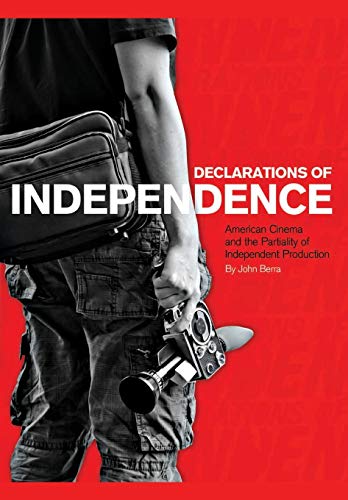
Declarations of Independence: American Cinema and the Partiality of Independent Production - Softcover
Inhaltsangabe
American independent cinema has gained mainstream popularity in recent years as audiences tire of the bloated, clichéd spectacle of Hollywood films. But how independent are these movies? As John Berra contends in Declarations of Independence, the supposedly alternative film scene employs the same production techniques as its Hollywood counterparts and may find an uncritical audience in fans looking to attach personal sentiments and social reference points to art forms. This provocative volume questions the autonomy of independent film, asking if it is possible for a unique filmic vision to thrive in an industry of mass production.
Die Inhaltsangabe kann sich auf eine andere Ausgabe dieses Titels beziehen.
Über die Autorin bzw. den Autor
John Berra is a lecturer in film and language studies at Renmin University of China. He is the author of Declarations of Independence: American Cinema and the Partiality of Independent Production and the editor of the first two volumes on American independent film in the Directory of World Cinema series.
Auszug. © Genehmigter Nachdruck. Alle Rechte vorbehalten.
Declarations of Independence
American Cinema and the Partiality of Independent Production
By John BerraIntellect Ltd
Copyright © 2008 Intellect Ltd
All rights reserved.
ISBN: 978-1-84150-185-7All rights reserved.
Contents
Acknowledgements,
Chapter One Genesis: Modern American Independent Cinema and its Position within an Industry of Mass Production,
Chapter Two Ancestry of Independence: Easy Rider and the Declaration of a New American Cinema,
Chapter Three The Art of the Possible: Hollywood Feature Film Production since 1970,
Chapter Four Oppositional Fantasies: The Economic Structure of American Independent Cinema and its Essential Lineaments,
Chapter Five Loyalty to the Rhetoric: Four American Film-makers and their Commitment to an Autonomous Mode of Cultural Production,
Chapter Six Graduating Class: American Independent Cinema as Finishing School,
Chapter Seven A Cultural Comparison: British Independent Cinema and its Relation to its American Counterpart,
Chapter Eight Selective Exhibition: The Sundance Film Festival and its Significance to the Independent Sector,
Chapter Nine The Business of Art: Miramax Films and the Cultivation of the Niche Market,
Chapter Ten The Reception of an Alternative Americana: Audiences and American Independent Cinema,
Bibliography,
Index,
CHAPTER 1
Genesis: Modern American Independent Cinema and its Position within an Industry of Mass Production
'Independent adj1 Free from influence or control of others. 2 not dependent on anything else for function or validity. 3 not relying on the support, esp. financial support, of others.'
'Cinema n1 A place designed for showing films. 2 the cinema the art or business of making films.'
It is debatable as to whether a genuine American 'independent cinema' exists in the new millennium, a debate which this study will enter into in due course. What is not debatable is that the term 'American independent cinema' not only exists, but carries with it a variety of meanings, associations, and expectations of both an artistic and commercial nature. A by-product of society's constant need to assign labels to, and invent categories for, all forms of cultural expression and enterprise, the term 'American independent cinema' has been used to describe both a mode of production, and a form a thinking, relating to the financing, filming, distribution and cultural appreciation of modern film. It is a term which is suggestive of the classic argument of the relationship between art and commerce, the patronage of the artist by the economically well-endowed sponsor, and yet also indicative of a thoroughly modern sense of artistic enterprise, as rapidly developing technology opens up a variety of opportunities for fledgling film-makers and ambitious entrepreneurs. The term 'American independent cinema' is also suggestive of a romantic vision of filmic productivity, alluding to work that exists within a great narrative tradition, yet is presented within the context of a modern art form, and has been created autonomously, without the interference of other parties. The question here is whether such a form of cultural production is sustainable. As Bourdieu dryly notes,
At a given level of autonomy, intellectuals are, other things being equal, proportionately more responsive to the seduction of the powers that be, the less well endowed they are with specific capital.
This is to say that, when art meets, or conflicts, with economy, the artist is more willing to compromise their ideals when faced with the lure of financial reward, or the overarching economic power of the corporate giants. Recent commentators such as Caves have argued that it is possible for autonomy and economy to co-exist:
The basic structural characteristics of creative industries – their technologies of production and consumption – fiercely resist governance by anything approaching a complete contrast. Yet they have evolved distinctive and serviceable contract forms that seem to differ from deal-making patterns prevalent in other sectors.
Caves is referring to the romantic ideal of the artist and sponsor, whose relationship is both mutually exclusive and beneficial and this is the root of the paradox that lies at the heart of film-making, and 'independent cinema' in particular. The main benefit of the motion picture is its status as a cultural product of mass consumption, but such cultural products can only be regarded as 'artistic' or 'independent' works if their creators are to be allowed absolute autonomy. In order for all the opportunities, particularly those of an economic nature, to be realized, compromises with regard to the autonomy of the artist, or director, may have to be enforced and endured. It is this tension between the needs or the artist and the demands of the market, and its most prominent suppliers, which will form the crux of this study.
1.1 The Aims and Objectives of the Study
(1) To disprove the popular assumption amongst commercial journalists and consumers of popular culture, that cinematic works that have been declared as, or critically assigned the status of, 'independent', are autonomous of corporate sponsorship, or influence from other forms of popular media. This study will systematically outline the theory that American 'independent' cinema is dependent on corporate sponsorship in the form of the Hollywood studios and this theory will be supported by economic and intertextual evidence, provided by references to specific feature films and how they have conformed to the system of mass production, in terms of their conception, technical construction, marketing, and distribution. In addition, this study will seek to place American 'independent' cinema within a theoretic framework to show its relation to, and dependence on, the corporate giants, before questioning if the nature of this relationship is actually one of co-dependency.
(2) To redefine what can be meant by the term 'modern American independent cinema' in the new millennium, through a discussion of its moral economy, methods of production and distribution, and the qualities of the films themselves. While the status of many films as being 'independent' from an economic standpoint may be found to be impossible to substantiate due to their ties with the corporate giants, it will be of interest to attach such films to moments of popular feeling and periods of industrial change, thereby setting them apart from the more commercial cinematic offerings that are popularly associated with the Hollywood production line. This will be an analysis of what has become known as the 'independent spirit', a description that has recently been applied to film-makers who are considered to be true to their own cinematic visions, whilst also seeking sponsorship from corporate organizations.
(3) To establish whether creative autonomy can actually exist within the system of mass production. This will entail an analysis of Hollywood's absorption of the 'independent' sector through reference to film-makers, the qualities of their work, the conditions under which it is created, and how it has been received by the audience.
1.2 The Social-Economic Background of the Study
Although the economics of feature film production and of mass entertainment in general, have previously been discussed in detail in an academic context, the industry sector that is American 'independent' cinema has been generally overlooked by scholars who have...
„Über diesen Titel“ kann sich auf eine andere Ausgabe dieses Titels beziehen.
Suchergebnisse für Declarations of Independence: American Cinema and the...

Beispielbild für diese ISBN
Declarations of Independence American Cinema and the Partiality of Independent Production
Anbieter: Daedalus Books, Portland, OR, USA
Verkäuferbewertung 4 von 5 Sternen

Paperback. Zustand: Fine. A bright, clean copy. ; 0.55 x 8.98 x 6.77 Inches; 224 pages. Bestandsnummer des Verkäufers 199190
Gebraucht kaufen
EUR 9,36
EUR 5,71 Versand
Versand innerhalb von USA
Versand innerhalb von USA
Anzahl: 1 verfügbar
Beispielbild für diese ISBN
Declarations of Independence: American Cinema and the Partiality of Independent Production
Anbieter: Powell's Bookstores Chicago, ABAA, Chicago, IL, USA
Verkäuferbewertung 5 von 5 Sternen

paperback. Zustand: Used-Like New. Clean copy. May have remainder mark. Bestandsnummer des Verkäufers 2038470
Gebraucht kaufen
EUR 11,75
EUR 4,39 Versand
Versand innerhalb von USA
Versand innerhalb von USA
Anzahl: 3 verfügbar
Beispielbild für diese ISBN
Declarations of Independence American Cinema and the Partiality of Independent Production
Anbieter: Daedalus Books, Portland, OR, USA
Verkäuferbewertung 4 von 5 Sternen
Paperback. Zustand: Fine. A bright, clean copy. ; 0.55 x 8.98 x 6.77 Inches; 224 pages. Bestandsnummer des Verkäufers 202264
Gebraucht kaufen
EUR 12,17
EUR 5,71 Versand
Versand innerhalb von USA
Versand innerhalb von USA
Anzahl: 1 verfügbar
Beispielbild für diese ISBN
Declarations of Independence : American Cinema and the Partiality of Independent Production
Anbieter: Better World Books Ltd, Dunfermline, Vereinigtes Königreich
Verkäuferbewertung 5 von 5 Sternen
Zustand: Good. Former library copy. Pages intact with minimal writing/highlighting. The binding may be loose and creased. Dust jackets/supplements are not included. Includes library markings. Stock photo provided. Product includes identifying sticker. Better World Books: Buy Books. Do Good. Bestandsnummer des Verkäufers GRP82534411
Gebraucht kaufen
EUR 14,92
EUR 5,81 Versand
Versand von Vereinigtes Königreich nach USA
Versand von Vereinigtes Königreich nach USA
Anzahl: 2 verfügbar
Foto des Verkäufers
Declarations of Independence : American Cinema and the Partiality of Independent Production
Anbieter: GreatBookPrices, Columbia, MD, USA
Verkäuferbewertung 5 von 5 Sternen
Zustand: New. Bestandsnummer des Verkäufers 5429436-n
Neu kaufen
EUR 36,81
EUR 2,32 Versand
Versand innerhalb von USA
Versand innerhalb von USA
Anzahl: Mehr als 20 verfügbar
Foto des Verkäufers
Declarations of Independence
Anbieter: Rarewaves.com USA, London, LONDO, Vereinigtes Königreich
Verkäuferbewertung 5 von 5 Sternen
Paperback. Zustand: New. American independent cinema has been an important creative and cultural media entity for the past fifteen years. The approach of this sector is one of cultural construction that simultaneously provides a socio-political reference through which critics and audience can attach certain films to popular movements and ideas. Declarations of Independence questions the supposed autonomy of this cinema and asks if independent film can possibly survive in the face of the mass-production and profit of Hollywood. Berra's text presents the reader with a unique structural approach to the subject matter with his arguments mirroring the actual film production process. He gives detailed insight into the core product with reference to specific films and studies of audiences and their enthusiasm for this type of alternative media. American Independent cinema continues to grow as a fashionable scene and Declarations of Independence analyses its popularity, economic viability and the production process of so-called 'niche' cinema. Berra uses directors such as Quentin Tarantino and Steven Soderberg as examples of those who have crossed successfully into the cultural mainstream, altering media and public perception. This comprehensive book is a useful resource for scholars as it gives an overview of the industry from conception of a film right though to festival exposure and public consumption. Berra also presents a strong academic argument and places the discussion of this increasingly popular genre within a wider socio-political context. Bestandsnummer des Verkäufers LU-9781841501857
Neu kaufen
EUR 39,21
Versand gratis
Versand von Vereinigtes Königreich nach USA
Versand von Vereinigtes Königreich nach USA
Anzahl: 7 verfügbar
Beispielbild für diese ISBN
Declarations of Independence
Anbieter: PBShop.store UK, Fairford, GLOS, Vereinigtes Königreich
Verkäuferbewertung 5 von 5 Sternen
PAP. Zustand: New. New Book. Shipped from UK. Established seller since 2000. Bestandsnummer des Verkäufers CX-9781841501857
Neu kaufen
EUR 35,49
EUR 4,84 Versand
Versand von Vereinigtes Königreich nach USA
Versand von Vereinigtes Königreich nach USA
Anzahl: 15 verfügbar
Beispielbild für diese ISBN
Declarations of Independence
Anbieter: PBShop.store US, Wood Dale, IL, USA
Verkäuferbewertung 5 von 5 Sternen
PAP. Zustand: New. New Book. Shipped from UK. Established seller since 2000. Bestandsnummer des Verkäufers CX-9781841501857
Foto des Verkäufers
Declarations of Independence : American Cinema and the Partiality of Independent Production
Anbieter: GreatBookPrices, Columbia, MD, USA
Verkäuferbewertung 5 von 5 Sternen
Zustand: As New. Unread book in perfect condition. Bestandsnummer des Verkäufers 5429436
Gebraucht kaufen
EUR 41,93
EUR 2,32 Versand
Versand innerhalb von USA
Versand innerhalb von USA
Anzahl: Mehr als 20 verfügbar
Beispielbild für diese ISBN
Declarations of Independence (Paperback)
Anbieter: Grand Eagle Retail, Bensenville, IL, USA
Verkäuferbewertung 5 von 5 Sternen
Paperback. Zustand: new. Paperback. American independent cinema has gained mainstream popularity in recent years as audiences tire of the bloated, cliched spectacle of Hollywood films. But how independent are these movies? As John Berra contends in Declarations of Independence, the supposedly alternative film scene employs the same production techniques as its Hollywood counterparts and may find an uncritical audience in fans looking to attach personal sentiments and social reference points to art forms. This provocative volume questions the autonomy of independent film, asking if it is possible for a unique filmic vision to thrive in an industry of mass production. "American Independent" cinema has been an important creative and cultural media entity for the past fifteen years. This title questions the supposed autonomy of this cinema and asks if independent film can possibly survive in the face of the mass-production and profit of Hollywood. Shipping may be from multiple locations in the US or from the UK, depending on stock availability. Bestandsnummer des Verkäufers 9781841501857