
Verwandte Artikel zu Creativity in the Classroom: Case Studies in Using...
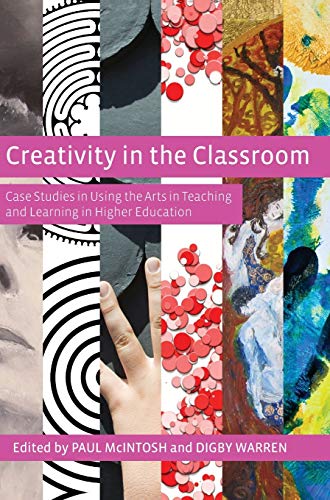
Creativity in the Classroom: Case Studies in Using the Arts in Teaching and Learning in Higher Education - Hardcover
Inhaltsangabe
This volume contests the current higher educational paradigm of using objectives and outcomes as ways to measure learning. Instead, the contributors propose approaches to learning that draw upon the creative arts and humanities, including cinema, literature, dance, drama and visual art.
Die Inhaltsangabe kann sich auf eine andere Ausgabe dieses Titels beziehen.
Über die Autorin bzw. den Autor
Paul McIntosh is a research fellow in the Centre for Medical Education at Queen Mary University London.Digby Warren is a university learning and teaching coordinator and program leader for the master’s program in learning and teaching in higher education at London Metropolitan University.
Auszug. © Genehmigter Nachdruck. Alle Rechte vorbehalten.
Creativity in the Classroom
Case Studies in Using the Arts in Teaching and Learning in Higher Education
By Paul McIntosh, Digby WarrenIntellect Ltd
Copyright © 2013 Intellect Ltd
All rights reserved.
ISBN: 978-1-84150-516-9All rights reserved.
Contents
Apologies for absence,
Acknowledgements,
Introduction: The Current Educational Climate: Why the Creative Arts and Humanities are so Important to Creativity and Learning in the Classroom Paul McIntosh,
PART I: Encouraging Creativity in the Classroom,
Chapter 1: Using the Creative Arts for Collaboration Babs Anderson and Jo Albin-Clark,
Chapter 2: Introducing Arts-based Inquiry into Medical Education: 'Exploring the Creative Arts in Health and Illness' Louise Younie,
PART II: Using Performance,
Chapter 3: Using Cinema to Enhance the Relevance of Economics to Students' Lives Gherardo Girardi,
Chapter 4: Fascinatin' Rhythm: Tapping into Themes of Leadership and Management by Making Music Dave Griffiths,
Chapter 5: A Dramatic Approach to Teaching Applied Ethics Craig Duckworth,
PART III: Using Poetry,
Chapter 6: Using Poetry to Create Conditions for Dialogue in a Postgraduate Course on Managing Diversity Christina Schwabenland,
Chapter 7: Teaching and Using Poetry in Healthcare Clare Hopkinson,
Chapter 8: Gaining a Wider Perspective on Life in Medical Education Mark Rickenbach,
PART IV: Using Imagery,
Chapter 9: Beyond Words: Surfacing Self in End-of-life Care Using Image-making Sue Spencer,
Chapter 10: Fashion Students Engaging in Iconic Designs in a Business World Ruth Marciniak, Debbie Holley and Caroline Dobson-Davies,
Chapter 11: Storytelling and Cycles of Development Karen Stuart,
Chapter 12: Developing Refl ective Learning Journals Audrey Beaumont,
Chapter 13: The Overlooked: Landscapes, Artistry and Teaching Paul Key,
Chapter 14: Mirror Mirror: Experiential Workshops Exploring 'Self' in Social Work Education and Practice Debbie Amas, Judy Hicks and Roxanna Anghel,
Chapter 15: The Labyrinth: A Journey of Discovery Jan Sellers,
PART V: Learning Technologies and Assessment,
Chapter 16: Alternatives to the Essay: Creative Ways of Presenting Work for Assessment Emma Bond and Jessica Clark,
Chapter 17: Creativity-mediated Training, Social Networks and Practitioner Enquiry in Higher Education Jouaquin Paredes, Agustin De La Herran and Daniel Velazquez,
Conclusion: Arts-based Inquiry as Learning in Higher Education: Purposes, Processes and Responses Digby Warren,
Index,
CHAPTER 1
Using the Creative Arts for Collaboration
Babs Anderson
(Liverpool Hope University)
Jo Albin-Clark
(Edge Hill University)
Introduction
The academic study of the Early Years of Childhood, from birth to eight years of age, encompasses a diverse learning community with a wide range of students, from foundation degree students, who may have significant practical experience and training yet few formal academic qualifications, to Early Childhood Studies students, who may have little or no experience of caring for young children at the beginning of their undergraduate course at university.
The content of Early Childhood (and Early Years) courses include aspects of academic disciplines such as history, philosophy, psychology and sociology in addition to applied areas, such as leadership and management, with an Early Years focus. The concept of critical pedagogy utilizing interdisciplinary spaces, while promoting the strengths of each component discipline (McArthur 2010), is one that rests easily within the subject area, focusing on emancipatory ideals in advancing social recognition of the value of studying Early Childhood so that any perceived lack of status of not only the subject area itself but also those who work within its remit can be addressed. Harvey and Norman (2007) suggest that university assessment procedures need to recognize learning within the workplace as valid, and this would appear to benefit the links between theory and its application in practice.
However, structuring courses at university around intended learning outcomes set by the teaching team or tutor, such as advocated by Biggs and Tang (2007), may not provide for the students' engagement with their own learning, incorporating their own ideas of what they would need and wish to know, as the learning outcomes for their course of study have been predetermined and transmitted as such explicitly to them. Additionally Blackmore (2009) examines the need for a more complex investigation into what constitutes valued knowledge in student-lecturer learning interactions rather than a simple reliance on student evaluations as unilateral sources of participant perspectives.
Hockings (2009) suggests that for a small but significant number of students, student-centred learning is ineffective, and one example of this is that when students are overwhelmed by competing claims on their time and energy they actively seek surface-level learning approaches in order to reduce their stressors. She argues further that to increase the educational potential for these students, the 'teacher' needs to have a clearer perspective on the historical sociocultural backgrounds of the students, recognizing the variance of experience, beliefs, attitudes and sense of identity within the student population.
Recognition of the teacher's expertise as a negotiator of a projected learning journey initiated by the interests of the learner has long been a cornerstone of Early Childhood pedagogy, both in this country and internationally (Waller 2009; Rodd 2006), and it would appear that there is much to learn in teaching and learning in Higher Education in the creation of independent autonomous and self-directed learners, following a pedagogy based on experiential learning, like that we employ for our youngest children.
The influence of the Reggio Emilia approach
As part of the teaching, training and professional development of Early Childhood teachers and practitioners, core aspects of many modules offered in our institutions include the influence of international approaches. The educational approach of the city of Reggio Emilia in Northern Italy is world renowned and referred to in almost reverential tones in the world of Early Childhood education. We wished to explore aspects of this approach that might be compatible with our own contexts, recognizing also that it is not replicable outside of its origins.
As Early Childhood lecturers and teachers, it was a rite of passage for us to travel to Reggio Emilia on an international study week in 2010 and understand first-hand its pedagogy and practice. Our wish was to engage in reflective dialogue and reflexive action to understand how our own thinking could be deepened and challenged. The aim was to consider how our work as lecturers could be enriched and perhaps transformed. 'Our job is to learn why we are teachers' (Rinaldi 2006: 139). We were intrigued as to how we could use this experience to extend and deepen the quality of our work with our diverse groups of students.
It is important, however, to set this approach in its historical sociocultural context in order to fully appreciate the origins and development of the Reggio Emilia approach to Early Childhood education and care. Reggio Emilia is historically a wealthy region, and after the devastation of the Second World War, a group of parents decided that they wanted to build a school within the community that was significantly...
„Über diesen Titel“ kann sich auf eine andere Ausgabe dieses Titels beziehen.
Suchergebnisse für Creativity in the Classroom: Case Studies in Using...

Beispielbild für diese ISBN
Creativity in the Classroom: Case Studies in Using the Arts in Teaching and Learning in Higher Education
Anbieter: Smith Family Bookstore Downtown, Eugene, OR, USA
Verkäuferbewertung 4 von 5 Sternen

Hardcover. Zustand: Very Good. text clean and unmarked. binding tight. boards have very light wear. fore-edge, head and foot of book are clean. Bestandsnummer des Verkäufers 5010121
Gebraucht kaufen
EUR 22,99
EUR 5,31 Versand
Versand innerhalb von USA
Versand innerhalb von USA
Anzahl: 1 verfügbar
Beispielbild für diese ISBN
Creativity in the Classroom
Anbieter: PBShop.store UK, Fairford, GLOS, Vereinigtes Königreich
Verkäuferbewertung 5 von 5 Sternen

HRD. Zustand: New. New Book. Shipped from UK. Established seller since 2000. Bestandsnummer des Verkäufers CX-9781841505169
Neu kaufen
EUR 61,72
EUR 9,03 Versand
Versand von Vereinigtes Königreich nach USA
Versand von Vereinigtes Königreich nach USA
Anzahl: 15 verfügbar
Foto des Verkäufers
Creativity in the Classroom : Case Studies in Using the Arts in Teaching and Learning in Higher Education
Anbieter: GreatBookPrices, Columbia, MD, USA
Verkäuferbewertung 5 von 5 Sternen
Zustand: New. Bestandsnummer des Verkäufers 18571224-n
Neu kaufen
EUR 70,18
EUR 2,36 Versand
Versand innerhalb von USA
Versand innerhalb von USA
Anzahl: 2 verfügbar
Beispielbild für diese ISBN
Creativity in the Classroom
Anbieter: PBShop.store US, Wood Dale, IL, USA
Verkäuferbewertung 5 von 5 Sternen
HRD. Zustand: New. New Book. Shipped from UK. Established seller since 2000. Bestandsnummer des Verkäufers CX-9781841505169
Foto des Verkäufers
Creativity in the Classroom : Case Studies in Using the Arts in Teaching and Learning in Higher Education
Anbieter: GreatBookPrices, Columbia, MD, USA
Verkäuferbewertung 5 von 5 Sternen
Zustand: As New. Unread book in perfect condition. Bestandsnummer des Verkäufers 18571224
Gebraucht kaufen
EUR 78,14
EUR 2,36 Versand
Versand innerhalb von USA
Versand innerhalb von USA
Anzahl: 2 verfügbar
Beispielbild für diese ISBN
Creativity in the Classroom: Case Studies in Using the Arts in Teaching and Learning in Higher Education
Anbieter: Ria Christie Collections, Uxbridge, Vereinigtes Königreich
Verkäuferbewertung 5 von 5 Sternen
Zustand: New. In English. Bestandsnummer des Verkäufers ria9781841505169_new
Neu kaufen
EUR 79,16
EUR 13,36 Versand
Versand von Vereinigtes Königreich nach USA
Versand von Vereinigtes Königreich nach USA
Anzahl: Mehr als 20 verfügbar
Foto des Verkäufers
Creativity in the Classroom : Case Studies in Using the Arts in Teaching and Learning in Higher Education
Anbieter: GreatBookPricesUK, Woodford Green, Vereinigtes Königreich
Verkäuferbewertung 5 von 5 Sternen
Zustand: New. Bestandsnummer des Verkäufers 18571224-n
Neu kaufen
EUR 75,59
EUR 17,75 Versand
Versand von Vereinigtes Königreich nach USA
Versand von Vereinigtes Königreich nach USA
Anzahl: 2 verfügbar
Foto des Verkäufers
Creativity in the Classroom : Case Studies in Using the Arts in Teaching and Learning in Higher Education
Anbieter: GreatBookPricesUK, Woodford Green, Vereinigtes Königreich
Verkäuferbewertung 5 von 5 Sternen
Zustand: As New. Unread book in perfect condition. Bestandsnummer des Verkäufers 18571224
Gebraucht kaufen
EUR 78,98
EUR 17,75 Versand
Versand von Vereinigtes Königreich nach USA
Versand von Vereinigtes Königreich nach USA
Anzahl: 2 verfügbar
Beispielbild für diese ISBN
Creativity In The Classroom
Print-on-DemandAnbieter: Biblios, Frankfurt am main, HESSE, Deutschland
Verkäuferbewertung 4 von 5 Sternen
Zustand: New. PRINT ON DEMAND pp. 284. Bestandsnummer des Verkäufers 1850528927
Neu kaufen
EUR 102,17
EUR 9,95 Versand
Versand von Deutschland nach USA
Versand von Deutschland nach USA
Anzahl: 4 verfügbar
Beispielbild für diese ISBN
Creativity In The Classroom
Print-on-DemandAnbieter: Majestic Books, Hounslow, Vereinigtes Königreich
Verkäuferbewertung 4 von 5 Sternen
Zustand: New. Print on Demand pp. 284. Bestandsnummer des Verkäufers 57982282
Neu kaufen
EUR 104,58
EUR 7,69 Versand
Versand von Vereinigtes Königreich nach USA
Versand von Vereinigtes Königreich nach USA
Anzahl: 4 verfügbar