
Verwandte Artikel zu Refugee Performance: Practical Encounters
Inhaltsangabe
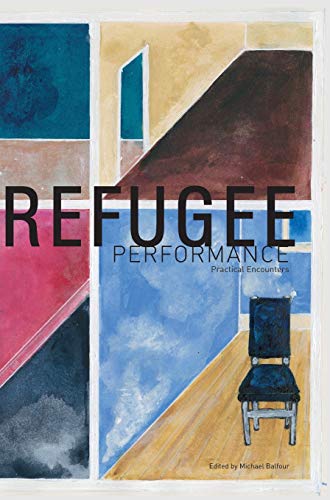
Exploring theatre works created for, by, and with refugees, this collection of essays combines newly commissioned scholarly work with examples of writing by refugees. These varied contributions illuminate performances that range from theatre in Thai refugee camps to site-specific works staged in a run-down immigrant community in the United Kingdom.
Die Inhaltsangabe kann sich auf eine andere Ausgabe dieses Titels beziehen.
Über die Autorin bzw. den Autor
Michael Balfour is chair of the Centre for the Arts in Development Communication. His previous books include Performance: In Place of War and Drama as Social Intervention.
Auszug. © Genehmigter Nachdruck. Alle Rechte vorbehalten.
Refugee Performance
Practical Encounters
By Michael BalfourIntellect Ltd
Copyright © 2013 Intellect Ltd
All rights reserved.
ISBN: 978-1-84150-637-1All rights reserved.
Contents
Acknowledgements,
Permissions,
Illustrations,
Author Biographies,
Preface,
Chapter 1: Iraqi Memories. A Personal and Poetic Exploration of Homecomings, Departures and Arrivals from a Theatre Director Who Fled Iraq in 1987 and Returns Home Again Niz Jabour,
Chapter 2: On Stitches Michael Balfour and Nina Woodrow,
Chapter 3: Health Theatre in a Hmong Refugee Camp: Performance, Communication, and Culture Dwight Conquergood,
Chapter 4: Play Extract: Forged in Fire A performance text created by Okello Kelo Sam, Laura Edmondson, and Robert Ajwang',
Chapter 5: Narrative Theatre as an Interactive Community Approach to Mobilizing Collective Action in Northern Uganda Yvonne Sliep, Kaethe Weingarten, and Andrew Gilbert,
Chapter 6: Marketing Trauma and the Theatre of War in Northern Uganda Laura Edmondson,
Chapter 7: Encounters in the Aida Refugee Camp in Palestine: Travel Notes on Attending Alrowwad Theatre's Production of Handala (2011) Rand T. Hazou,
Chapter 8: Rape as War Strategy: A Drama from Croatia Sanja Nikcevic,
Chapter 9: Far Away, So Close: Psychosocial and Theatre Activities with Serbian Refugees Guglielmo Schininà,
Chapter 10: Play Extract: Refugees Zlatko Topcic (Translated into English by Davor Diklic),
Chapter 11: 'Politics Begins as Ethics': Levinasian Ethics and Australian Performance Concerning Refugees Tom Burvill,
Chapter 12: Refugee Performance: Encounters with Alterity Michael Balfour,
Chapter 13: Repeat Performance: Dancing DiDinga with the Lost Boys of Southern Sudan Felecia Faye McMahon,
Chapter 14: Theatre as a Healing Space: Ping Chong's Children of War Yuko Kurahashi,
Chapter 15: Drama and Citizenship Education: Tensions of Creativity, Content and Cash Sarah Woodland and Rob Lachowicz,
Chapter 16: Inclusive Democracy: A Consideration of Playback Theatre with Refugee and Asylum Seekers in Australia Rea Dennis,
Chapter 17: Hospitable Stages and Civil Listening: Being an Audience for Participatory Refugee Theatre Alison Jeffers,
Index,
CHAPTER 1
Iraqi Memories. A Personal and Poetic Exploration of Homecomings, Departures and Arrivals from a Theatre Director Who Fled Iraq in 1987 and Returns Home Again
Niz Jabour
Prelude
I use the word dreamatic(not dramatic), because dreams in language are my only hope to reach out for the understanding with which to develop creative narratives in time and place. This is a process that can be described thus: 'To take hold of our own existence, our own history, and make it into a dream that was there from the beginning when we were called into this space' (Pelias et al. 2008: 254, emphasis added).
The poet Omar Khayyam asks a question about time travel in our dreams, about the meaning behind (us) being born and why (we) come to live:
If my coming were up to me, I'd never be born
And if my going were of my accord, I'd go with scorn
Isn't it better in this world, so old and worn
Never to be born, neither stay, nor away be torn?
(Omar Khayyam, Rubaiyat)
In answer to the Persian poet, I found myself a refugee without any given options, and if I had known that I would become a refugee, I would have wished I had never been born.
Background
I was born in 1962 in a city called Najaf, which is the centre and holy place for Muslims of the Shia faith. It is a small town known as the home of the largest cemetery in Iraq and the shrine of Imam Ali Bin Abi Talib.
My unique position as an artist stems from my upbringing, education and training in arts (specifically in theatre) in Iraq, my subsequent lengthy and involved experiences in exile and my work with local and exiled multi-ethnic communities in Iraq, Pakistan and Australia (since 1998). I was a young child when the Ba'ath regime came to power and was a university student at the inception of Saddam Hussein's leadership in 1979. As an Iraqi artist, I studied theatre and directing for years, only to see any possibilities for a future disappear. I lived through the sacking of libraries and destruction of books, and I have witnessed it all again, with different targets, in more recent years on visits home since 2004.
I lived the multiple complexities of cultural identity during my journey as a refugee, crossing borders between Iraq, Iran, Pakistan and Australia.
The power of narrative
We narrate what we see and experience either in our inner reality or in our imagination. The power of narrative is the power of our voices to maintain memory in all forms and patterns. The re-telling of stories becomes a real option for making human voices heard through forms of conversation and performance. Words form stories that can store history. Words have power, and this is why, under tyranny and in dictatorship, specific words are officially banned and others suffer from self-censorship.
We participate in actions and we get involved in the outcome of events, whether we are or have been the oppressed or the oppressor, victim or witness, powerful or powerless. We engage in the processes that generate the re-telling of collective or individual memory.
We reconstruct frameworks of events, memories and imagination corresponding to historical and/or cultural frames in our memories. The reconsideration of history no longer remains a chronicle of the powerful but becomes an account of the voiceless (powerless), silent and dismissed voices of the people.
I like the attention Ricoeur pays to the role of mediation or mediator, where history is the mediator between memory and forgetting. I am, however, more interested in having artists – singers, painters, poets, mimes, actors, writers, directors, film-makers, musicians, dancers, composers, performers – stand as mediators between memory and remembrance. To give them the means to narration based on the experiences, imaginings and interpretations that may bring some light to their truth and sense of justice.
In Memory: an Anthology (Wood and Byatt 2008: 203) the poet Craig Raine wrote: 'Memory is like metaphor in its operation [...] I see almost every narrative, every performance as form of metaphor in which I encounter narrative in the structure of thematic designs through one's self.'
I agree with this, and find here an exposition of the interaction between the self and poetic and everyday languages as a means to further the exchanges between personal and historical narratives.
Personal memory and historical events in an everyday-life narrative
I invite you to visit The Rooms [of my story] with me. 'Room[s] of imagination, room[s] of memory' are metaphors to narrate stories within a poetic narrative in which 'the event itself operates as a lightning rod that allows us to see clearly for a brief moment.'
At home: 13 November 2008 – 8.17 a.m.
I am at home now. I am at home, in a circle of unfinished thoughts and doubts about the future. It is just a huge dust in Iraq all day and every time. Dust awaits and welcomes me, across the border, into the city and at home, like a monstrous salute for an absent return. It is enough to be alive. I have arrived in a country that is like a big prison, where concrete blocks prevent the eye from looking to the other side...
„Über diesen Titel“ kann sich auf eine andere Ausgabe dieses Titels beziehen.
Suchergebnisse für Refugee Performance: Practical Encounters

Beispielbild für diese ISBN
Refugee Performance: Practical Encounters
Anbieter: Midtown Scholar Bookstore, Harrisburg, PA, USA
Verkäuferbewertung 5 von 5 Sternen

Hardcover. Zustand: Good. Good - Bumped and creased book with tears to the extremities, but not affecting the text block, may have remainder mark or previous owner's name - GOOD Standard-sized. Bestandsnummer des Verkäufers M1841506370Z3
Gebraucht kaufen
EUR 24,42
EUR 5,17 Versand
Versand innerhalb von USA
Versand innerhalb von USA
Anzahl: 3 verfügbar
Beispielbild für diese ISBN
Refugee Performance: Practical Encounters
Anbieter: Midtown Scholar Bookstore, Harrisburg, PA, USA
Verkäuferbewertung 5 von 5 Sternen
Hardcover. Zustand: Acceptable. HARDCOVER Acceptable - This is a significantly damaged book. It should be considered a reading copy only. Please order this book only if you are interested in the content and not the condition. May be ex-library. Standard-sized. Bestandsnummer des Verkäufers M1841506370Z4
Gebraucht kaufen
EUR 24,64
EUR 5,17 Versand
Versand innerhalb von USA
Versand innerhalb von USA
Anzahl: 1 verfügbar
Beispielbild für diese ISBN
Refugee Performance : Practical Encounters
Anbieter: Better World Books Ltd, Dunfermline, Vereinigtes Königreich
Verkäuferbewertung 5 von 5 Sternen
Zustand: Very Good. Former library copy. Pages intact with possible writing/highlighting. Binding strong with minor wear. Dust jackets/supplements may not be included. Includes library markings. Stock photo provided. Product includes identifying sticker. Better World Books: Buy Books. Do Good. Bestandsnummer des Verkäufers 58177425-20
Gebraucht kaufen
EUR 28,64
EUR 5,82 Versand
Versand von Vereinigtes Königreich nach USA
Versand von Vereinigtes Königreich nach USA
Anzahl: 1 verfügbar
Beispielbild für diese ISBN
Refugee Performance: Practical Encounters
Verlag:
Intellect, Ltd., Bristol, 2013
ISBN 10: 1841506370
ISBN 13: 9781841506371
Gebraucht
Hardcover
Erstausgabe
Anbieter: Winged Monkey Books, Washington, DC, USA
Verkäuferbewertung 4 von 5 Sternen

First Edition. Hardcover, no jacket, very good with light wear. Book. Bestandsnummer des Verkäufers 022172
Gebraucht kaufen
EUR 31,04
EUR 4,31 Versand
Versand innerhalb von USA
Versand innerhalb von USA
Anzahl: 1 verfügbar
Beispielbild für diese ISBN
Refugee Performance
Anbieter: PBShop.store UK, Fairford, GLOS, Vereinigtes Königreich
Verkäuferbewertung 5 von 5 Sternen
HRD. Zustand: New. New Book. Shipped from UK. Established seller since 2000. Bestandsnummer des Verkäufers CX-9781841506371
Neu kaufen
EUR 60,69
EUR 6,83 Versand
Versand von Vereinigtes Königreich nach USA
Versand von Vereinigtes Königreich nach USA
Anzahl: 15 verfügbar
Foto des Verkäufers
Refugee Performance : Practical Encounters
Anbieter: GreatBookPrices, Columbia, MD, USA
Verkäuferbewertung 5 von 5 Sternen
Zustand: New. Bestandsnummer des Verkäufers 18482058-n
Neu kaufen
EUR 66,09
EUR 2,27 Versand
Versand innerhalb von USA
Versand innerhalb von USA
Anzahl: Mehr als 20 verfügbar
Beispielbild für diese ISBN
Refugee Performance
Anbieter: PBShop.store US, Wood Dale, IL, USA
Verkäuferbewertung 5 von 5 Sternen
HRD. Zustand: New. New Book. Shipped from UK. Established seller since 2000. Bestandsnummer des Verkäufers CX-9781841506371
Foto des Verkäufers
Refugee Performance : Practical Encounters
Anbieter: GreatBookPrices, Columbia, MD, USA
Verkäuferbewertung 5 von 5 Sternen
Zustand: As New. Unread book in perfect condition. Bestandsnummer des Verkäufers 18482058
Gebraucht kaufen
EUR 68,00
EUR 2,27 Versand
Versand innerhalb von USA
Versand innerhalb von USA
Anzahl: Mehr als 20 verfügbar
Beispielbild für diese ISBN
Refugee Performance: Practical Encounters
Anbieter: Chiron Media, Wallingford, Vereinigtes Königreich
Verkäuferbewertung 5 von 5 Sternen
Hardcover. Zustand: New. Bestandsnummer des Verkäufers 6666-NBN-9781841506371
Neu kaufen
EUR 59,06
EUR 18,03 Versand
Versand von Vereinigtes Königreich nach USA
Versand von Vereinigtes Königreich nach USA
Anzahl: Mehr als 20 verfügbar
Foto des Verkäufers
Refugee Performance : Practical Encounters
Anbieter: GreatBookPricesUK, Woodford Green, Vereinigtes Königreich
Verkäuferbewertung 5 von 5 Sternen
Zustand: New. Bestandsnummer des Verkäufers 18482058-n
Neu kaufen
EUR 60,68
EUR 17,46 Versand
Versand von Vereinigtes Königreich nach USA
Versand von Vereinigtes Königreich nach USA
Anzahl: Mehr als 20 verfügbar