
Verwandte Artikel zu Everyday Corruption and the State: Citizens and Public...
Inhaltsangabe
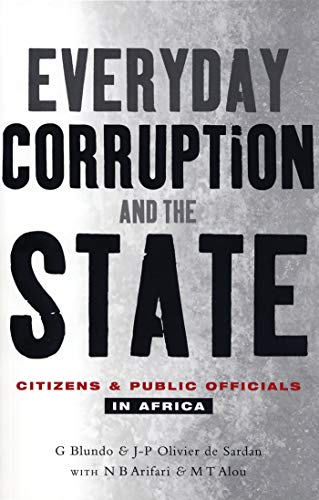
This detailed study of everyday corruption in three different African countries highlights its alarming prevalence. The authors analyze the various forms of corruption; the corrupt strategies public officials resort to; and how these forms and strategies have become embedded in the daily administrative practices of the state. The authors investigate the roots of the system, notably the growing inability of weakened states in Africa to reward their employees adequately or deliver the services on the scale expected of the state in the age of structural adjustment and collapsing commodity prices.
Die Inhaltsangabe kann sich auf eine andere Ausgabe dieses Titels beziehen.
Über die Autorin bzw. den Autor
Giorgio Blundo, Jean-Pierre Olivier de-Sardan, N. B. Arifari and M. T. Alou
Auszug. © Genehmigter Nachdruck. Alle Rechte vorbehalten.
Everyday Corruption and the State
Citizens and Public Officials in Africa
By Giorgio Blundo, Jean-Pierre Olivier de Sardan, N. Bako Arifari, M. Tidjani Alou, Susan CoxZed Books Ltd
Copyright © 2006 Giorgio Blundo and Jean-Pierre Olivier de Sardan
All rights reserved.
ISBN: 978-1-84277-563-9All rights reserved.
Contents
PART I Approach, Method, Summary,
1 Why should we study everyday corruption and how should we go about it? G. Blundo and J.-P. Olivier de Sardan, 3,
2 Corruption in Africa and the social sciences: a review of the literature Giorgio Blundo, 15,
3 Everyday corruption in West Africa G. Blundo and J.-P. Olivier de Sardan, 69,
4 The popular semiology of corruption G. Blundo and J.-P. Olivier de Sardan, 110,
PART II Sectoral Studies,
5 Corruption in the legal system Mahaman Tidjani Alou, 137,
6 'We don't eat the papers': corruption in transport, customs and the civil forces Nassirou Bako Arifari, 177,
7 An ordered corruption? The social world of public procurement Giorgio Blundo, 225,
Notes, 263,
Bibliography, 275,
Index, 291,
CHAPTER 1
Why should we study everyday corruption and how should we go about it?
G. Blundo and J.-P. Olivier de Sardan
This book is based on two years of field and documentary studies carried out in Benin, Niger and Senegal from 1999 to 2001. The subject of the research was petty everyday corruption, which is widespread and systemic throughout the public — that is, administrative and political — sphere in all three countries. The research focused on the following specific areas and sectors: transport and customs (in the three countries); the legal system (in the three countries); health (in Benin and Niger); public procurements (in Benin and Senegal); the local tax system (in Senegal); the way corruption is dealt with by the press (in the three countries); development-aid projects (based on the example of the scandal surrounding Italian-Senegalese development cooperation); and the policies adopted to fight corruption in the three countries.
The team consisted of six researchers of six different nationalities; we also availed of the services of fourteen research assistants who were trained by us in the field. The findings of our research were first collated and debated in the three countries concerned and were then presented in a report and a thematic issue of the journal Politique Africaine. This book, which is being published simultaneously in French and English, differs considerably from these publications in terms of both its structure and its content and incorporates new analyses and an extended and updated bibliography. It is the first detailed and systematic anthropological study to be carried out in a group of countries on the specific topic of everyday corruption in Africa.
Why study corruption?
The individual members of our research team already had extensive experience in carrying out research on topics involving the anthropology of development and political anthropology — that is, the decentralization of local powers, public health, development projects and the management of local resources — in the three countries involved in the study. The topics of corruption and administrative dysfunction continually arose in conversations and interviews with informants in the course of these studies. Thus, without consciously seeking it out, we were constantly confronted with the issue of corruption in our previous work.
Despite this, we never considered corruption an autonomous field of research, a scientific construct per se. It was never our aim to establish a subdiscipline to be known as the 'anthropology of corruption'; nor was it our objective to hunt down and investigate cases of illicit administrative practices everywhere. From the outset, we viewed corruption as a stepping stone leading to other phenomena, as a particularly useful way of accessing other realities and a way of penetrating further into the daily routine of the public services right to the core of the relations between public services and their users. Thus, productive perspectives emerged in the course of our research that could contribute towards the identification of an anthropology of the state, of professional cultures, of administrative conduits and of the ethics of the public service, or what could be described more generally as a 'socio-anthropology of African public spaces'.
Once we go beyond the organizational charts, legal and regulatory texts and political declarations, we find that the 'real' functioning of the state in these three countries is actually very removed from its 'official' functioning. Without expressing any value judgements, it is valid to refer to a 'generalized informal functioning' of the state here. Indeed, based on the laws and regulations in force, public discourse and the expectations of the users of state services, one could even go so far as describing it as 'generalized dysfunction'. Of course, generally negative perceptions on the part of service users is the lot of all 'interface bureaucracy', even in Europe. Indeed, it is an almost structural characteristic of public services that they give rise to a disproportionate level of demand in relation to the actual supply available and that they show complete indifference to — if not disregard for — their users' time (Lipsky 1980). Nonetheless, the concrete situations observed in the course of our study would suggest that our informants' grievances should not be classified as mere local variants of the characteristic stereotypes of the world of bureaucracy (see Hertzfeld 1992). Of course, this 'generalized informal functioning' of the state does not mean that there is a complete absence of rules and regulations, or that the corrupt practices are merely a matter of the 'law of the market' or simple power relations. On the contrary, everyday corruption is a social activity which is regulated de facto and in accordance with complex rules, and tightly controlled by a series of tacit codes and practical norms. These tacit codes and practical norms differ significantly from public codes and official or legal norms and it was the main objective of our study and this book to identify and describe them — for they are never explicit and are often even unconscious and automatic.
The tacit codes and practical norms at work in the context of corruption largely exceed the scope of the latter and concern the habitual behaviours in the public services, and even the societies, studied. The 'generalized informal functioning' of the state provides fertile ground for the existence of corrupt practices, but does not fully merge with them. For example, it is difficult to identify a clear boundary between 'favouritism', clientelism and 'string-pulling', on the one hand, and 'arrangements' involving monetary compensations, on the other, and similarly between legitimate commission and tips and illegal pots-de-vin — bribes — and extortion. In order to take into account this overlap between corrupt practices and all of the 'real' everyday practices of state services, we adopted the broadest possible acceptation of the 'complex of corruption' and one which is far removed from strictly legal definitions: that is, all practices involving the use of public office that are improper — in other words, illegal and/or illegitimate from the perspective of the regulations in force or from that of users — and give rise to undue personal gain. Moreover, we were extremely wary of defining a clear...
„Über diesen Titel“ kann sich auf eine andere Ausgabe dieses Titels beziehen.
Suchergebnisse für Everyday Corruption and the State: Citizens and Public...

Beispielbild für diese ISBN
Everyday Corruption and the State: Citizens and Public Officials in Africa
Verlag:
Bloomsbury Publishing PLC, 2006
ISBN 10: 1842775634
ISBN 13: 9781842775639
Gebraucht
Paperback
Anbieter: ThriftBooks-Dallas, Dallas, TX, USA
Verkäuferbewertung 5 von 5 Sternen

Paperback. Zustand: Very Good. No Jacket. May have limited writing in cover pages. Pages are unmarked. ~ ThriftBooks: Read More, Spend Less. Bestandsnummer des Verkäufers G1842775634I4N00
Gebraucht kaufen
EUR 21,07
Versand gratis
Versand innerhalb von USA
Versand innerhalb von USA
Anzahl: 1 verfügbar
Foto des Verkäufers
Everyday Corruption and the State: Citizens and Public Officials in Africa
Anbieter: Fables Books, Goshen, IN, USA
Verkäuferbewertung 5 von 5 Sternen
Zustand: good. A former university library book with all the expected stamps, stickers and markings. Some shelf, storage or usage wear present. The binding is tight and all pages are present. The pages appear unmarked. Pictures available upon request. Individually inspected by Scott. Thanks for supporting an independent bookseller! Bestandsnummer des Verkäufers FBV.1842775634.G
Gebraucht kaufen
EUR 18,71
EUR 2,67 Versand
Versand innerhalb von USA
Versand innerhalb von USA
Anzahl: 1 verfügbar
Beispielbild für diese ISBN
Everyday Corruption and the State: Citizens and Public Officials in Africa
Anbieter: Anybook.com, Lincoln, Vereinigtes Königreich
Verkäuferbewertung 5 von 5 Sternen
Zustand: Good. This is an ex-library book and may have the usual library/used-book markings inside.This book has soft covers. In good all round condition. Please note the Image in this listing is a stock photo and may not match the covers of the actual item,450grams, ISBN:9781842775639. Bestandsnummer des Verkäufers 4132921
Gebraucht kaufen
EUR 9,83
EUR 15,58 Versand
Versand von Vereinigtes Königreich nach USA
Versand von Vereinigtes Königreich nach USA
Anzahl: 1 verfügbar
Beispielbild für diese ISBN
Everyday Corruption and the State: Citizens and Public Officials in Africa
Anbieter: Ammareal, Morangis, Frankreich
Verkäuferbewertung 5 von 5 Sternen
Softcover. Zustand: Très bon. Ammareal reverse jusqu'à 15% du prix net de cet article à des organisations caritatives. ENGLISH DESCRIPTION Book Condition: Used, Very good. Ammareal gives back up to 15% of this item's net price to charity organizations. Bestandsnummer des Verkäufers H-781-494
Gebraucht kaufen
EUR 18,28
EUR 16,50 Versand
Versand von Frankreich nach USA
Versand von Frankreich nach USA
Anzahl: 1 verfügbar
Beispielbild für diese ISBN
Everyday Corruption and the State / Citizens and Public Officials in Africa
Anbieter: Libereso, Amsterdam, Niederlande
Verkäuferbewertung 5 von 5 Sternen
Paperback. New. 298 pp. Bestandsnummer des Verkäufers 194043679
Gebraucht kaufen
EUR 26,90
EUR 23,00 Versand
Versand von Niederlande nach USA
Versand von Niederlande nach USA
Anzahl: 1 verfügbar
Beispielbild für diese ISBN
Everyday Corruption And the State : Citizens And Public Officials in Africa
Anbieter: GreatBookPrices, Columbia, MD, USA
Verkäuferbewertung 5 von 5 Sternen
Zustand: New. Bestandsnummer des Verkäufers 4184448-n
Neu kaufen
EUR 51,88
EUR 2,35 Versand
Versand innerhalb von USA
Versand innerhalb von USA
Anzahl: Mehr als 20 verfügbar
Beispielbild für diese ISBN
Everyday Corruption and the State
Print-on-DemandAnbieter: PBShop.store US, Wood Dale, IL, USA
Verkäuferbewertung 5 von 5 Sternen
PAP. Zustand: New. New Book. Shipped from UK. THIS BOOK IS PRINTED ON DEMAND. Established seller since 2000. Bestandsnummer des Verkäufers L0-9781842775639
Neu kaufen
EUR 54,30
Versand gratis
Versand innerhalb von USA
Versand innerhalb von USA
Anzahl: Mehr als 20 verfügbar
Foto des Verkäufers
Everyday Corruption and the State
Verlag:
Bloomsbury Publishing PLC, GB, 2006
ISBN 10: 1842775634
ISBN 13: 9781842775639
Neu
Paperback
Anbieter: Rarewaves.com USA, London, LONDO, Vereinigtes Königreich
Verkäuferbewertung 5 von 5 Sternen
Paperback. Zustand: New. Daily life in Africa is governed by the 'petty' corruption of public officials in services such as health, transport, or the judicial system. This remarkable study of everyday corruption in three African countries investigates the reasons for its extraordinary prevalence.The authors construct an illuminating analytical framework around the various forms of corruption, the corruptive strategies public officials resort to, and how these forms and strategies have become embedded in daily administrative practices. They investigate the roots of the system in the growing inability of weakened states in Africa to either reward their employees adequately or to deliver expected services. They conclude that corruption in Africa today is qualitatively different from other parts of the world in its pervasiveness, its legitimations, and its huge impact on the nature of the state. Bestandsnummer des Verkäufers LU-9781842775639
Neu kaufen
EUR 54,62
Versand gratis
Versand von Vereinigtes Königreich nach USA
Versand von Vereinigtes Königreich nach USA
Anzahl: Mehr als 20 verfügbar
Foto des Verkäufers
Everyday Corruption And the State : Citizens And Public Officials in Africa
Anbieter: GreatBookPrices, Columbia, MD, USA
Verkäuferbewertung 5 von 5 Sternen
Zustand: As New. Unread book in perfect condition. Bestandsnummer des Verkäufers 4184448
Gebraucht kaufen
EUR 53,14
EUR 2,35 Versand
Versand innerhalb von USA
Versand innerhalb von USA
Anzahl: Mehr als 20 verfügbar
Beispielbild für diese ISBN
Everyday Corruption and the State
Print-on-DemandAnbieter: PBShop.store UK, Fairford, GLOS, Vereinigtes Königreich
Verkäuferbewertung 5 von 5 Sternen
PAP. Zustand: New. New Book. Delivered from our UK warehouse in 4 to 14 business days. THIS BOOK IS PRINTED ON DEMAND. Established seller since 2000. Bestandsnummer des Verkäufers L0-9781842775639
Neu kaufen
EUR 51,65
EUR 4,97 Versand
Versand von Vereinigtes Königreich nach USA
Versand von Vereinigtes Königreich nach USA
Anzahl: Mehr als 20 verfügbar