
Verwandte Artikel zu BRICS and Development Alternatives: Innovation Systems...
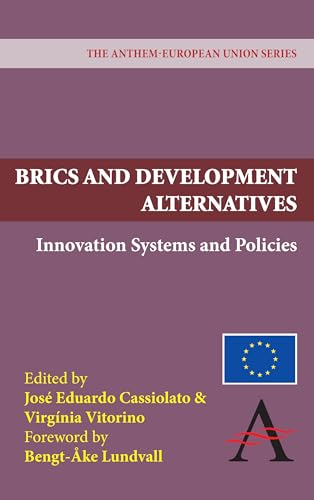
BRICS and Development Alternatives: Innovation Systems and Policies (The Anthem-european Union Series, Band 2) - Hardcover
Inhaltsangabe
The BRICS countries – Brazil, Russia, India, China and South Africa – are currently at the crossroads of major structural economic and political changes. This book provides a comparative analysis of the national innovation systems of the five BRICS countries and the trends in each of their science, technology and innovation policies. The BRICS Project was a workshop launched as part of the Globelics Scientific Committee, a global research network on the economics of learning, innovation and competence. The BRICS Project identifies and analyses development opportunities; highlights common characteristics and challenges of the BRICS countries; and helps to uncover possible paths to fulfil the BRICS countries’ socio-political and economic development potential. The BRICS Project also reveals development alternatives that contain the potential to help both developed and underdeveloped countries to overcome the problems brought by ‘an exhausted production and consumption system and a malignant regulatory and financial regime’. The collected research and workshop papers are now available in BRICS and Development Alternatives, an invaluable contribution to the understanding of the rise of these new emerging science and technology (S&T) powers and to improving evidence-based S&T policymaking with regard to these countries.
The BRICS countries (Brazil, Russia, India, China and South Africa) are currently at the crossroads of major structural economic and political changes. This book provides a comparative analysis of the national innovation systems of the five BRICS countries (Brazil, Russia, India, China and South Africa) and the trends in each of their science, technology and innovation policies. It makes use of an analytical framework, the concept 'systems of innovation and competence building' developed within 'Globelics' (the Global Research Network on the Economics of Learning, Innovation and Capacity Building Systems).
Die Inhaltsangabe kann sich auf eine andere Ausgabe dieses Titels beziehen.
Über die Autorin bzw. den Autor
José Eduardo Cassiolato is Coordinator of RedeSist and Professor at the Institute of Economics, Federal University of Rio de Janeiro, Brazil. He is also a member of Globelics Scientific Committee – a Global Research Network on the Economics of Learning, Innovation and Competence.
Virginia Vitorino is policy officer at the European Commission, Directorate-General for Research, International Cooperation Directorate.
Bengt-Åke Lundvall is Professor in Economics at the University of Aalborg. He has worked on science and technology issues in relation to employment and international competitiveness and currently concentrates on innovation theory, national systems of innovation and competence building and on the analysis of the economics of knowledge.
Auszug. © Genehmigter Nachdruck. Alle Rechte vorbehalten.
BRICS and Development Alternatives: Innovation Systems and Policies
By José Eduardo Cassiolato, Virgínia VitorinoWimbledon Publishing Company
Copyright © 2009 European Communities
All rights reserved.
ISBN: 978-1-84331-799-9All rights reserved.
Contents
List of contributors, vii,
Preface, xi,
Acknowledgements, xiii,
Foreword The BRICS Countries and Europe Bengt-Åke Lundvall, xv,
1. Science, Technology and Innovation Policies in the BRICS Countries: an introduction José Eduardo Cassiolato and Helena Maria Martins Lastres, 1,
2. Achievements and Shortcomings of Brazil's Innovation Policies Priscila Koeller and José Eduardo Cassiolato, 35,
3. Prospective Agenda for Science and Technology and Innovation Policies in Russia Leonid Gokhberg, Natalia Gorodnikova, Tatiana Kuznetsova, Alexander Sokolov and Stanislav Zaichenko, 73,
4. Science, Technology and Innovation Policies in India: Achievements and Limits K. J. Joseph and Dinesh Abrol, 101,
5. Science and Technology and Innovation Policy in China Xielin Liu and Jianbing Liu, 133,
6. The South African Innovation Policies: Potential and Constraint Glenda Kruss and Jo Lorentzen, 163,
Notes, 191,
CHAPTER 1
SCIENCE, TECHNOLOGY AND INNOVATION POLICIES IN THE BRICS COUNTRIES: AN INTRODUCTION
José E. Cassiolato and Helena M. M. Lastres
1. Preamble
The crisis that has hit the world economy since 2008 has lent support to suggestions put forward previously that a significant share of the growth potential of the world economy resides in a few large less developed countries. Brazil, Russia, India, China and South Africa (BRICS) have such potential. More than just that, the BRICS countries are thought to have the capacity to 'change the world' on account of both the threats and the opportunities they represent from the economic, social and political points of view.
International agencies and analysts suggest that investors should pay careful attention to the opportunities offered by these countries. In such analyses, the focus has been restricted to identifying investment possibilities in the BRICS production structures and examining the prospects offered by their consumer markets. This book is part of a study — the BRICS project — where the interest in analysing the BRICS goes much further. These countries present significant development opportunities, as well as several common characteristics and challenges. Identifying and analysing them may help to uncover possible paths for fulfilling their socio-political and economic development potential. More importantly, it can also reveal development alternatives that might help both developed and underdeveloped countries to overcome the problems brought by an exhausted production and consumption system and a malignant regulatory and financial regime.
The BRICS project is an investigation conducted by the Global Research Network for Learning, Innovation and Competence Building Systems — Globelics — and the Research Network on Local Production and Innovation Systems — RedeSist — at the Economics Institute of the Federal University of Rio de Janeiro, Brazil. It is carried out by researchers from the five countries. The central focus of the study is a comparative analysis of the national systems of innovation (NSIs) of Brazil, Russia, India, China and South Africa.
Conceptually, the project is structured around the systems of innovation (SI) framework. The notion of innovation system has at its centre the industrial, S&T and education subsystems, but includes also the promotion, financial and regulation subsystem, as well as other spheres connected to the national and international contexts where knowledge is generated, used and diffused. The objective is to characterise and compare the NSIs of the five countries, pointing out convergences, divergences and synergies and identifying connections both actual and potential.
This book presents a discussion of recent science, technology and innovation (STI) policies pursued by the BRICS, using the broad understanding of the NSI approach as a general analytical framework. In this approach, delineated in section 2 of this chapter, the effectiveness of policies directed towards STI depends on a wide-ranging set of factors that includes the historic specificities of each country, its position in the world hierarchy and the existing general macroeconomic framework, context and policies. Besides stressing the importance of the innovation systems concept for an analysis of STI policies, with an emphasis on contributions by several authors from the developing world, this introductory chapter offers a general picture of the BRICS, pointing out their present relative importance and strength in section 3, and bringing forward in section 4 elements of their STI policies that will be dealt with in more detail in the country chapters. Section 5 sets out the concluding considerations of the chapter.
2. The Systems of Innovation Framework and its Importance to Development
Some of the most fruitful thinking developed in advanced countries in the last 30 years came from a resurrection and updating of earlier thinking that emphasised the role of innovation as an engine of economic growth and the long-run cyclical character of technical change. In 1982, Freeman's paper pointed out the importance that Smith, Marx and Schumpeter attached to innovation (p. 1) and accentuated its systemic and national character (p. 18). He also stressed the crucial role of government policies to cope with the uncertainties associated with the upsurge of a new techno-economic paradigm and the very limited circumstances under which free trade could promote economic development. Since it was formulated in the 1980s, the SI approach has been increasingly used in different parts of the world to analyse processes of acquisition, use and diffusion of innovations and to guide policy recommendations.
Particularly relevant in the SI perspective is the fact that since the beginning of the 1970s, the innovation concept has been widened, to be understood as a systemic, non-linear process rather than an isolated occurrence. Emphasis has been given to its interactive character and to the importance of (and complementarities between) incremental and radical, technical and organisational innovations and their different and simultaneous sources. A corollary of this argument is the specific and localised character of innovation and knowledge. Innovation should then be understood as the process by which firms master and implement the design and production of goods and services that are new to them, irrespective of whether or not they are new to their competitors — domestic or foreign, is particularly important for the analysis of innovation in less developed countries (Nelson 1993, Mytelka 2000).
This understanding helps to avoid overemphasis on R&D in the innovation process, encouraging policy-makers to take a broader perspective on the opportunities for learning and innovation in small and medium-sized enterprises and in the so-called traditional industries (Mytelka & Farinelli, 2003). Understanding innovation as a localised, context-specific and socially determined process implies, for instance, that acquisition of technology abroad is not a substitute for local efforts. On the contrary, a lot of knowledge is needed to be able to interpret information, select, buy (or copy), transform and internalise technology.
Systems of innovation, defined as a set of different institutions that...
„Über diesen Titel“ kann sich auf eine andere Ausgabe dieses Titels beziehen.
Suchergebnisse für BRICS and Development Alternatives: Innovation Systems...

Beispielbild für diese ISBN
BRICS and Development Alternatives: Innovation Systems and Policies (The Anthem-European Union Series)
Anbieter: Books From California, Simi Valley, CA, USA
Verkäuferbewertung 4 von 5 Sternen

Hardcover. Zustand: Very Good. Bestandsnummer des Verkäufers mon0003152155
Gebraucht kaufen
EUR 68,76
EUR 4,46 Versand
Versand innerhalb von USA
Versand innerhalb von USA
Anzahl: 1 verfügbar
Beispielbild für diese ISBN
BRICS and Development Alternatives
Anbieter: PBShop.store UK, Fairford, GLOS, Vereinigtes Königreich
Verkäuferbewertung 5 von 5 Sternen

HRD. Zustand: New. New Book. Shipped from UK. Established seller since 2000. Bestandsnummer des Verkäufers CX-9781843317999
Neu kaufen
EUR 77,52
EUR 5,92 Versand
Versand von Vereinigtes Königreich nach USA
Versand von Vereinigtes Königreich nach USA
Anzahl: 15 verfügbar
Beispielbild für diese ISBN
BRICS and Development Alternatives
Anbieter: PBShop.store US, Wood Dale, IL, USA
Verkäuferbewertung 5 von 5 Sternen
HRD. Zustand: New. New Book. Shipped from UK. Established seller since 2000. Bestandsnummer des Verkäufers CX-9781843317999
Beispielbild für diese ISBN
Brics and Development Alternatives: Innovation Systems and Policies
Print-on-DemandAnbieter: Revaluation Books, Exeter, Vereinigtes Königreich
Verkäuferbewertung 5 von 5 Sternen
Hardcover. Zustand: Brand New. 1st edition. 222 pages. 9.25x6.25x0.75 inches. In Stock. This item is printed on demand. Bestandsnummer des Verkäufers __1843317990
Neu kaufen
EUR 81,43
EUR 11,80 Versand
Versand von Vereinigtes Königreich nach USA
Versand von Vereinigtes Königreich nach USA
Anzahl: 1 verfügbar
Beispielbild für diese ISBN
BRICS and Development Alternatives: Innovation Systems and Policies (The Anthem-European Union Series, 1)
Anbieter: Ria Christie Collections, Uxbridge, Vereinigtes Königreich
Verkäuferbewertung 5 von 5 Sternen
Zustand: New. In English. Bestandsnummer des Verkäufers ria9781843317999_new
Neu kaufen
EUR 102,20
EUR 13,32 Versand
Versand von Vereinigtes Königreich nach USA
Versand von Vereinigtes Königreich nach USA
Anzahl: 1 verfügbar
Foto des Verkäufers
BRICS and Development Alternatives
Anbieter: Rarewaves.com USA, London, LONDO, Vereinigtes Königreich
Verkäuferbewertung 5 von 5 Sternen
Hardback. Zustand: New. The BRICS countries (Brazil, Russia, India, China and South Africa) are currently at the crossroads of major structural economic and political changes. This book provides a comparative analysis of the national innovation systems of the five BRICS countries (Brazil, Russia, India, China and South Africa) and the trends in each of their science, technology and innovation policies. It makes use of an analytical framework, the concept 'systems of innovation and competence building' developed within 'Globelics' (the Global Research Network on the Economics of Learning, Innovation and Capacity Building Systems). Bestandsnummer des Verkäufers LU-9781843317999
Neu kaufen
EUR 117,18
Versand gratis
Versand von Vereinigtes Königreich nach USA
Versand von Vereinigtes Königreich nach USA
Anzahl: Mehr als 20 verfügbar
Foto des Verkäufers
BRICS and Development Alternatives
Anbieter: Rarewaves USA, HEBRON, KY, USA
Verkäuferbewertung 5 von 5 Sternen
Hardback. Zustand: New. The BRICS countries (Brazil, Russia, India, China and South Africa) are currently at the crossroads of major structural economic and political changes. This book provides a comparative analysis of the national innovation systems of the five BRICS countries (Brazil, Russia, India, China and South Africa) and the trends in each of their science, technology and innovation policies. It makes use of an analytical framework, the concept 'systems of innovation and competence building' developed within 'Globelics' (the Global Research Network on the Economics of Learning, Innovation and Capacity Building Systems). Bestandsnummer des Verkäufers LU-9781843317999
Neu kaufen
EUR 123,90
Versand gratis
Versand innerhalb von USA
Versand innerhalb von USA
Anzahl: Mehr als 20 verfügbar
Foto des Verkäufers
BRICS and Development Alternatives
Print-on-DemandAnbieter: moluna, Greven, Deutschland
Verkäuferbewertung 5 von 5 Sternen
Zustand: New. Dieser Artikel ist ein Print on Demand Artikel und wird nach Ihrer Bestellung fuer Sie gedruckt. Über den AutorEdited by José Eduardo Cassiolato and Virginia Vitorino, with a Foreword by Bengt-Åke LundvallInhaltsverzeichnisList of Contributors Preface Acknowledgements Foreword . Bestandsnummer des Verkäufers 4280460
Neu kaufen
EUR 122,23
EUR 48,99 Versand
Versand von Deutschland nach USA
Versand von Deutschland nach USA
Anzahl: Mehr als 20 verfügbar
Foto des Verkäufers
BRICS and Development Alternatives
Anbieter: Rarewaves USA United, HEBRON, KY, USA
Verkäuferbewertung 5 von 5 Sternen
Hardback. Zustand: New. The BRICS countries (Brazil, Russia, India, China and South Africa) are currently at the crossroads of major structural economic and political changes. This book provides a comparative analysis of the national innovation systems of the five BRICS countries (Brazil, Russia, India, China and South Africa) and the trends in each of their science, technology and innovation policies. It makes use of an analytical framework, the concept 'systems of innovation and competence building' developed within 'Globelics' (the Global Research Network on the Economics of Learning, Innovation and Capacity Building Systems). Bestandsnummer des Verkäufers LU-9781843317999
Neu kaufen
EUR 128,37
EUR 44,64 Versand
Versand innerhalb von USA
Versand innerhalb von USA
Anzahl: Mehr als 20 verfügbar
Beispielbild für diese ISBN
BRICS and Development Alternatives
Print-on-DemandAnbieter: Books Puddle, Woodside, NY, USA
Verkäuferbewertung 4 von 5 Sternen
Zustand: New. Print on Demand pp. 222. Bestandsnummer des Verkäufers 261303056
Neu kaufen
EUR 171,28
EUR 3,56 Versand
Versand innerhalb von USA
Versand innerhalb von USA
Anzahl: Mehr als 20 verfügbar