
Verwandte Artikel zu First Poems (Caribbean Modern Classics)
Inhaltsangabe
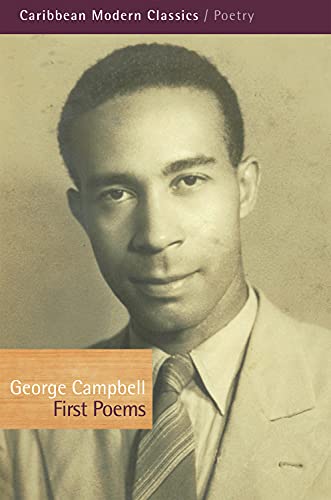
First published in 1945, this compilation features the work of Jamaican poet George Campbell. Perceptive and inspirational, these poems consider the events that marked the nationalist struggle for Jamaican independence, such as the imprisonment of militants by British colonial authorities, the appalling social conditions that drove the masses to revolt, and the desperate poverty of the black majority. Honoring martyred heroes of the Jamaican struggle against slavery and colonialism, Campbell writes about the hopes and consolations to be derived from religious faith, but a faith in which Jesus and Lenin were not necessarily incompatible icons. Other, more personal topics, such as love and its ecstasies and bitter disappointments and Jamaica&;s natural beauty are also celebrated.
Die Inhaltsangabe kann sich auf eine andere Ausgabe dieses Titels beziehen.
Über die Autorin bzw. den Autor
George Campbell was a journalist and critic at theDaily Gleaner and Public Opinion in Jamaica. He was the cofounder of the literary magazineFocus and a consultant for the Institute of Jamaica and the People’s National Party news archives.
„Über diesen Titel“ kann sich auf eine andere Ausgabe dieses Titels beziehen.
Suchergebnisse für First Poems (Caribbean Modern Classics)

Foto des Verkäufers
George Campbell: First Poems
Anbieter: Rarewaves USA, HEBRON, KY, USA
Verkäuferbewertung 5 von 5 Sternen

Paperback. Zustand: New. When they first began to appear in the 1930s, George Campbell's poems blasted through the colonial Victorianism of contemporary Jamaican poetry. Dubbed 'the poet of the revolution' by Jamaica's founding political father, Norman Manley, Campbell was the one Caribbean poet whom Derek Walcott acknowledged as an inspiration.Campbell wrote about the struggle for independence and the appalling social conditions that drove the Jamaican masses to revolt, and about the rising consciousness of black Jamaicans after centuries of oppression. He wrote out of a consciousness of history and religious faith, a faith in which, for him, Jesus and Lenin were not incompatible icons. He also wrote about love, its ecstasies and bitter disappointments, and some of his very best poems are luminous celebrations of Jamaica's natural beauty.George Campbell was born of Jamaican parents in Panama in 1916 and lived variously in Columbia and Costa Rica before returning to Jamaica. He became intensely involved in the nationalist movement and with the Manley family, who championed the poetry he was beginning to write. First Poems appeared in 1945. In the same year, Campbell migrated to New York, where he worked in theatre and dance. In 1978, he returned to Jamaica, working as a consultant to the Institute of Jamaica and the People's National Party archives. In 1994 he returned to New York, where he died in 2002. Bestandsnummer des Verkäufers LU-9781845231491
Beispielbild für diese ISBN
Caribbean Modern Classics: George Campbell: First Poems
Anbieter: Anybook.com, Lincoln, Vereinigtes Königreich
Verkäuferbewertung 5 von 5 Sternen
Zustand: Good. This is an ex-library book and may have the usual library/used-book markings inside.This book has soft covers. Clean from markings. In good all round condition. Please note the Image in this listing is a stock photo and may not match the covers of the actual item,300grams, ISBN:9781845231491. Bestandsnummer des Verkäufers 8668932
Gebraucht kaufen
EUR 9,27
EUR 15,86 Versand
Versand von Vereinigtes Königreich nach USA
Versand von Vereinigtes Königreich nach USA
Anzahl: 1 verfügbar
Foto des Verkäufers
George Campbell: First Poems
Anbieter: Rarewaves USA United, HEBRON, KY, USA
Verkäuferbewertung 5 von 5 Sternen
Paperback. Zustand: New. When they first began to appear in the 1930s, George Campbell's poems blasted through the colonial Victorianism of contemporary Jamaican poetry. Dubbed 'the poet of the revolution' by Jamaica's founding political father, Norman Manley, Campbell was the one Caribbean poet whom Derek Walcott acknowledged as an inspiration.Campbell wrote about the struggle for independence and the appalling social conditions that drove the Jamaican masses to revolt, and about the rising consciousness of black Jamaicans after centuries of oppression. He wrote out of a consciousness of history and religious faith, a faith in which, for him, Jesus and Lenin were not incompatible icons. He also wrote about love, its ecstasies and bitter disappointments, and some of his very best poems are luminous celebrations of Jamaica's natural beauty.George Campbell was born of Jamaican parents in Panama in 1916 and lived variously in Columbia and Costa Rica before returning to Jamaica. He became intensely involved in the nationalist movement and with the Manley family, who championed the poetry he was beginning to write. First Poems appeared in 1945. In the same year, Campbell migrated to New York, where he worked in theatre and dance. In 1978, he returned to Jamaica, working as a consultant to the Institute of Jamaica and the People's National Party archives. In 1994 he returned to New York, where he died in 2002. Bestandsnummer des Verkäufers LU-9781845231491
Neu kaufen
EUR 17,27
EUR 43,11 Versand
Versand innerhalb von USA
Versand innerhalb von USA
Anzahl: 2 verfügbar