
Verwandte Artikel zu Dark Encounters: A Collection of Ghost Stories
Inhaltsangabe
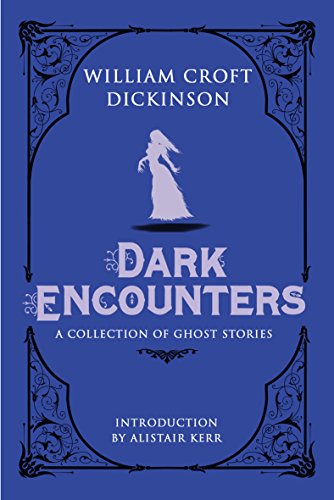
First published in 1963 by Harvill Press, Dark Encounters is an elegantly spine-tingling collection of ghost stories set in the brooding landscape of Scotland and often referring to real people, places and objects. From a demonic book that brings its readers to an early death to the murderous spectre of a feudal baron, these tales are a welcome addition to the long and distinguished canon of Scottish ghost stories. For those who seek the unnerving and the inexplicable, Dark Encounters is guaranteed to raise the hairs on the back of your neck.
Die Inhaltsangabe kann sich auf eine andere Ausgabe dieses Titels beziehen.
Über die Autorin bzw. den Autor
William Croft Dickinson (1897–1963) came to study history at St Andrews in 1915. Military service in the trenches in France during the First World War interrupted his studies but in 1921 he graduated with a First and went on to teach history at the London School of Economics. In 1944 he was appointed Fraser Professor of Scottish History and Paleography at the University of Edinburgh, during which time he founded and edited the Scottish Historical Review, and where he remained until his death. Apart from his historical works, Dickinson wrote many books for children and ghost stories; stories and legends were an essential part of the historical narrative to him. Alistair W.J. Kerr graduated from the University of Edinburgh in 1975 and served in the diplomatic service until 2009. He is the author of a military biography Betrayal: The Murder of Robert Nairac GC (Cambridge Academic, 2015) and is a long-standing admirer of William Croft Dickinson’s work.
Auszug. © Genehmigter Nachdruck. Alle Rechte vorbehalten.
Dark Encounters
A Collection of Ghost Stories
By Alistair KerrBirlinn Limited
Copyright © 2017 Alistair Kerr
All rights reserved.
ISBN: 978-1-84697-408-3All rights reserved.
Contents
Introduction by Alistair Kerr,
1 The Keepers of the Wall,
2 Return at Dusk,
3 The Eve of St Botulph,
4 Can These Stones Speak?,
5 The Work of Evil,
6 The Return of the Native,
7 Quieta non Movere,
8 Let the Dead Bury the Dead,
9 The Castle Guide,
10 The Witch's Bone,
11 The Sweet Singers,
12 The House of Balfother,
13 His Own Number,
14 The MacGregor Skull,
Notes,
A Note on the Author of the Introduction,
CHAPTER 1
The Keepers of the Wall
The Keepers of the Wall
'I SEE THAT someone has discovered a number of skeletons beneath the foundations of a wall and has brought forward the old idea that they were put there so that their ghosts could hold up the wall.'
'And why not?' interposed Henderson. 'It was long thought that burying a body under a wall would help to hold the wall secure.'
'Didn't Gordon Childe find something like that at Skara Brae?' queried Drummond.
'Yes,' Henderson confirmed. 'He found the skeletons of two old women at the foot of one of the walls; but he made only a suggestion that possibly they had been buried there so that their ghosts could hold up the wall. A guess, if you like. But a good guess.'
'I could tell you of a much more modern instance,' put in Robson, our new Professor of Mediaeval Archaeology. And I noticed that he spoke hesitantly. 'A sixteenth-century instance. Ghosts to hold up a wall. Perhaps even ghosts to gather the living to help them in their task,' he added slowly. 'Don't ask me to explain what I mean by that. I just don't know. All I know is that recently I had a terrifying experience on the west coast – an experience that still makes me frightened of visiting ancient ruins by night.'
'I once had a terrifying experience myself,' said Drummond, quietly. 'You'll find at least one listener who'll understand. And the oftener you tell a tale, the less it haunts you.'
'Well, perhaps I'll find some of your relief, Drummond, by telling you the story of my night in the castle of Dunross – in March of this year, just before I came to Edinburgh to take up my chair.'
* * *
As you probably know, Dunross is one of a small group of interesting twelfth-century stone castles on the western seaboard. Only one of its sea-walls still stands, right up to the original wall-head (a feature which I now know only too well); the other two sea-walls have fallen down the cliff in a cascade of stones to the sea. The remaining wall, the landward wall, is little more than a few feet high, ruined and broken, though in it there is an entrance-gate with the remains of a stone stairway that undoubtedly rose up to the wall-walk. The better-known and better-preserved castles of Kisimul, Mingary and Tioram, each of them, like Dunross, perched on a sea rock, follow much the same plan; and I had a theory that the siting, the plan, and the constructional details of all four were so closely related that they bespoke the work of one particular school of military architects. Because of that, I had decided to make a careful examination of Dunross to confirm my belief that it fitted into the general plan of the group.
Right at the start I was fortunate enough to find a crofter living by himself in a good-sized house some two or three miles from the castle. He had more than one room to spare, and he was more than willing to put me up. Moreover, he seemed to take a keen interest in my work, and came to join me every evening so that we could go home from Dunross together. And, as we walked back to his house, I would burden him with architectural details in which, as I was to learn in the end, he took no interest whatsoever.
I had appreciated his regular evening call, and had looked upon it as a friendly act. I had also appreciated our regular walk home. But when, on the night prior to my departure, I told him I would have to make one last visit to the castle in order to check a detail of the entrance-gate which I had not entered clearly enough in my note-book, I discovered he had had a definite reason of his own for calling to pick me up at the end of each day's work.
'You will not be going to Dunross in the night?' he asked, as I prepared to set out.
'Why, yes,' I replied. 'I just want to check a detail of the entrance-gate. I'll soon be back; and I have a torch. But don't wait up for me.'
'You cannot go there after the dark,' he replied, fiercely. 'It would be madness. You would not come back. The wall would shut you in.'
I looked at him with astonishment. 'The wall would shut me in,' I repeated, lamely.
'Just so,' he answered. 'And for why would you think I have brought you away every evening as the darkness was closing in? Was it not to make sure you would not be kept there, like the rest of them? Shut in by the wall, to help to hold it firm.'
'To hold what wall firm? And how?' I asked, more mystified still. 'And who are "the rest", anyway?'
'You did not know, then?'
I shook my head.
'It is the ghosts of the MacLeods,' he replied. 'And since you do not know, I must tell you what way it is.'
And thereupon he told me a strange tale that, away back in the past, when there was a long-standing feud between the MacLeods and the MacDonalds of Clanranald, the MacDonalds had seized a birlinn, manned by MacLeods, and had brought the boat and their prisoners to Dunross. It was a time when MacDonald himself was rebuilding one of the sea-walls of his castle. So what did MacDonald do? Some of the MacLeods were just thrown into the dungeons, and left to starve there till they died; but six of them, fine strong fellows, were buried at the foot of MacDonald's new wall so that their ghosts would hold it secure. And that, I was told, was the one sea-wall which still stood, with never a stone that had fallen from it. Had I not seen it for myself? The other walls were ruined and tumbled down. But the ghosts of the six MacLeods would always hold that one sea-wall secure and strong.
'Well, that may be so,' I answered, when he had finished. 'But I still don't see why it should be dangerous to go to Dunross by night. As long as those ghosts are holding up the wall it can hardly fall down on me.'
'May be so!' he repeated, his eyes flashing. 'I tell you, man, it is so. No one has gone to Dunross by night and returned again. The MacLeods are wearying of their work and aye seeking others to share with them the burden of the wall.'
'And so evening visitors have been compelled to stay on,' I rejoined. And probably there was a little banter in my tone.
'I have told you the tale of it,' he replied, with Highland dignity. 'My father knew it, and his father before him. And, for a truth, they told me of two men who did not return. One, I mind, was a shepherd, seeking a ewe that had strayed; the other was a young man like yourself, who had come from the south and who would not be believing in ghosts and in walls that could shut a man in.'
With that parting shot he left me, to attend to some small task of his own. I could see that my disbelief had offended him, but I knew that the hurt would soon pass. But what of his tale? Of course I didn't believe it. And yet, for a brief space, I did hesitate about my final visit to Dunross. In the end I decided to go. Walls simply did not shut one in; and probably every Scottish castle had its...
„Über diesen Titel“ kann sich auf eine andere Ausgabe dieses Titels beziehen.
Suchergebnisse für Dark Encounters: A Collection of Ghost Stories

Beispielbild für diese ISBN
Dark Encounters: A Collection of Ghost Stories
Anbieter: WorldofBooks, Goring-By-Sea, WS, Vereinigtes Königreich
Verkäuferbewertung 5 von 5 Sternen

Paperback. Zustand: Very Good. The book has been read, but is in excellent condition. Pages are intact and not marred by notes or highlighting. The spine remains undamaged. Bestandsnummer des Verkäufers GOR009086472
Gebraucht kaufen
EUR 3,85
EUR 6,53 Versand
Versand von Vereinigtes Königreich nach USA
Versand von Vereinigtes Königreich nach USA
Anzahl: 5 verfügbar
Beispielbild für diese ISBN
Dark Encounters : A Collection of Ghost Stories
Anbieter: Better World Books Ltd, Dunfermline, Vereinigtes Königreich
Verkäuferbewertung 5 von 5 Sternen
Zustand: Good. None. Former library copy. Pages intact with minimal writing/highlighting. The binding may be loose and creased. Dust jackets/supplements are not included. Includes library markings. Stock photo provided. Product includes identifying sticker. Better World Books: Buy Books. Do Good. Bestandsnummer des Verkäufers 39772635-20
Gebraucht kaufen
EUR 5,63
EUR 5,83 Versand
Versand von Vereinigtes Königreich nach USA
Versand von Vereinigtes Königreich nach USA
Anzahl: 1 verfügbar
Beispielbild für diese ISBN
Dark Encounters : A Collection of Ghost Stories
Anbieter: Better World Books: West, Reno, NV, USA
Verkäuferbewertung 5 von 5 Sternen
Zustand: Fine. None. Used book that is in almost brand-new condition. May contain a remainder mark. Better World Books: Buy Books. Do Good. Bestandsnummer des Verkäufers 18614234-20
Gebraucht kaufen
EUR 16,07
Versand gratis
Versand innerhalb von USA
Versand innerhalb von USA
Anzahl: 1 verfügbar
Beispielbild für diese ISBN
Dark Encounters
Anbieter: Mooney's bookstore, Den Helder, Niederlande
Verkäuferbewertung 4 von 5 Sternen

Zustand: As New. Bestandsnummer des Verkäufers C405C0480F0BC77
Gebraucht kaufen
EUR 22,49
EUR 14,95 Versand
Versand von Niederlande nach USA
Versand von Niederlande nach USA
Anzahl: 1 verfügbar