
Verwandte Artikel zu Forging Multilingual Spaces: Integrated Perspectives...
Forging Multilingual Spaces: Integrated Perspectives on Majority and Minority Bilingual Education (Bilingual Education and Bilingualism) - Hardcover
Buch 65 von 158: Bilingual Education & Bilingualism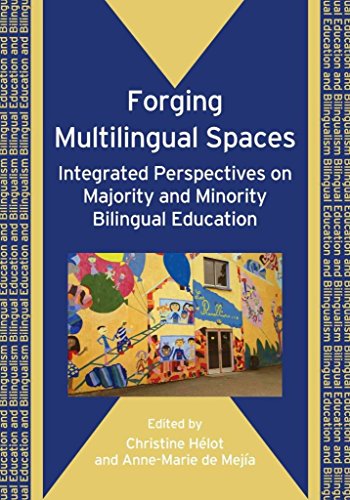
Inhaltsangabe
This book offers a new perspective for research in the field of bilingual education by proposing an integrated approach to the study of bilingualism in minority and majority settings. Programmes for indigenous groups, for national minorities and for migrants are analysed together with programmes aimed at dominant language groups, by well-known scholars from eight different countries in Europe and the Americas. Each contribution seeks to go beyond the traditional dichotomy between policy, practice and research into bilingual education programmes for majority language speakers, and modalities offered for minority language speakers. Thus, the book argues for the construction of a shared discourse for research into bilingualism and bilingual education and for the adoption of an ecological perspective on language education.
Die Inhaltsangabe kann sich auf eine andere Ausgabe dieses Titels beziehen.
Über die Autorinnen und Autoren
Christine Hélot is a professor of English and a teacher educator at the University of Strasbourg in France (Institut Universitaire de Formation des Maîtres d’Alsace). She is the coordinator of a research programme on plurilingualism, intercultural education, and language learning.
Anne-Marie de Mejía works in the Centre for Research and Development in Education at Universidad de los Andes, Bogotá, Colombia. She has a Ph. D in Linguistics in the area of Bilingual Education. Her research interests include bilingual classroom interaction, process of teacher empowerment and bilingual teacher development.
Christine Hélot is a professor of English and a teacher educator at the University of Strasbourg in France (Institut Universitaire de Formation des Maîtres d'Alsace). She is the coordinator of a research programme on plurilingualism, intercultural education, and language learning.Anne-Marie de Mejía works in the Centre for Research and Development in Education at Universidad de los Andes, Bogotá, Colombia. She has a Ph. D in Linguistics in the area of Bilingual Education. Her research interests include bilingual classroom interaction, process of teacher empowerment and bilingual teacher development.
Auszug. © Genehmigter Nachdruck. Alle Rechte vorbehalten.
Forging Multilingual Spaces
Integrated Perspectives on Majority and Minority Bilingual Education
By Christine Hélot, Anne-Marie de MejiaMultilingual Matters
Copyright © 2008 Christine Helot, Anne-Marie de Mejia and the authors of individual chapters
All rights reserved.
ISBN: 978-1-84769-076-0All rights reserved.
Contents
The Contributors, vii,
1 Introduction Christine Helot and Anne-Marie de Mejia, 1,
Part 1: The Americas,
2 Teaching Spanish and Spanish in Teaching in the USA: Integrating Bilingual Perspectives Ofelia García, 31,
3 Plurilingual Latin America: Indigenous Languages, Immigrant Languages, Foreign Languages – Towards an Integrated Policy of Language and Education Rainer Enrique Hamel, 58,
4 Points of Contact or Separate Paths: A Vision of Bilingual Education in Colombia Anne-Marie de Mejia and Maria Emilia Montes Rodriguez, 109,
5 Staff Profiles in Minority and Prestigious Bilingual Education Contexts in Argentina Cristina Banfi and Silvia Rettaroli, 140,
Part 2: Europe,
6 The National Languages Strategy in the UK: Are Minority Languages Still on the Margins? Jim Anderson, Charmian Kenner and Eve Gregory, 183,
7 Bilingual Education in France: School Policies Versus Home Practices Christine Helot, 203,
8 Languages and Language Learning in Catalan Schools: From the Bilingual to the Multilingual Challenge Cristina Escobar Urmeneta and Virginia Unamuno, 228,
9 Educating for Participation in a Bilingual or a Multilingual Society? Challenging the Power Balance between English and Irish (Gaelic) and Other Minority Languages in Ireland Muiris O Laoire, 256,
CHAPTER 1
Introduction: Different Spaces – Different Languages. Integrated Perspectives on Bilingual Education in Majority and Minority Settings
CHRISTINE HÉLOT and ANNE-MARIE DE MEJÍA
In many parts of the world there exists a traditional divide between policy, practice and research into bilingualism and bilingual education programmes for majority language speakers, and modalities offered for minority language speakers. As a result, policymakers, teachers and researchers who are involved with bilingual programmes in international languages often have little contact with researchers and practitioners who are concerned with bilingual education programmes in minority communities. This separation leads to a necessarily limited view of the progress of research on bilingualism and bilingual education, and means that linguistic and pedagogical insights and perceptions from each tradition are often not available to inform future general developments in the field.
Furthermore, while bilingualism in internationally prestigious languages is generally considered worthy of investment of considerable sums of money, as it provides access to a highly 'visible', socially accepted form of bilingualism, leading to the possibility of employment in the global marketplace, bilingualism in minority languages leads, in many cases, to an 'invisible' form of bilingualism in which the native language is undervalued and associated with underdevelopment, poverty and backwardness. Thus, on the one hand, bilingualism may well bring advantages, prestige and power (de Mejía, 2002), but on the other, it can give rise to problems and disadvantages, 'disempowering' individuals who happen to speak languages considered of limited value in the global marketplace (Cummins, 2000). This double vision of bilingualism has been referred to by Barriga Villanueva (2007: 14) as a phenomenon of 'claroscuros'. She characterises the two sides of bilingualism in the following manner, 'the luminous side is related to a high level of culture, of personal prestige ...; the dark side ... is that which is related to the power and domination of a hegemonic language'.
The discourse commonly used to refer to bilingual education generally reinforces these types of dichotomies. As Hornberger (1989: 273, 2003a) recognises in her postulation of a continua model of biliteracy, rather than concern ourselves with 'polar opposites, ... we need to take account of all dimensions represented by the continua'. In other words, we need to go beyond these dichotomies so that we can represent the nature of bilingualism and multilingualism more appropriately in relation to the complex, shifting realities of the world today. Ofelia García (2005: personal communication) acknowledges, with regard to the situation in the USA, 'The old paradigms of bilingual education do not work anymore. Bilingual situations today are fluid.' The implication is that if we continue to use a naturalised discourse which focuses on dichotomies, barriers will continue to exist and the lack of a shared discourse will be exploited to create division, so that bilingualism in minority languages will continue to be seen as a disadvantage.
In a colloquium organised on this topic at the Fifth International Symposium on Bilingualism in Barcelona in 2005, participants from eight different countries were asked to rethink bilingual education in a way which broke away from dichotomous oppositions, and to critically examine some of the more recent policies and practices in relation to the development of bi/multilingualism in schools. While the main aim of the colloquium was to confront reflections on how to bridge the gap between elite and minority bilingualism, another objective was to gather together researchers who have studied bilingual education from different points of view. Some researchers were more familiar with programmes for indigenous groups (Hamel), others with programmes for national minority groups (O'Laoire, Escoba Urmeneta and Unamuno), others with programmes for migrant minority groups (Anderson, Kenner, Gregory and García) and others again with programmes for dominant language groups (Hélot, de Mejía, Montes Rodríguez, Banfi and Rettaroli).
In the Barcelona colloquium there was testimony to the success of teacher initiatives at grassroots level in countries such as the USA, Ireland, France and England; however, responses at government level were seen as less encouraging. Participants acknowledged the need for the development of more powerful strategies at macro level and highlighted the responsibility of academics in promoting change. There was also a call for the creation of spaces in school programmes, which would allow for bilingual children's voices to be heard in a collaborative learning situation, rather than existing in isolation, in separate streams or in 'pull-out' situations. Charmian Kenner (2005, personal communication) suggested that, 'the needs of L1 and L2 speakers should be met in the same shared space', in a sensitive manner. Both Dual Language Programmes and Language Awareness Programmes were seen as possible ways forward for developing this kind of 'meeting-place' of different languages and cultures. Thus, the possibility of integrating a language awareness component into bilingual education professional development courses was proposed as a means of helping bilingual teachers come to terms with the challenges of recognising and promoting language and cultural diversity in the classroom. Indeed, it should be acknowledged that today pupils attending bilingual education programmes may speak a different language from the two languages used to learn in school. It is somewhat ironic that bilingual education should exclude the home languages of some pupils in the same way as monolingual education does. This implies that bilingual educators need to rethink their attitudes and representations towards...
„Über diesen Titel“ kann sich auf eine andere Ausgabe dieses Titels beziehen.
Suchergebnisse für Forging Multilingual Spaces: Integrated Perspectives...

Beispielbild für diese ISBN
Forging Multilingual Spaces: Integrating Perspectives on Majority and Minority Bilingual Education (Bilingual Education and Bilingualism): Integrated . (Bilingual Education & Bilingualism)
Anbieter: Anybook.com, Lincoln, Vereinigtes Königreich
Verkäuferbewertung 5 von 5 Sternen

Zustand: Good. This is an ex-library book and may have the usual library/used-book markings inside.This book has hardback covers. In good all round condition. No dust jacket. Please note the Image in this listing is a stock photo and may not match the covers of the actual item,600grams, ISBN:9781847690760. Bestandsnummer des Verkäufers 8745832
Gebraucht kaufen
EUR 20,28
EUR 15,86 Versand
Versand von Vereinigtes Königreich nach USA
Versand von Vereinigtes Königreich nach USA
Anzahl: 1 verfügbar
Beispielbild für diese ISBN
FORGING MULTILINGUAL SPACES: INTEGRATING PERSPECTIVES ON MAJORITY AND MINORITY BILINGUAL EDUCATION (BILINGUAL EDUCATION AND BILINGUALISM)
Anbieter: Basi6 International, Irving, TX, USA
Verkäuferbewertung 5 von 5 Sternen
Zustand: Brand New. New. US edition. Expediting shipping for all USA and Europe orders excluding PO Box. Excellent Customer Service. Bestandsnummer des Verkäufers ABEOCT25-219443
Beispielbild für diese ISBN
FORGING MULTILINGUAL SPACES: INTEGRATING PERSPECTIVES ON MAJORITY AND MINORITY BILINGUAL EDUCATION (BILINGUAL EDUCATION AND BILINGUALISM)
Anbieter: Romtrade Corp., STERLING HEIGHTS, MI, USA
Verkäuferbewertung 5 von 5 Sternen
Zustand: New. This is a Brand-new US Edition. This Item may be shipped from US or any other country as we have multiple locations worldwide. Bestandsnummer des Verkäufers ABBB-181762
Beispielbild für diese ISBN
Forging Multilingual Spaces: Integrated Perspectives on Majority and Minority Bilingual Education (Bilingual education and Bilingualism)
Anbieter: Books Puddle, New York, NY, USA
Verkäuferbewertung 4 von 5 Sternen

Zustand: New. Bestandsnummer des Verkäufers 261318841
Neu kaufen
EUR 61,94
EUR 3,47 Versand
Versand innerhalb von USA
Versand innerhalb von USA
Anzahl: 1 verfügbar
Beispielbild für diese ISBN
Forging Multilingual Spaces: Integrated Perspectives on Majority and Minority Bilingual Education (Bilingual education and Bilingualism)
Anbieter: Majestic Books, Hounslow, Vereinigtes Königreich
Verkäuferbewertung 4 von 5 Sternen
Zustand: New. Bestandsnummer des Verkäufers 6529126
Neu kaufen
EUR 58,98
EUR 7,58 Versand
Versand von Vereinigtes Königreich nach USA
Versand von Vereinigtes Königreich nach USA
Anzahl: 1 verfügbar
Beispielbild für diese ISBN
FORGING MULTILINGUAL SPACES: INTEGRATING PERSPECTIVES ON MAJORITY AND MINORITY BILINGUAL EDUCATION (BILINGUAL EDUCATION AND BILINGUALISM)
Anbieter: SMASS Sellers, IRVING, TX, USA
Verkäuferbewertung 4 von 5 Sternen
Zustand: New. Brand New Original US Edition. Customer service! Satisfaction Guaranteed. Bestandsnummer des Verkäufers SNTA-181762
Beispielbild für diese ISBN
Forging Multilingual Spaces: Integrated Perspectives on Majority and Minority Bilingual Education (Bilingual education and Bilingualism)
Anbieter: Biblios, Frankfurt am main, HESSE, Deutschland
Verkäuferbewertung 4 von 5 Sternen
Zustand: New. Bestandsnummer des Verkäufers 181318835
Neu kaufen
EUR 59,70
EUR 9,95 Versand
Versand von Deutschland nach USA
Versand von Deutschland nach USA
Anzahl: 1 verfügbar