
Verwandte Artikel zu Ethnographic Fieldwork: A Beginner's Guide
Inhaltsangabe
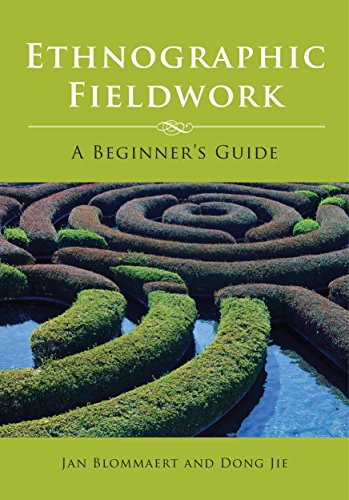
Ethnographic fieldwork is something which is often presented as mysterious and inexplicable. How do we know certain things after having done fieldwork? Are we sure we know? And what exactly do we know? This book describes ethnographic fieldwork as the gradual accumulation of knowledge about something you don't know much about. We start from ignorance and gradually move towards knowledge, on the basis of practices for which we have theoretical and methodological motivations. Jan Blommaert and Dong Jie draw on their own experiences as fieldworkers in explaining the complexities of ethnographic fieldwork as a knowledge trajectory. They do so in an easily accessible way that makes these complexities easier to understand and to handle before, during and after fieldwork.
"This immensely accessible and readable book engages the reader from beginning to end in a style which is informal, informative and intellectually fulfilling. Blommaert and Dong offer invaluable practical advice, guiding the reader through the sequences of the ethnographic research process. They successfully illustrate the fundamentals of ethnographic fieldwork, while presenting a set of splendid resources for both the beginner researcher and the experienced ethnographer." Angela Creese, University of Birmingham, UK
"Written in an entertaining and accessible style, this book is a refreshing approach to ethnographic fieldwork. Unlike many other authors who present field research as a set of ready-made recipes to follow, Blommaert and Dong engage their readers in an exciting theoretical and methodological journey into the ethnographic paradigm. This is a must-read for anybody interested in ethnography. "Cecile B. Vigouroux, Simon Fraser University, Canada
Die Inhaltsangabe kann sich auf eine andere Ausgabe dieses Titels beziehen.
Über die Autorin bzw. den Autor
Jan Blommaert is Professor of Language, Culture and Globalization at Tilburg University, where he is also the director of the Babylon Center. His publications include Language Ideological Debates (1999), Discourse: A Critical Introduction (2005), Grassroots Literacy (2008) and The Sociolinguistics of Globalization (2010).Dong Jie completed her PhD at Tilburg University in 2009, her dissertation was about the practices of identity construction of Chinese internal migrants in Beijing. She is a postdoctoral fellow at the Babylon Center and the Department of Languages and Cultures, Tilburg University.
Auszug. © Genehmigter Nachdruck. Alle Rechte vorbehalten.
Ethnographic Fieldwork
A Beginner's Guide
By Jan BlommaertMultilingual Matters
Copyright © 2010 Jan Blommaert and Dong Jie
All rights reserved.
ISBN: 978-1-84769-294-8All rights reserved.
Contents
1 Introduction, 1,
2 Ethnography, 4,
Ethnography as a Paradigm, 5,
Resources and Dialectics, 7,
Ethnography as Counter-hegemony, 10,
The Ethnographic Argument, 12,
3 The Sequence 1: Prior to Fieldwork, 16,
4 The Sequence 2: In the Field, 24,
Chaos, 24,
The Learning Process, 26,
Observation and Fieldnotes, 29,
Interviewing, 42,
Collecting Rubbish, 58,
Conclusion, 59,
5 The Sequence 3: After Fieldwork, 63,
Your Data, 63,
Techniques and Methods, 67,
Analysing Narrative, 70,
6 Postscript, 85,
References, 87,
Index, 89,
CHAPTER 1
Introduction
It is a scary thing, isn't it: the idea of being alone 'in the field', trying to accomplish a task initially formulated as a perfectly coherent research plan with questions, methods, readings and so on – and finding out that the 'field' is a chaotic, hugely complex place. Fieldwork is the moment when the researcher climbs down to everyday reality and finds out that the rules of academia are not necessarily the same as those of everyday life. Unfortunately, the only available solution to that is unilateral adaptation by the researcher. Everyday life will never adjust to your research plan; the only way forward is to adapt your plan and ways of going about things to the rules of everyday reality. There is no magic formula for this, and this book should not – not! – be read as such.
But there are things one can do better or worse, and whichever way we look at it, fieldwork is a theorised mode of action, something in which researchers still follow certain procedures and have to follow them; something in which a particular set of actions need to be performed; and something that needs to result in a body of knowledge that can be re-submitted to rigorous, disciplined academic tactics. This book is aimed at providing some general suggestions for how to go about it, at demarcating a space in which what we do can be called 'research'. It is a complex space, not something one immediately recognises, and given the increased emphasis on fieldwork – ethnographic fieldwork – some things may require structured attention.
We will start with a number of observations on ethnography. These are crucial: whenever we say ethnography (and formulate fieldwork as part of that procedure) we invoke a particular scientific tradition. It is amazing to see how often that tradition is misunderstood or misrepresented. Yet, a fair understanding of it is indispensable if we want to know what our fieldwork will yield: it will yield ethnographic data, and such data are fundamentally different from data collected through most other approaches. Informed readers will detect in our discussion many traces of the foundational work by Johannes Fabian and Dell Hymes – the two main methodologists of contemporary ethnography, whose works remain indispensable reading for anyone seriously interested in ethnography. Next, we will go through the 'sequence' usually performed in fieldwork: pre-field preparation, entering the field, observation, interviewing, data formulation, analysis, the return from the field.
One should note that we do not provide a 'do and don't' kind of guide to fieldwork. We will rather focus on more fundamental procedures of knowledge-construction. There are several purely practical guidelines for aspects of fieldwork. Fieldwork here is treated as an intellectual enterprise, a procedure that requires serious reflection as much as practical preparation and skill. Still, it is our hope (and silent conviction) that these reflections are, at the end of the day, very practical. One can never be good at anything when one doesn't really know what one is doing.
A second disclaimer is this. We are both linguistic anthropologists and sociolinguists; our views on ethnography and fieldwork necessarily have their roots in experiences with working on languages and linguistic/ sociolinguistic phenomena. Most of the concrete examples or illustrations we provide will, consequently, relate to such issues, and we hope that the non-language-focused student will not be scared by them. An effort may be required to convert these illustrations and arguments into other topics; do try to make the effort. Throughout the book, we will also provide vignettes from Dong Jie's fieldwork on identity construction among rural migrants in Beijing. Her research, carried out between 2006 and 2009, will run through the book as a steady beat. This does not mean that Dong Jie was the only of the two authors who learned and experienced fieldwork; the trials and errors of fieldwork were also very much part of Jan's experience as a researcher. Elements from Jan's experience will occur throughout the book, especially in the final chapter. But Dong Jie's fresh materials may speak in a more authentic voice to our preferred readers: young researchers who are embarking on their first fieldwork jobs.
Finally, we want to use a motto for this text, something that provides a baseline for what follows. It's a quote from Hymes (1981: 84), occurring in an argument about the need for analytic attention to 'behavioral repertoire' – the actual range of forms of behaviour that people display, and that makes them identifiable as members of a culture. This repertoire of individuals does not coincide with that of the culture in its whole: it is always a mistake to equate the resources of a language, culture or society with those of its members. Nobody possesses the full range of skills and resources, everyone has control over just parts of them, nobody is a perfect speaker of a language or a perfect member of a culture or society. In addition, Hymes alerts us to
the small portion of cultural behavior that people can be expected to report or describe, when asked, and the much smaller portion that an average person can be expected to manifest by doing on demand.
And he caustically adds, between brackets, 'Some social research seems incredibly to assume that what there is to find out can be found out by asking'.
Let us keep this motto in mind. People are not cultural or linguistic catalogues, and most of what we see as their cultural and social behaviour is performed without reflecting on it and without an active awareness that this is actually something they do. Consequently, it is not a thing they have an opinion about, nor an issue that can be comfortably put in words when you ask about it. Ethnographic fieldwork is aimed at finding out things that are often not seen as important but belong to the implicit structures of people's life. Asking is indeed very often the worst possible way of trying to find out.
CHAPTER 2Ethnography
Ethnography is a strange scientific phenomenon. On the one hand, it can be seen as probably the only truly influential 'invention' of anthropological linguistics, having triggered important developments in social-scientific fields as diverse as pragmatics and discourse analysis, sociology and historiography and having caused a degree of attention to small detail in human interaction previously unaddressed in many fields of the social sciences. At the same time, ethnography has for decades come under fire from within. Critical anthropology emerged from within ethnography, and strident...
„Über diesen Titel“ kann sich auf eine andere Ausgabe dieses Titels beziehen.
Suchergebnisse für Ethnographic Fieldwork: A Beginner's Guide

Beispielbild für diese ISBN
Ethnographic Fieldwork: A Beginner's Guide
Verlag:
Multilingual Matters Limited, 2010
ISBN 10: 184769294X
ISBN 13: 9781847692948
Gebraucht
Paperback
Anbieter: ThriftBooks-Dallas, Dallas, TX, USA
Verkäuferbewertung 5 von 5 Sternen

Paperback. Zustand: Fair. No Jacket. Readable copy. Pages may have considerable notes/highlighting. ~ ThriftBooks: Read More, Spend Less. Bestandsnummer des Verkäufers G184769294XI5N00
Gebraucht kaufen
EUR 8,87
Versand gratis
Versand innerhalb von USA
Versand innerhalb von USA
Anzahl: 1 verfügbar
Beispielbild für diese ISBN
Ethnographic Fieldwork: A Beginner's Guide
Verlag:
Multilingual Matters Limited, 2010
ISBN 10: 184769294X
ISBN 13: 9781847692948
Gebraucht
Paperback
Anbieter: ThriftBooks-Atlanta, AUSTELL, GA, USA
Verkäuferbewertung 5 von 5 Sternen
Paperback. Zustand: Very Good. No Jacket. May have limited writing in cover pages. Pages are unmarked. ~ ThriftBooks: Read More, Spend Less. Bestandsnummer des Verkäufers G184769294XI4N00
Gebraucht kaufen
EUR 8,87
Versand gratis
Versand innerhalb von USA
Versand innerhalb von USA
Anzahl: 1 verfügbar
Beispielbild für diese ISBN
Ethnographic Fieldwork: A Beginner's Guide
Anbieter: One Planet Books, Columbia, MO, USA
Verkäuferbewertung 4 von 5 Sternen

paperback. Zustand: Good. Ships in a BOX from Central Missouri! May not include working access code. Will not include dust jacket. Has used sticker(s) and some writing and/or highlighting. UPS shipping for most packages, (Priority Mail for AK/HI/APO/PO Boxes). Bestandsnummer des Verkäufers 001147820U
Gebraucht kaufen
EUR 6,87
EUR 3,55 Versand
Versand innerhalb von USA
Versand innerhalb von USA
Anzahl: 2 verfügbar
Beispielbild für diese ISBN
Ethnographic Fieldwork: A Beginner's Guide
Anbieter: WorldofBooks, Goring-By-Sea, WS, Vereinigtes Königreich
Verkäuferbewertung 5 von 5 Sternen
Paperback. Zustand: Very Good. The book has been read, but is in excellent condition. Pages are intact and not marred by notes or highlighting. The spine remains undamaged. Bestandsnummer des Verkäufers GOR012257653
Gebraucht kaufen
EUR 5,65
EUR 6,65 Versand
Versand von Vereinigtes Königreich nach USA
Versand von Vereinigtes Königreich nach USA
Anzahl: 1 verfügbar
Beispielbild für diese ISBN
Ethnographic Fieldwork: A Beginner's Guide
Anbieter: Textbooks_Source, Columbia, MO, USA
Verkäuferbewertung 5 von 5 Sternen
paperback. Zustand: Good. Ships same day or next business day! UPS shipping available (Priority Mail for AK/HI/APO/PO Boxes). Used sticker and some writing and/or highlighting. Used books may not include working access code. Used books will not include dust jackets. Bestandsnummer des Verkäufers 001147820U
Gebraucht kaufen
EUR 11,02
EUR 3,55 Versand
Versand innerhalb von USA
Versand innerhalb von USA
Anzahl: 2 verfügbar
Beispielbild für diese ISBN
Ethnographic Fieldwork: A Beginner's Guide
Anbieter: Phatpocket Limited, Waltham Abbey, HERTS, Vereinigtes Königreich
Verkäuferbewertung 5 von 5 Sternen
Zustand: Good. Your purchase helps support Sri Lankan Children's Charity 'The Rainbow Centre'. Ex-library, so some stamps and wear, but in good overall condition. Our donations to The Rainbow Centre have helped provide an education and a safe haven to hundreds of children who live in appalling conditions. Bestandsnummer des Verkäufers Z1-B-031-02170
Gebraucht kaufen
EUR 7,00
EUR 12,64 Versand
Versand von Vereinigtes Königreich nach USA
Versand von Vereinigtes Königreich nach USA
Anzahl: 2 verfügbar
Beispielbild für diese ISBN
Ethnographic Fieldwork: A Beginner's Guide
Anbieter: Anybook.com, Lincoln, Vereinigtes Königreich
Verkäuferbewertung 5 von 5 Sternen
Zustand: Fair. This is an ex-library book and may have the usual library/used-book markings inside.This book has soft covers. In fair condition, suitable as a study copy. Please note the Image in this listing is a stock photo and may not match the covers of the actual item,250grams, ISBN:9781847692948. Bestandsnummer des Verkäufers 3983555
Gebraucht kaufen
EUR 7,66
EUR 15,49 Versand
Versand von Vereinigtes Königreich nach USA
Versand von Vereinigtes Königreich nach USA
Anzahl: 1 verfügbar
Beispielbild für diese ISBN
Ethnographic Fieldwork: A Beginner's Guide
Anbieter: Russell Books, Victoria, BC, Kanada
Verkäuferbewertung 5 von 5 Sternen
paperback. Zustand: Very Good. Bestandsnummer des Verkäufers FORT715260
Gebraucht kaufen
EUR 9,17
EUR 17,81 Versand
Versand von Kanada nach USA
Versand von Kanada nach USA
Anzahl: 1 verfügbar
Beispielbild für diese ISBN
Ethnographic Fieldwork: A Beginners Guide
Anbieter: Greener Books, London, Vereinigtes Königreich
Verkäuferbewertung 4 von 5 Sternen
Paperback. Zustand: Used; Very Good. **SHIPPED FROM UK** We believe you will be completely satisfied with our quick and reliable service. All orders are dispatched as swiftly as possible! Buy with confidence! Greener Books. Bestandsnummer des Verkäufers 4942965
Gebraucht kaufen
EUR 15,16
EUR 23,76 Versand
Versand von Vereinigtes Königreich nach USA
Versand von Vereinigtes Königreich nach USA
Anzahl: 1 verfügbar
Beispielbild für diese ISBN
Ethnographic Fieldwork: A Beginner's Guide
Anbieter: YESIBOOKSTORE, MIAMI, FL, USA
Verkäuferbewertung 5 von 5 Sternen
paperback. Zustand: As New. Bestandsnummer des Verkäufers 184769294X-VB
Gebraucht kaufen
EUR 50,59
Versand gratis
Versand innerhalb von USA
Versand innerhalb von USA
Anzahl: 1 verfügbar