
Verwandte Artikel zu CLIL in Higher Education: Towards a Multilingual Language...
CLIL in Higher Education: Towards a Multilingual Language Policy (Bilingual Education & Bilingualism, Band 92) - Softcover
Buch 89 von 158: Bilingual Education & Bilingualism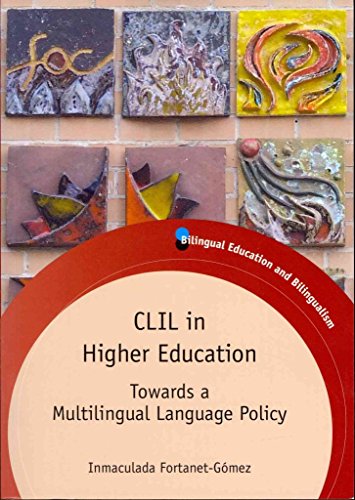
Inhaltsangabe
This book offers a unique view of multilingualism in higher education from a global perspective. It presents a contextualised case of a multilingual language policy which takes the Content and Language Integrated Learning (CLIL) approach. The volume discusses various approaches to multilingual education including CLIL and then proposes guidelines for a multilingual language policy for Universitat Jaume I in Castelló, Spain. It examines the advantages of a multilingual education programme and reviews the success of existing language policies. This book will be an essential resource for researchers and students as well as policy makers.
Die Inhaltsangabe kann sich auf eine andere Ausgabe dieses Titels beziehen.
Über die Autorin bzw. den Autor
Dr. Inmaculada Fortanet is a full professor and researcher at Universitat Jaume I (Castellón, Spain), where she has coordinated the Group for Research on Academic and Professional English (GRAPE) for the last 20 years. Her research interests are related to Content and Language Integrated Learning in Higher Education and to multimodal discourse analysis. She is the author of CLIL in Higher Education. Towards a Multilingual Language Policy (Multilingual Matters, 2013). She is a founding member of the association ICLHE (Integrating Content and Language in Higher Education) and she belongs to its Executive Board since its creation. She has published articles in English for Specific Purposes, Journal of English for Academic Purposes, Discourse Studies, ESP across Cultures, among others.
Auszug. © Genehmigter Nachdruck. Alle Rechte vorbehalten.
CLIL in Higher Education
Towards a Multilingual Language Policy
By Inmaculada Fortanet-GómezMultilingual Matters
Copyright © 2013 Inmaculada Fortanet-Gómez
All rights reserved.
ISBN: 978-1-84769-935-0All rights reserved.
Contents
Acknowledgements,
Introduction,
Part 1: Multilingualism and Multilingual Education,
1 Multilingualism,
2 Multilingual Education,
Part 2: Multilingualism in Higher Education,
3 The Sociopolitical Context,
4 The Language Component,
5 The Pedagogical Component,
6 The Human Factor,
Part 3: Towards a Multilingual Higher Education Institution: The Case of Universitat Jaume I,
7 Description of the Study,
8 Background and Context of Universitat Jaume I,
9 Proposals for a Multilingual Language Policy,
Conclusions,
Appendix 1: Questionnaires,
Appendix 2: Complete Tables,
References,
Index,
CHAPTER 1
Multilingualism
1.1 Definition of Multilingualism
Although bilingualism and multilingualism refer to the knowledge and use of two and of more than two languages, respectively, very often the term 'bilingualism' has been used to refer to both concepts, as in the case of Baetens Beardsmore's (1982) definition:
Bilingualism (...) must be able to account for the presence of at least two languages within one and the same speaker, remembering that ability in these two languages may or may not be equal, and the way the two or more languages are used plays a highly significant role. (Baetens Beardsmore, 1982: 3)
Moore and Gajo (2009) distinguish between multilingualism (the study of social contact) and plurilingualism (the study of individuals' repertoires and agency in several languages). In this book I have chosen the term multilingualism to refer to both the social and the individual situation in which two or more languages are known and used by speakers. Plurilingualism is, in turn, considered as one of the characteristics of multilingual individuals, as explained in Section 1.3.
Multilingualism is not something new. It has happened all over the world and at all times in the history of humankind. However, according to Aronin and Singleton (2008: 4), current multilingualism is 'assimilable to politicoeconomic aspects of globalisation, global mobility and "postmodern" modes of thinking', and as such has different characteristics from historical multilingualism. Multilingualism is related to today's 'new linguistic dispensation', that is, to the modern concepts of time, space and identity as a background to language. In relation to time, linguistic communication has been affected by the use of technologies that have made it instantaneous both in its written and oral forms (mobile phones, audio and video communication, computer software, etc.). Space is no longer fixed and its relationship with languages has varied. Mobility culture and the accessibility to modern means of transport have also altered the concept of identity and the idea of belonging to a certain culture and place. In addition, virtual existence in cyberspace has created new identities and new social groups to be part of.
Although it is true that today's way of life, particularly in the West, favours multilingualism, throughout history a large number of people have always been multilingual, that is, they utilised and many still use two or more languages in their everyday lives (Cenoz & Genesee, 1998). Research on multilingualism has unveiled the complexity of linguistic and cultural variation in the multilinguals' use of languages, which may vary over time. The competence of multilinguals in each of the languages they know is no longer the only important aspect of multilingualism. It is also important to learn the status of the languages each person possesses, which may differ according to the situation and place where these languages are used. They can be official or non-official languages, majority or minority languages, international, national, regional or local languages. The use the people make of the language can be individual or social.
Social multilingualism can be explained in relation to historical, political and educational dimensions. The concern for multilingual education in different parts of the world relates to the status of the language in any of the possibilities described above. In countries that went through a long colonial period in their history, such as India or South Africa, one of the major concerns is still the attitude towards the colonial versus the local or regional languages in educational contexts (Bekker, 2003; Ferguson, 2003). Although most of these countries have approved constitutions that declare as official languages several of their own languages along with the colonial language, it is the latter that is normally used in the classroom. The reasons usually given by the education authorities often relate to the great variety of languages used among the pupils (as many as 11 are official in South Africa out of the 25 that are spoken by a significant number of people). However, the underlying reason is often the power relationship between the speakers of those languages (Baetens Beardsmore, 2003). Even though European countries have been colonisers rather than colonies, a similar situation can be found in European regions which had their own language, such as Friesland in the Netherlands, Brittany in France or the Ruthenian region in Slovakia. Nowadays these languages have become mostly secluded within the family and home domain, and the state language has beenadopted in the education system (Hornsby & Agarin, 2012). Some other languages went through a similar situation but social, political and historical events swung in their favour so that a few years ago they began to be incorporated in some way or other into the classroom and the public and administrative domains. This is the case for Welsh in Wales, and Galician, Basque and Catalan in Spain.
In addition to the minority local languages, some countries have received a great number of immigrants who may keep their own language through one or several generations. Sometimes these languages are considered to be problematic for their integration and immigrants are encouraged to use only the national language of the host country with their children, forcing them to become monolingual. In cases where they decide to preserve their mother tongues, their multilingualism is most often reduced to the private domain only. Most countries in Europe, as in many other parts of the world, have received immigrants at some time in their history, especially in the large cities, so this situation needs to be considered when dealing with multilingualism.
Regarding individual multilingualism, the situation is rather different depending on whether the bilingual or multilingual speakers are immersed in a society that shares this multilingualism (social multilingualism) or, on the contrary, they are surrounded by monolinguals or people who speak languages different from the ones spoken by them. A case thoroughly studied, especially from the point of view of psycholinguistics and second language learning, is that of a child with a home language which is different from the social or school language, such as in the case of the immigrants described above (Cots & Nussbaum, 2008; Kasanga, 2008; Lotherington & Eamer, 2008).
On the other hand, looking through the social perspective, a country may be multilingual even when most of the citizens have competence in just one language, such as for example in Switzerland or Canada,...
„Über diesen Titel“ kann sich auf eine andere Ausgabe dieses Titels beziehen.
Suchergebnisse für CLIL in Higher Education: Towards a Multilingual Language...

Beispielbild für diese ISBN
CLIL in Higher Education: Towards a Multilingual Language Policy (Bilingual Education and Bilingualism)
Anbieter: Anybook.com, Lincoln, Vereinigtes Königreich
Verkäuferbewertung 5 von 5 Sternen

Zustand: Fair. This is an ex-library book and may have the usual library/used-book markings inside.This book has soft covers. In fair condition, suitable as a study copy. Please note the Image in this listing is a stock photo and may not match the covers of the actual item,500grams, ISBN:9781847699350. Bestandsnummer des Verkäufers 9421519
Gebraucht kaufen
EUR 20,08
EUR 15,38 Versand
Versand von Vereinigtes Königreich nach USA
Versand von Vereinigtes Königreich nach USA
Anzahl: 1 verfügbar
Beispielbild für diese ISBN
CLIL in Higher Education
Anbieter: PBShop.store UK, Fairford, GLOS, Vereinigtes Königreich
Verkäuferbewertung 5 von 5 Sternen
PAP. Zustand: New. New Book. Shipped from UK. Established seller since 2000. Bestandsnummer des Verkäufers CX-9781847699350
Neu kaufen
EUR 43,36
EUR 4,91 Versand
Versand von Vereinigtes Königreich nach USA
Versand von Vereinigtes Königreich nach USA
Anzahl: 15 verfügbar
Foto des Verkäufers
CLIL in Higher Education : Towards a Multilingual Language Policy
Anbieter: GreatBookPrices, Columbia, MD, USA
Verkäuferbewertung 5 von 5 Sternen
Zustand: New. Bestandsnummer des Verkäufers 19172777-n
Neu kaufen
EUR 46,71
EUR 2,36 Versand
Versand innerhalb von USA
Versand innerhalb von USA
Anzahl: Mehr als 20 verfügbar
Beispielbild für diese ISBN
CLIL in Higher Education
Anbieter: PBShop.store US, Wood Dale, IL, USA
Verkäuferbewertung 5 von 5 Sternen
PAP. Zustand: New. New Book. Shipped from UK. Established seller since 2000. Bestandsnummer des Verkäufers CX-9781847699350
Foto des Verkäufers
CLIL in Higher Education
Verlag:
Channel View Publications Ltd, GB, 2013
ISBN 10: 1847699359
ISBN 13: 9781847699350
Neu
Paperback
Anbieter: Rarewaves.com USA, London, LONDO, Vereinigtes Königreich
Verkäuferbewertung 5 von 5 Sternen
Paperback. Zustand: New. This book offers a unique view of multilingualism in higher education from a global perspective. It presents a contextualised case of a multilingual language policy which takes the Content and Language Integrated Learning (CLIL) approach. The volume discusses various approaches to multilingual education including CLIL and then proposes guidelines for a multilingual language policy for Universitat Jaume I in Castelló, Spain. It examines the advantages of a multilingual education programme and reviews the success of existing language policies. This book will be an essential resource for researchers and students as well as policy makers. Bestandsnummer des Verkäufers LU-9781847699350
Neu kaufen
EUR 52,92
Versand gratis
Versand von Vereinigtes Königreich nach USA
Versand von Vereinigtes Königreich nach USA
Anzahl: Mehr als 20 verfügbar
Foto des Verkäufers
CLIL in Higher Education : Towards a Multilingual Language Policy
Anbieter: GreatBookPrices, Columbia, MD, USA
Verkäuferbewertung 5 von 5 Sternen
Zustand: As New. Unread book in perfect condition. Bestandsnummer des Verkäufers 19172777
Gebraucht kaufen
EUR 51,26
EUR 2,36 Versand
Versand innerhalb von USA
Versand innerhalb von USA
Anzahl: Mehr als 20 verfügbar
Beispielbild für diese ISBN
CLIL in Higher Education
Print-on-DemandAnbieter: Majestic Books, Hounslow, Vereinigtes Königreich
Verkäuferbewertung 4 von 5 Sternen

Zustand: New. Print on Demand pp. 304. Bestandsnummer des Verkäufers 55102186
Neu kaufen
EUR 46,96
EUR 7,67 Versand
Versand von Vereinigtes Königreich nach USA
Versand von Vereinigtes Königreich nach USA
Anzahl: 4 verfügbar
Beispielbild für diese ISBN
CLIL in Higher Education
Print-on-DemandAnbieter: Biblios, Frankfurt am main, HESSE, Deutschland
Verkäuferbewertung 4 von 5 Sternen
Zustand: New. PRINT ON DEMAND pp. 304. Bestandsnummer des Verkäufers 1854490431
Neu kaufen
EUR 46,64
EUR 9,95 Versand
Versand von Deutschland nach USA
Versand von Deutschland nach USA
Anzahl: 4 verfügbar
Beispielbild für diese ISBN
CLIL in Higher Education
Print-on-DemandAnbieter: Books Puddle, Woodside, NY, USA
Verkäuferbewertung 4 von 5 Sternen
Zustand: New. Print on Demand pp. 304. Bestandsnummer des Verkäufers 2654490421
Neu kaufen
EUR 53,35
EUR 3,56 Versand
Versand innerhalb von USA
Versand innerhalb von USA
Anzahl: 4 verfügbar
Foto des Verkäufers
CLIL in Higher Education
Verlag:
Channel View Publications Ltd, GB, 2013
ISBN 10: 1847699359
ISBN 13: 9781847699350
Neu
Paperback
Anbieter: Rarewaves USA, HEBRON, KY, USA
Verkäuferbewertung 5 von 5 Sternen
Paperback. Zustand: New. This book offers a unique view of multilingualism in higher education from a global perspective. It presents a contextualised case of a multilingual language policy which takes the Content and Language Integrated Learning (CLIL) approach. The volume discusses various approaches to multilingual education including CLIL and then proposes guidelines for a multilingual language policy for Universitat Jaume I in Castelló, Spain. It examines the advantages of a multilingual education programme and reviews the success of existing language policies. This book will be an essential resource for researchers and students as well as policy makers. Bestandsnummer des Verkäufers LU-9781847699350
Neu kaufen
EUR 61,20
Versand gratis
Versand innerhalb von USA
Versand innerhalb von USA
Anzahl: Mehr als 20 verfügbar