
Verwandte Artikel zu The Development Dictionary: A Guide to Knowledge as...
Inhaltsangabe
In this classic collection, some of the world's most eminent critics of development review the key concepts of the development discourse.
Each essay examines one concept from a historical and anthropological point of view, highlights its particular bias, and exposes its historical obsolescence and intellectual sterility. The authors argue that a bidding farewell to the whole Eurocentric development idea is urgently needed, in order to liberate people's minds in both North and South for bold responses to the environmental and ethical challenges now confronting humanity. The combined result forms a must-read invitation to experts, grassroots movements and students of development to recognize the tainted glasses they put on whenever they participate in the development discourse.Die Inhaltsangabe kann sich auf eine andere Ausgabe dieses Titels beziehen.
Über die Autorin bzw. den Autor
Wolfgang Sachs is an author and research director at the Wuppertal Institute for Climate, Environment and Energy, in Germany. He has been chair of the board of Greenpeace Germany, a member of the Intergovernmental Panel on Climate Change, and is a member of the Club of Rome. Amongst the various appointments he has held are co-editor of the Society for International Development's journal Development; visiting professor of science, technology and society at Pennsylvania State University and fellow at the Institute for Cultural Studies in Essen. He regularly teaches at Schumacher College and as Honorary Professor at the University of Kassel.
Wolfgang Sachs's first English book, For Love of the Automobile: Looking Back into the History of Our Desires, was published by the University of California Press in 1992. Several of his works have been published by Zed Books. They include the immensely influential Development Dictionary: A Guide to Knowledge as Power (edited, 1992), which has since been translated into numerous languages; Global Ecology: A New Arena of Political Conflict (edited, 1993); Greening the North: A Post-Industrial Blueprint for Ecology and Equity (co-authored with Reinhard Loske and Manfred Linz, 1998); Planet Dialectics: Explorations in Environment and Development (1999) and (with T. Santarius et al) Fair Future: Resource Conflicts, Security, and Global Justice (2007).Auszug. © Genehmigter Nachdruck. Alle Rechte vorbehalten.
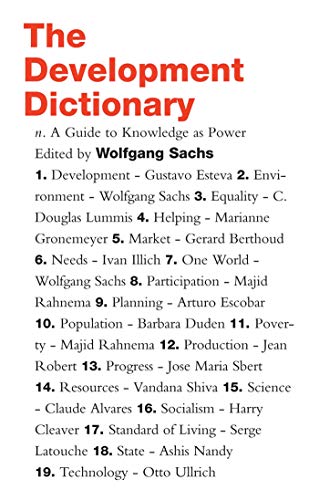
The Development Dictionary
A Guide to Knowledge as Power
By Wolfgang SachsZed Books Ltd
Copyright © 2010 Wolfgang Sachs
All rights reserved.
ISBN: 978-1-84813-380-8All rights reserved.
Contents
WOLFGANG SACHS Preface to the New Edition, vi,
WOLFGANG SACHS Introduction, xv,
GUSTAVO ESTEVA Development, 1,
WOLFGANG SACHS Environment, 24,
C. DOUGLAS LUMMIS Equality, 38,
MARIANNE GRONEMEYER Helping, 55,
GÉRALD BERTHOUD Market, 74,
IVAN ILLICH Needs, 95,
WOLFGANG SACHS One World, 111,
MAJID RAHNEMA Participation, 127,
ARTURO ESCOBAR Planning, 145,
BARBARA DUDEN Population, 161,
MAJID RAHNEMA Poverty, 174,
JEAN ROBERT Production, 195,
JOSÉ MARÍA SBERT Progress, 212,
VANDANA SHIVA Resources, 228,
CLAUDE ALVARES Science, 243,
HARRY CLEAVER Socialism, 260,
SERGE LATOUCHE Standard of Living, 279,
ASHIS NANDY State, 295,
OTTO ULLRICH Technology, 308,
Contributors, 323,
Index, 325,
CHAPTER 1
Development
GUSTAVO ESTEVA
To say 'yes', to approve, to accept, the Brazilians say 'no' – pois nao. But no one gets confused. By culturally rooting their speech, by playing with the words to make them speak in their contexts, the Brazilians enrich their conversation.
In saying 'development', however, most people are now saying the opposite of what they want to convey. Everyone gets confused. By using uncritically such a loaded word, and one doomed to extinction, they are transforming its agony into a chronic condition. From the unburied corpse of development, every kind of pest has started to spread. The time has come to unveil the secret of development and see it in all its conceptual starkness.
THE INVENTION OF UNDERDEVELOPMENT
At the end of World War II, the United States was a formidable and incessant productive machine, unprecedented in history. It was undisputedly at the centre of the world. It was the master. All the institutions created in those years recognized that fact: even the United Nations Charter echoed the United States Constitution.
But the Americans wanted something more. They needed to make entirely explicit their new position in the world. And they wanted to consolidate that hegemony and make it permanent. For these purposes, they conceived a political campaign on a global scale that clearly bore their seal. They even conceived an appropriate emblem to identify the campaign. And they carefully chose the opportunity to launch both – 20 January 1949. That very day, the day on which President Truman took office, a new era was opened for the world – the era of development.
We must embark [President Truman said] on a bold new program for making the benefits of our scientific advances and industrial progress available for the improvement and growth of underdeveloped areas.
The old imperialism – exploitation for foreign profit – has no place in our plans. What we envisage is a program of development based on the concepts of democratic fair dealing.
By using for the first time in such context the word 'underdeveloped', Truman changed the meaning of development and created the emblem, a euphemism, used ever since to allude either discreetly or inadvertently to the era of American hegemony.
Never before had a word been universally accepted on the very day of its political coinage. A new perception of one's own self, and of the other, was suddenly created. Two hundred years of social construction of the historical–political meaning of the term 'development' were successfully usurped and transmogrified. A political and philosophical proposition of Marx, packaged American-style as a struggle against communism and at the service of the hegemonic design of the United States, succeeded in permeating both the popular and the intellectual mind for the rest of the century.
Underdevelopment began, then, on 20 January 1949. On that day, 2 billion people became underdeveloped. In a real sense, from that time on, they ceased being what they were, in all their diversity, and were transmogrified into an inverted mirror of others' reality: a mirror that belittles them and sends them off to the end of the queue, a mirror that defines their identity, which is really that of a heterogeneous and diverse majority, simply in the terms of a homogenizing and narrow minority.
Truman was not the first to use the word. Wilfred Benson, a former member of the Secretariat of the International Labour Organization, was probably the person who invented it when he referred to the 'underdeveloped areas' while writing on the economic basis for peace in 1942. But the expression found no further echo, either with the public or with the experts. Two years later. Rosenstein-Rodan continued to speak of 'economically backward areas'. Arthur Lewis, also in 1944, referred to the gap between the rich and the poor nations. Throughout the decade, the expression appeared occasionally in technical books or United Nations documents. But it only acquired relevance when Truman presented it as the emblem of his own policy. In this context, it took on an unsuspected colonizing virulence.
Since then, development has connoted at least one thing: to escape from the undignified condition called underdevelopment. When Nyerere proposed that development be the political mobilization of a people for attaining their own objectives, conscious as he was that it was madness to pursue the goals that others had set; when Rodolfo Stavenhagen proposes today ethno-development or development with self-confidence, conscious that we need to 'look within' and 'search for one's own culture' instead of using borrowed and foreign views; when Jimoh Omo-Fadaka suggests a development from the bottom up, conscious that all strategies based on a top-down design have 2 failed to reach their explicitly stated objectives; when Orlando Fals Borda and Anisur Rahman insist on participatory development, conscious of the exclusions made in the name of development; when Jun Nishikawa proposes an 'other' development for Japan, conscious that the current era is ending; when they and so many others qualify development and use the word with caveats and restrictions as if they were walking in a minefield, they do not seem to see the counterproductivity of their efforts. The minefield has already exploded.
In order for someone to conceive the possibility of escaping from a particular condition, it is necessary first to feel that one has fallen into that condition. For those who make up two-thirds of the world's population today, to think of development – of any kind of development – requires first the perception of themselves as underdeveloped, with the whole burden of connotations that this carries.
Today, for two-thirds of the peoples of the world, underdevelopment is a threat that has already been carried out; a life experience of subordination and of being led astray, of discrimination and subjugation. Given that precondition, the simple fact of associating with development one's own intention tends to annul the intention, to contradict it, to enslave it. It impedes thinking of one's own objectives, as Nyerere wanted; it undermines confidence in oneself and one's own culture, as Stavenhagen demands; it clamours for management from the top down, against which Jimoh rebelled; it converts participation into a manipulative trick to involve people in struggles for getting what the powerful want to impose on them, which was precisely...
„Über diesen Titel“ kann sich auf eine andere Ausgabe dieses Titels beziehen.
Suchergebnisse für The Development Dictionary: A Guide to Knowledge as...

Beispielbild für diese ISBN
The Development Dictionary: A Guide to Knowledge as Power, Second Edition (Development Essentials)
Anbieter: BooksRun, Philadelphia, PA, USA
Verkäuferbewertung 5 von 5 Sternen

Paperback. Zustand: Fair. 2. The item might be beaten up but readable. May contain markings or highlighting, as well as stains, bent corners, or any other major defect, but the text is not obscured in any way. Bestandsnummer des Verkäufers 1848133804-7-1
Gebraucht kaufen
EUR 7,71
Versand gratis
Versand innerhalb von USA
Versand innerhalb von USA
Anzahl: 1 verfügbar
Beispielbild für diese ISBN
The Development Dictionary : A Guide to Knowledge As Power
Anbieter: Better World Books Ltd, Dunfermline, Vereinigtes Königreich
Verkäuferbewertung 5 von 5 Sternen
Zustand: Good. 2nd Edition. Former library copy. Pages intact with minimal writing/highlighting. The binding may be loose and creased. Dust jackets/supplements are not included. Includes library markings. Stock photo provided. Product includes identifying sticker. Better World Books: Buy Books. Do Good. Bestandsnummer des Verkäufers 9400652-6
Gebraucht kaufen
EUR 9,08
EUR 5,89 Versand
Versand von Vereinigtes Königreich nach USA
Versand von Vereinigtes Königreich nach USA
Anzahl: 1 verfügbar
Beispielbild für diese ISBN
The Development Dictionary : A Guide to Knowledge As Power
Anbieter: Better World Books Ltd, Dunfermline, Vereinigtes Königreich
Verkäuferbewertung 5 von 5 Sternen
Zustand: Very Good. 2nd Edition. Pages intact with possible writing/highlighting. Binding strong with minor wear. Dust jackets/supplements may not be included. Stock photo provided. Product includes identifying sticker. Better World Books: Buy Books. Do Good. Bestandsnummer des Verkäufers 4853144-6
Gebraucht kaufen
EUR 9,08
EUR 5,89 Versand
Versand von Vereinigtes Königreich nach USA
Versand von Vereinigtes Königreich nach USA
Anzahl: 1 verfügbar
Beispielbild für diese ISBN
The Development Dictionary: A Guide to Knowledge as Power (Development Essentials)
Anbieter: Anybook.com, Lincoln, Vereinigtes Königreich
Verkäuferbewertung 5 von 5 Sternen
Zustand: Good. This is an ex-library book and may have the usual library/used-book markings inside.This book has soft covers. Clean from markings. In good all round condition. Please note the Image in this listing is a stock photo and may not match the covers of the actual item,550grams, ISBN:9781848133808. Bestandsnummer des Verkäufers 9947546
Gebraucht kaufen
EUR 16,32
EUR 15,37 Versand
Versand von Vereinigtes Königreich nach USA
Versand von Vereinigtes Königreich nach USA
Anzahl: 1 verfügbar
Beispielbild für diese ISBN
The Development Dictionary: A Guide to Knowledge as Power, Second Edition (Development Essentials)
Anbieter: GoldBooks, Denver, CO, USA
Verkäuferbewertung 5 von 5 Sternen
Paperback. Zustand: new. New Copy. Customer Service Guaranteed. Bestandsnummer des Verkäufers 78A81_84_1848133804
Neu kaufen
EUR 91,06
EUR 4,89 Versand
Versand innerhalb von USA
Versand innerhalb von USA
Anzahl: 1 verfügbar