
Verwandte Artikel zu Battle of North Cape: the Death Ride of the Scharnhorst,...
Battle of North Cape: the Death Ride of the Scharnhorst, 1943 (Campaign Chronicles) - Softcover
Buch 14 von 19: Campaign Chronicles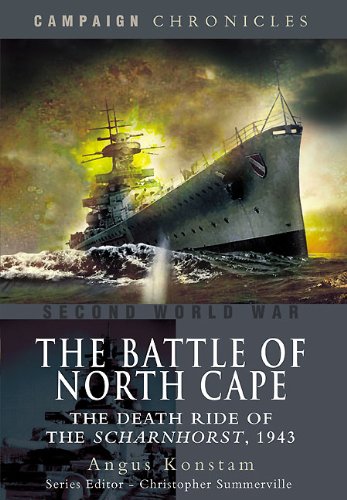
Inhaltsangabe
On 25 December 1943 the German battlecruiser Scharnhorst slipped out Altenfjord in Norway to attack Arctic convoy JW55B which was carrying vital war supplies to the Soviet Union. But British naval intelligence knew of the Scharnhorst's mission before she sailed and the vulnerable convoy was protected by a large Royal Naval force including the battleship Duke of York. In effect the Scharnhorst was sailing into a trap. One of the most compelling naval dramas of the Second World War had begun. ‘Angus Konstam’s gripping account tells the story of this crucial but under-studied naval battle, and explains why the hopes of the German Kreigsmarine went down with their last great ship; only 37 of the German battlecruiser’s 1700 crew were saved.’ The Nautical Magazine‘This book illuminates this forgotten and overlooked battle like an unexpected enemy star shell bursting out of the Arctic night.’ IPMS ‘Angus Konstam’s book is an excellent read and strongly recommended…. thoughtful and totally engrossing….If you are interested in the Royal Navy in the Second World War, the Arctic convoy campaign or capital ship actions, The Battle of the North Cape is well worth its cover price.’ Naval Review
Die Inhaltsangabe kann sich auf eine andere Ausgabe dieses Titels beziehen.
Auszug. © Genehmigter Nachdruck. Alle Rechte vorbehalten.
The Battle of North Cape
The Death Ride of the Scharnhorst, 1943
By Angus KonstamPen and Sword Books Ltd
Copyright © 2009 Angus Konstam
All rights reserved.
ISBN: 978-1-84884-557-2All rights reserved.
Contents
Maps and Illustrations,
Background,
Introduction,
The Rivals,
Order of Battle,
Ship Specifications,
Campaign Chronicle,
Day 1: Monday, 20 December 1943,
Day 2: Tuesday, 21 December 1943,
Day 3: Wednesday, 22 December 1943,
Day 4: Thursday, 23 December 1943,
Day 5: Christmas Eve – Friday, 24 December 1943,
Day 6: Christmas Day – Saturday 25 December 1943,
Day 7: Sunday 26 December 1943,
The Middle and Morning Watches (00:00–07:59 hours),
The Forenoon Watch (08:00–11:59 hours),
The Afternoon Watch (12:00–15:59 hours),
The Dog Watches (16:00–19:59 hours),
Aftermath,
The Survivors,
Conclusion,
Index,
CHAPTER 1
Campaign Chronicle
Day 1: Monday, 20 December 1943
Seconds before 17:00 hours, Rear Admiral Maitland Boucher gave the order. A signal gun fired, its smoke whipped away by the strong southeasterly wind, and the flag signal for 'Convoy shall proceed' was hoisted above the Fort Kullyspell, which served as the admiral's flag-ship. The large, ponderous screws of nineteen merchant ships began to turn, and Convoy JW 55B got under way. Named after a Canadian trading post, the Fort Kullyspell was typical of the ships that made up the rest of the convoy. She was a brand new merchantman – a 'Victory Ship' – built at the West Coast Shipbuilders' Yard at Vancouver, and handed over to her new owners just four months earlier. Technically, the Canadian-built merchantman was owned by the Hall Brothers Shipping Company of Newcastle, Canada, but 'for the duration' she was operated on behalf of the Ministry of War Transport. Like other 'Victory Ships' of the 'Fort' class she was 441 feet in length and distinguished by having a single funnel, acentral island super-structure, and hatch spaces with cranes (derricks) fore and aft. On paper she displaced some 7,192 tons, although that morning, with her holds filled with crated aircraft and stores, she rode considerably lower in the water than usual.
Convoy JW 55B had gathered at the head of Loch Ewe, a deep water inlet some 10 miles long and 4 miles wide at its broadest point, just south of the Isle of Ewe. It was a remote spot, fringed with little hamlets, the largest of which was Poolewe. It was a beautiful, tranquil spot – if you liked that sort of thing. For the sailors on board the merchantmen and escort vessels it was idyllic, compared with where they were going. It took the best part of an hour for the gaggle of ships to pass the headland of Rubha na Sasan and enter the open Atlantic waters of The Minches. Nowadays, a solitary monument stands on that lonely, chilly headland, but in December 1943 it was garrisoned, and the convoy was watched by the bored, benumbed, men of the Artillery Regiment. Their job was to guard the entrance to the great sea loch. Gun emplacements, boom nets and anti-aircraft positions all played their part in turning this part of the West Coast of Scotland into one of the most important anchorages in Europe.
Once out in The Minches the ships turned to starboard and headed north-northeast, with the mainland of Scotland on their starboard side and the Isle of Lewis somewhere through the wintry darkness to port. By midnight the convoy was passing the shelter of the Butt of Lewis, the northern tip of the island, while Cape Wrath – the north-western tip of the Scottish mainland – lay 10 miles to starboard. The merchantmen and their escorts now began to feel the full force of the Atlantic swell as the ships steamed on through the darkness. The night of 21/22 December would prove uneventful – just the first leg of a long, cold, dangerous voyage.
Some 300 miles to the north, another group of ships was making preparations to put to sea. The Fighting Destroyer Escort, made up of ships from the 17th Destroyer Flotilla lying in the Skaalefjord (Skálafjordur) off Tórshavn, the capital of the Faeroe Islands, where their crews were taking on stores. Captain 'Bes' McCoy's flotilla was Convoy JW 55B's covering force, and its departure was scheduled to coincide with the arrival of the convoy at a rendezvous 64 degrees north – due north of the Faeroes and east of Iceland. The sailing of JW 55B had already been delayed twenty-four hours due to bad weather, so McCoy's men had a day's respite. If all went according to plan the destroyers would sail late the following evening.
Approximately 700 miles to the north-north-west Admiral Fraser's Force 2 was heading back to Akureyri on the Eyjafjördur, its bleak anchorage on Iceland's northern coast, having just escorted the pre-vious Convoy JW 55A all the way to the Kola Inlet. The flagship Duke of York was expected to arrive at Akureyri late the following evening. The force would then take on fuel and stores and return to sea fortyeight hours later, where it would provide long-range cover for Convoy JW 55B.
The final two elements in this giant operation were approximately 1,500 miles away from the Fort Kullyspell, lying in the desolate Soviet anchorage of the Kola Inlet. The nineteen merchantmen of Convoy JW 55A had reached the anchorage the evening before – late on 19 December, escorted by a force of Royal Navy cruisers. Kola Inlet was home to the Soviet Northern Fleet, and led to the port of Murmansk, where a railway ran south into the heart of Russia. Rear Admiral Burnett's Force 1 had reached its designated anchorage at Vaenga Bay just after midnight that morning – 20 December. The British warship anchorage was close but separate from the main Soviet naval base at Polyarni Inlet, which lay on the opposite side of the great waterway. 20 December was spent refuelling, as Force 1 prepared to put to sea again.
That afternoon a Convoy Conference was held on board the light cruiser Belfast, which served as Burnett's flagship. It was attended by the admiral, the convoy commodore, their respective staffs, and by the captains and masters of all the warships and merchantmen who were destined to take part in the forthcoming operation. Outgoing Convoy JW 55A had reached port safely but, given the limited cargo handling facilities available, it would take up to four weeks to unload all its stores. Therefore, the homeward bound convoy – designated RA 55A – consisted of merchant ships that had already spent some time in the inlet, anchored at Rosta, halfway between Vaenga Bay and Murmansk, on the exposed eastern side of the waterway. Seven lucky ships had arrived as part of JW 54B, and therefore had spent just seventeen days at Kola. The rest had arrived there almost four weeks before, as part of Convoy JW 54A. The captains involved must have been delighted to know they were finally heading home. The aim of the conference was to sort out any problems, talk strategy and tactics, and make sure everyone knew what to do. As Convoy JW 55B was steaming out of Loch Ewe, the Convoy Conference on board Belfast broke up and Burnett and his officers prepared for their evening's entertainment – a concert by the Soviet Red Banner Fleet Choir.
These five elements – the two convoys, the two covering forces, and the destroyer escort – were all vital parts in a colossal naval operation. When Rear Admiral Boucher ordered Convoy JW 55B...
„Über diesen Titel“ kann sich auf eine andere Ausgabe dieses Titels beziehen.
Suchergebnisse für Battle of North Cape: the Death Ride of the Scharnhorst,...

Beispielbild für diese ISBN
The Battle of the North Cape: The Death Ride of the Scharnhorst, 1943 (Campaign Chronicles)
Anbieter: Cronus Books, Carson City, NV, USA
Verkäuferbewertung 5 von 5 Sternen

paperback. Zustand: New. ~ NEW Inside and Out! Clean & Crisp Pages. (E-mail for more info./pics). Bestandsnummer des Verkäufers 260907145
Beispielbild für diese ISBN
Battle of North Cape: The Death Ride of the Scharnhorst, 1943
Anbieter: World of Books (was SecondSale), Montgomery, IL, USA
Verkäuferbewertung 5 von 5 Sternen
Paperback. Zustand: Good. On 25 December 1943 the German battlecruiser Scharnhorst slipped out Altenfjord in Norway to attack Arctic convoy JW55B which was carrying vital war supplies to the Soviet Union. But British naval intelligence knew of the Scharnhorst's mission before she sailed and the vulnerable convoy was protected by a large Royal Naval force including the battleship Duke of York. In effect the Scharnhorst was sailing into a trap. One of the most compelling naval dramas of the Second World War had begun. 'Angus Konstam's gripping account tells the story of this crucial but under-studied naval battle, and explains why the hopes of the German Kreigsmarine went down with their last great ship; only 37 of the German battlecruiser's 1700 crew were saved.' The Nautical Magazine 'This book illuminates this forgotten and overlooked battle like an unexpected enemy star shell bursting out of the Arctic night.' IPMS 'Angus Konstam's book is an excellent read and strongly recommended. thoughtful and totally engrossing.If you are interested in the Royal Navy in the Second World War, the Arctic convoy campaign or capital ship actions, The Battle of the North Cape is well worth its cover price.' Naval Review. Bestandsnummer des Verkäufers 00109403221
Gebraucht kaufen
EUR 17,09
Versand gratis
Versand innerhalb von USA
Versand innerhalb von USA
Anzahl: 1 verfügbar
Beispielbild für diese ISBN
The Battle of North Cape : The Death Ride of the Scharnhorst 1943
Verlag:
Pen & Sword Books Limited, 2011
ISBN 10: 184884557X
ISBN 13: 9781848845572
Gebraucht
Softcover
Anbieter: Better World Books, Mishawaka, IN, USA
Verkäuferbewertung 5 von 5 Sternen
Zustand: Good. Pages intact with minimal writing/highlighting. The binding may be loose and creased. Dust jackets/supplements are not included. Stock photo provided. Product includes identifying sticker. Better World Books: Buy Books. Do Good. Bestandsnummer des Verkäufers 14695163-6
Gebraucht kaufen
EUR 17,10
Versand gratis
Versand innerhalb von USA
Versand innerhalb von USA
Anzahl: 1 verfügbar
Beispielbild für diese ISBN
Battle of North Cape: The Death Ride of the Scharnhorst, 1943
Anbieter: World of Books Inc, Montgomery, IL, USA
Verkäuferbewertung 4 von 5 Sternen

Paperback. Zustand: Good. On 25 December 1943 the German battlecruiser Scharnhorst slipped out Altenfjord in Norway to attack Arctic convoy JW55B which was carrying vital war supplies to the Soviet Union. But British naval intelligence knew of the Scharnhorst's mission before she sailed and the vulnerable convoy was protected by a large Royal Naval force including the battleship Duke of York. In effect the Scharnhorst was sailing into a trap. One of the most compelling naval dramas of the Second World War had begun. 'Angus Konstam's gripping account tells the story of this crucial but under-studied naval battle, and explains why the hopes of the German Kreigsmarine went down with their last great ship; only 37 of the German battlecruiser's 1700 crew were saved.' The Nautical Magazine 'This book illuminates this forgotten and overlooked battle like an unexpected enemy star shell bursting out of the Arctic night.' IPMS 'Angus Konstam's book is an excellent read and strongly recommended. thoughtful and totally engrossing.If you are interested in the Royal Navy in the Second World War, the Arctic convoy campaign or capital ship actions, The Battle of the North Cape is well worth its cover price.' Naval Review. Bestandsnummer des Verkäufers CIN184884557XG
Gebraucht kaufen
EUR 18,93
Versand gratis
Versand innerhalb von USA
Versand innerhalb von USA
Anzahl: 1 verfügbar
Beispielbild für diese ISBN
The Battle of the North Cape: The Death Ride of the Scharnhorst, 1943 (Campaign Chronicles)
Anbieter: Sequitur Books, Boonsboro, MD, USA
Verkäuferbewertung 5 von 5 Sternen
Paperback. Zustand: As New. Softcover. Good binding and cover. Bestandsnummer des Verkäufers 2102090033
Gebraucht kaufen
EUR 13,78
EUR 5,33 Versand
Versand innerhalb von USA
Versand innerhalb von USA
Anzahl: 2 verfügbar
Foto des Verkäufers
Battle of North Cape: The Death Ride of the Scharnhorst, 1943
Anbieter: Rarewaves.com USA, London, LONDO, Vereinigtes Königreich
Verkäuferbewertung 5 von 5 Sternen
Paperback. Zustand: New. 'Angus Konstam's gripping account tells the story of this crucial but under-studied naval battle, and explains why the hopes of the German Kriegsmarine went down with their last great ship; only 37 of the German battlecruiser's 1700 crew were saved.' - The Nautical Magazine'Angus Konstam's book is an excellent read and strongly recommended.thoughtful and totally engrossing.If you are interested in the Royal Navy in the Second World War, the Arctic convoy campaign or capital ship actions, The Battle of North Cape is well worth its cover price.' - Naval ReviewOn 25 December 1943 the German battlecruiser Scharnhorst slipped out Altenfjord in Norway to attack Artic convoy JW55B which was carrying vital war supplies to the Soviet Union. But British naval intelligence knew of the Scharnhorst's mission before she sailed and the vulnerable convoy was protected by a large Royal Naval force including the battleship Duke of York. In effect the Scharnhorst was sailing into a trap. One of the most compelling naval dramas of the Second World War had begun.ANGUS KONSTAM is a highly respected and widely published military historian.The body of his work encompasses everything from ancient Greece to the Second World War. However, his main field is maritime and naval history. He has published books on Blackbeard: America's Most Notorious Pirate, The History of Pirates, PT Boats: US Naval Torpedo Boats, The History of Shipwrecks, Hunt the Bismarck and the 7th U-Boat Flotilla. His most recent books include Salerno 1943: The Allied Invasion of Italy and Piracy. Bestandsnummer des Verkäufers LU-9781848845572
Neu kaufen
EUR 20,39
Versand gratis
Versand von Vereinigtes Königreich nach USA
Versand von Vereinigtes Königreich nach USA
Anzahl: 2 verfügbar
Beispielbild für diese ISBN
Battle of North Cape: The Death Ride of the Scharnhorst, 1943 (Campaign Chronicles)
Verlag:
Pen & Sword Military 2011-10-01, 2011
ISBN 10: 184884557X
ISBN 13: 9781848845572
Neu
Paperback
Anbieter: Chiron Media, Wallingford, Vereinigtes Königreich
Verkäuferbewertung 5 von 5 Sternen
Paperback. Zustand: New. Brand new book, sourced directly from publisher. Dispatch time is 24-48 hours from our warehouse. Book will be sent in robust, secure packaging to ensure it reaches you securely. Bestandsnummer des Verkäufers 6666-GRD-9781848845572
Neu kaufen
EUR 15,53
EUR 5,90 Versand
Versand von Vereinigtes Königreich nach USA
Versand von Vereinigtes Königreich nach USA
Anzahl: 3 verfügbar
Foto des Verkäufers
Battle of North Cape: The Death Ride of the Scharnhorst, 1943 (Paperback)
Verlag:
Pen & Sword Books Ltd, South Yorkshire, 2011
ISBN 10: 184884557X
ISBN 13: 9781848845572
Neu
Paperback
Anbieter: Grand Eagle Retail, Bensenville, IL, USA
Verkäuferbewertung 5 von 5 Sternen
Paperback. Zustand: new. Paperback. On 25 December 1943 the German battlecruiser Scharnhorst slipped out of Altenfjord in Norway to attack Arctic convoy JW55B which was carrying vital war supplies to the Soviet Union. But British naval intelligence knew of the Scharnhorst's mission before she sailed and the vulnerable convoy was protected by a large Royal Naval force including the battleship Duke of York. In effect the Scharnhorst was sailing into a trap. One of the most compelling naval dramas of the Second World War had begun. SELLING POINTS: .Compelling account of the doomed voyage of the German battlecruiser. .Insight into the experience of naval warfare 60 years ago. .Assesses the performance of the two commanders. .Close analysis of the naval strategy and tactics. AUTHOR: Angus Konstam is a highly respected and widely published military historian. The body of his work encompasses everything from ancient Greece to the Second World War. However, his main field is maritime and naval history. He has published books on Blackbeard: America's Most Nortorious Pirate, The History of Pirates, PT Boats: US Naval Topedo Boats, The History of Shipwrecks, Hunt the Bismark and the 7th U-Boat Flotilla. His most recent books include Salerno 1943: The Allied Invasion of Italy and Piracy: The Complete History. Angus lives in Edinburgh, and can be visited on his website: REVIEWS "Angus Konstam's gripping account tells the story of this crucial but under-studied naval battle, and explains why the hopes of the German Kreigsmarine went down with their last great ship: only 37 of the German battlecruiser's 1700 crew were saved" The Nautical Magazine "This book illuminates this forgotten and overlooked battle like an unexpected enemy starshell bursting out of the Arctic night". IPMS "Angus Konstam's book is an excellent read and strongly recommended.thoughtful and totally engrossing.If you are interested in the Royal Navy in the Second World War, the Arctic convoy campaign or capital ship actions, The Battle of the North Cape is well worth its cover price". Naval Review ILLUSTRATIONS: 40 illustrations * On 25 December 1943 the German battlecruiser Scharnhorst sailed to attack Arctic convoy JW55B, which was carrying vital war supplies to the Soviet Union. But British naval intelligence knew of the mission before she sailed. In effect the Scharnhorst was sailing into a trap. One of the most compelling naval dramas of World War II had begun. Shipping may be from multiple locations in the US or from the UK, depending on stock availability. Bestandsnummer des Verkäufers 9781848845572
Beispielbild für diese ISBN
Battle of North Cape: The Death Ride of the Scharnhorst, 1943
Anbieter: PBShop.store UK, Fairford, GLOS, Vereinigtes Königreich
Verkäuferbewertung 5 von 5 Sternen
PAP. Zustand: New. New Book. Shipped from UK. Established seller since 2000. Bestandsnummer des Verkäufers GB-9781848845572
Neu kaufen
EUR 18,82
EUR 4,92 Versand
Versand von Vereinigtes Königreich nach USA
Versand von Vereinigtes Königreich nach USA
Anzahl: 3 verfügbar
Foto des Verkäufers
Battle of North Cape: The Death Ride of the Scharnhorst, 1943
Anbieter: Rarewaves USA, HEBRON, KY, USA
Verkäuferbewertung 5 von 5 Sternen
Paperback. Zustand: New. 'Angus Konstam's gripping account tells the story of this crucial but under-studied naval battle, and explains why the hopes of the German Kriegsmarine went down with their last great ship; only 37 of the German battlecruiser's 1700 crew were saved.' - The Nautical Magazine'Angus Konstam's book is an excellent read and strongly recommended.thoughtful and totally engrossing.If you are interested in the Royal Navy in the Second World War, the Arctic convoy campaign or capital ship actions, The Battle of North Cape is well worth its cover price.' - Naval ReviewOn 25 December 1943 the German battlecruiser Scharnhorst slipped out Altenfjord in Norway to attack Artic convoy JW55B which was carrying vital war supplies to the Soviet Union. But British naval intelligence knew of the Scharnhorst's mission before she sailed and the vulnerable convoy was protected by a large Royal Naval force including the battleship Duke of York. In effect the Scharnhorst was sailing into a trap. One of the most compelling naval dramas of the Second World War had begun.ANGUS KONSTAM is a highly respected and widely published military historian.The body of his work encompasses everything from ancient Greece to the Second World War. However, his main field is maritime and naval history. He has published books on Blackbeard: America's Most Notorious Pirate, The History of Pirates, PT Boats: US Naval Torpedo Boats, The History of Shipwrecks, Hunt the Bismarck and the 7th U-Boat Flotilla. His most recent books include Salerno 1943: The Allied Invasion of Italy and Piracy. Bestandsnummer des Verkäufers LU-9781848845572