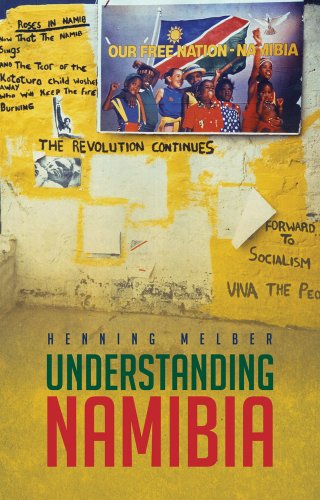
Since independence in 1990, Namibia has witnessed only one generation with no memory of colonialism - the 'born frees', who voted in the 2009 elections. The anti-colonial liberation movement, SWAPO, dominates the political scene, effectively making Namibia a de facto one-party state dominated by the first 'struggle generation'. While those in power declare their support for a free, fair, and just society, the limits to liberation are such that emancipation from foreign rule has only been partially achieved. Despite its natural resources Namibia is among the world's most unequal societies and indicators of wellbeing have not markedly improved for many among the former colonised majority, despite a constitution enshrining human rights, social equality, and individual liberty. This book analyses the transformation of Namibian society since independence. Melber explores the achievements and failures and contrasts the narrative of a post-colonial patriotic history with the socio-economic and political realities of the nation-building project. He also investigates whether, notwithstanding the relative stability prevailing to date, the negotiation of controlled change during Namibia's decolonisation could have achieved more than simply a change of those in control.
Die Inhaltsangabe kann sich auf eine andere Ausgabe dieses Titels beziehen.
Henning Melber joined SWAPO as the son of German immigrants in 1974. He was Director of the Namibian Economic Policy Research Unit (NEPRU) in Windhoek, Research Director of The Nordic Africa Institute and Executive Director of The Dag Hammarskjold Foundation, both in Uppsala. He is Senior Advisor to the Foundation and Extraordinary Professor at the Universities of Pretoria and of the Free State in Bloemfontein.
„Über diesen Titel“ kann sich auf eine andere Ausgabe dieses Titels beziehen.
Anbieter: PBShop.store UK, Fairford, GLOS, Vereinigtes Königreich
HRD. Zustand: New. New Book. Shipped from UK. Established seller since 2000. Bestandsnummer des Verkäufers FV-9781849044127
Anzahl: 1 verfügbar
Anbieter: Rarewaves.com USA, London, LONDO, Vereinigtes Königreich
Hardback. Zustand: New. Since independence in 1990, Namibia has witnessed only one generation with no memory of colonialism - the 'born frees', who voted in the 2009 elections. The anti-colonial liberation movement, SWAPO, dominates the political scene, effectively making Namibia a de facto one-party state dominated by the first 'struggle generation'. While those in power declare their support for a free, fair, and just society, the limits to liberation are such that emancipation from foreign rule has only been partially achieved. Despite its natural resources Namibia is among the world's most unequal societies and indicators of wellbeing have not markedly improved for many among the former colonised majority, despite a constitution enshrining human rights, social equality, and individual liberty. This book analyses the transformation of Namibian society since independence. Melber explores the achievements and failures and contrasts the narrative of a post-colonial patriotic history with the socio-economic and political realities of the nation-building project.He also investigates whether, notwithstanding the relative stability prevailing to date, the negotiation of controlled change during Namibia's decolonisation could have achieved more than simply a change of those in control. Bestandsnummer des Verkäufers LU-9781849044127
Anzahl: 1 verfügbar
Anbieter: Grand Eagle Retail, Bensenville, IL, USA
Hardcover. Zustand: new. Hardcover. Since independence in 1990, Namibia has witnessed only one generation with no memory of colonialism - the 'born frees', who voted in the 2009 elections. The anti-colonial liberation movement, SWAPO, dominates the political scene, effectively making Namibia a de facto one-party state dominated by the first 'struggle generation'. While those in power declare their support for a free, fair, and just society, the limits to liberation are such that emancipation from foreign rule has only been partially achieved. Despite its natural resources Namibia is among the world's most unequal societies and indicators of wellbeing have not markedly improved for many among the former colonised majority, despite a constitution enshrining human rights, social equality, and individual liberty. This book analyses the transformation of Namibian society since independence. Melber explores the achievements and failures and contrasts the narrative of a post-colonial patriotic history with the socio-economic and political realities of the nation-building project. He also investigates whether, notwithstanding the relative stability prevailing to date, the negotiation of controlled change during Namibia's decolonisation could have achieved more than simply a change of those in control. The book offers a frank account of an African state that shook off colonial rule but has yet to see the fruits of independence distributed evenly among its people. Drawing on inside knowledge of SWAPO, the anti-colonial liberation movement, the author provides a valuable case study of nation building in the modern era. Shipping may be from multiple locations in the US or from the UK, depending on stock availability. Bestandsnummer des Verkäufers 9781849044127
Anbieter: Revaluation Books, Exeter, Vereinigtes Königreich
Hardcover. Zustand: Brand New. 240 pages. 8.43x5.59x0.94 inches. In Stock. Bestandsnummer des Verkäufers __1849044120
Anzahl: 1 verfügbar
Anbieter: Books Puddle, New York, NY, USA
Zustand: New. Bestandsnummer des Verkäufers 26357247724
Anzahl: 3 verfügbar
Anbieter: THE SAINT BOOKSTORE, Southport, Vereinigtes Königreich
Hardback. Zustand: New. New copy - Usually dispatched within 4 working days. Bestandsnummer des Verkäufers B9781849044127
Anzahl: 1 verfügbar
Anbieter: AussieBookSeller, Truganina, VIC, Australien
Hardcover. Zustand: new. Hardcover. Since independence in 1990, Namibia has witnessed only one generation with no memory of colonialism - the 'born frees', who voted in the 2009 elections. The anti-colonial liberation movement, SWAPO, dominates the political scene, effectively making Namibia a de facto one-party state dominated by the first 'struggle generation'. While those in power declare their support for a free, fair, and just society, the limits to liberation are such that emancipation from foreign rule has only been partially achieved. Despite its natural resources Namibia is among the world's most unequal societies and indicators of wellbeing have not markedly improved for many among the former colonised majority, despite a constitution enshrining human rights, social equality, and individual liberty. This book analyses the transformation of Namibian society since independence. Melber explores the achievements and failures and contrasts the narrative of a post-colonial patriotic history with the socio-economic and political realities of the nation-building project. He also investigates whether, notwithstanding the relative stability prevailing to date, the negotiation of controlled change during Namibia's decolonisation could have achieved more than simply a change of those in control. The book offers a frank account of an African state that shook off colonial rule but has yet to see the fruits of independence distributed evenly among its people. Drawing on inside knowledge of SWAPO, the anti-colonial liberation movement, the author provides a valuable case study of nation building in the modern era. Shipping may be from our Sydney, NSW warehouse or from our UK or US warehouse, depending on stock availability. Bestandsnummer des Verkäufers 9781849044127
Anzahl: 1 verfügbar
Anbieter: Rarewaves.com UK, London, Vereinigtes Königreich
Hardback. Zustand: New. Since independence in 1990, Namibia has witnessed only one generation with no memory of colonialism - the 'born frees', who voted in the 2009 elections. The anti-colonial liberation movement, SWAPO, dominates the political scene, effectively making Namibia a de facto one-party state dominated by the first 'struggle generation'. While those in power declare their support for a free, fair, and just society, the limits to liberation are such that emancipation from foreign rule has only been partially achieved. Despite its natural resources Namibia is among the world's most unequal societies and indicators of wellbeing have not markedly improved for many among the former colonised majority, despite a constitution enshrining human rights, social equality, and individual liberty. This book analyses the transformation of Namibian society since independence. Melber explores the achievements and failures and contrasts the narrative of a post-colonial patriotic history with the socio-economic and political realities of the nation-building project.He also investigates whether, notwithstanding the relative stability prevailing to date, the negotiation of controlled change during Namibia's decolonisation could have achieved more than simply a change of those in control. Bestandsnummer des Verkäufers LU-9781849044127
Anzahl: 1 verfügbar
Anbieter: Mispah books, Redhill, SURRE, Vereinigtes Königreich
hardcover. Zustand: New. NEW. SHIPS FROM MULTIPLE LOCATIONS. book. Bestandsnummer des Verkäufers ERICA82918490441206
Anzahl: 1 verfügbar