
Verwandte Artikel zu Biofuels Handbook: Rsc (RSC Energy Series)
Inhaltsangabe
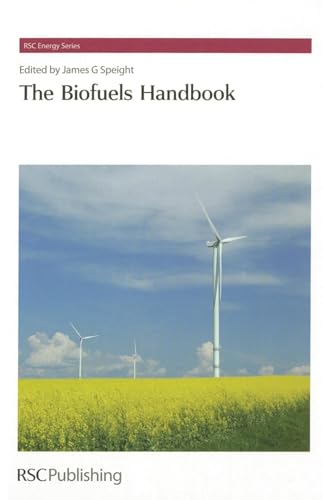
Petroleum-based fuels are well-established products that have served industry and consumers for more than one hundred years. However petroleum, once considered inexhaustible, is now being depleted at a rapid rate. As the amount of available petroleum decreases, the need for alternative technologies to produce liquid fuels that could potentially help prolong the liquid fuels culture and mitigate the forthcoming effects of the shortage of transportation fuels is being sought. The dynamics are now coming into place for the establishment of a synthetic fuels industry; the processes for recovery of raw materials and processing options have to change to increase the efficiency of oil production and it is up to various levels of government not only to promote the establishment of such an industry but to recognise the need for available and variable technology. This timely handbook is written to assist the reader in understanding the options that available for the production of synthetic fuel from biological sources. Each chapter contains tables of the chemical and physical properties of the fuels and fuel sources. It is essential that the properties of such materials be presented in order to assist the researcher to understand the nature of the feedstocks as well as the nature of the products. If a product cannot be employed for its hope-for-use, it is not a desirable product and must be changed accordingly. Such plans can only be made when the properties of the original product are understood. The fuels considered include conventional and unconventional fuel sources; the production and properties of fuels from biomass, crops, wood, domestic and industrial waste and landfill gas.
Die Inhaltsangabe kann sich auf eine andere Ausgabe dieses Titels beziehen.
Über die Autorin bzw. den Autor
Dr Speight has more than forty years of experience in areas associated with (1) the properties and recovery of reservoir fluids, including heavy oil, and tar sand bitumen, (2) refining conventional petroleum as well as heavy oil, tar sand bitumen, synthetic fuels, and biofuels, (3) the properties of fuels, synthetic fuels, and biofuels, (4) the properties, behavior, and processing of natural gas, including gas-to-liquids, (5) the properties and behavior of coal, including coal liquids, and (6) the properties and behavior of oil shale, including shale oil. Environmental effects and remediation technologies related to fossil fuel and synthetic fuel processing. He is the author of more than four hundred publications, reports, and presentations and more than thirty books and bibliographies related to fossil fuels, synthetic fuels, biofuels, fuels processing, and environmental issues. Dr Speight is visiting Professor at University of Utah, University of Trinidad and Tobago. Technical University of Denmark (Lyngby, Denmark), University of Petroleum (Beijing, China), University of Regina (Regina, Saskatchewan, Canada), and University of Akron (Akron, Ohio, USA).
Von der hinteren Coverseite
Petroleum-based fuels are well-established products that have served industry and consumers for more than one hundred years. However petroleum, once considered inexhaustible, is now being depleted at a rapid rate. As the amount of available petroleum decreases, the need for alternative technologies to produce liquid fuels that could potentially help prolong the liquid fuels culture and mitigate the forthcoming effects of the shortage of transportation fuels is being sought. The dynamics are now coming into place for the establishment of a synthetic fuels industry; the processes for recovery of raw materials and processing options have to change to increase the efficiency of oil production and it is up to various levels of government not only to promote the establishment of such an industry but to recognise the need for available and variable technology. This timely handbook is written to assist the reader in understanding the options that available for the production of synthetic fuel from biological sources. Each chapter contains tables of the chemical and physical properties of the fuels and fuel sources. It is essential that the properties of such materials be presented in order to assist the researcher to understand the nature of the feedstocks as well as the nature of the products. If a product cannot be employed for its hope-for-use, it is not a desirable product and must be changed accordingly. Such plans can only be made when the properties of the original product are understood. The fuels considered include conventional and unconventional fuel sources; the production and properties of fuels from biomass, crops, wood, domestic and industrial waste and landfill gas.
Auszug. © Genehmigter Nachdruck. Alle Rechte vorbehalten.
The Biofuels Handbook
By James G. SpeightThe Royal Society of Chemistry
Copyright © 2011 The Royal Society of Chemistry
All rights reserved.
ISBN: 978-1-84973-026-6All rights reserved.
Contents
Part 1 Fuels from Conventional and Unconventional Sources,
Chapter 1 Conventional Fuel Sources James G. Speight, 3,
Chapter 2 Unconventional Fuel Sources James G. Speight, 42,
Chapter 3 Fuels from Biomass – Overview Mustafa Balat, 76,
Chapter 4 A Biorefinery James G. Speight, 118,
Chapter 5 Biofuels Natasha Ramroop Singh, 160,
Part 2 Fuels from Cellulosic and Lignocellulosic Materials,
Chapter 1 Production of Fuels from Crops Ayhan Demirbas, 201,
Chapter 2 Properties of Fuels from Crops Ayhan Demirbas, 228,
Chapter 3 Production of Fuels from Wood Sources Mrinal K. Ghose, 255,
Chapter 4 Properties of Fuels from Wood Sources James G. Speight, 304,
Part 3 Fuels from Waste Materials,
Chapter 1 Production and Properties of Fuels from Domestic and Industrial Waste Ejae John and Kamel Singh, 333,
Chapter 2 Properties of Fuels from Domestic and Industrial Waste Ejae John and Kamel Singh, 377,
Chapter 3 Production of Fuels from Landfills Kamel Singh and Musti K.S. Sastry, 408,
Chapter 4 Uses of Landfill Gas Solange Kelly, 454,
Chapter 5 The Fischer–Tropsch Process Ralph Chadeesingh, 476,
Glossary, 518,
Subject Index, 542,
CHAPTER 1
Part 1
Fuels from Conventional and Unconventional Sources
CHAPTER 1
Conventional Fuel Sources
JAMES G. SPEIGHT
CD&W Inc., PO Box 1722, Laramie, WY 82070-4808, USA
1.1 Introduction
Conventional fuel sources are the two major hydrocarbon natural products – petroleum and natural gas. Both petroleum and natural gas are fossil fuels and are not replenished rapidly.
Nonconventional fuels (alternative fuels) are any materials or substances that can be used as fuels, other than conventional fuels. Examples of nonconventional fuels include biodiesel, bioalcohol (methanol, ethanol, butanol), hydrogen, and fuels from biomass sources. In fact, a biofuel is any as solid, liquid, or gaseous fuel consisting of, or derived from biomass. Biomass can also be used directly for heating or power — known as biomass fuel. Biofuel can be produced from any carbon source that can be replenished rapidly, e.g. plants. Many different plants and plant-derived materials are used for biofuel manufacture.
Petroleum (also called crude oil) also includes crude oil, natural gas, and heavy oil (a type of petroleum). Tar sand bitumen is not included because it is not a type of petroleum (Speight, 2007). Both crude oil and natural gas are predominantly a mixture of hydrocarbons. Under conditions of standard temperature and pressure at the surface, the lower molecular weight hydrocarbons methane, ethane, propane, and butane occur as gases, while the higher molecular weight hydrocarbons are in the form of liquids and/or solids.
An oil well produces predominantly petroleum and natural gas and, because the pressure is lower at the surface than it is in the underground formation (reservoir), some of the gas will come out of solution and be recovered (associated gas, solution gas).
On the other hand, a gas well produces predominately natural gas, which is a gaseous fossil fuel consisting primarily of methane but including significant quantities of ethane, butane, propane, carbon dioxide, nitrogen, helium, and hydrogen sulfide. It is found in natural gas fields (unassociated natural gas, nonassociated natural gas), oil fields (associated natural gas) and in coal seams or coal beds (coalbed methane).
However, because the underground temperature and pressure are higher than at the surface, the gas may contain heavier hydrocarbons such as pentane, hexane, heptane, and octane in the gaseous state. Under surface conditions these will condense out of the gas (natural gas condensate,condensate) and the condensed liquid resembles gasoline in appearance and is similar in composition to light crude oil.
Unprocessed petroleum and natural gas are not generally useful and are sent (by pipeline and/or by ocean tanker) to a refinery where the different hydrocarbon molecules are separated into the various components that can be used as fuels, lubricants, road asphalt, and as feedstock for petrochemical processes that manufacture such products as plastics, detergents, solvents, elastomers, and fibers such as nylon and polyesters. Petroleum refining is the means by which crude petroleum is converted to a series of saleable products.
A petroleum refinery is a group of manufacturing plants (Figure 1.1) which are used to separate petroleum into fractions and the subsequent treating of these fractions to yield marketable products, particularly fuels (Kobe and McKetta, 1958; Nelson, 1958; Gruse and Stevens, 1960; Bland and Davidson, 1967; Hobson and Pohl, 1973; Speight, 2007). The configuration of refineries may vary from refinery to refinery. Some refineries may be more oriented toward the production of gasoline (reforming and/or catalytic cracking) whereas the configuration of other refineries may be more oriented towards the production of middle distillates such as jet fuel, and gas oil.
In general, crude oil, once refined, yields three basic groupings of products that are produced when it is broken down into cuts or fractions (Table 1.1). The gas and gasoline cuts form the lower boiling products and are usually more valuable than the higher-boiling fractions and provide gas (liquefied petroleum gas), naphtha, aviation fuel, motor fuel and feedstocks for the petrochemical industry. Naphtha, a precursor to gasoline and solvents, is extracted from both the light and middle range of distillate cuts and is also used as a feedstock for the petrochemical industry. The middle distillates refer to products from the middle boiling range of petroleum and include kerosene, diesel fuel, distillate fuel oil, and light gas oil. Waxy distillate and lower boiling lubricating oils are sometimes included in the middle distillates. The remainder of the crude oil includes the higher-boiling lubricating oils, gas oil, and residuum (the nonvolatile fraction of the crude oil). The residuum can also produce heavy lubricating oils and waxes but is more often used for asphalt production. The complexity of petroleum is emphasized insofar as the actual proportions of light, medium and heavy fractions vary significantly from one crude oil to another.
The yields and quality of refined petroleum products produced by any given oil refinery depend on the mixture of crude oil used as feedstock and the configuration of the refinery facilities. Light/sweet crude oil is generally more expensive and has inherent high yields of higher-value low-boiling products such as naphtha, gasoline, jet fuel, kerosene, and diesel fuel. Heavy sour crude oil is generally less expensive and produces greater yields of lower-value higher-boiling products that must be converted into lower boiling products.
This chapter presents an overview of petroleum refining in order for the reader to place each process in the correct context of the production of conventional fuels.
1.2 Petroleum Refining
1.2.1 Dewatering and Desalting
Petroleum is recovered from the reservoir mixed with a variety of substances: gases, water, and dirt (minerals). Thus, refining actually commences with the production of fluids from...
„Über diesen Titel“ kann sich auf eine andere Ausgabe dieses Titels beziehen.
Suchergebnisse für Biofuels Handbook: Rsc (RSC Energy Series)

Foto des Verkäufers
Biofuels Handbook (RSC Energy Series, Volume 5)
Verlag:
Royal Society of Chemistry, 2011
ISBN 10: 1849730261
ISBN 13: 9781849730266
Gebraucht
Hardcover
Anbieter: The Happy Book Stack, Murfreesboro, TN, USA
Verkäuferbewertung 4 von 5 Sternen

Zustand: good. Book may have little to no writing and or underlining inside, and is in overall good condition. Cover may have some cosmetic wear. Fast shipping! Bestandsnummer des Verkäufers 5ALSUN000237_ns
Gebraucht kaufen
EUR 47,88
Versand gratis
Versand innerhalb von USA
Versand innerhalb von USA
Anzahl: 1 verfügbar
Beispielbild für diese ISBN
THE BIOFUELS HANDBOOK (HB 2011)
Anbieter: Romtrade Corp., STERLING HEIGHTS, MI, USA
Verkäuferbewertung 5 von 5 Sternen

Zustand: New. This is a Brand-new US Edition. This Item may be shipped from US or any other country as we have multiple locations worldwide. Bestandsnummer des Verkäufers ABBB-59856
Beispielbild für diese ISBN
THE BIOFUELS HANDBOOK (HB 2011)
Anbieter: Basi6 International, Irving, TX, USA
Verkäuferbewertung 5 von 5 Sternen
Zustand: Brand New. New. US edition. Expediting shipping for all USA and Europe orders excluding PO Box. Excellent Customer Service. Bestandsnummer des Verkäufers ABEOCT25-221555
Beispielbild für diese ISBN
THE BIOFUELS HANDBOOK (HB 2011)
Anbieter: SMASS Sellers, IRVING, TX, USA
Verkäuferbewertung 4 von 5 Sternen
Zustand: New. Brand New Original US Edition. Customer service! Satisfaction Guaranteed. Bestandsnummer des Verkäufers SNTA-59856
Beispielbild für diese ISBN
Biofuels Handbook
Anbieter: Basi6 International, Irving, TX, USA
Verkäuferbewertung 5 von 5 Sternen
Zustand: Brand New. New. US edition. Expediting shipping for all USA and Europe orders excluding PO Box. Excellent Customer Service. Bestandsnummer des Verkäufers ABEOCT25-221556
Beispielbild für diese ISBN
Biofuels Handbook
Anbieter: Romtrade Corp., STERLING HEIGHTS, MI, USA
Verkäuferbewertung 5 von 5 Sternen
Zustand: New. This is a Brand-new US Edition. This Item may be shipped from US or any other country as we have multiple locations worldwide. Bestandsnummer des Verkäufers ABBB-203489
Beispielbild für diese ISBN
Biofuels Handbook
Anbieter: SMASS Sellers, IRVING, TX, USA
Verkäuferbewertung 4 von 5 Sternen
Zustand: New. Brand New Original US Edition. Customer service! Satisfaction Guaranteed. Bestandsnummer des Verkäufers SNTA-203489
Beispielbild für diese ISBN
The Biofuels Handbook
Verlag:
Royal Society of Chemistry RSC, 2011
ISBN 10: 1849730261
ISBN 13: 9781849730266
Neu
Hardcover
Anbieter: Books Puddle, New York, NY, USA
Verkäuferbewertung 4 von 5 Sternen
Zustand: New. pp. 574. Bestandsnummer des Verkäufers 263174196
Neu kaufen
EUR 188,03
EUR 3,44 Versand
Versand innerhalb von USA
Versand innerhalb von USA
Anzahl: 4 verfügbar
Beispielbild für diese ISBN
The Biofuels Handbook
Anbieter: Romtrade Corp., STERLING HEIGHTS, MI, USA
Verkäuferbewertung 5 von 5 Sternen
Zustand: New. This is a Brand-new US Edition. This Item may be shipped from US or any other country as we have multiple locations worldwide. Bestandsnummer des Verkäufers ABBB-137415
Beispielbild für diese ISBN
The Biofuels Handbook
Anbieter: Basi6 International, Irving, TX, USA
Verkäuferbewertung 5 von 5 Sternen
Zustand: Brand New. New. US edition. Expediting shipping for all USA and Europe orders excluding PO Box. Excellent Customer Service. Bestandsnummer des Verkäufers ABEOCT25-221557